
Guide · 13 min read
What Does It Mean to Be Homebound and What to Do Next
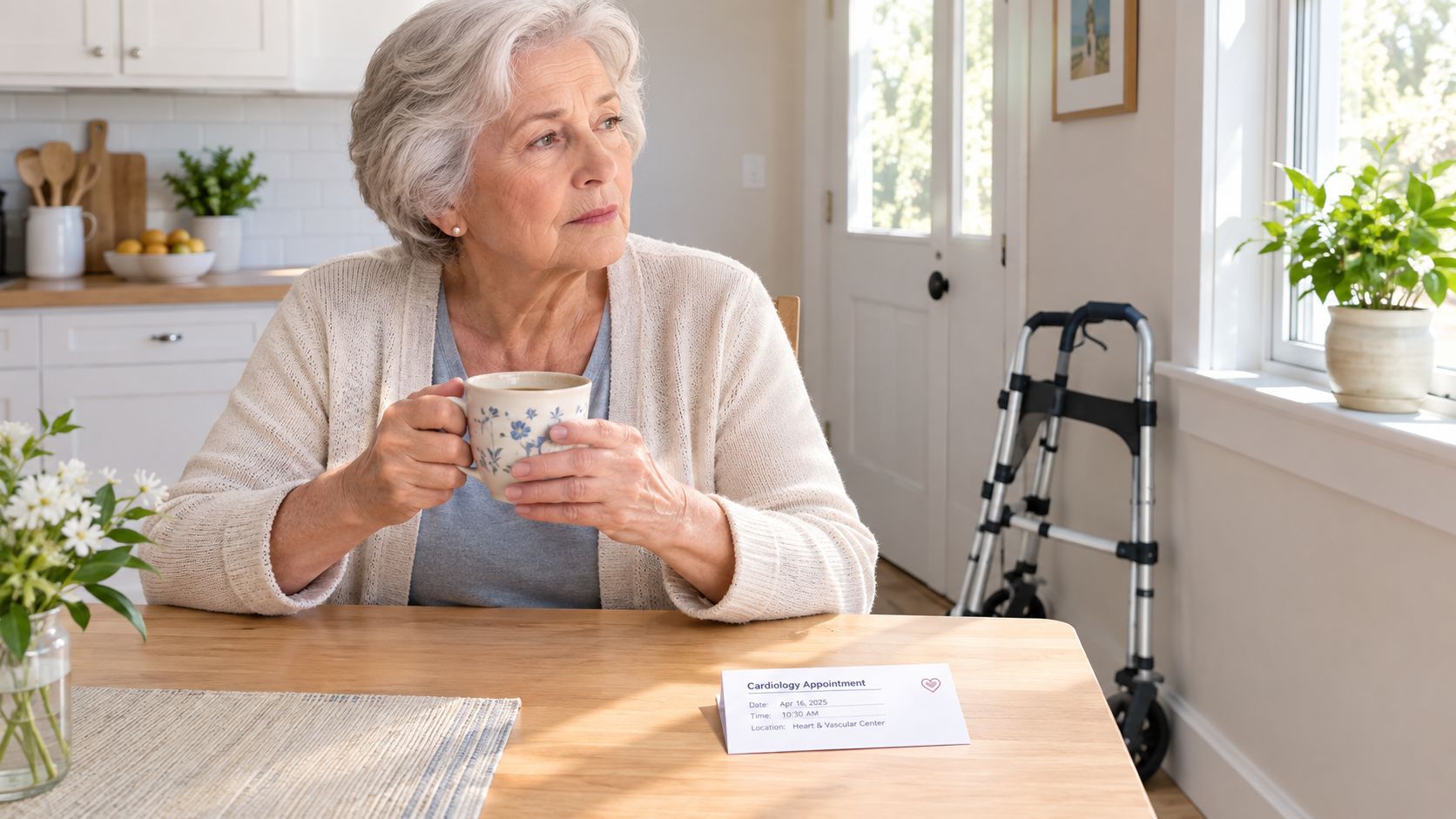
At 7:30 in the morning, Margaret's daughter is already thinking about the 11 a.m. cardiology appointment. Margaret is 78 and wants to go, but getting out means finding her walker, managing the front steps without a railing, and resting after walking even a short distance. The clinic is only a short drive away. Still, the car transfer, hallway, waiting room, exam table, and trip home feel like one long physical test.
Families often ask, “What does it mean to be homebound?” They may be trying to understand why a loved one keeps canceling appointments, why a routine errand now takes the entire day, or whether occasional trips outside mean the person no longer qualifies for care at home. The answer involves both everyday function and a narrower Medicare standard. It also requires looking closely at the mechanics of leaving home, including stairs, oxygen, fatigue, transportation, cognition, and caregiver availability.
Table of Contents
- When Leaving Home Becomes the Hardest Part of the Day
- What Homebound Actually Means Beyond Staying Indoors
- The Functional and Medical Reasons Someone Becomes Homebound
- How Common Homebound Status Really Is
- Signs Caregivers Should Watch For
- Why Homebound Status Changes Access to Care
- How House Call Primary Care Supports Homebound Patients
- Next Steps for Families Who Suspect a Loved One Is Homebound
When Leaving Home Becomes the Hardest Part of the Day
Margaret's daughter helps her stand, checks that the walker is positioned correctly, and gathers a coat, medication list, water bottle, and portable oxygen. Margaret has left the house before. She attended a family gathering recently and made it to a medical appointment several weeks ago. But each trip required planning, physical help, and a long recovery afterward.
That pattern is often more informative than the simple question, “Does she ever leave the house?” A person may technically go outdoors yet still face a persistent and clinically meaningful barrier to routine appointments. The effort may begin before the front door, continue through transportation and the clinic, and last well after the person returns home.
The trip matters more than the destination
A daughter may see her father walk from the living room to the kitchen and assume he can manage a doctor's office. But a clinic trip involves different demands: uneven ground, stairs or curbs, getting into a vehicle, sitting upright, using a public restroom, following directions, and tolerating delays. Someone with heart or lung disease may become breathless before reaching the car. Someone with dementia may walk well indoors but become unsafe in an unfamiliar building.
Homebound status isn't a statement about motivation. It describes the relationship between a person's abilities and the demands of ordinary community travel. Families also face emotional strain while adapting to these changes, and resources about building resilience in 2026 may help caregivers manage the broader transition.
Practical rule: Ask how much help and recovery a trip requires, not only whether the person managed to leave home once.
The rest of this article translates the term into practical observations a family can recognize and discuss with a clinician.
What Homebound Actually Means Beyond Staying Indoors
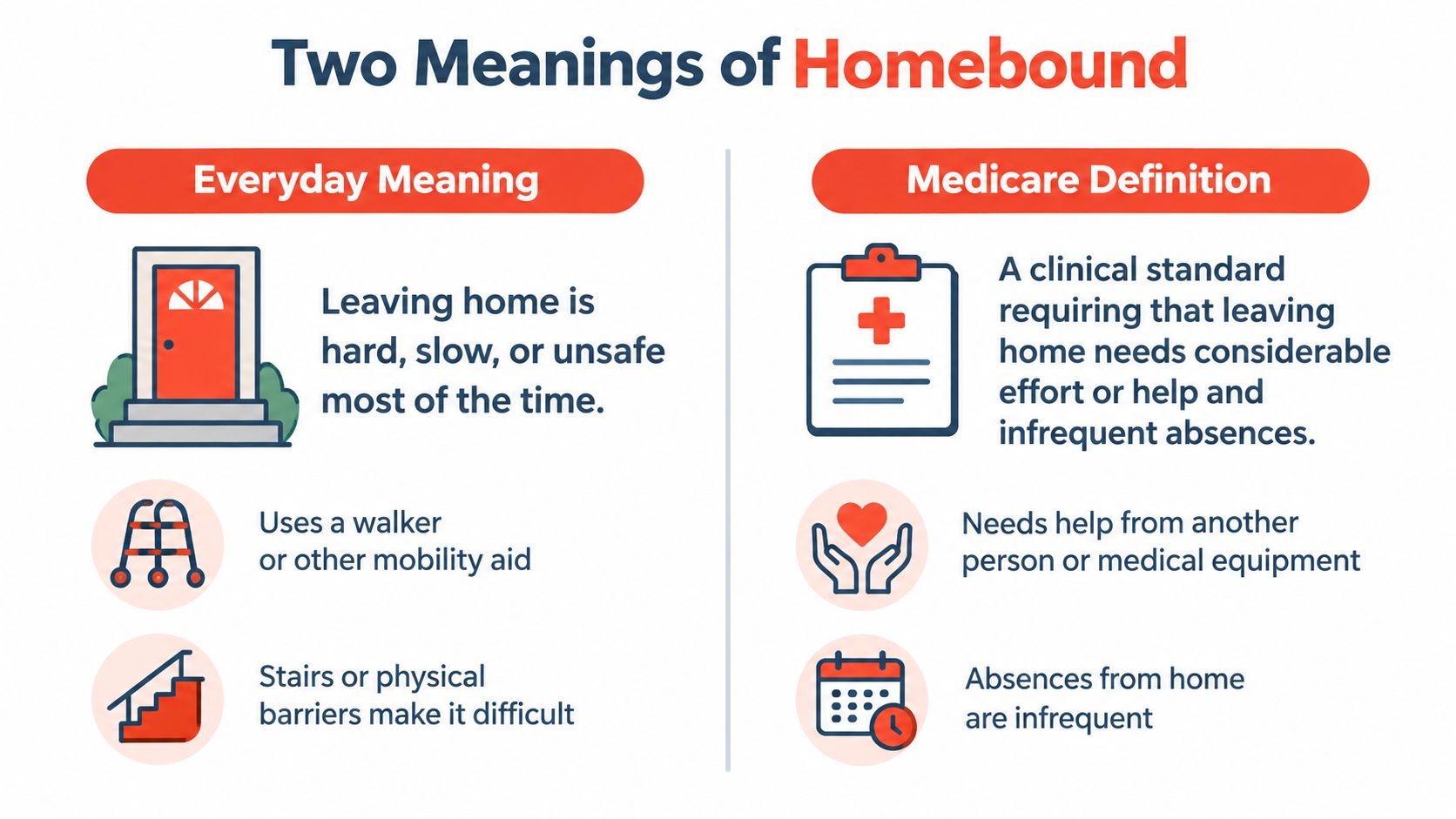
Think of homebound as having two meanings that overlap but aren't identical. The everyday meaning describes a person for whom leaving home is usually difficult, exhausting, unsafe, or dependent on another person. The Medicare meaning is a more specific clinical standard used in determining eligibility for the Medicare home health benefit.
Under the Centers for Medicare & Medicaid Services home health guidance, a person generally must need a supportive device, special transportation, or another person's assistance to leave home, or have a condition for which leaving home is medically inadvisable. The person must also be unable to leave home normally, with any departure requiring a “considerable and taxing effort.”
In plain language, the outing must demand much more than an ordinary trip. It may involve assistance getting dressed, navigating stairs, transferring into a vehicle, managing oxygen, preventing a fall, or recovering from severe fatigue. The clinician should describe the actual limiting mechanism and the help or exertion involved.
Leaving home occasionally doesn't automatically end homebound status
Medicare specifically allows certain infrequent departures. These can include healthcare, religious services, adult day care, or unusual events such as a funeral, graduation, or haircut. A short absence doesn't automatically show that a person can manage routine office-based care.
The important questions are whether leaving home is normal and regular, whether the person needs substantial help or equipment, and whether the effort is considerable and taxing. A person who leaves home once in a while for an important event may still be homebound for purposes of routine care.
Homebound at a glance
| Everyday meaning | Medicare meaning |
|---|---|
| Leaving home is hard, slow, tiring, or unsafe most of the time | Leaving home generally requires assistance, equipment, special transportation, or is medically inadvisable |
| The focus is access and daily function | The focus is a clinical standard used for Medicare home health |
| A person may need house-call primary care even without qualifying for home health | Homebound status alone isn't enough for Medicare-covered home health |
Medicare home health has additional requirements beyond homebound status, including a need for qualifying intermittent skilled services, physician supervision, a plan of care, and a qualifying face-to-face encounter. That means a person can need in-home primary care without meeting every requirement for the home health benefit.
The Functional and Medical Reasons Someone Becomes Homebound
Homebound status usually develops from several small barriers that combine. A walker alone may be manageable in a familiar hallway. A walker plus front steps, winter ice, poor balance, no railing, and no available driver can turn a routine appointment into an unsafe undertaking.
Functional limitations
Weakness after hospitalization, arthritis, painful joints, falls, poor vision, and balance problems can make stairs, curbs, and long distances feel dangerous. A person may grip furniture while crossing the living room, but that doesn't mean they can safely move through a parking lot or a medical building.
Transfers matter, too. Getting from a chair to a wheelchair, from a wheelchair into a car, and from the car onto an exam table may require hands-on help. These movements can be more difficult than walking a short distance inside the home.
Medical conditions
Heart failure and COPD can cause breathlessness or fatigue with minimal exertion. Stroke, Parkinson's disease, advanced diabetes, dementia, and recovery after surgery can affect strength, coordination, cognition, pain, or safety awareness. Oxygen dependence may make transportation and movement more complicated even when the person can walk a few steps.
A person with dementia may be physically capable of reaching the front door but unable to handle traffic, remember the appointment location, or respond safely to an unexpected change. Cognitive impairment can therefore create a homebound situation without severe weakness.
Environmental and caregiver barriers
The home environment often exposes the true access problem. A broken staircase, no elevator, icy walkway, narrow doorway, or distant parking area can change what is realistically possible. So can the absence of a caregiver who can drive, assist with transfers, or stay through the appointment.
Look at the whole pathway: A diagnosis doesn't determine homebound status by itself. Function, safety, environment, assistance, and exertion must be considered together.
The Medicare home health definition is narrower than the clinical need for a house call. A person may need a clinician at home because travel is ineffective or unsafe even when they don't need intermittent skilled nursing or therapy under a Medicare home health plan. The practical question is not only, “What diagnosis does this person have?” It is also, “What prevents safe, repeatable access to care?”
How Common Homebound Status Really Is
A daughter may feel that her mother is uniquely isolated because she rarely sees her outside the house. Then she speaks with a neighbor, a home health aide, or a geriatric clinician and realizes that many older adults face a similar pattern. Homebound status is a routine healthcare-access issue, not an extreme label reserved for people who never leave bed.
A peer-reviewed analysis of the Medicare Current Beneficiary Survey found that among community-dwelling older Medicare beneficiaries, 5.6% were completely or mostly homebound, representing approximately 2 million people. The analysis identified 395,422 completely homebound people, or 1.1% of the population, and 1,578,984 mostly homebound people, or 4.5%. These figures describe older Medicare beneficiaries living in the community, not every adult in the United States.
Homebound population at a glance
The estimates below come from the peer-reviewed analysis of homebound older Medicare beneficiaries.
| Category | Estimated U.S. Adults | Share of Population | Key Characteristic |
|---|---|---|---|
| Completely homebound | 395,422 | 1.1% | Never or rarely left home and was classified as completely homebound |
| Mostly homebound | 1,578,984 | 4.5% | Left home infrequently and was classified as mostly homebound |
| Completely or mostly homebound | Approximately 2 million | 5.6% | Community-dwelling older Medicare beneficiaries |
The broader disability picture helps explain why mobility is often central. CDC data from 2016 found that 25.7% of noninstitutionalized U.S. adults, about 61.4 million people, reported at least one disability, and mobility disability was the most common category at 13.7%. Cognitive, independent-living, hearing, vision, and self-care disabilities also affect whether someone can manage a clinic trip safely.
Homebound status isn't synonymous with disability. It often appears when mobility, cognition, self-care, chronic illness, transportation, and caregiver barriers overlap. That overlap is why a home visit can reveal important information that a clinic encounter may never expose.
Signs Caregivers Should Watch For
A caregiver may notice the pattern in ordinary moments. The person skips the upstairs bedroom because the stairs feel unsafe. The pill organizer remains unopened. A cardiology appointment is rescheduled twice, not because the person doesn't care, but because arranging the ride feels overwhelming.
One sign alone doesn't establish homebound status. A pattern that persists over weeks deserves a calm conversation and a clinical evaluation.
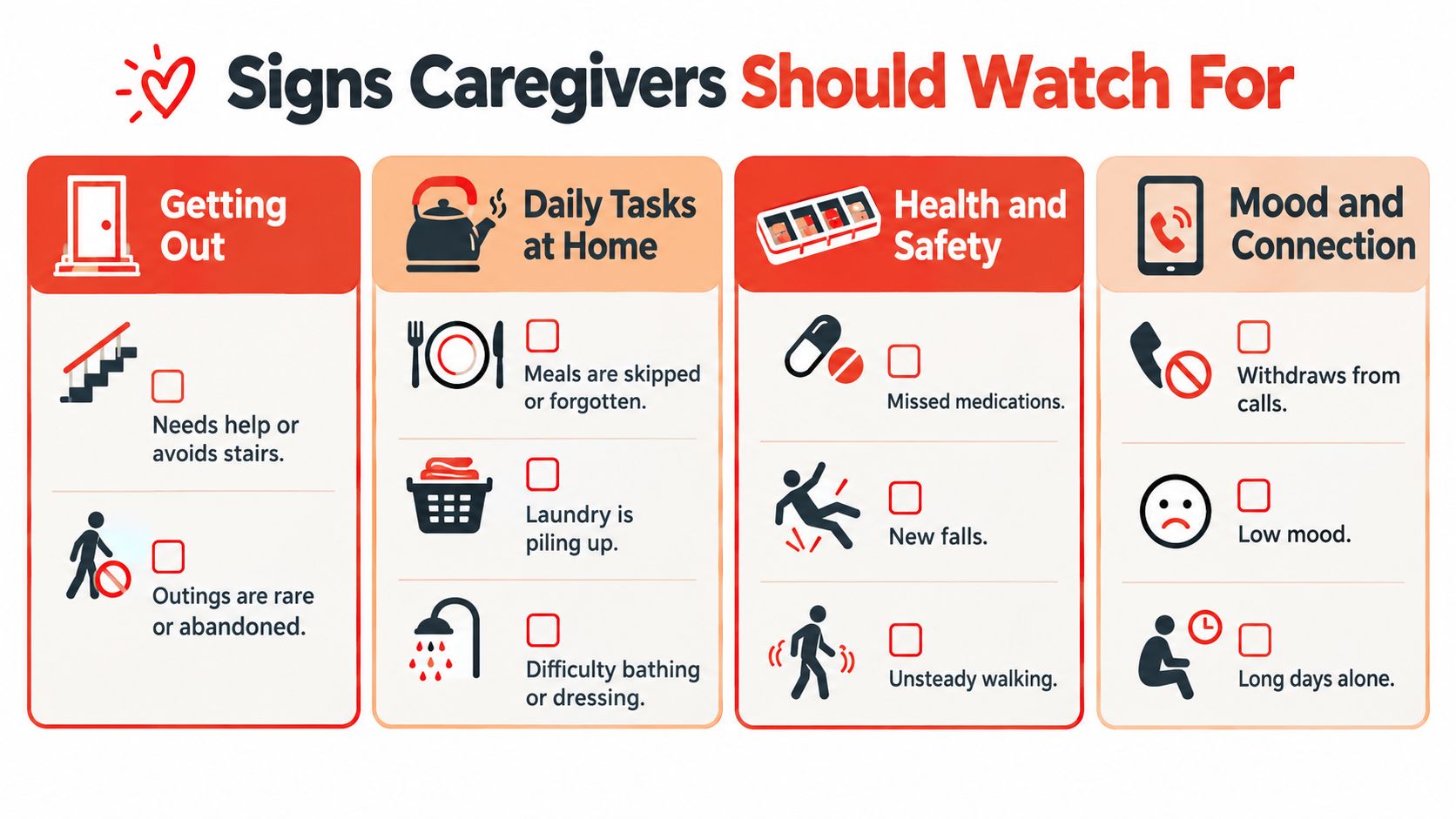
Everyday clues at home
- Getting around: The person has an uneven gait, grips furniture, avoids the stairs, or needs hands-on help at the front door.
- Recovering from outings: A single appointment leads to daytime sleeping, marked fatigue, or several days spent recovering.
- Managing medications: Pill organizers remain full, refills are missed, or bottles from different prescribers are mixed together.
- Maintaining self-care: Showers are skipped, clothing changes become less frequent, or spoiled food remains in the refrigerator.
- Managing appointments: Visits are canceled, transportation is repeatedly rescheduled, or the person expresses dread about the ride and waiting room.
- Staying connected: Phone calls become less frequent, hobbies stop, and loose clothing suggests weight loss.
What to ask without creating shame
Instead of asking, “Why won't you go to the doctor?” try, “Which part of the trip feels hardest?” The answer may reveal a hidden barrier, such as getting down the stairs, managing shortness of breath, finding a restroom, or remembering instructions in a busy building.
A practical conversation can include whether the person has fallen, missed medications, struggled with bathing, run out of food, or needed more caregiver help. Families can also use this guide to early warning signs to organize observations before speaking with a clinician.
“I want to understand what makes appointments difficult so we can find a safer way to provide care.”
The aim isn't to label someone prematurely. It's to identify whether the current care arrangement matches the person's abilities and needs.
Why Homebound Status Changes Access to Care
For a mobile patient, a clinic visit may feel like one appointment. For a homebound patient, it can become a chain of separate tasks. Someone must arrange an accessible vehicle, coordinate a caregiver's schedule, prepare medication bottles and paperwork, manage weather, negotiate curbs and elevators, and wait while tired or short of breath.
The return trip adds another burden. By the time the patient gets home, the appointment itself may have consumed enough energy to affect meals, medications, bathing, and sleep. Families may then postpone the next visit, delay a refill, or wait until symptoms become urgent.
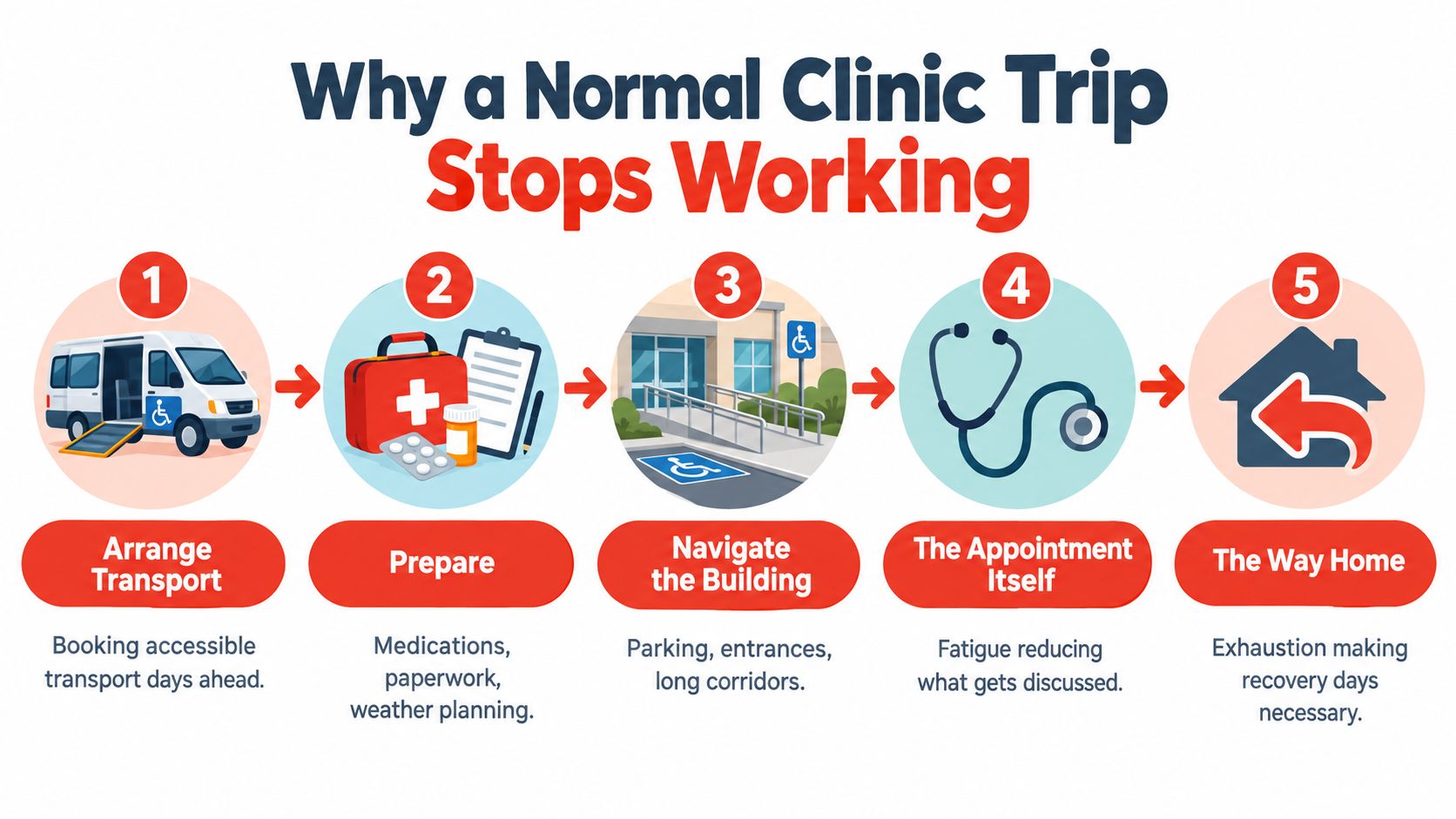
What a house call can change
A house-call model reverses the direction of travel. Instead of asking a frail patient to adapt to the clinic, a clinician brings primary care to the patient's living space. A visit can include vital signs, a physical examination, medication reconciliation with the actual bottles on the table, point-of-care testing, wound checks, and coordination with specialists or mobile diagnostic services.
The home also provides clinical information that an office can't. The clinician can see the stairs, bathroom setup, food supply, oxygen equipment, pill organization, and the way the patient moves from a chair to the front door. Those observations can guide a safer care plan.
A Medicare Annual Wellness Visit guide can help families understand preventive planning, but the practical delivery model matters when getting to an office is the central barrier.
The following video offers another way to visualize why ordinary clinic logistics can become exhausting for a person with limited mobility.
Home safety is part of access planning. Families reviewing bathroom hazards may also benefit from these disabled bathroom remodel safety tips when considering grab bars, transfers, and safer movement around the home.
Without a redesigned delivery model, the patient remains responsible for overcoming every barrier before receiving care. House calls, transitional visits, medication reviews, and in-home diagnostics address the access problem where it occurs.
How House Call Primary Care Supports Homebound Patients
House-call primary care isn't just a shorter version of an office visit. It changes what the clinician can assess and what the family can accomplish during one encounter. The clinician arrives at the patient's home, evaluates the immediate concern, reviews the broader medical picture, and builds the plan around the patient's actual environment.
A routine visit may address chronic disease management for diabetes, heart failure, COPD, hypertension, chronic kidney disease, or high cholesterol. A geriatric visit may focus on memory, falls, nutrition, mood, caregiver capacity, and daily function. A post-hospital visit can clarify discharge instructions and compare the medication list with the bottles the patient is taking.
Services that fit the home setting
- Primary care visits: History, examination, treatment planning, prescription management, and follow-up occur at home.
- Medication reviews: The clinician can identify duplicate bottles, outdated instructions, and confusion across multiple prescribers.
- In-home diagnostics: Phlebotomy, urine testing, EKGs, and coordination of mobile imaging can reduce unnecessary travel.
- Preventive care: Annual wellness planning and vaccinations can be incorporated into a home-based care relationship.
- Transitional care: Early follow-up after hospitalization or rehabilitation can address medication changes, symptoms, and pending appointments.
- Care coordination: The clinician can communicate with specialists, hospitals, caregivers, laboratories, and home health services.
A house-call primary care program guide can help families compare home-based primary care with traditional outpatient arrangements. The right option depends on the person's medical needs, insurance, urgency, and ability to participate safely.
Why the home improves the assessment
A patient may say, “I'm doing fine,” while the clinician sees an untouched walker, loose rugs, an unsteady transfer, or several medication bottles with conflicting labels. A caregiver may also describe a different pattern than the patient can recall, especially when memory loss or fatigue affects the history.
Home visits aren't a substitute for emergency services when someone has a life-threatening problem. They are a practical approach for ongoing primary care, chronic disease follow-up, post-hospital review, preventive care, and non-emergency concerns when travel has become the main obstacle.
For families searching for Visiting physicians NJ, Visiting Doctors NJ, Dr House calls NJ, Doctor house calls NJ, House calls for seniors, an In Home Doctor for Elderly, At-Home Doctor Visits, Visiting Docs, Doctor home visits for elderly, or Doctor House Calls for Seniors, the useful question is what the practice can deliver in the home and how it coordinates follow-up.
Next Steps for Families Who Suspect a Loved One Is Homebound
Start with the practical definition. If leaving home requires considerable and taxing effort, depends on substantial assistance or equipment, and happens only infrequently, the person may fit the clinical picture of being homebound. Occasional medical care or another short, unusual outing doesn't automatically rule it out.
Write down what has happened recently. Include falls, missed or canceled appointments, difficulty with stairs, recovery time after outings, medication confusion, transportation failures, and changes in bathing, eating, or walking. Specific examples help a clinician assess function more accurately than a general statement such as, “She doesn't get out much.”
Then call the person's primary care physician and ask whether a house-call evaluation or another home-based service is appropriate. Formal homebound certification and Medicare home health eligibility require a clinical assessment. The physician must also determine whether the person needs qualifying skilled services, a plan of care, or another level of support.
Hospice eligibility, skilled nursing, and home health coverage involve separate clinical requirements. A family shouldn't try to determine those categories from the word homebound alone.
Recognizing the problem early can open access to care before missed visits, medication problems, or unsafe travel lead to an emergency. The aim is to preserve health and independence at home while matching services to the person's actual needs.
Life Primary Care offers in-home primary care, chronic disease management, preventive visits, post-hospital follow-up, medication reviews, and home-based diagnostics for patients who can't reliably travel to a clinic. If leaving home has become the main barrier to care, visit Life Primary Care to learn how a house-call evaluation can support your family.
Ready for a visit at home?
Call and speak with a real person. We will confirm your insurance, find a time and come to you.
973-607-4911 Call now