
Guide · 13 min read
House Call Program Explained: How It Works for Seniors
A parent's morning can change quickly when an older adult can't get dressed, climb into a car, or wait in a crowded clinic. The appointment still matters, but the journey to reach it may create more risk than the checkup itself. A house call program addresses that problem by bringing primary care to the patient's home, where the clinician can evaluate both the person and the setting in which care takes place.
For families searching for Visiting physicians NJ, Visiting Doctors NJ, or Doctor house calls NJ, the practical questions are usually straightforward. Who qualifies? What happens during the visit? Which services can be provided at home? How do insurance and follow-up work? The answers become clearer when you look at both the history of house calls and the operating details of a modern New Jersey practice.
Table of Contents
- Bringing the Doctor's Office to Your Living Room
- The Quiet Comeback of the House Call
- What Happens During a House Call Visit
- Services You Can Actually Receive at Home
- Eligibility, Insurance, and Scheduling in New Jersey
- Why House Call Programs Improve Health Outcomes
- Where House Call Programs Still Fall Short
- How to Get Started With a House Call Program
Bringing the Doctor's Office to Your Living Room
The kettle is boiling when the clinician steps through the front door. A small dog circles the medical bag, the patient's daughter clears a chair near the window, and the visiting physician asks how the week has gone before opening a chart. There's no reception desk and no hurried move from one exam room to another. The appointment begins in the place where the patient eats, sleeps, takes medication, and manages daily challenges.

A house call program is more than an occasional doctor visit. It's a structured primary care service in which physicians, nurse practitioners, or physician assistants deliver routine and acute care inside the patient's home. The team may manage chronic illness, review medications, perform preventive care, coordinate testing, and arrange follow-up without requiring the patient to travel to a clinic.
That model suits people whose health makes travel difficult. A senior with mobility loss may struggle with stairs and transportation. Someone recovering from surgery may need a medical review before they can comfortably leave home. A person managing several chronic conditions may benefit from having the clinician see the actual medication bottles, walking paths, bathroom setup, and caregiver routine.
Practical rule: The home is part of the clinical record. It can reveal barriers that a clinic questionnaire might miss.
Life Primary Care provides an example of how this works in northern and central New Jersey. Its clinicians travel to private homes, apartments, family residences, and assisted living communities, while a coordination office manages scheduling, insurance verification, and follow-up. Patients and caregivers can also learn more about the broader model through this guide to in-home primary care.
The experience still has clinical structure. The team takes a history, examines the patient, evaluates current concerns, documents findings, and develops a plan. The difference is that the plan reflects the patient's real surroundings, not just what can be observed under fluorescent lights.
The Quiet Comeback of the House Call
A patient who cannot safely reach a clinic may still need regular primary care. That practical problem helps explain why the house call, once a routine part of American medicine, is returning in a more structured form.
Home visits accounted for about 40% of medical practice in the 1930s, then fell to 10% by 1950 and 0.6% of patient encounters by 1980. Hospitals, office-based medicine, changing insurance arrangements, and payment systems that favored facility care all helped move routine treatment away from the home. A peer-reviewed review of home-based medical care describes the later reversal: house calls increased from under 1 million in 1996 to 2.2 million in 2016, while assisted living and group homes recorded 3.2 million domiciliary visits in 2016.
Policy changes made that return easier to sustain. In 1998, Medicare introduced higher-level home-visit CPT codes and increased payments. An AAFP analysis of home-based primary care and reimbursement reports a 43% increase in annual house calls, from 1.4 million in 1998 to 2.1 million in 2004. Medicare added higher-level domiciliary-visit codes in 2006, and those visits grew from fewer than 1.3 million in 2006 to more than 3 million in 2016.
The modern program keeps the personal setting of an old-fashioned house call while adding care coordination, electronic records, mobile diagnostics, and chronic disease protocols. That combination fits older adults who are homebound, frail, recently discharged, or managing multiple medications. The home becomes the care site, while the program supplies the clinical structure.
Outcome data also help explain the renewed interest. The Medicare Independence at Home model reduced costs by about $2,000 per patient per year. The VA home-based primary care model reduced hospital days by 60%, readmissions by 21%, and nursing home use by 89%.
Life Primary Care operates within this shift across six New Jersey counties. Reimbursement rules, clinician staffing, and a homebound patient population determine which households the program can realistically reach. Its work shows how a historical practice becomes a current delivery model shaped by local capacity and patient need.
What Happens During a House Call Visit
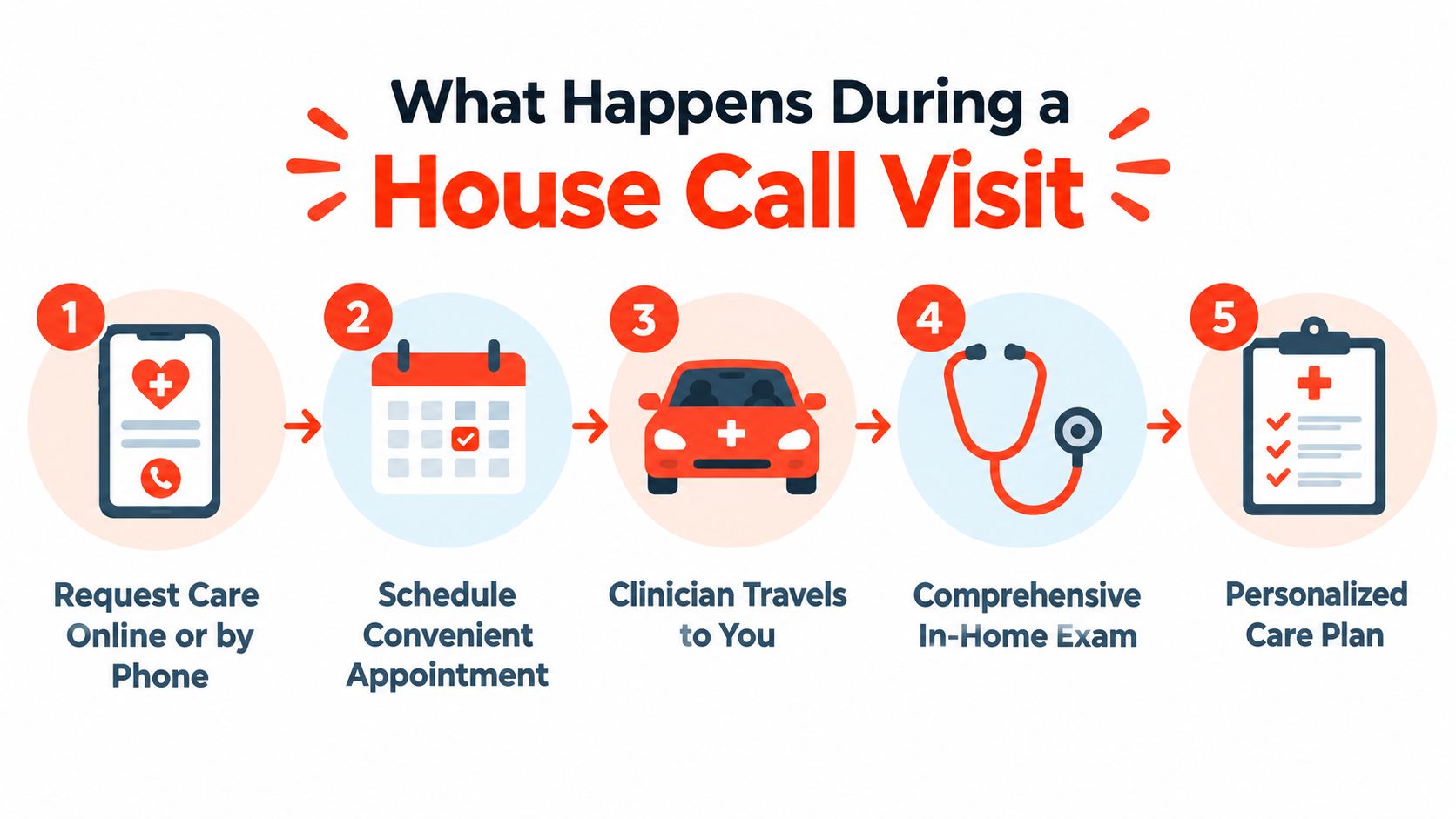
A home visit usually follows a predictable workflow, even though the conversation feels less formal than a clinic appointment. The process begins when a patient or caregiver makes a phone or online request. The coordination team gathers basic medical information, confirms the address, reviews insurance details, and determines whether the patient's needs fit the program.
A scheduling window follows. Home-based primary care visits typically last an hour or more, with stable patients often seen every four to six weeks and patients with acute medical problems seen more frequently, potentially daily (Commonwealth Fund overview of home-based primary care). Another AAFP article describes a typical house-call process as lasting 45 to 90 minutes, with frequent breaks common (AAFP house-call practice resource).
Before the clinician arrives
Have the patient's medication bottles available, not only a typed list. Include prescriptions from specialists, over-the-counter products, vitamins, inhalers, creams, and recently stopped medications. Families should also gather discharge paperwork, recent test results, insurance information, and a short list of questions.
During the appointment
The clinician brings a portable examination kit and sets up in a practical location, often at the kitchen or dining table. The visit may include:
- Medication reconciliation: The clinician compares the actual bottles with the medical record and identifies possible duplications, omissions, or confusion.
- Physical assessment: Vital signs, symptoms, mobility, breathing, pain, nutrition, and other relevant findings are reviewed.
- Home-safety observation: Rugs, lighting, stairs, bathroom access, and fall risks can become part of the care discussion.
- Caregiver conversation: A family member can explain changes in behavior, missed doses, sleep, appetite, or daily function that the patient may not mention.
- Plan development: Prescriptions, lab orders, referrals, education, and follow-up are organized before the clinician leaves.
The longer format matters because the clinician can connect symptoms with routines. A patient who appears stable in an office may have trouble reaching the bathroom, opening medication containers, preparing food, or using oxygen safely at home.
After the visit
The team documents the encounter, sends relevant information to specialists, transmits prescriptions to the pharmacy, and coordinates mobile phlebotomy or other testing when appropriate. Follow-up may be arranged within weeks for a stable patient or sooner when the clinical situation requires closer monitoring.
Services You Can Actually Receive at Home
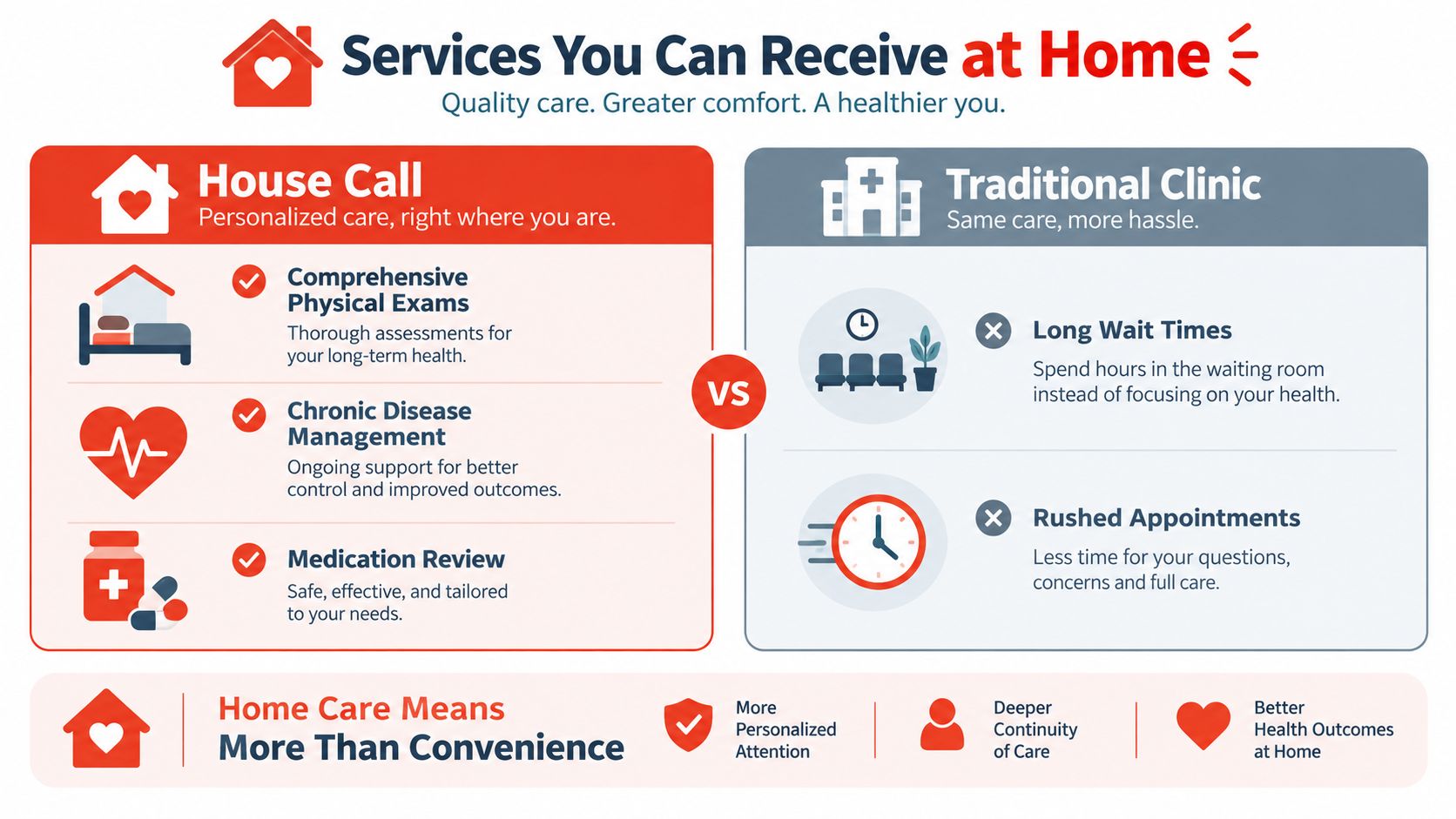
Many people hear “house call” and think of a brief urgent visit for a minor complaint. A well-designed in-home medical care program can cover much more. The clinician may perform a full physical exam, manage chronic conditions, reconcile medications, provide wound care, administer injections or vaccinations, arrange lab draws, perform an EKG, and use point-of-care testing when available.
Chronic disease management can include diabetes, hypertension, COPD, heart failure, chronic kidney disease, and high cholesterol. Preventive care may include a Medicare Annual Wellness Visit, while transitional care can address medication changes and instructions after a hospital stay. Geriatric care, dementia care, palliative care, and urgent same-day visits may also fit the model, depending on the practice and the patient's needs.
What the home adds
The physical setting provides information that a clinic often can't. A clinician may notice that a patient can't safely use the stairs, has limited food available, struggles to read prescription labels, or relies on a caregiver who is exhausted. These observations can change the care plan without turning the visit into a judgment about the household.
A visiting doctor can also see how treatment fits daily life. An inhaler may be prescribed correctly but used incorrectly. A pill organizer may be full, yet the patient may not know which compartment to open. A wound may look different when the clinician sees the bed, chair, or mobility pattern that surrounds it.
What still requires another setting
Home care has boundaries. Severe chest pain, major breathing difficulty, stroke symptoms, serious injury, uncontrolled bleeding, or another emergency requires emergency services rather than waiting for a routine home visit. Advanced imaging, complex procedures, and some specialist evaluations may require a clinic, hospital, imaging center, or emergency department.
Telehealth can support follow-up, but it doesn't replace every in-person examination. The appropriate setting depends on urgency, available equipment, the clinician's assessment, and the patient's safety.
Eligibility, Insurance, and Scheduling in New Jersey
Eligibility begins with practical need and geography. A house call practice may focus on older adults with mobility limitations, people recovering after hospitalization or surgery, individuals living with dementia, and patients whose chronic illness makes office travel difficult. The residence must also fall within the practice's service area, which can vary by provider.
An intake call usually collects the patient's address, medical history, current concerns, medication information, insurance details, and primary care records. The first appointment then gives the clinician an opportunity to confirm the patient's needs, complete an assessment, and establish a continuing plan.
Medicare rules can be confusing because “home visit” doesn't always mean “homebound.” Medicare doesn't require house-call patients to meet the homebound definition used for skilled nursing and therapy in the home. Since January 2019, Medicare also hasn't required documentation explaining why a home visit was needed instead of an office visit (Johns Hopkins explanation of home-based primary care).
Insurance and Scheduling at a Glance
| Category | Details |
|---|---|
| Service area | Confirm that the patient's home is within the practice's New Jersey coverage area. |
| Common patients | Older adults with mobility limitations, post-hospital patients, people with dementia, and patients with complex chronic conditions. |
| Coverage questions | Ask whether the practice accepts Medicare, Medicare Advantage, commercial insurance, or Medicaid managed care. |
| Patient responsibility | Confirm copays, deductibles, coinsurance, non-covered services, and any membership or concierge charges before scheduling. |
| Appointment request | Use the practice's phone or online intake process and provide current medical information. |
| Urgent needs | Ask whether same-day visits are available and which symptoms require emergency care instead. |
| Continuing care | Discuss routine follow-up, communication between visits, prescription handling, and specialist coordination. |
Coverage differs by plan, so families shouldn't assume that an insurance card guarantees the same benefits for every service. Ask what the insurer will be billed, what the patient may owe, and whether mobile labs, imaging, vaccines, or care-management services are handled separately. This overview of doctor house calls and eligibility can help families prepare for that conversation.
Why House Call Programs Improve Health Outcomes
A swollen ankle noticed during a scheduled home visit can lead to a medication adjustment that week, rather than an emergency department visit later. That is the central advantage of a house call program: clinicians see warning signs in the setting where daily care happens. Medication discrepancies, worsening swelling, early infection, poor nutrition, or an unsafe transfer may be easier to address at home than after a crisis begins.
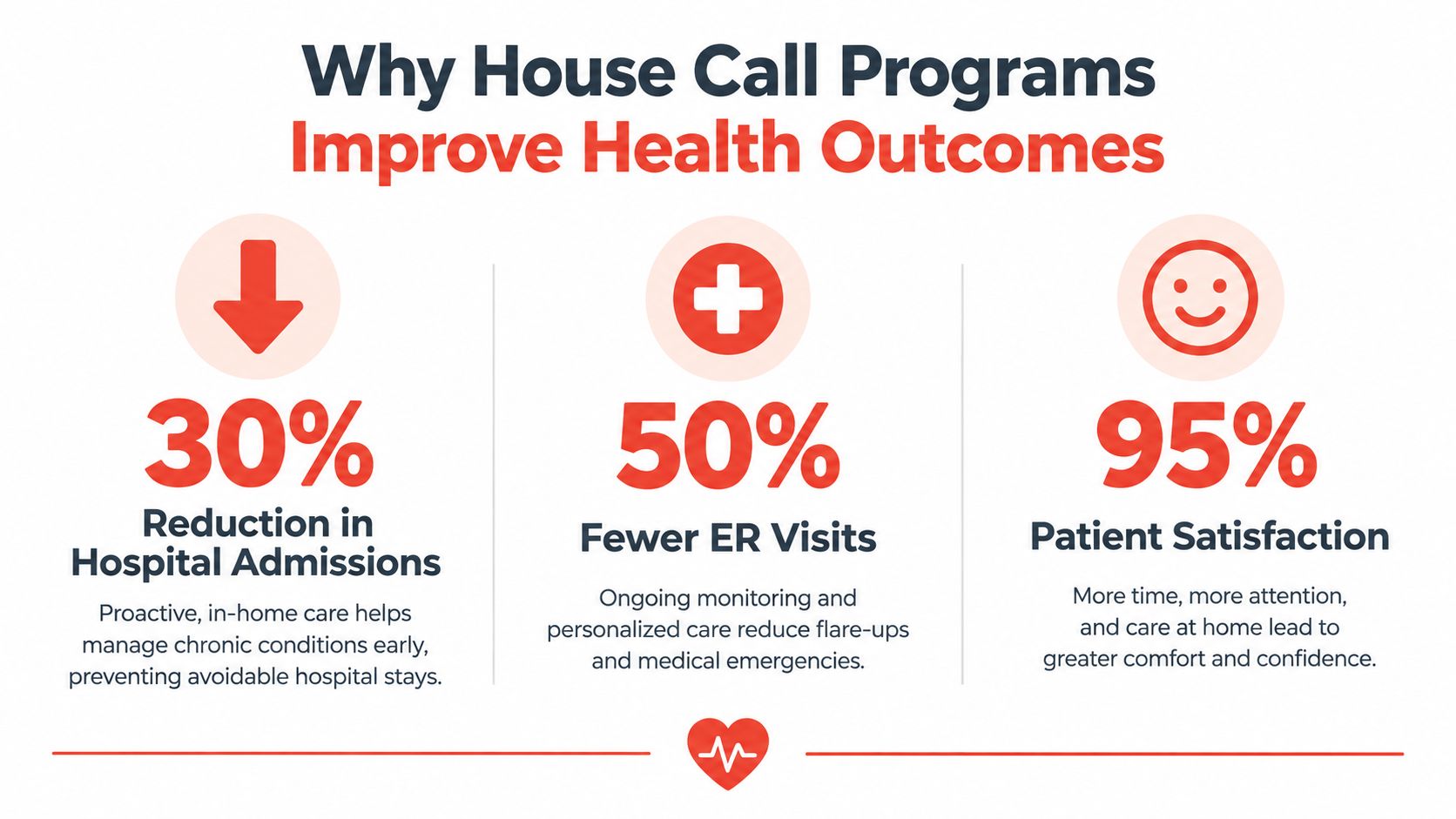
A systematic review covering about 46,156 patients found fewer hospitalizations, hospital bed days, emergency department visits, and long-term care admissions among people receiving home-based primary care (systematic review summarized by the AAFP). The Independence at Home demonstration also associated home-based care with a 23% reduction in hospitalizations, a 27% decrease in 30-day readmissions, and approximately $111 in monthly savings per beneficiary.
Why the setting changes the result
A home visit gives the clinician time to review medications, assess function, and answer caregiver questions. It also reveals practical barriers that an office conversation may miss: whether the patient can walk safely, reach food, use medical equipment, or follow the prescribed routine. Those observations support earlier, more targeted changes.
For a post-stroke patient, the visit may focus on mobility, swallowing, medication changes, and caregiver capacity. For someone with advanced frailty, comfort, nutrition, fall prevention, and avoiding burdensome travel may take priority. A kitchen-table review can also expose duplicate prescriptions or confusion that a quick verbal check would overlook.
One home-based primary care cohort shows how these observations connect with program operations. 130 home visits served 62 patients, and the Medicare Annual Wellness Visit was completed for 51.6% of enrollees. After enrollment, the share of patients with at least one ED visit fell from 21.0% to 12.9%, hospitalizations fell from 19.4% to 14.5%, and average per-member-per-month cost fell from $3,053.21 to $1,567.96 (Journal of the American Board of Family Medicine cohort report).
These findings support targeted care, not a guarantee of identical results for every patient. Families researching health care delivered at home should ask how the program monitors changes between visits, coordinates prescriptions, and responds when a manageable problem begins to worsen.
Where House Call Programs Still Fall Short
A patient may qualify for home-based care yet live too far from a clinician's route. Rural adults were 78% less likely than adults in the largest metropolitan counties to receive home-based medical care, although about 1 in 5 people live in rural counties, according to a Health Affairs analysis of rural home-based primary care. Long travel distances, limited staffing, referral patterns, and low patient density can make rural programs difficult to sustain.
The provider base is also small. Workforce summaries estimate that about 1,000 providers deliver most U.S. home-based primary care, while only 12% of current homebound patients have access. Demand cannot close that gap by itself.
Payment determines whether a program can add staff, cover travel time, and retain clinicians. Reviews identify inadequate payment models, workforce-retention problems, and unmet community demand. A 2018 review of nurse-practitioner-led home-based primary care reported fewer hospitalizations and emergency department visits in some programs, while findings for health status and costs remained mixed (BMC Health Services Research review).
House calls work best as a targeted model for patients whose needs exceed what ordinary clinic access can reliably provide.
A living room cannot replace every hospital, imaging center, or specialist office. Some diagnoses require advanced testing, procedures, or evaluations that must occur elsewhere. Digital records and remote monitoring can support continuity, but they also add expense and leave teams to decide which needs require an in-person visit.
A sustainable house call program therefore needs adequate reimbursement, trained clinicians, efficient routing, specialist backup, and reliable communication between home and outside settings. Without those supports, even a well-run program may remain limited to a small patient group in communities where staffing and payment align. That explains why New Jersey programs such as Life Primary Care must define service areas and coordinate referrals rather than handle every form of care at home.
How to Get Started With a House Call Program
A family caregiver can begin with a short checklist:
- Confirm location and eligibility: Ask whether the residence is in the service area and whether the senior's mobility limits, chronic illness, or recovery needs fit the program.
- Gather records: Prepare the insurance card, medication bottles, discharge summaries, recent results, and current primary care provider's details.
- Verify coverage: Ask about Medicare, Medicare Advantage, commercial insurance, Medicaid managed care, copays, deductibles, and non-covered services.
- Book the first visit: Request a home appointment and ask how long the clinician expects to stay.
- Prepare the space: Clear a safe path, place medications together, and write down the patient's main questions.
- Include support: Have a family member or caregiver present, or reachable by phone, if the patient wants help recalling information.
- Set follow-up expectations: Confirm the routine cadence, urgent-contact process, prescription renewals, lab coordination, and specialist communication.
Care coordination can reduce the administrative load that often falls on relatives, especially when several clinicians, pharmacies, and appointments are involved. Families arranging broader support may also find this resource on how care coordination reduces stress useful when organizing responsibilities around an older adult.
Life Primary Care provides in-home primary care, chronic disease management, wellness visits, diagnostics, transitional care, and urgent non-emergency visits for patients across northern and central New Jersey. Visit Life Primary Care to check the service area, request an appointment, and discuss whether a home-based care plan fits your family's needs.
Ready for a visit at home?
Call and speak with a real person. We will confirm your insurance, find a time and come to you.
973-607-4911 Call now