
Guide · 18 min read
10 Early Warning Signs of Decline in Older Adults

A parent who usually finishes breakfast leaves most of the plate untouched. A daughter notices that he's moving cautiously, seems unusually confused, or has stopped answering messages with his usual clarity. The family debates whether to watch for another day, call the primary-care office, or seek emergency help.
That uncertainty is common because clinical deterioration often begins as a departure from a person's usual baseline, not as one dramatic symptom. Older adults may show new confusion, withdrawal, poor intake, weakness, or reduced mobility before a clear diagnosis emerges. Those changes shouldn't be dismissed as normal aging.
The following early warning signs focus on what families and caregivers can observe at home, which changes need prompt clinician contact, and which symptoms require 911. A home assessment can be useful when travel is difficult, but it isn't a substitute for emergency services when breathing, circulation, consciousness, or neurological function is failing.
Table of Contents
- 1. Unexplained Weight Loss Or Changes In Appetite
- 2. Confusion, Memory Loss, Or Changes In Mental Status
- 3. Difficulty With Balance, Falls, Or Loss Of Coordination
- 4. Persistent Cough, Shortness Of Breath, Or Chest Discomfort
- 5. Fever, Chills, Or Signs Of Infection
- 6. Severe Pain That Is New Or Worsening
- 7. Difficulty Urinating, Burning, Or Incontinence
- 8. Severe Nausea, Vomiting, Or Inability To Keep Food Down
- 9. Swelling In Legs, Feet, Or Ankles
- 10. Changes In Bowel Habits, Constipation, Or Blood In Stool
- Comparison of 10 Early Warning Signs
- Turn Observations Into Timely Care
1. Unexplained Weight Loss Or Changes In Appetite
Weight loss matters even when it happens gradually. A noticeable decline without intentional dieting, a sudden loss of appetite, or a new pattern of skipping meals can reflect infection, medication effects, swallowing difficulty, metabolic illness, nutritional deficiency, or another condition that needs evaluation.
The practical question is not only, “How much has this person lost?” It's also, “What changed around eating?” A clinician visiting the home can see whether food is available, whether the kitchen is accessible, whether stairs make meal preparation difficult, and whether the person can safely chew and swallow. A medication review may identify a drug that suppresses appetite, while in-home blood testing can help investigate suspected deficiencies or thyroid problems.
A Medicare Annual Wellness Visit can also establish a useful baseline for weight and nutrition. CMS describes the visit as including a personalized prevention plan, and Medicare identifies G0438 for the initial annual wellness visit and G0439 for subsequent visits, with each code billable once in a 12-month period. Details and coverage rules are available through Medicare's yearly wellness visit guidance.
Practical rule: A new eating problem deserves prompt attention when it persists, causes weakness, or appears with confusion, vomiting, pain, or difficulty swallowing.
Contact a visiting physician within days when family or a caregiver notices unexplained weight loss. Bring medication bottles, note recent hospital or surgery instructions, and record what the person eats and drinks. For related clinical context, an abdominal assessment nursing guide can help caregivers understand what information to document before the visit.
2. Confusion, Memory Loss, Or Changes In Mental Status
“Not herself” can be a medically important description. New confusion, slower responses, disorientation, unusual sleepiness, withdrawal, personality change, or trouble managing familiar tasks may signal delirium, infection, medication toxicity, dehydration, low oxygen, or a longer-term cognitive disorder.
The timeline is especially important. A sudden change over hours or a day is different from a gradual decline over months. Families should write down when the change began, what the person was doing beforehand, whether there was a fall or hospitalization, and whether any medication was started, stopped, or doubled. Clinicians need that history because a familiar office conversation may miss fluctuations that caregivers see throughout the day.
An in-home assessment offers a direct view of daily function. The clinician can interview family members, inspect medication bottles from every prescriber, assess hydration and safety, and compare the person's behavior with the home environment. The evaluation can also consider non-memory-driven dementia clues, such as difficulty managing finances or medications, getting lost in familiar places, poor judgment, or mood and personality changes, which are described in CDC guidance on Alzheimer's disease signs and symptoms.
A follow-up home visit or telehealth check can monitor whether symptoms improve after treatment or medication changes. Don't label sudden confusion as normal aging. If the person is difficult to wake, has a new facial droop, one-sided weakness, trouble speaking, or severe breathing difficulty, call 911.
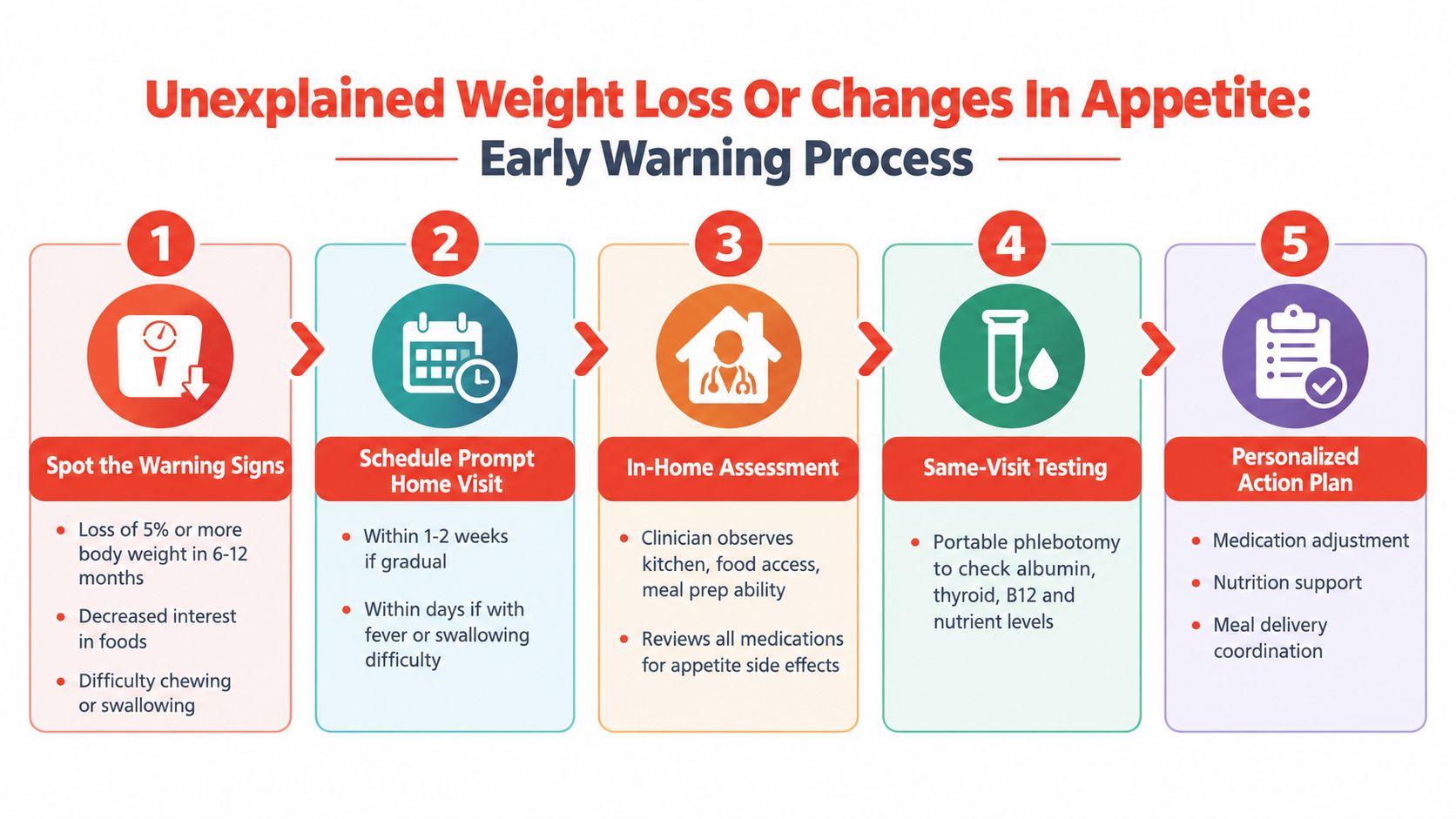
For a visual process overview, use this infographic about assessing unexplained weight loss and appetite changes. Hearing and cognition can also overlap, so families may review information about hearing loss and cognitive decline.
3. Difficulty With Balance, Falls, Or Loss Of Coordination
A fall is not merely an accident to file away. New unsteadiness, stumbling, shorter steps, difficulty rising from a chair, or loss of coordination may result from medication effects, blood-pressure changes, vision problems, inner-ear disorders, neurological disease, weakness, or hazards inside the home.
The home itself supplies information an office can't. A visiting clinician can observe how the person walks from the bedroom to the bathroom, whether they hold onto furniture, and whether a rug, poor lighting, clutter, or a steep staircase contributes to risk. Medication bottles can be reviewed in the same setting, including drugs that may cause dizziness or sedation. Balance and gait testing may also be safer and more realistic in familiar surroundings.
After a fall, contact a clinician promptly, especially if there's new pain, difficulty bearing weight, a head impact, confusion, or use of blood-thinning medication. Call 911 for suspected serious injury, loss of consciousness, severe weakness, or new stroke-like symptoms.
A home visit should produce an actionable plan, not just reassurance:
- Check the route to the bathroom: Look for clutter, loose rugs, inadequate lighting, and missing grab bars.
- Review every medication: Include prescriptions, over-the-counter products, sleep aids, and supplements.
- Discuss rehabilitation: Physical or occupational therapy may help restore safe movement and improve the environment.
- Use a home safety guide: Families can review this prevent-falls-at-home checklist before the clinician arrives.
Place the first media element near the start of the discussion:

Later, families may find this fall prevention video useful after the immediate medical assessment and safety review.
4. Persistent Cough, Shortness Of Breath, Or Chest Discomfort
Breathing changes deserve a lower threshold for action. A persistent cough, breathlessness with minimal activity or at rest, wheezing, unusual fatigue, or chest discomfort can accompany pneumonia, heart disease, asthma, COPD exacerbation, or another serious condition.
Call 911 for chest pain or pressure with shortness of breath, dizziness, fainting, severe sweating, blue lips, sudden confusion, or rapidly worsening breathing. Don't wait for a home visit in that situation. Emergency responders can begin assessment and treatment while transporting the patient.
For less severe but persistent symptoms, a prompt in-home evaluation can clarify urgency. A clinician can use portable pulse oximetry, listen to the heart and lungs, review inhalers and other medications, and observe how the person breathes while walking a few steps in the actual home. The visit may also uncover smoke, dust, mold, pet dander, or other environmental triggers. Patients with chronic lung disease can learn more from this COPD care resource.
Keep a brief symptom record. Note when the cough or breathlessness occurs, what worsens it, whether fever is present, and whether the person is taking medications as prescribed. A cough that doesn't resolve shouldn't be normalized, particularly after a recent hospitalization or respiratory infection.

An in-home clinician can help distinguish a problem suited to same-day primary care from one requiring emergency evaluation. Families can also reduce exposure to suspected allergy-induced asthma triggers, while recognizing that environmental control doesn't replace medical assessment when breathing is impaired.
5. Fever, Chills, Or Signs Of Infection
Older adults don't always develop an obvious fever when they're seriously ill. New chills, weakness, confusion, painful urination, wound drainage, redness, warmth, swelling, sore throat, or a sudden decline in function may be the first visible indication of infection.
Contact a clinician the same day when fever or chills occur, especially after a procedure, surgery, hospitalization, or wound closure. An in-home visit avoids forcing a frail or homebound patient through travel and a waiting room. The clinician can examine the skin, lungs, throat, surgical site, and urinary symptoms, then decide whether portable urine testing, wound testing, treatment, or emergency referral is appropriate.
Record when symptoms started and what accompanied them. Include body aches, cough, urinary changes, reduced intake, recent antibiotics, and recent hospital instructions. Don't save the information for a routine appointment if the person is worsening.
A new change in behavior may be the infection signal, even when the thermometer doesn't look dramatic.
Take prescribed antibiotics exactly as directed. Don't start leftover medication or stop a prescribed course early without speaking with the treating clinician. If the person becomes difficult to wake, develops severe breathing trouble, collapses, or deteriorates rapidly, call 911 rather than waiting for a house call.
6. Severe Pain That Is New Or Worsening
Pain that suddenly appears, intensifies, interrupts sleep, or prevents ordinary movement needs assessment. It may reflect an injury, disease progression, a post-operative problem, constipation, urinary trouble, medication effects, or an unrelated acute condition.
A home visit shows more than a pain score. The clinician can observe facial expression, guarding, posture, transfers, and the movements that trigger or relieve discomfort. The medication review can distinguish undertreated pain from side effects, duplication, unsafe combinations, or a new drug causing the problem.
Keep a simple record with the location, onset, pattern, aggravating factors, relieving factors, and effect on walking, eating, sleeping, and bathing. A 0–10 pain scale may help communicate severity, but function matters just as much. Someone who reports moderate pain but can no longer stand safely needs prompt attention.
Call 911 for sudden severe chest pain, difficulty breathing, new weakness or numbness, a major fall, severe abdominal pain, or signs of stroke. Don't wait for an at-home doctor visit in those circumstances.
For non-emergency pain, request prompt primary-care evaluation. A visiting physician may identify a muscular cause, adjust pain treatment, recommend physical therapy, or arrange imaging and referral. Pain isn't an unavoidable part of aging, and it shouldn't be accepted as the price of remaining at home.
7. Difficulty Urinating, Burning, Or Incontinence
A new urinary change can be clinically meaningful. Burning, urgency, increased frequency, difficulty starting, retention, new incontinence, foul-smelling urine, or a major change in nighttime urination may relate to infection, prostate problems, diabetes, dehydration, or medication effects.
Urinary symptoms combined with fever, back pain, vomiting, or confusion require prompt contact with a clinician. In-home care can include portable urine testing, medication review, evaluation for retention, and a safety assessment of the route to the bathroom. That last step matters because urgency and poor lighting can turn a treatable urinary problem into a fall.
Families should bring every medication bottle, not only drugs they believe are relevant. Diuretics, sedating medicines, and other prescriptions can affect urinary frequency, alertness, balance, or continence. The clinician can also discuss practical measures such as scheduled bathroom trips, pads, bladder training, or equipment, depending on the cause and the patient's abilities.
Use this guide to whether a UTI can cause loss of appetite as a related resource, but don't use appetite loss alone to diagnose an infection. A urine test and clinical assessment may be needed.
Call 911 for severe weakness, fainting, severe back or abdominal pain, inability to urinate with distress, or rapidly worsening confusion. Otherwise, arrange same-day or prompt primary-care contact, particularly for a homebound adult.
8. Severe Nausea, Vomiting, Or Inability To Keep Food Down
Repeated vomiting can become dangerous because it interferes with fluids, nutrition, and medication absorption. Older adults may become dehydrated, weak, dizzy, confused, or more prone to falls before family members recognize the severity.
A clinician visiting the home can assess mouth dryness, alertness, pulse, blood pressure, intake, urine output, abdominal symptoms, and medication timing. The review may reveal a new prescription, pain medicine, antibiotic, supplement, or other product causing nausea. Depending on the findings, the clinician can coordinate additional treatment, testing, or fluids.
Request prompt evaluation when vomiting continues, the person can't keep down essential medication, or fluid intake is falling. Call 911 if vomit contains blood, appears dark, or accompanies severe abdominal pain, collapse, severe weakness, or breathing difficulty.
While arranging care, small sips of clear fluid may be easier to tolerate than a large drink. Don't force food, and don't change prescription doses without clinical guidance. Record when vomiting occurs, what was eaten or taken beforehand, the color and consistency, and associated symptoms. That information helps the clinician separate a medication problem from infection, gastrointestinal disease, obstruction, or another urgent cause.
The home setting also reveals whether the person can safely reach fluids, use the bathroom, and manage medications. Those practical details can determine whether treatment at home is reasonable or whether emergency evaluation is safer.
9. Swelling In Legs, Feet, Or Ankles
New swelling deserves a careful comparison. Note whether it affects one leg or both, whether it appeared suddenly, and whether the skin is warm, red, tender, or tight. Edema can be associated with heart, kidney, liver, circulatory, medication, or local inflammatory problems.
One-sided swelling with calf pain, warmth, or redness needs urgent evaluation because a blood clot is possible. Call 911 if it occurs with sudden shortness of breath, chest pain, fainting, or coughing blood. Don't massage a painful, swollen leg while waiting for assessment.
A home clinician can examine both legs, compare swelling with and without shoes, assess skin temperature and color, listen for cardiopulmonary findings, review medications, and evaluate changes in weight or exercise tolerance. If the pattern suggests a condition requiring imaging or hospital treatment, the clinician can direct the patient to emergency care rather than offering false reassurance.
For gradual swelling without emergency features, contact primary care promptly. Bring a list of recent medication changes and describe whether elevation or activity changes the swelling. Don't make major fluid or salt changes independently, particularly if the person has heart or kidney disease. The appropriate plan depends on the underlying cause, prescribed medications, and overall examination.
10. Changes In Bowel Habits, Constipation, Or Blood In Stool
Constipation is common when mobility falls, fluids decrease, or medications change, but persistence makes it a warning sign rather than a minor inconvenience. New diarrhea, alternating constipation and diarrhea, rectal pain, black stool, or visible blood also deserves evaluation.
Call 911 for severe abdominal pain with vomiting, a rigid or markedly swollen abdomen, collapse, heavy bleeding, black tar-like stool with weakness, or rapidly worsening illness. For persistent constipation or a sustained bowel-pattern change, arrange prompt primary-care contact. A home visit can uncover opioid use, low fluid intake, inactivity, difficulty preparing food, or trouble reaching the bathroom.
Keep a bowel diary with frequency, consistency, straining, pain, blood, diet, fluid intake, and medication timing. That record is often more useful than a vague statement that “bowels are irregular.” The clinician can review contributing drugs, examine the abdomen, decide whether further examination or testing is needed, and arrange a specialist referral when appropriate.
Don't assume blood is only hemorrhoids. It may have a benign explanation, but it still needs clinical review. Likewise, don't start repeated laxatives without understanding the cause, especially when vomiting, severe pain, or possible obstruction is present.
Comparison of 10 Early Warning Signs
| Condition | Complexity 🔄 | Resources Required ⚡ | Expected Outcome ⭐ | Ideal Use Case 📊 | Key Advantage / Tip 💡 |
|---|---|---|---|---|---|
| Unexplained Weight Loss or Changes in Appetite | Moderate, multifactorial evaluation and nutrition assessment | Home weight checks, medication review, portable labs (TSH, B12, albumin), nutrition/care coordination | ⭐⭐, often treatable if nutritional or med-related; serious causes need further workup | Gradual: within 1–2 weeks; urgent if fever, confusion, or swallowing difficulty | Observe kitchen/food access; document baseline weight and review meds |
| Confusion, Memory Loss, or Changes in Mental Status | High, differentiate delirium vs dementia; needs collateral history | Family interviews, med reconciliation, portable labs/EKG, cognitive testing; possible imaging/specialist | ⭐⭐, delirium often reversible; dementia requires longer-term management | Same/next-day for acute confusion; 2–3 days if gradual onset | Get detailed timeline from family; prioritize medication review |
| Difficulty with Balance, Falls, or Loss of Coordination | Moderate, gait, balance, and environment assessment | Gait/balance tests, home safety review, med review, portable EKG/labs, PT/OT referral | ⭐⭐, many risks modifiable; some neurologic causes need specialist care | Same-day if injurious fall; next-day for recent fall; 2–3 days for persistent imbalance | Assess stairs/bathroom hazards and review fall-risk meds; arrange PT as needed |
| Persistent Cough, Shortness of Breath, or Chest Discomfort | Moderate, respiratory vs cardiac evaluation; rule out emergencies | Pulse oximetry, auscultation, portable EKG, labs, possible mobile x‑ray; specialist referral if needed | ⭐⭐, many causes treatable outpatient; acute cardiac events require ER | Same-day for cough with fever or low O2; call 911 for acute chest pain | Use symptom diary; request pulse oximetry and home environment check |
| Fever, Chills, or Signs of Infection | Low–Moderate, prompt evaluation to prevent progression | Portable urinalysis/wound cultures, labs, antibiotics coordination; telehealth follow-up | ⭐⭐, many infections treatable if caught early; severe cases may need admission | Same-day if fever with confusion/rapid breathing; next-day if milder | Take temperature; request same-day visit and on-site testing |
| Severe Pain That Is New or Worsening | Moderate–High, rule out emergencies and assess function | Focused exam, med review, analgesic adjustment, possible imaging or palliative consult | ⭐⭐, many causes manageable; emergent etiologies require ER | Call 911 for chest/neurologic pain; same-day if pain limits activity | Keep a pain diary; ask for medication review and functional assessment |
| Difficulty Urinating, Burning, or Incontinence | Low–Moderate, often straightforward but can indicate retention or UTI | Portable urinalysis, med review, bathroom accessibility check, urology referral if needed | ⭐⭐, UTIs commonly treatable; retention/prostate may need specialist care | Same-day if burning with fever; next-day if without fever; 1–2 weeks for incontinence | Bring all medications; request on-site urinalysis and bathroom safety review |
| Severe Nausea, Vomiting, or Inability to Keep Food Down | Moderate, assess dehydration and offending medications | Hydration assessment, electrolyte/kidney labs, antiemetic prescriptions, IV fluid coordination if needed | ⭐⭐, medication-related causes often reversible; severe dehydration may need hospitalization | Same-day if blood in vomit, severe pain, or dehydration; next-day if persistent | Sip small amounts of clear fluids; log episodes and request med review |
| Swelling in Legs, Feet, or Ankles | Moderate, determine systemic vs local causes (DVT, HF, renal) | Physical exam, labs (kidney/liver), portable EKG, possible ER imaging for suspected DVT, med review | ⭐⭐, many causes manageable; one-sided swelling may be urgent (DVT) | Same-day if one-sided with pain/warmth; next-day for new bilateral swelling | Compare both legs; report one-sided warmth/pain immediately and review meds |
| Changes in Bowel Habits, Constipation, or Blood in Stool | Moderate–High, exclude serious pathology (bleeding, obstruction) | Medication review, abdominal exam, stool testing, GI referral/colonoscopy if indicated | ⭐⭐, constipation often treatable; blood or severe pain may need urgent workup | Same-day if severe pain with blood; next-day if blood without pain; 1–2 weeks for persistent constipation | Keep a bowel diary; report any blood and review constipating medications |
Turn Observations Into Timely Care
Start with the person's baseline. Ask what was normal recently, then identify the specific departure: eating less, walking differently, sleeping more, missing medications, forgetting familiar tasks, breathing harder, or using the bathroom differently. The most useful report includes when the change began, whether it was sudden or gradual, what accompanied it, and whether it's getting worse.
Gather the information a clinician will need before calling:
- Medication list: Include prescription drugs, over-the-counter products, supplements, recent changes, and medications from other specialists.
- Discharge information: Keep hospital instructions, procedure dates, wound directions, new prescriptions, and follow-up recommendations nearby.
- Symptom record: Note temperature, food and fluid intake, falls, bowel and urinary changes, pain pattern, breathing symptoms, and alertness.
- Functional change: Explain what the person can no longer do safely, such as preparing food, walking to the bathroom, taking medications, or transferring from bed to chair.
Early warning scores emerged in modern hospital medicine in the late 1990s and early 2000s because serious deterioration was often preceded by abnormal vital signs. The first Early Warning Score was published in 1997, the Modified Early Warning Score followed in 2001, and the UK's National Early Warning Score was first released in 2012, followed by NEWS2 in 2017 and NHS adoption soon afterward, as described in this review of early warning scores. These systems track signals such as breathing rate, oxygen saturation, blood pressure, pulse, temperature, and consciousness. They reinforce a practical lesson for families: small physiological changes can matter, but an alert only helps when someone responds.
In general-ward patients, 81% had a Modified Early Warning Score of 3 or more at least once during the 48 hours before their event, according to research on early warning signs before clinical deterioration. That finding doesn't mean every abnormal reading predicts a crisis. It means caregivers shouldn't ignore a cluster of changes, especially when function, alertness, intake, breathing, and circulation shift together.
Remote monitoring can add context when it follows trends in blood pressure, heart rate, blood sugar, and oxygen saturation rather than isolated readings. A review of patient experience found that participants reported better understanding of their condition, more timely care, and greater safety at home, as discussed in this review of remote patient monitoring. Monitoring still has limits. A device can show a concerning trend, but it can't examine a swollen leg, reconcile pill bottles, assess a home hazard, or decide alone whether emergency transport is needed.
Home-based primary care is broader than a convenience visit. It includes health promotion, disease prevention, health maintenance, education, diagnosis, treatment of acute and chronic illness, and goals-of-care discussions, as outlined in this overview of home-based primary care. For Medicare patients, homebound status generally involves trouble leaving home where doing so requires considerable and taxing effort. Home health and home-based primary care are different services, and a person may qualify for home-based primary care even when they don't qualify for Medicare home health, according to AAFP guidance on home-based medical care.
After hospitalization, timing and medication reconciliation matter. Care-transition programs may arrange a home visit within 72 hours after discharge, using a Medication Discrepancy Tool to identify differences between what the patient was taking and what the discharge plan requires, as described in AAFP care-transition guidance. For a person who is confused, weak, nauseated, or unable to prepare meals after discharge, that early review can clarify what needs a clinician's attention.
Emergency symptoms should bypass home care. Call 911 for sudden severe breathing trouble, chest discomfort with concerning symptoms, stroke-like signs, serious injury, loss of consciousness, severe weakness, or rapidly worsening illness. For non-emergency changes, Life Primary Care provides primary care house calls, urgent same-day visits for established patients, post-hospital follow-up, medication reviews, in-home labs and diagnostics, and telehealth follow-up across Morris, Essex, Union, Somerset, Passaic, and Bergen counties in northern and central New Jersey. Visit Life Primary Care for current service availability and scheduling details.
If an older adult has a new change in eating, cognition, mobility, breathing, pain, urination, swelling, or bowel function, Life Primary Care can assess the person at home and coordinate follow-up, medication review, labs, or diagnostics. Visit Life Primary Care to review in-home medical care options and request scheduling information.
Ready for a visit at home?
Call and speak with a real person. We will confirm your insurance, find a time and come to you.
973-607-4911 Call now