
Guide · 12 min read
What Is a Medicare Annual Wellness Visit? a Practical Guide

A Medicare Annual Wellness Visit is a Medicare Part B preventive appointment covered once every 12 months, designed to create a personalized prevention plan rather than perform a head-to-toe physical. It becomes available after you've had Part B for more than 12 months.
Your father may be sitting at the kitchen table with a reminder card in one hand and his reading glasses in the other, wondering whether he already scheduled an appointment. His daughter may be asking a practical question: “Is this the same as his yearly physical, or is it something different?”
That confusion is common. The AWV looks at health risks, prevention, screenings, vaccines, safety, and personal goals. It's designed to look forward, not to diagnose every new symptom or manage every active problem during the same visit. Medicare describes the AWV as a prevention plan and health risk assessment, not a routine physical exam.
When the conversation happens at home, the setting can make the questions feel less rushed. A clinician can discuss medications beside the actual medicine cabinet, talk about fall risks while seeing the hallway, and include a family caregiver by speakerphone. The structure remains Medicare-defined, but the conversation can feel more practical and personal.
Table of Contents
- A Calm Start at the Kitchen Table
- Who Qualifies for the Annual Wellness Visit
- How an AWV Differs from a Routine Physical
- What Happens During the Visit Step by Step
- Understanding the Costs and Coverage
- Bringing the Annual Wellness Visit to Your Home
- Common Misconceptions Worth Clearing Up
- Scheduling Your Visit and What Comes Next
A Calm Start at the Kitchen Table
The first few minutes of an AWV often answer the question families brought to the appointment: “What is a Medicare Annual Wellness Visit supposed to accomplish?”
It's a structured preventive conversation. The clinician gathers information about health history, family history, daily function, safety, mood, memory, and preventive needs. Together, the patient and clinician use that information to create or update a personalized prevention plan.
That plan might point to a screening, immunization, safety change, medication discussion, or follow-up with another clinician. The AWV itself isn't meant to replace care for chest pain, a new rash, worsening shortness of breath, or another active concern. Those problems may require a separate problem-focused evaluation.

A planning appointment, not a test of performance
Some older adults worry that they'll be judged if they've missed screenings, forgotten a medication name, or need help with daily tasks. The questions aren't a test. They help the care team understand what support and prevention planning may be useful.
CMS identifies several core elements, including a health risk assessment, updates to medical and family history, height, weight, body mass index or waist circumference, and blood pressure in its Annual Wellness Visit guidance.
Practical rule: Bring honest information, not perfect information. The visit works best when the clinician sees the patient's real routines, concerns, and support needs.
The result should be a clearer roadmap for the coming year. That's why the appointment can matter even when the patient feels well. Prevention is easier to organize when it's written down and connected to the person's actual life.
Who Qualifies for the Annual Wellness Visit
Eligibility depends on Medicare Part B enrollment and timing, not age alone. A patient must have Part B and have held it for more than 12 months before receiving a first Annual Wellness Visit. After that, Medicare covers one AWV every 12 months, as long as another AWV has not occurred during that period. Medicare explains the yearly Wellness Visit eligibility rules.
That timing works like a calendar checkpoint. The Part B start date in the patient's Medicare record matters more than the patient's birthday. The rule applies to adults enrolled in Part B, including people who qualified for Medicare before turning 65.
Welcome to Medicare versus the AWV
The one-time Welcome to Medicare preventive visit takes place during the first 12 months of Part B enrollment. The AWV follows that initial period. A patient does not have to complete the Welcome visit to qualify for a later AWV, but the services have different eligibility windows.
CMS pays for the first AWV, code G0438, once per beneficiary, and for each subsequent AWV, code G0439, every 12 months thereafter, according to its Medicare preventive services billing guidance. The AWV also cannot occur in the same calendar year as the Welcome to Medicare visit.
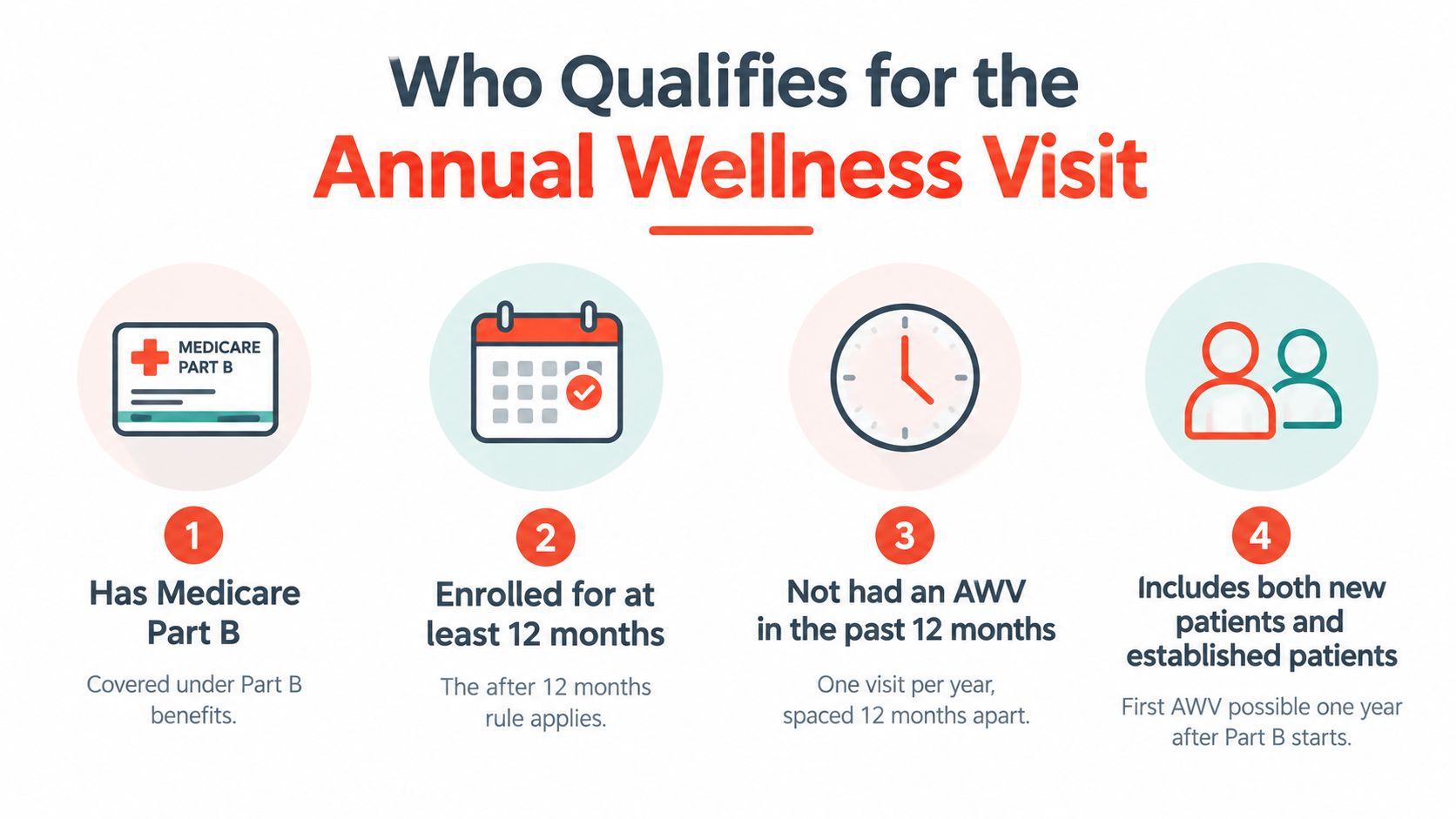
Before scheduling a 45–60 minute in-home visit through a New Jersey house call practice, patients can check their Part B start date or ask the billing office to verify the record. This guide to Medicare Annual Wellness Visit requirements can also help clarify which visit fits the timeline. Confirming eligibility first helps the clinician and patient use the kitchen-table conversation for planning, rather than sorting out a preventable billing mismatch.
How an AWV Differs from a Routine Physical
An AWV and a traditional annual physical may both happen once a year, but they answer different questions.
A physical is generally a hands-on, head-to-toe assessment. It may evaluate a new concern, manage an existing condition, and include examinations or tests based on the clinician's findings. The AWV is primarily a structured prevention and planning conversation.
| Feature | Medicare Annual Wellness Visit (AWV) | Traditional Annual Physical |
|---|---|---|
| Main purpose | Identify risks and create or update a prevention plan | Assess health and evaluate current concerns |
| Core discussion | Health Risk Assessment, medical and family history, prevention needs | Symptoms, examination findings, conditions, and treatment |
| Examination | Not a full head-to-toe physical exam | Usually includes a hands-on physical assessment |
| Standard testing | No routine labs, imaging, urinalysis, or EKG as standard AWV components | Tests depend on the clinician's assessment and the patient's needs |
| Preventive planning | Screenings, immunizations, risk reduction, and referrals | May be included, but the visit also addresses active care |
| New symptoms | Usually need a separate problem-focused service | Appropriate for evaluation and management of new concerns |
The AWV may include a Health Risk Assessment, review of medical and family history, vital signs, cognitive and depression screening, a personalized prevention plan, and referrals for covered screenings. It deliberately doesn't function as a full physical exam, and a urinalysis or EKG isn't a standard AWV component.
For a plain-language explanation of how Medicare treats yearly physicals, My Policy Quote's insurance insights on Medicare and annual physicals can help clarify the distinction. A clinician may schedule an AWV and a separate evaluation in the same year when the patient needs both preventive planning and care for an active condition.
What Happens During the Visit Step by Step
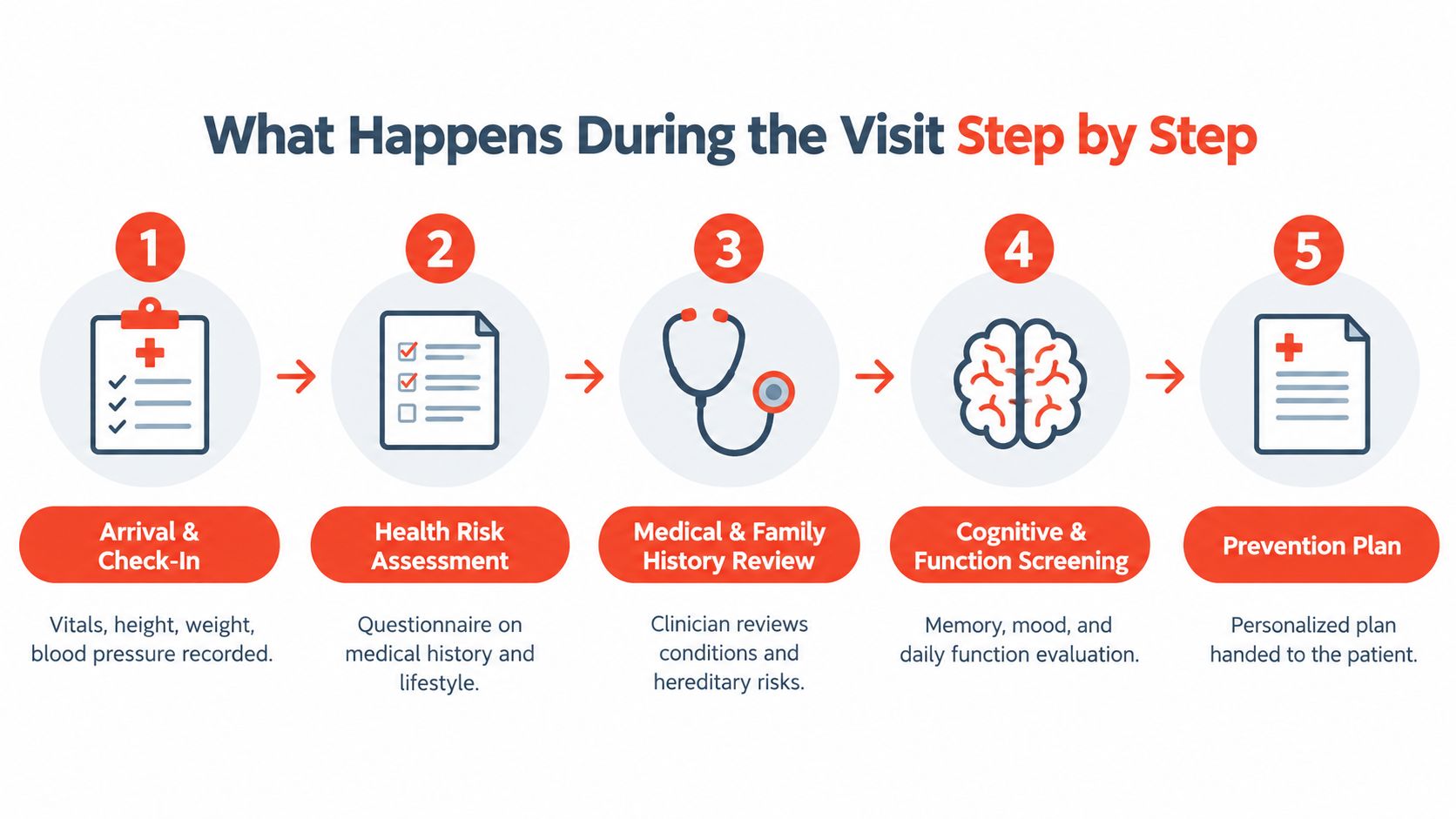
At a New Jersey kitchen table, an AWV follows a practical sequence. During a 45–60 minute window, the clinician gathers information, records measurements, discusses risks, and builds a prevention plan the patient and family can use after the visit.
The opening questions
The Health Risk Assessment, or HRA, starts with daily life rather than a diagnosis. Questions may cover mood, memory, falls, exercise, nutrition, tobacco or alcohol use, living arrangements, daily activities, and access to support. A patient may not think to mention trouble preparing meals or feeling unsteady, but those details can change the prevention plan.
The clinician then reviews medical and family history, current medicines, vitamins, supplements, allergies, and other treating clinicians. Medication reconciliation compares what the patient takes with the medical record. Like matching two checklists, this can reveal duplicate medicines, outdated prescriptions, or directions that became unclear after a hospital stay.
Measurements and screening
The clinician records height, weight, BMI or waist circumference when appropriate, and blood pressure. The visit then moves through vision, fall-risk, depression, and cognitive screening, with each result explained as it is recorded, consistent with Medicare's preventive-services guidance.
A depression screen can identify mood changes that family members have noticed but have not named. A cognitive assessment looks for possible changes in memory or thinking. Fall-risk questions address balance, previous falls, footwear, medicines, and hazards in the home. In a house call, the clinician can discuss those risks in the setting where they occur.
The written plan
The final product is a personalized prevention plan. It brings together preventive services that may be due, immunization needs, recommended screenings, risk factors, and follow-up priorities. One document gives the patient and family a clear list to review later.
Routine labs, imaging, and a hands-on head-to-toe physical exam are not standard AWV components. If the patient raises a new symptom, the clinician can explain whether a separate problem-focused service is appropriate.
The conversation needs enough time for careful answers and clear next steps. An in-home visit makes the plan more practical because the clinician can connect recommendations with the patient's routines, medications, support system, and home environment.
Understanding the Costs and Coverage
Medicare Part B covers the AWV at no cost when the patient is eligible and the provider accepts assignment. That means no coinsurance or deductible applies to the AWV service itself under the general Medicare rule.
The billing distinction matters. A separate problem-focused evaluation, laboratory work, vaccination, chronic-condition management, or another service performed during the appointment may be billed separately. Deductible or coinsurance rules can apply to those additional services depending on the patient's coverage.
| Code | When Used | Patient Cost with Part B |
|---|---|---|
| G0438 | First Medicare Annual Wellness Visit | No cost for the AWV itself when eligible and the provider accepts assignment |
| G0439 | Subsequent yearly Medicare Annual Wellness Visit | No cost for the AWV itself when eligible and the provider accepts assignment |
Patients with Medicare Advantage receive the AWV benefit, but they should confirm whether the clinician is in the plan's network. A provider may also charge for a missed appointment, depending on the practice's policy.
These are general Medicare rules, not a personal coverage determination. Before scheduling, patients can verify eligibility and billing questions with Medicare, their Medicare Advantage plan, or the practice's billing office. Families considering home-based care can also review whether doctors still make house calls and ask how the AWV will be billed.
Bringing the Annual Wellness Visit to Your Home
The Medicare rules don't change because the AWV happens at home. The clinician still completes the Health Risk Assessment, reviews medical and family history, records vital signs, considers cognitive and functional risks, and creates the prevention plan.
The setting does change the information available during the conversation. At the kitchen table, a clinician may notice a loose rug, poorly lit stairs, an awkward path to the bathroom, missing grab bars, or medication bottles stored in a confusing location. Those observations don't replace formal screening, but they can make safety planning more concrete.
Life Primary Care provides in-home primary care across northern and central New Jersey, including Bergen, Passaic, Morris, Essex, Hudson, and Union counties. Its clinicians bring portable equipment and complete Medicare Annual Wellness Visits in the patient's residence. The practice's in-home care guide describes how house calls can support patients who have difficulty traveling.
Who may benefit from the home setting
An in-home AWV can be practical for a senior managing several chronic conditions, recovering after hospitalization, living with mobility limitations, experiencing cognitive changes, or lacking dependable transportation. Family caregivers can participate in person or by phone, which may help when the patient doesn't remember every medication, appointment, or recent change.
The longer 45–60 minute visit window allows time to discuss the prevention plan, examine medication bottles, and identify follow-up needs without asking the patient to organize transportation to a clinic and wait in a crowded room. The clinician can coordinate referrals, follow-up, and same-day sick care when an active concern also needs attention.
That creates continuity beyond a single yearly appointment. The AWV establishes the prevention roadmap, while later home visits, telehealth follow-ups, chronic disease care, and post-hospital support can address what happens next.
Common Misconceptions Worth Clearing Up
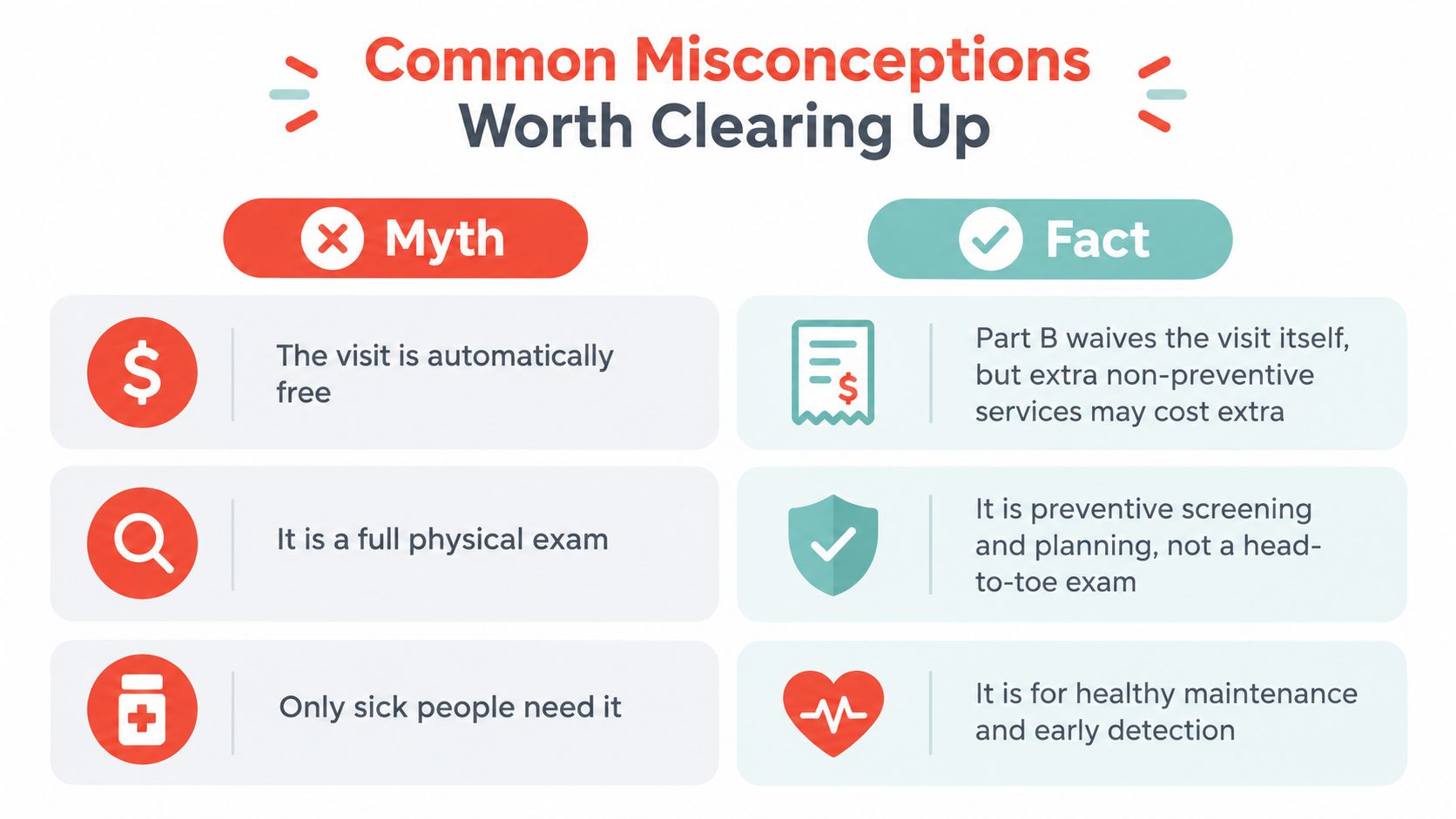
Myth: The AWV is automatically free for everyone with Medicare.
Fact: Medicare Part B covers the eligible AWV itself without coinsurance or a deductible when the provider accepts assignment. A non-preventive service, such as evaluating an unrelated complaint, ordering a test, or performing a procedure, may create a separate bill.
Myth: The AWV is a full physical exam.
Fact: It's a preventive planning visit, not a head-to-toe examination. The visit reviews risk, history, function, mood, memory, vital signs, and preventive needs. A separate primary care appointment may be appropriate for active symptoms or a detailed physical assessment.
Myth: The AWV replaces every recommended screening.
Fact: The AWV helps identify which screenings and immunizations may be due. It doesn't automatically perform every test. The personalized plan connects the patient with the services that fit the person's history and needs.
Myth: A patient must leave home to receive the visit.
Fact: In-home practices can complete the AWV at the patient's residence. This can remove transportation and mobility barriers while allowing the clinician to understand the patient's everyday environment.
Families also deserve to know how to protect personal Medicare information. A practical Medicare scam protection guide from Gini Help offers reminders about suspicious calls, requests, and messages.
Scheduling Your Visit and What Comes Next
Start by checking the Part B timeline. The patient should have had Part B for more than 12 months, or should be beyond the initial Welcome to Medicare period. If the timing isn't clear, the billing office or Medicare plan can verify eligibility before the appointment.
Gather the information that will make the discussion accurate:
- Medication details: Place prescription bottles, over-the-counter medicines, vitamins, and supplements together.
- Provider list: Write down primary care clinicians, specialists, therapists, and other treating professionals.
- Immunization records: Include records from pharmacies, previous practices, or family files when available.
- Advance directive: Keep an advance directive or health care proxy document nearby if one exists.
- Recent concerns: Note changes in memory, mood, balance, sleep, appetite, or daily activities for discussion.
When booking a home visit in northern or central New Jersey, ask whether the appointment will use a 45–60 minute time block and confirm what the practice needs for insurance verification. On the day of the visit, clear a comfortable space at the kitchen table and keep a working phone available if a family member plans to join by speaker.
Afterward, review the personalized prevention plan before putting it with the patient's other medical records. Schedule follow-ups identified during the conversation, and ask the billing office about any service that appears separately on a statement.
Questions families often ask
Can an AWV address a new symptom?
The patient can mention it, but a new or active problem may require a separate evaluation and billing service.
Should a caregiver attend?
A caregiver can participate when the patient wants support or when medication, memory, safety, or daily-function details are difficult to recall.
What should happen after the plan is created?
The patient and care team should use it to organize screenings, immunizations, referrals, and follow-up care.
Life Primary Care offers Medicare Annual Wellness Visits and ongoing primary care in the patient's home across northern and central New Jersey. Visit Life Primary Care to learn how to arrange an in-home prevention visit at the kitchen table.
Ready for a visit at home?
Call and speak with a real person. We will confirm your insurance, find a time and come to you.
973-607-4911 Call now