
Guide · 13 min read
What Is Geriatric Care: Goals, Syndromes, and Home Benefits
Your parent has just come home from the hospital, but the discharge instructions are spread across the kitchen counter, several medication bottles look unfamiliar, and nobody is sure whether the hallway is safe at night. An office visit may identify the diagnosis that brought them to the hospital. A home visit can reveal why recovery may still fail.
What is geriatric care in practical terms? It's function-preserving, person-centered medicine for older adults. The clinician considers disease, but also asks whether the patient can stand safely, manage medications, prepare food, remember instructions, use the bathroom, sleep, and remain connected to the people who support daily life.
Table of Contents
- What Geriatric Care Means
- Common Geriatric Syndromes In Plain Language
- How A Geriatric Assessment Works
- Why Home Visits Reveal What Offices Miss
- The Role Of Caregivers And Family Support
- Benefits Of Delivering Geriatric Care At Home
- Real Scenarios Of Geriatric Care Outcomes
What Geriatric Care Means
A patient may have stable heart failure, diabetes, arthritis, COPD, or kidney disease and still be losing the ability to manage daily life. Geriatric care starts by asking what will keep that person safe, independent, and aligned with their goals. The clinician treats disease while assessing cognition, mobility, mood, nutrition, medication safety, social circumstances, and the level of treatment the patient wants.
The field took shape in 1909, when New York physician Ignatz Nascher coined “geriatrics” to distinguish medical care for older people from general adult medicine. Its development included formal education, research, and clinical institutions. The first U.S. geriatric-medicine fellowship began in 1966 at City Hospital Center, affiliated with Mount Sinai School of Medicine. Congress established the National Institute on Aging in 1974, authorized the first Geriatric Research, Education, and Clinical Centers within the Veterans Health Administration in 1976, and Mount Sinai created the first separate U.S. academic department of geriatrics in 1982. Formal geriatric certification followed in 1988. Between 1988 and 2002, 10,207 physicians received geriatric-medicine certification, according to this brief history of geriatric medicine.
Function Matters Alongside Diagnosis
A stable lab result does not show whether someone can still climb the stairs, prepare a meal, or get to the bathroom safely. A medication may be reasonable on its own yet become unsafe alongside another prescription, poor food intake, impaired kidney function, or repeated falls. Geriatric care connects those details and weighs the treatment burden against the person's daily function.
The World Health Organization projects that the global population aged 60 and older will reach 1.4 billion by 2030 and 2.1 billion by 2050, compared with approximately 1 billion in 2019. Its WHO ageing and health overview also projects that older adults will represent about one in six people by 2030 and one in five by 2050. Care that protects function and coordinates decisions therefore matters across clinical settings, including the home.
A useful overview of senior primary care includes more than routine disease management. It explains how clinicians protect daily abilities, reduce avoidable treatment burden, and help families choose care that fits the patient's abilities and values.
The Practical Standard
A successful plan is not the one with the most tests or medications. It addresses important medical problems while preserving walking, eating, communicating, toileting, sleeping, and participation in meaningful routines.
Practical rule: Treat the disease, then measure whether the person can still do what matters to them.
Common Geriatric Syndromes In Plain Language
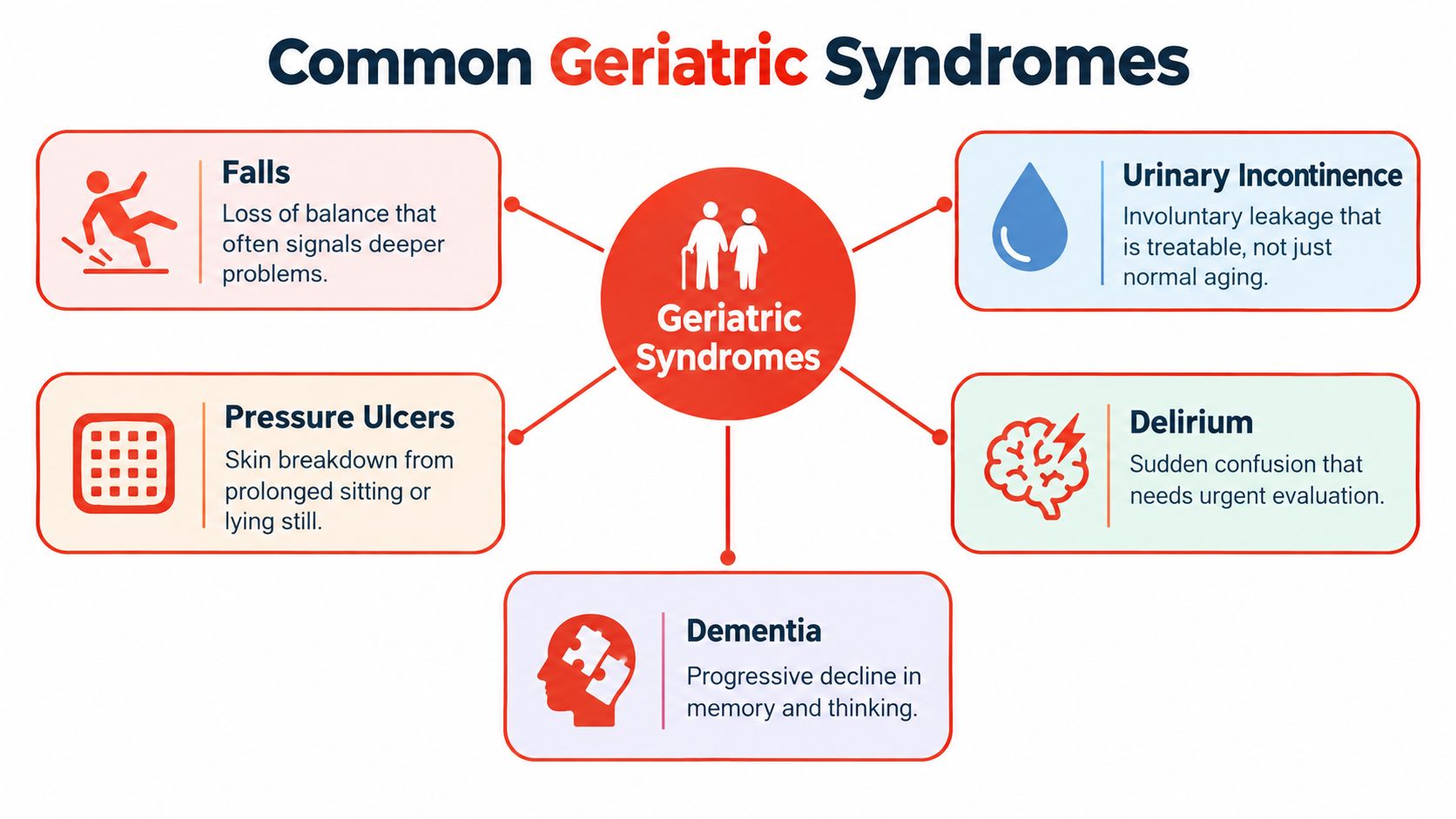
Geriatric syndromes are clinical problems with several interacting causes. A fall may involve weak legs, poor vision, an unsafe rug, dizziness from medication, dehydration, or difficulty judging distance. Urinary incontinence may reflect infection, constipation, mobility limitations, cognitive impairment, medication effects, or an inability to reach the bathroom quickly.
Treating only one suspected disease often leaves the actual hazard untouched. A patient may receive treatment for dizziness but continue falling because the bathroom route is dark and the walker is stored too far away. Someone may receive a bladder medication yet remain incontinent because they can't rise from the chair without assistance.
How These Syndromes Interact
- Falls: A fall can result from impaired balance, weakness, vision changes, medication effects, or environmental hazards. Afterward, fear of falling may lead to less movement, which further weakens the legs.
- Urinary incontinence: Leakage deserves assessment rather than dismissal as a normal part of aging. It can affect sleep, skin integrity, confidence, and willingness to leave home.
- Pressure ulcers: Prolonged sitting or lying, poor nutrition, moisture, reduced sensation, and limited ability to reposition can damage skin. Prevention depends on movement, inspection, nutrition, and appropriate support surfaces.
- Delirium: Sudden confusion is different from a gradual memory disorder and needs prompt evaluation. Infection, medication changes, dehydration, pain, constipation, and hospitalization can contribute.
- Dementia: Progressive decline in memory and thinking changes how a person manages medication, finances, meals, driving, and safety. Families can find practical guidance in this resource on dementia care.
Why Labels Aren't Enough
These problems often overlap. A person with dementia may forget to use a walker, a person with incontinence may avoid drinking, and dehydration may increase confusion or dizziness. A pressure injury may then develop because the patient spends more time in one chair.
The clinical response should identify contributing factors, not just attach a label. That means reviewing medicines, observing mobility, asking about daily routines, checking nutrition and hydration, examining skin when appropriate, and learning what changed before the problem appeared.
How A Geriatric Assessment Works
A geriatric assessment starts with a person's daily life, not only the diagnosis list. It is a structured review of medical, psychological, functional, environmental, and social needs, designed to protect function and support goals that matter at home. The result should be a coordinated plan with patient-defined priorities, assigned responsibilities, follow-up, and clear instructions for escalation.
The World Health Organization's ICOPE framework covers locomotion, nutrition and vitality, vision, hearing, cognition, psychological status, urinary continence, caregiver support, and wider social-care needs. Its ICOPE guidance also supports thorough assessment, shared planning, coordinated referrals, community or home-based interventions, self-management, and caregiver support.
What Gets Reviewed
A clinician should begin by asking what the patient wants to preserve. One person may want to walk to the mailbox again. Another may prioritize staying at home, avoiding hospitalization, attending worship, or preparing breakfast without help. These goals guide decisions when treatments compete for time, energy, or safety.
The assessment usually brings together several practical domains:
- Medical conditions and symptoms: Review diagnoses, recent changes, pain, breathing, sleep, bowel and bladder function, falls, and recent emergency or hospital care.
- Medication use: Compare prescriptions, over-the-counter products, supplements, doses, indications, duplicate therapies, renal-dose requirements, and the patient's actual routine. The chart is incomplete if bottles at home show a different pattern.
- Cognition and mood: Look for memory changes, confusion, depression, anxiety, impaired judgment, and the person's ability to understand and follow the plan.
- Mobility and daily activities: Assess gait, transfers, strength, assistive devices, bathing, dressing, eating, toileting, and household tasks.
- Nutrition and the environment: Consider food access, weight change, swallowing concerns, kitchen access, stairs, bathroom layout, lighting, oxygen use, and medication storage.
- Support and coordination: Identify who helps, what they can realistically do, which specialists are involved, and how information will move between the home, hospital, pharmacy, and clinical team.
A full assessment often requires several professionals. Depending on the patient, the team may include a geriatrician, nurse, clinical pharmacist, rehabilitation therapist, dietitian, social worker, or mental-health professional, as described in this peer-reviewed overview of comprehensive geriatric assessment.
The following short overview walks through the domains a full assessment covers.
The Plan Must Be Actionable
The final plan should state what changes, who will help, and when progress will be checked. It may include medication adjustments, physical therapy, nutrition support, equipment, home-health services, caregiver teaching, specialist referral, or a discussion about treatment priorities.
A diagnosis without ownership creates more paperwork. A useful plan gives the family a shared medication list, follow-up timing, warning signs, and a direct way to report deterioration. It also connects clinical recommendations to the realities of the household, where the patient must carry them out.
Why Home Visits Reveal What Offices Miss
A patient may walk steadily into the clinic, answer questions clearly, and report taking every medication correctly. At home, the same person may grip furniture at each turn, avoid a staircase, or leave a walker in another room because it cannot fit through the doorway. Those details show how illness affects daily function, not just which symptoms appear during an appointment.
Office Snapshot Versus Home Reality
| A brief office encounter may show | A home visit can reveal |
|---|---|
| The patient's reported symptoms | How symptoms affect meals, bathing, sleep, and movement |
| A medication list in the chart | The actual bottles, organizers, duplicates, and missed doses |
| A short walk in a clinical corridor | The route to the bathroom, stairs, thresholds, and furniture used for support |
| A blood-pressure reading | Whether the patient can safely manage the treatment plan at home |
| A caregiver's summary | The workload, routines, and practical gaps the caregiver is managing |
A home assessment should record clinical status, fall risk, mobility, medication use, adherence, daily activities, and links to community support. These details connect medical decisions with the conditions in which the patient must follow them.
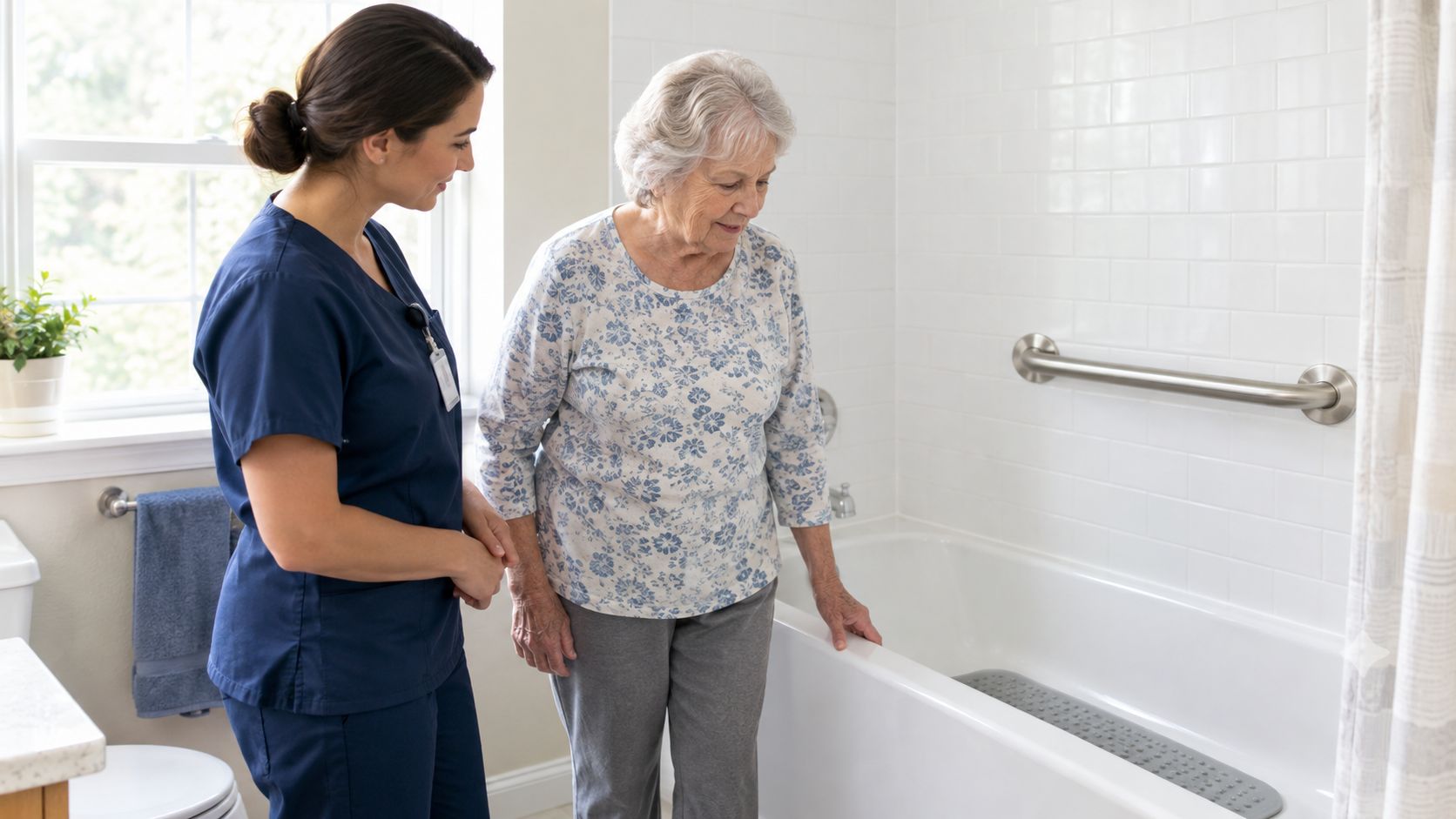
The clinician can ask the patient to demonstrate how they rise from a chair, find their medications, enter the shower, or complete another routine task. The visit may also show whether food is available, whether bathroom supports are usable, and whether instructions fit the caregiver's actual workload. A recommendation that looks reasonable in the chart may fail once it meets narrow pathways, fatigue, pain, or limited assistance.
What Works Better At Home
Home-based care suits problems centered on function, adherence, safety, or coordination. Emergencies still require emergency services, and some tests or treatments belong in a hospital or specialist setting.
The main advantage is direct observation. A clinician can compare the chart with the household, identify barriers, and adjust the treatment approach before a manageable problem becomes a crisis. Life Primary Care describes visits that typically last 45 to 60 minutes, including review of stairs, bathroom setup, the home environment, and medication bottles.
Home care also exposes trade-offs. Moving a frequently used item may reduce reaching but increase walking distance. A mobility aid may improve stability yet remain unused if it cannot pass through the home. A medication schedule may be medically appropriate but impractical if no one can prepare doses at the required times.
Medicare distinguishes physician services in a patient's private residence through CPT codes 99341 through 99350 and place-of-service code 12. Facility-based domiciliary services use separate codes, as explained in this CMS home-services guidance.
The Role Of Caregivers And Family Support
A geriatric plan that ignores the caregiver usually fails at home. Family members may organize pills, arrange transportation, communicate with specialists, monitor meals, manage finances, and respond to nighttime confusion while also working or living in another state.
Including caregivers doesn't mean taking control away from the older adult. It means clarifying consent, preferences, responsibilities, and limits. The clinician should ask what the caregiver is able to do, not assume that a daughter, spouse, or neighbor can provide unlimited supervision.
Turning Stress Into A Shared Plan
Medication routines work better when one current list identifies every prescriber and the person who fills each organizer. Fall prevention works better when someone checks the path to the bathroom, confirms that the walker is accessible, and knows what to do after a near-fall. Dementia care works better when caregivers receive consistent guidance about routines, supervision, nutrition, and changes that require clinical attention.
Incontinence can place a particular strain on dignity, laundry, sleep, and skin care. Families may benefit from practical education on supporting someone with incontinence, especially when they're trying to balance privacy with timely assistance.
Caregiver reality: A recommendation is only useful if the household can carry it out on an ordinary Tuesday evening.
Home-based care reduces some coordination burdens because the clinician sees the patient, caregiver, medications, and environment together. Results, referrals, follow-up, and changes to the plan can be discussed before the visit ends. That doesn't eliminate caregiver strain, but it can replace repeated guesswork with defined tasks and escalation points.
The patient remains the center of care. The caregiver becomes a supported partner rather than an invisible member of the clinical team.
Benefits Of Delivering Geriatric Care At Home
An older adult who uses oxygen may spend much of the day preparing for a clinic visit, then arrive too tired to participate fully. Someone recovering from surgery may manage the front door with help but struggle to transfer safely into a car. Cognitive impairment can cause confusion before the appointment even begins.
At-Home Doctor Visits remove travel from the assessment. A house-call clinician can evaluate the patient where medication, meals, mobility, oxygen equipment, and caregiver support take place. That setting matters for people with limited mobility, fluctuating frailty, oxygen dependence, or unreliable transportation. It also shows whether a recommendation fits the household, rather than only whether it makes sense on paper.
Three Situations Where Timing Matters
After discharge, the clinician can compare hospital instructions with the bottles on the counter and the prescriptions used before admission. Post-discharge home care commonly addresses medication reconciliation, functional status, safety, adherence, and connections to community services. Seeing these factors together can expose omissions that a symptom-focused office visit may miss.
For chronic disease, regular home monitoring reveals practical barriers behind an unexplained reading or setback. A patient with heart failure may understand dietary advice but lack suitable food. A person with diabetes may struggle to open containers or read labels. Someone with COPD may use oxygen safely in the living room while creating a trip hazard along the route to the bathroom.
In-home care also supports prevention. A clinician can discuss lighting, grab bars, shower access, medication storage, and daily activity while observing the physical arrangement. Families planning bathroom changes can compare accessible renovation cost estimates before choosing modifications.
What The Model Doesn't Replace
House calls are not substitutes for emergency services. Severe breathing difficulty, chest pain, sudden weakness, major bleeding, or serious injury may require an immediate emergency response. Home care works as a coordinated layer for primary care, transitional follow-up, medication review, chronic disease management, preventive visits, and non-emergency urgent assessment.
Medicare distinguishes private residences from facilities for home-service billing. The applicable coding guidance lists CPT codes 99341 through 99350 for services provided in the patient's home and identifies place-of-service code 12 as “Patient's Home.” Practices should explain how they apply those rules rather than presenting a house call as an all-purpose service.
For a fuller explanation of health care delivered at home, families should ask how the practice handles laboratories, imaging, referrals, hospital communication, medication changes, and follow-up between visits. Those operational details determine whether a visit becomes coordinated care or remains a one-time examination.
Real Scenarios Of Geriatric Care Outcomes
A patient recovering from a hip fracture may return home with new pain medicine, a blood thinner, physical-therapy instructions, and an older medication list that no longer matches the discharge plan. During a Doctor home visit for elderly patients, the clinician can compare the written instructions with the bottles, observe transfers, identify the safest route to the bathroom, and clarify who will oversee each dose. The intervention is practical: fewer assumptions, clearer ownership, and earlier recognition when recovery is not following the expected path.
In another household, an older adult with dementia may have fallen twice but still insist that nothing has changed. A home assessment can show poor lighting, loose pathways, a chair that is difficult to rise from, and a caregiver trying to supervise meals and medication without a workable routine. The response may involve equipment, environmental changes, medication review, caregiver support, and follow-up rather than just adding another diagnosis.
Structured coordination can affect utilization as well as daily function. In the GERI-VET study, a specialist screening and coordination model reduced emergency-department admission rates from 57.5% to 50.1%, an absolute reduction of 7.4 percentage points, without an increase in 30-day hospitalization rates, according to this peer-reviewed review of geriatric emergency care. The study took place in an emergency-department setting, not through home visits, but it illustrates why assessment, team coordination, and follow-up matter.
The point of geriatric care isn't to prevent every decline. It's to recognize change early, protect function where possible, align treatment with the patient's goals, and keep the household from carrying an unsafe plan alone.
Life Primary Care provides in-home primary care, chronic disease management, medication reviews, post-hospital transitional visits, dementia care, diagnostics coordination, and non-emergency urgent visits across northern and central New Jersey. Visit Life Primary Care to learn whether a home-based appointment fits your older adult's mobility, recovery, and care-coordination needs.
Ready for a visit at home?
Call and speak with a real person. We will confirm your insurance, find a time and come to you.
973-607-4911 Call now