
Guide · 15 min read
Dementia Care at Home: A Practical Family Guide
A parent who once managed errands independently may now become distressed before leaving the house. Getting dressed turns into an argument, the car ride causes confusion, and a crowded waiting room makes the appointment harder still. By the time the clinician enters the exam room, the family caregiver is exhausted and the patient may no longer be able to describe what happened at home.
That's why dementia care often needs to move beyond the clinic. A home visit lets the clinician see medication bottles, stairs, lighting, meals, routines, and caregiver workload in their real setting. For families searching for Visiting physicians NJ, Visiting Doctors NJ, or Doctor house calls NJ, the central question isn't just whether a doctor can travel. It's whether care becomes more accurate and practical when it happens where daily life unfolds.
Table of Contents
- When Clinic Visits Stop Making Sense
- What Dementia Care Really Means at Home
- The Six Pillars of Home-Based Dementia Care
- How a Home Visit Changes the Assessment
- Daily Routines and Behavioral Strategies
- Medications, Falls, and Why Review Is Even Simpler
- What an In-Home Primary Care Team Provides
- A Practical First Two Weeks for Families
When Clinic Visits Stop Making Sense
The morning starts before sunrise. An adult daughter lays out her father's clothes, searches for his hearing aids, and explains the appointment several times. Her father, who has mid-stage dementia, insists he already went to the doctor yesterday. When she tries to guide him toward the car, he becomes frightened and angry.
The trip takes longer than expected. Parking adds another challenge. In the waiting room, bright lights, unfamiliar voices, and other patients increase his agitation. By the time the appointment begins, he's tired and unable to answer questions he might have answered calmly at home. His daughter fills in the gaps, but even she isn't sure how accurately she remembers the medication schedule or the episodes that happened overnight.
This isn't a failure of effort. Transportation, waiting, and unfamiliar surroundings can make cognitive symptoms harder to observe accurately. A familiar home can reduce disorientation and expose triggers that remain invisible in an office. The clinician may notice that confusion begins when the hallway becomes dark, that a bathroom trip requires an unsafe turn, or that several pill bottles sit together without a clear schedule.
The practical guide to whether doctors can make house calls can help families understand what this model involves and when it may fit.

The home is part of the clinical picture
A home visit may reveal:
- Medication habits: Whether the person opens the right bottles, skips doses, or takes duplicate products.
- Movement patterns: How the person rises from a chair, manages stairs, and reaches the bathroom.
- Environmental triggers: Whether clutter, glare, noise, or poor evening lighting contributes to distress.
- Caregiver workload: Which tasks require repeated prompting and which responsibilities have become unsafe.
The World Health Organization describes dementia as a major social and economic challenge, with 57 million people living with dementia globally in 2021 and nearly 10 million new cases each year. The same WHO dementia fact sheet reports that dementia cost the world economy about US$1.3 trillion in 2019, with informal family care accounting for roughly half of those costs.
A home-based approach isn't merely a fallback for people who can't manage transportation. It's a deliberate clinical choice. The place where symptoms occur often contains information that an office interview can't capture.
What Dementia Care Really Means at Home
Dementia is an umbrella term for conditions that affect memory, thinking, judgment, communication, and behavior. Alzheimer's disease is the most common cause, but dementia can result from different diseases and combinations of health problems. The effects vary from person to person, so care must respond to the individual rather than follow a single script.
Dementia care means supporting the whole pattern of life around those changes. It includes medical assessment, medication review, monitoring, family education, safety planning, and coordination with other professionals. It also includes practical questions such as whether the person is eating, sleeping, bathing, using the bathroom safely, and staying connected to other people.
Move the conversation to the kitchen table
A useful way to understand home-based care is to picture a clinician pulling up a chair at the family kitchen table. Instead of asking only what happened since the last appointment, the clinician can see how breakfast is prepared, where medications are stored, who provides reminders, and what happens when the usual routine changes.
That setting turns an episodic problem-solving visit into an ongoing relationship with the patient and care partner. The clinician can ask the family to demonstrate a difficult task, observe communication between relatives, and identify changes that might otherwise be described as “just getting worse.”

Home care also requires attention to factors that families may overlook. Air pollution and other environmental exposures are not usually the first concern during a medication discussion, but families interested in the broader relationship between living conditions and cognition may find this resource on cognitive health and air quality useful.
A practical distinction: dementia care isn't only about treating memory loss. It's about making ordinary activities safer, calmer, and more manageable.
The AHRQ definition of home-based primary care describes a model that combines medical care in the home with intensive coordination and, when needed, long-term services and supports. That matters because families often need one plan that connects prescriptions, specialists, aides, equipment, transportation alternatives, and emotional support.
The person living with dementia remains the center of the plan. The family caregiver becomes an essential partner, not an invisible assistant expected to remember every instruction.
The Six Pillars of Home-Based Dementia Care
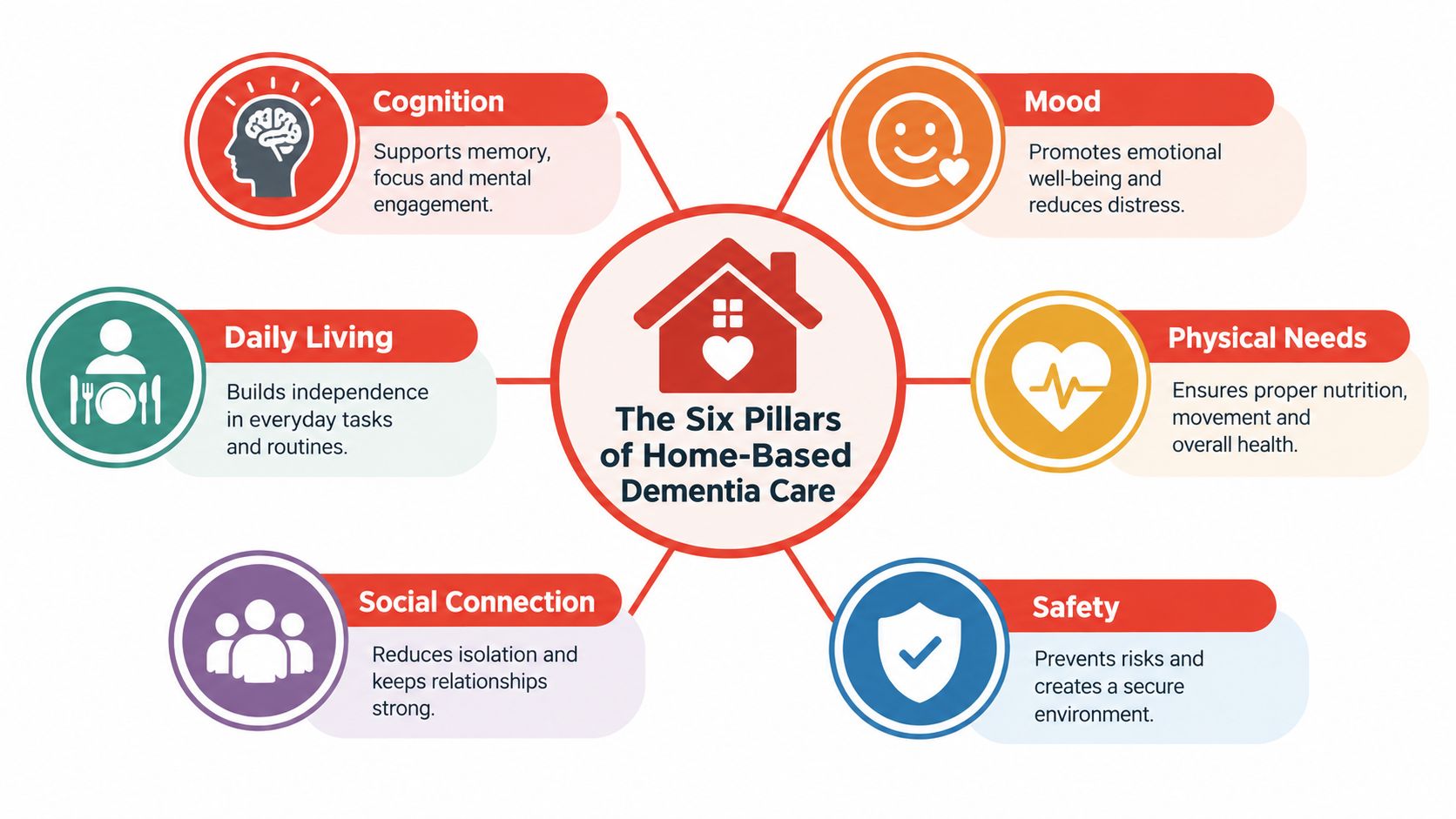
Good home-based dementia care uses the house as both the care setting and a source of clinical information. A clinician doesn't assess memory in isolation. The visit connects cognition with function, mood, physical health, safety, relationships, and daily living.
Assessment begins with the person's actual day
The first pillar is thorough assessment. This includes cognitive changes, mood, mobility, nutrition, continence, sleep, chronic conditions, and the ability to complete everyday tasks. A person may appear relatively comfortable during a short interview but struggle to dress, prepare food, or follow a medication plan without help.
The second pillar is daily routine. Predictable timing for sleep, meals, personal care, light activity, and social contact can reduce uncertainty. A routine shouldn't be rigid, but it should give the person familiar anchors as internal timing becomes less reliable.
Communication should reduce the task
The third pillar is communication. Use short sentences, one request at a time, and a calm tone. If someone says an inaccurate statement, correcting every detail may increase distress without improving safety. Validation, redirection, and offering a simple choice often work better than an argument.
The fourth pillar is safety. The clinician and family look at falls, wandering, stove use, locks, stairs, bathroom access, lighting, and medication storage. A loose rug or dark corridor can matter as much as a diagnosis because it changes what the person can safely do.
Medications and coordination complete the plan
The fifth pillar is medication review. The question isn't just whether a drug was prescribed. It's whether the current list remains necessary, understandable, and safe for this person's balance, alertness, blood pressure, and routine.
The sixth pillar is specialist coordination. Neurology, psychiatry, social work, home health, rehabilitation, and palliative care may each contribute useful expertise. Families need those contributions joined into one understandable plan rather than scattered across disconnected appointments.
A short visual explanation can help relatives discuss these domains together:
The 2023 systematic review of home care for people living with dementia found that home care may reduce hospital readmissions and costs while improving patient and family experience, although the quality of the available studies varied. The practical lesson is modest but important. A home visit can make the care plan more grounded in the person's real environment.
How a Home Visit Changes the Assessment
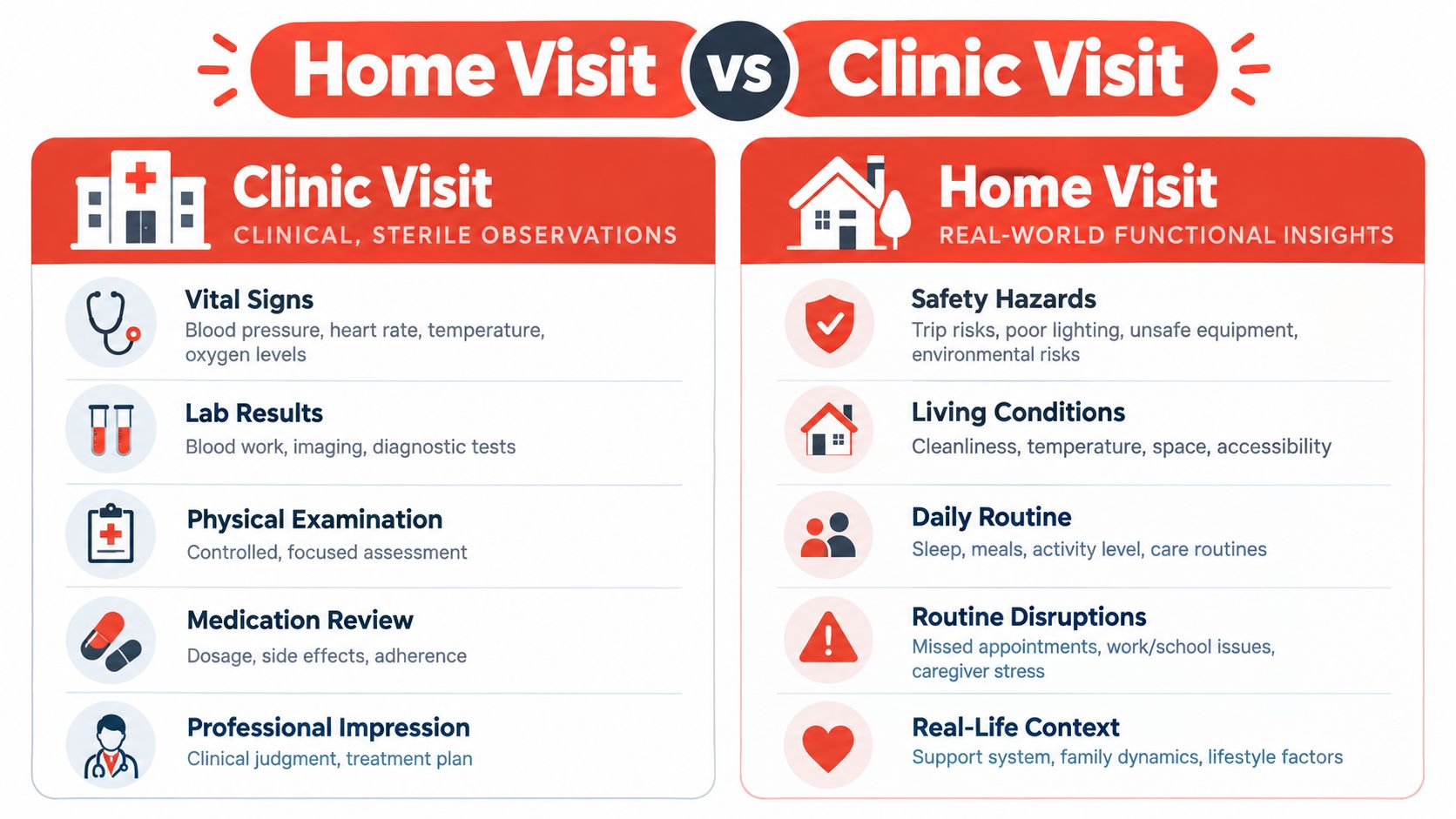
A clinician arrives while the person is in the middle of an ordinary day. The visit usually starts with conversation: what has changed, what feels difficult, and what happened before the appointment was arranged. A visit lasting 45 to 60 minutes may then include an examination, medication review, functional observation, and assessment of the surroundings.
The difference from a clinic appointment is the kind of evidence available. At home, the clinician can compare what the family reports with what happens during familiar tasks.
| Clinic setting | Home setting |
|---|---|
| The patient describes how they walk | The clinician observes the route from chair to bathroom |
| The family recalls medication use | The clinician sees the bottles, organizer, and written reminders |
| The patient reports feeling safe | The clinician checks stairs, rugs, lighting, and bathroom access |
| The caregiver summarizes the routine | The clinician sees how meals, bathing, and supervision work |
A family might say, “She's unsteady on the stairs.” In the home, the clinician may find a narrow staircase, worn tread, or a light switch that is difficult to reach. Those details turn a general concern into practical choices, such as improving lighting, reducing clutter, or arranging a safer route. They may also support a referral for physical or occupational therapy when appropriate.
What families can prepare
Before the visit, gather:
- All medication containers: Include prescriptions, over-the-counter products, vitamins, and medicines kept in another room.
- Recent concerns: Note falls, nighttime wakefulness, appetite changes, pain, agitation, or new confusion.
- A typical schedule: Describe when the person wakes, eats, bathes, rests, and becomes more unsettled.
- Questions from every caregiver: Include relatives who help remotely or visit at different times.
CMS distinguishes between covered home health services, which require a patient to meet “confined to home” criteria, and physician home visits billed with home-visit codes 99341 through 99350 using place of service 12. Those physician visits do not require the beneficiary to be confined to home, as explained in the CMS Medicare benefit policy manual. Families should confirm eligibility, coverage, and billing details with the practice and insurer.
The useful outcome is a plan tied to the home, not a longer list of observations. That plan might include installing a nightlight, moving a frequently used chair, labeling drawers, or changing how medications are organized.
Daily Routines and Behavioral Strategies
Every morning, a son asks his mother to take a bath. She refuses, raises her voice, and grips the bathroom door. He explains that she bathed yesterday, points out the dirty clothes, and repeats the request. The more he tries to prove that bathing is necessary, the more threatened she feels.
A calmer approach starts with the behavior rather than the argument. Is she cold? Is the bathroom too bright? Does she understand the request, or does “take a bath” contain too many steps? A caregiver might offer a warm towel, turn on the water first, and say, “Let's wash your hands,” before moving through one small action at a time.
Let the routine carry some of the work
Predictable timing lowers the number of decisions a person must make. If breakfast, medication, bathing, and a short walk usually happen in a familiar order, the person may need fewer explanations. Keep the sequence visible with simple notes or pictures if that helps.
For difficult tasks:
- Use one step: Say “Please sit here” rather than describing the whole bathing process.
- Offer limited choices: “Blue shirt or green shirt?” is easier than “What do you want to wear?”
- Protect dignity: Close doors, explain before touching, and allow extra time.
- Redirect early: Change the activity when frustration is rising instead of insisting on winning the discussion.
Meals may go better when food is served at a familiar time and in manageable portions. If someone refuses a medication, don't hide it in food or change the dose without guidance from the prescribing clinician. Record the refusal and ask the care team how to handle that specific medicine.
Late-day confusion, often called sundowning, may worsen when the house becomes darker and the person is tired. Earlier activity, steady lighting, reduced noise, and a familiar caregiver can help create a gentler transition into evening. These strategies won't remove every difficult moment, but they can reduce the struggle surrounding it.
The goal isn't perfect compliance. The goal is less fear, less conflict, and safer participation in ordinary care.
Medications, Falls, and Why Review Is Even Simpler
Medication lists become difficult when several clinicians prescribe for different conditions. A sedating drug may calm agitation but also affect balance. A blood-pressure medicine may be appropriate but contribute to dizziness in a person who eats and drinks inconsistently. An over-the-counter sleep product may add confusion to a regimen no one realized had become complicated.
A home review starts with reconciliation. The clinician compares every bottle in the home with the active medication list, checks how the caregiver gives each medicine, and identifies duplicates, outdated instructions, and products taken differently from the prescription. The prescriber or pharmacist can then decide whether a medication should continue, change, or be deprescribed.
The connection with falls is substantial. One nursing-home study found medication exposure implicated in around three-quarters of falls, and more than 80% of medication-related falls involved psychotropic drugs, according to this review of medication-related fall risk. The same source associates taking five or more medications with higher fall risk and injury after a fall.
A review doesn't mean stopping medicines suddenly. It means asking whether each medicine still has a clear purpose, whether its risks have changed, and whether the schedule is realistic for the household.
| Medication class | Why it matters in dementia | What a home review checks |
|---|---|---|
| Psychotropic medicines | Sedation, dizziness, and impaired balance may increase fall risk | Timing, benefit, adverse effects, and whether the medicine is still needed |
| Sleep products | May worsen daytime alertness or nighttime confusion | Actual use, response, and non-drug alternatives |
| Blood-pressure medicines | Dizziness can occur when intake, posture, or health changes | Blood-pressure pattern, standing symptoms, and dosing schedule |
| Pain medicines | Some can cause sedation, constipation, or confusion | Pain relief, alertness, bowel habits, and safer options |
| All other prescriptions | Multiple prescribers may create duplication or interaction | Complete bottle-by-bottle reconciliation |
The medication review guide for home care gives families a way to organize this process before a visit. Environmental changes matter too. Families adapting a home for an older adult can use child-safety principles as a starting point, then adjust them for adult dignity and mobility with this resource on how to make your home safe for kids.
A multifactorial fall plan may combine medication review, environmental changes, and individualized exercise. That combination is more useful than focusing on one loose rug while overlooking sedation, weakness, or poor footwear.
What an In-Home Primary Care Team Provides
An in-home primary care team turns isolated tasks into a continuing care relationship. A scheduled house call may address cognition, chronic disease, nutrition, sleep, mobility, and medication use in one setting. An urgent same-day visit may evaluate a fall or sudden change in confusion when the situation isn't an emergency but waiting for a routine appointment would create risk.
After a hospital discharge, a transitional visit can compare the discharge instructions with the medicines already in the home. Families often discover at this point that an old bottle remains on the counter, a new dose is unclear, or a specialist's instruction conflicts with what the caregiver understood. The team can communicate questions back to the appropriate clinicians rather than leaving the family to coordinate everything alone.
Telehealth has a different role. A brief check-in can help the team hear whether sleep changed, whether a new behavior appeared, or whether a caregiver needs clarification between home visits. It doesn't replace an examination when one is needed, but it can keep small concerns from becoming invisible.
Continuity is more than familiarity
The same clinician seeing the same hallway over time may notice a meaningful change. A grab bar may have been installed but never used because it's too high. A patient may appear calm during the day but become frightened whenever evening shadows reach the stairs. A pillbox may look organized while the person still takes an extra dose from a bottle kept in the bedroom.
The in-home primary care approach combines house calls, chronic-care management, care coordination, and follow-up around the patient's living situation. Families should expect written instructions after each visit, including medication changes, warning signs, referrals, testing plans, and the date or method of follow-up.
The family's role is to report what happens between visits, not to diagnose the cause. Keep notes concrete. “She became frightened after sunset and tried to leave through the front door” gives the team more useful information than “her dementia is worse.”
A Practical First Two Weeks for Families
A new diagnosis or care transition can make every task feel urgent. Start by collecting observations rather than trying to solve everything at once.
Week one focuses on seeing the pattern
Use a notebook or phone note to record:
- Sleep: When the person settles, wakes, naps, or becomes restless.
- Meals and fluids: What is accepted, refused, or difficult to prepare.
- Medications: When each medicine is given and whether any dose is missed or refused.
- Confusion and behavior: What happened immediately before distress, wandering, or withdrawal.
- Mobility and safety: Any stumble, near-fall, unsafe transfer, or difficulty using the bathroom.
During this week, schedule a baseline home assessment if clinic travel is no longer realistic. Remove obvious tripping hazards, improve dark walkways, and place every medication bottle in one bag for professional review. Don't discard medicines until the prescribing clinician or pharmacist confirms what should happen.
Week two focuses on one workable plan
Choose one consistent daily sequence for waking, meals, personal care, activity, and rest. Add basic safety equipment, such as nightlights or a shower chair, based on the person's actual needs and the care team's guidance. Hold a family meeting, even by phone, and assign specific responsibilities. One person might manage appointments, another medications, and another grocery delivery or evening supervision.
Confirm the next clinician contact before the first visit ends. Ask who to call for a medication question, a non-emergency change in confusion, a fall without apparent injury, or a new caregiver concern.
Families often ask, “What should we do first?” The most useful first step is usually one home-based assessment. It gives the care team a view of the person, the environment, the medication setup, and the family routine at the same time. That starting point is more actionable than collecting disconnected referrals without a shared plan.
Life Primary Care provides in-home primary care, geriatric and dementia care, medication reviews, post-hospital visits, urgent visits, diagnostics, and telehealth follow-ups across northern and central New Jersey. If clinic travel has become stressful or unsafe, visit Life Primary Care to request a home-based assessment and discuss the next practical step for your family.
Ready for a visit at home?
Call and speak with a real person. We will confirm your insurance, find a time and come to you.
973-607-4911 Call now