
Guide · 12 min read
Palliative Care Services: What They Are and Who They Help
A father comes home from the hospital with a new diagnosis, a stack of prescriptions, and a follow-up appointment two weeks away. His daughter wants to help, but no one has told her who to call when pain flares on a Sunday evening, or whether asking for extra support means stepping away from treatment. Palliative care services fill this gap.
Palliative care adds a layer of support for people living with serious illness and for the family members helping them. It addresses symptoms like pain, nausea, breathlessness, and fatigue while treatment for the illness itself continues. The World Health Organization reports that tens of millions of people worldwide need this kind of care each year, and most never receive it.
The work is easier to picture than the name suggests. A palliative care clinician acts like a coordinator on a complex project: the cardiologist, oncologist, and primary care provider each handle their own specialty, while the palliative clinician keeps the patient's comfort and priorities in view. A referral can come from a doctor, a hospital discharge planner, or a family member who asks.
In a home-based primary care model, that support reaches the kitchen table instead of a clinic exam room. The clinician reviews symptoms where they occur, checks how medications are working in daily life, and stays in contact with the rest of the team. Families can request this care at any point in a serious illness, and it can start with a single question.
Table of Contents
- What Palliative Care Services Mean for Families Facing Serious Illness
- The Core Idea Behind Palliative Care
- Palliative Care vs Hospice Without the Confusion
- What an In-Home Palliative Care Visit Looks Like
- How Palliative Care Works With Other Care a Patient Already Receives
- Common Misconceptions That Keep Families From Asking
- How Life Primary Care Delivers In-Home Palliative Services in New Jersey
- When to Consider Asking About Palliative Care and What to Look For
What Palliative Care Services Mean for Families Facing Serious Illness
Families often hesitate at the name. "Palliative" sounds final, as though asking for it means agreeing to give up on treatment. The truth is closer to the opposite: palliative care adds support on top of the care a patient already receives.
Palliative care is an added layer of support for people living with serious illness. It works to improve comfort and quality of life by addressing symptoms such as pain, nausea, breathlessness, and exhaustion, and by helping patients and families communicate with the clinicians involved in their care. It can begin while treatment for the illness itself continues, with no decision about hospice required.
In practice, that support might mean a clinician asking where the pain sits and when it gets worse, a conversation about whether the current treatment plan still fits the patient's priorities, or a caregiver finally learning whom to call when something changes overnight. The palliative team works alongside the primary care clinician, cardiologist, and oncologist rather than replacing any of them. Its job is to connect the pieces so the patient's needs and preferences stay visible to everyone involved.
The need for this kind of care extends far beyond any single diagnosis. The World Health Organization describes palliative care as a responsibility of health systems, tied to comfort, well-being, and dignity for adults and children with life-threatening illness. Access remains uneven, though: approximately 78% of people needing palliative care live in low- and middle-income countries, according to the WHO's Global Atlas of Palliative Care, where trained professionals and services can be hard to reach.
For a homebound older adult, the question of access is local too. When leaving the house means arranging transport, managing oxygen equipment, or spending more strength than the day allows, care that comes to the patient matters. Support delivered where someone lives can be the difference between getting help early and going without it.
The Core Idea Behind Palliative Care
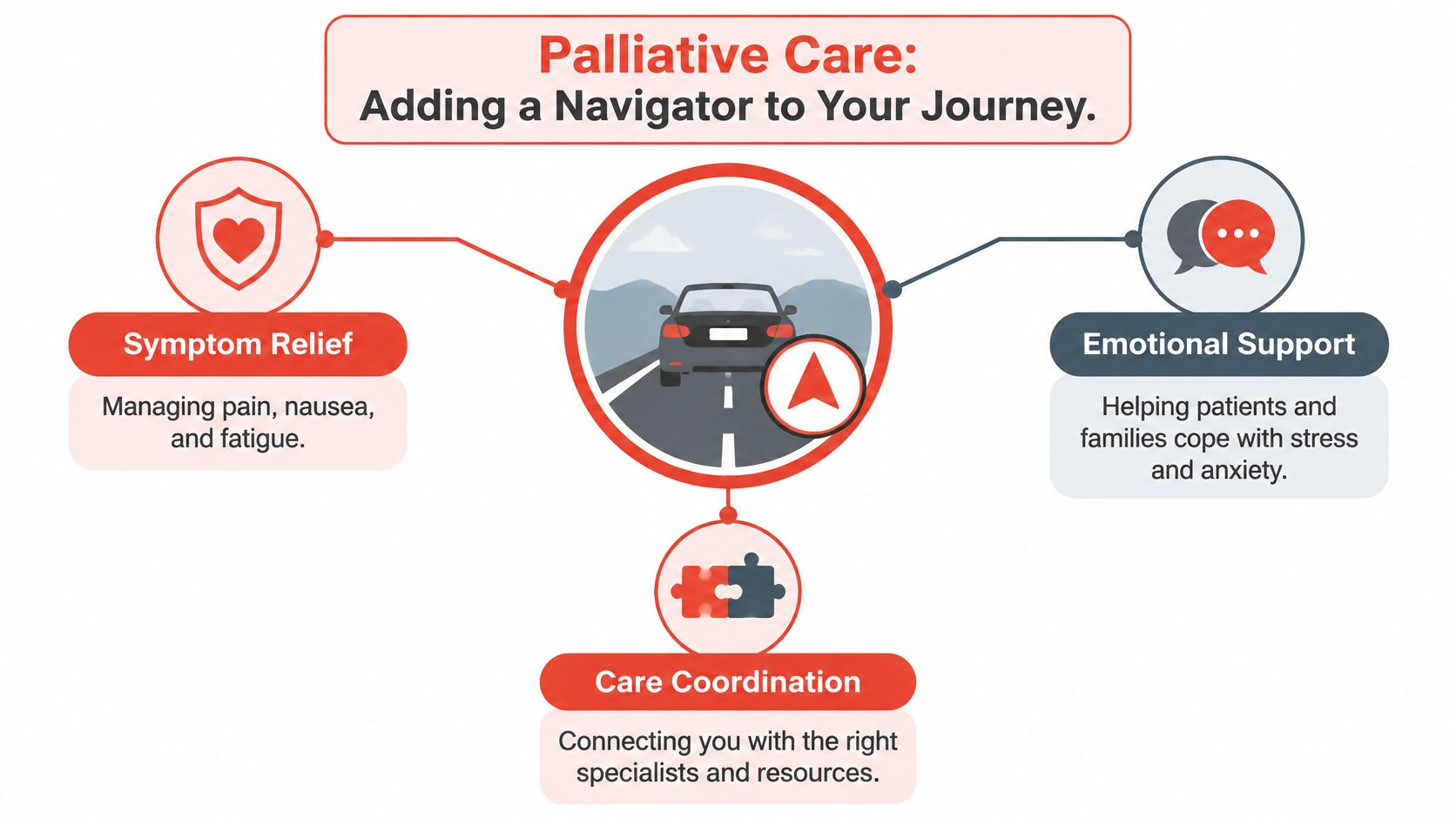
Think of palliative care as adding a navigator to a car that's already on the road. The patient keeps working with clinicians who treat the underlying illness. The palliative care team helps the patient and family manage the journey, address problems along the way, and keep care connected to what matters most.
What the added support can include
First, the team listens to what's difficult. A patient might describe pain, nausea, fatigue, or worry about being alone when symptoms change. A clinician can assess the concern, discuss it with the patient's existing providers, and help coordinate next steps. Patients and families can raise symptoms and questions, while the treating clinicians determine what changes to care are appropriate.
Next, the team looks at medicines and routines. A medication review can help the patient and clinician discuss what each medicine is for, whether instructions are clear, and whether the current plan is manageable. Families can bring every medication bottle and written instruction to the conversation rather than trying to remember the details.
Care also includes conversations about goals and preferences. A patient might want to keep pursuing treatment but avoid an unnecessary trip to the hospital if symptoms can be assessed another way. These discussions don't force a decision. They give the care team useful context for planning and communication.
Caregivers are part of the picture, too. They may need help understanding who to contact, what changes to report, or how to find practical support. The navigator analogy fits because the work is about helping people make sense of options, not taking the steering wheel away from the patient.
A useful way to describe it: Palliative care supports comfort, communication, and coordination while a person receives care for serious illness.
Families looking for a plain-language introduction to care at home can also explore palliative home care services as a resource for understanding how supportive care may be organized outside a hospital.
Palliative Care vs Hospice Without the Confusion
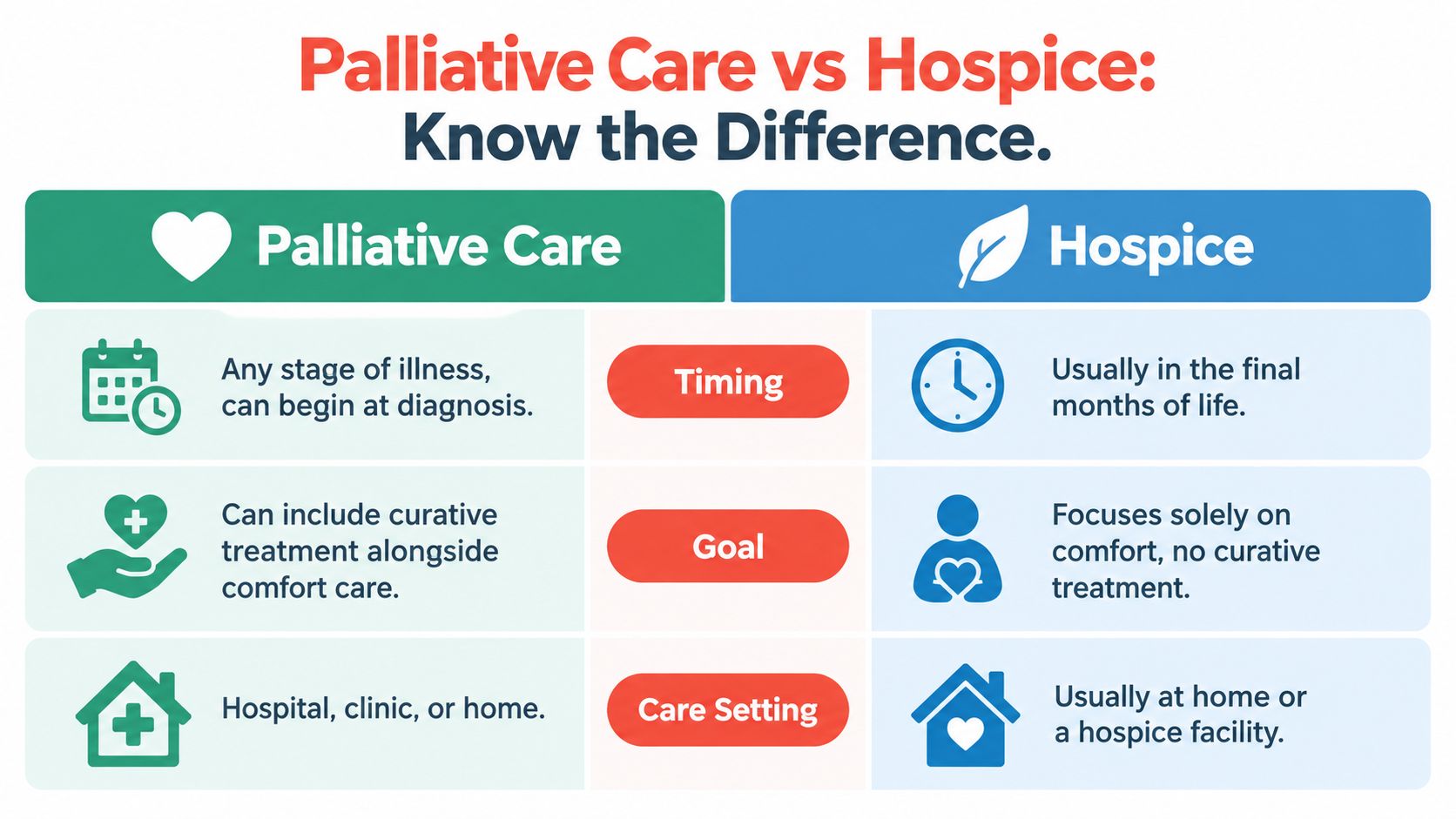
The simplest distinction is timing and treatment goals. Palliative care can be available at any stage of serious illness and can accompany treatment intended to slow or treat the illness. Hospice is generally for people whose care is focused primarily on comfort near the end of life, after a doctor certifies a limited prognosis. The exact hospice rules and coverage details depend on the applicable program and a patient's circumstances.
| Dimension | Palliative Care | Hospice |
|---|---|---|
| Timing | Can begin while a person is receiving treatment for serious illness | Generally considered when the focus shifts primarily to comfort near the end of life |
| Treatment goals | Can support comfort alongside disease-directed treatment | Centers care on comfort rather than curative treatment |
| Setting | May be provided in a hospital, clinic, or home, depending on the service | May be provided at home or in another hospice setting |
| Support | May include symptom assessment, communication, and care coordination | Provides a comfort-focused plan coordinated by the hospice team |
What the distinction means in practice
A person receiving chemotherapy, dialysis, cardiac care, or treatment for another serious condition can ask whether palliative support is appropriate without deciding to stop that treatment. The palliative team may focus on how the person is feeling, what support the family needs, and how to keep clinicians informed. Asking about palliative care is a request for support, not a declaration that treatment is over.
Hospice is a different care arrangement. It's generally considered when the patient's goals and medical situation meet the relevant eligibility requirements and the plan centers on comfort. Families who want to understand the decision process can read more about qualifying for hospice.
These are broad distinctions, not a substitute for a conversation with the patient's clinicians. Care options, services, and coverage can vary, so families can ask the treating team to explain what would apply in their particular situation. Understanding the difference can make it easier to ask a more practical next question: what happens during a palliative care visit at home?
What an In-Home Palliative Care Visit Looks Like

An in-home visit brings the conversation to the place where daily care happens. A clinician may arrive with a portable exam kit and the patient's chart prepared, then talk with the patient and family about the illness, current concerns, and the support already in place. For a house call practice, a visit may typically last 45 to 60 minutes, allowing time to understand the person's situation rather than focus only on a single symptom.
The clinician may ask what has changed since the last appointment, what symptoms are interfering with daily life, and what the patient hopes to manage better. A family member can share concerns, too, while the patient's own preferences remain central. The clinician may review medication bottles in the home and compare them with the patient's care information, raising questions for the relevant prescribers when needed.
The home is part of the assessment
At home, the clinician can see details that may be difficult to describe in an office. Stairs, bathroom access, lighting, and the route from the bedroom to the kitchen can all affect how safely a person moves through the day. The clinician may also discuss falls, daily activities, and the practical work of caregiving.
A visit can include a conversation about what matters most to the patient and how that can inform communication with other clinicians. The family might want to understand who to contact about a symptom, how follow-up will happen, or whether a referral or test should be discussed with the care team. The clinician can help coordinate next steps and explain what requires follow-up.
This video offers another view of in-home medical care and the way a clinician can meet patients in their living environment.
Before the clinician leaves, the family can clarify the next steps, including any referrals, tests, or follow-up arrangements. Phone-based communication may help the care team check progress between visits. This model can be especially useful for homebound seniors, people recently discharged from hospital, and people living with dementia who may feel more settled in familiar surroundings.
How Palliative Care Works With Other Care a Patient Already Receives
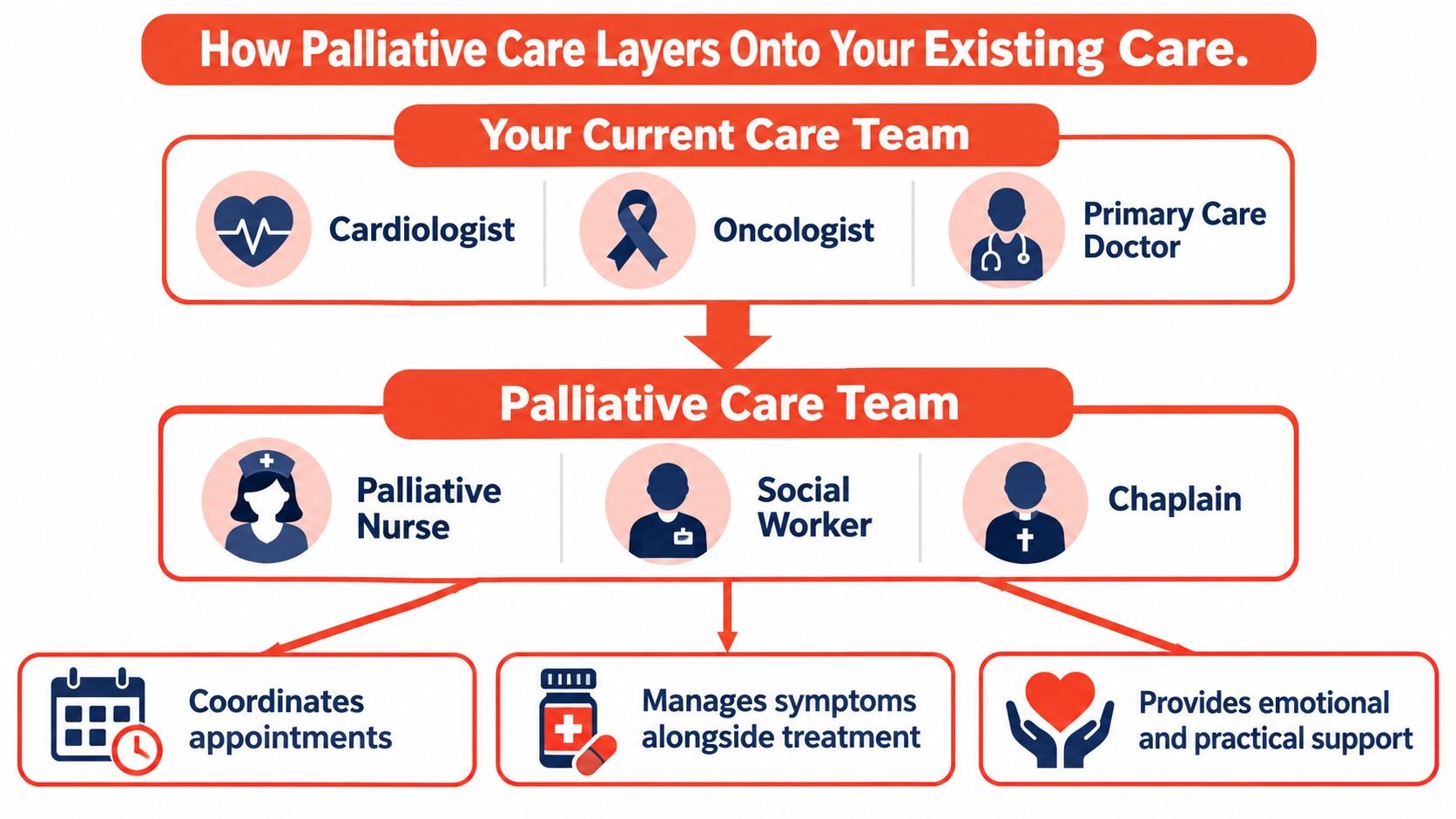
Palliative care is a coordinating role, not a competing medical team. A person with heart failure may continue seeing a cardiologist. Someone with COPD may continue using prescribed inhalers or oxygen. A person with diabetes can keep following the treatment plan created with their clinicians. Palliative support helps the patient and family discuss comfort, daily challenges, and coordination alongside that care.
Connecting care after a hospital stay
After discharge, a patient may have instructions from the hospital, medicines from several prescribers, and appointments with specialists. An in-home visit can give the patient and family a chance to review what they understand, identify questions, and coordinate with the clinicians involved. The care team can also discuss whether labs, diagnostics, or additional follow-up should be arranged.
The home setting can be useful for dementia care, too. A familiar environment may make it easier for a clinician to see how the patient manages everyday routines and for caregivers to describe what is becoming difficult. The family can ask for practical education and help communicating concerns to the patient's other clinicians.
A home-based primary care practice can coordinate with hospitals, specialists, and therapists already involved in a patient's care. That matters because families shouldn't have to act as the only messenger between every clinician. Care coordination may include clarifying who is following up on a question or making sure the patient's concerns reach the right provider.
Palliative care and treatment goals aren't the same thing. Families who want to explore that distinction further can read about palliative care and curative care. The useful question for a care team is how supportive care can fit around the patient's current treatment and responsibilities, rather than replace them.
Common Misconceptions That Keep Families From Asking
Myth: Palliative care means hospice.
Reality: Palliative care can be available alongside treatment for serious illness. Hospice is a separate option, generally associated with a shift toward comfort-focused care near the end of life.
Myth: Asking means giving up on treatment.
Reality: A family can ask about support while the patient continues disease-directed treatment. Palliative care may help the patient and care team address symptoms, communication, and practical needs.
Myth: It's only for people with cancer.
Reality: Serious illness can take many forms. The reason to ask is the person's needs, such as persistent symptoms, difficulty managing care, or strain on family caregivers, not a particular diagnosis alone.
Myth: A hospital referral is always required.
Reality: The pathway depends on local services and the patient's situation. A primary care clinician can help start a conversation about palliative support, and families can ask that clinician what referral options are available.
Why the first question can be hard
Families may worry that bringing up palliative care will alarm the patient or suggest a decision has already been made. That concern is understandable, especially when people have heard the term used only in connection with hospice. A simple way to begin is to describe the difficulty at hand: symptoms that are disrupting daily life, uncertainty after discharge, or a caregiver who needs more help coordinating care.
The point of asking is to understand options. Patients and families can raise questions, explain what matters to them, and ask clinicians to clarify how different services might fit. A conversation doesn't commit anyone to a particular treatment plan.
How Life Primary Care Delivers In-Home Palliative Services in New Jersey
Life Primary Care is a house call primary care practice serving patients in Morris, Essex, Union, Somerset, Passaic, and Bergen counties. There is no clinic or waiting room; patient care happens at home. The practice provides in-home palliative support alongside primary care, chronic disease management, and other services.
A clinician arrives with a portable exam kit and the patient's chart prepared. Because the practice already functions as the patient's primary care home, palliative support can be folded into a routine visit rather than arranged as a separate referral. During that visit, the clinician can assess symptoms, review medications, and talk with the family about how comfort-focused care might fit with treatment the patient already receives from existing specialists.
Scheduling and follow-up
The coordination office in East Hanover handles scheduling, insurance verification, and follow-up. Medicare and most major insurers are accepted, with no travel fee, concierge fee, or membership charge, according to the practice. New patients are generally scheduled within a few business days. Established patients can often receive same-day urgent visits for non-emergency problems, with the office triaging calls to decide whether a home visit or phone guidance fits the situation.
The clinician can communicate results and care plans by phone, and arrange referrals, labs, and the next visit before leaving. The practice is independent of hospital systems, so it can coordinate with the hospital or specialists already involved in the patient's care.
Families searching for a visiting doctor or house-call physician in New Jersey can ask the same practical questions: whether the provider coordinates with current clinicians, how urgent needs are handled between visits, and how services fit the care plan.
When to Consider Asking About Palliative Care and What to Look For
Progressive symptoms, repeated hospital visits, caregiver strain, confusion about medicines after discharge, or a new serious diagnosis can all be reasons to ask about palliative care. They're reasons to start a conversation, not proof that a crisis is inevitable. Families can also ask how Medicare may cover palliative care, since coverage depends on the service and the patient's plan.
When comparing an in-home provider, look for:
- Home visits that meet the patient where they live.
- Coordination with existing specialists and primary care clinicians.
- Clear insurance information before care begins.
- Accessible scheduling for new and established patients.
- Phone follow-up so questions and next steps don't get lost between visits.
Palliative care is a practical layer of support that families can ask about early. A clinician who knows the patient's situation can explain which services may fit and how they can work alongside ongoing treatment.
Life Primary Care brings primary care and palliative support to patients at home, with coordination for existing clinicians and follow-up. If your family is trying to make care more manageable, contact Life Primary Care to ask whether an in-home visit may fit your needs.
Ready for a visit at home?
Call and speak with a real person. We will confirm your insurance, find a time and come to you.
973-607-4911 Call now