
Guide · 13 min read
Palliative Care Covered by Medicare What It Includes

Your mother is sitting in her living room after a hospital stay. Her pain is better some days and worse on others. She still wants treatment for her heart or lung condition, but getting to a clinic has become exhausting. As you sort through medication bottles and discharge papers, one question keeps coming up: Is palliative care covered by Medicare, and will someone come to the house?
The answer depends on which Medicare payment path applies. Before hospice, comfort-focused care is usually billed as medically necessary care under ordinary Medicare Part A or Part B rules. After a hospice election, services related to the terminal illness move into the Medicare hospice benefit, where the hospice provider coordinates and pays for a bundled package of support.
That distinction explains why online answers can feel incomplete. Palliative care and hospice share a focus on comfort, but they aren't the same clinical service or insurance pathway. The practical details also matter for families in New Jersey comparing Visiting physicians NJ, At-Home Doctor Visits, home health, specialists, and hospice. The sections below separate the rules, explain what may happen at home, and identify questions to ask before a visit or service begins.
Table of Contents
- Introduction to Palliative Care and Medicare Coverage Questions
- What Palliative Care Means and How It Differs From Hospice
- How Medicare Pays for Palliative Care Before Hospice Election
- What the Medicare Hospice Benefit Covers and What It Does Not
- Palliative Care at Home and How House Call Visits Fit Medicare Rules
- Documentation Certification and Billing Basics Families Should Understand
- Practical Next Steps to Get Covered Palliative Support at Home
Introduction to Palliative Care and Medicare Coverage Questions
A serious illness can turn ordinary tasks into daily obstacles. Someone with cancer may need help managing pain or nausea. A person with COPD may struggle with breathlessness and organizing medicines. With heart failure, symptom checks and communication among several clinicians may matter as much as the diagnosis itself. Palliative care addresses these concerns while disease-directed treatment continues.
Medicare does not use one nationwide benefit called “palliative care” for every setting. Coverage usually follows four practical questions: What service is being provided? Why is it medically necessary? Which clinician is providing it? Has the patient elected hospice? Non-hospice palliative support is generally assembled from covered Part A or Part B services, while Medicare hospice coverage rules apply after hospice election.
The practical question is not only “Is palliative care covered?” It is “Which service is being provided, who is billing Medicare, and has hospice been elected?”
Two patients can have the same symptom and different billing paths. Before hospice, a physician may evaluate and manage pain under ordinary Part B rules when the service meets Medicare's medical-necessity requirements. After hospice election, pain connected to the terminal illness falls under the hospice plan. The hospice provider coordinates the related care, medicines, equipment, and support.
For a New Jersey family, the distinction can affect whether a home visit is billed as an ordinary medically necessary clinician service or handled through a hospice arrangement. A house call may be appropriate when limited mobility, oxygen use, dementia, or transportation problems make an office visit impractical. The location alone does not decide the payment path. The clinician must select the applicable service category and record why care was needed in the home.
Families should ask before scheduling: Is this palliative service covered under ordinary Part A or Part B rules, or is hospice involved? Who will submit the claim? Could deductibles, coinsurance, authorization rules, or plan requirements apply? The care team and insurance plan must confirm coverage, medical necessity, and cost-sharing for the specific service.
What Palliative Care Means and How It Differs From Hospice
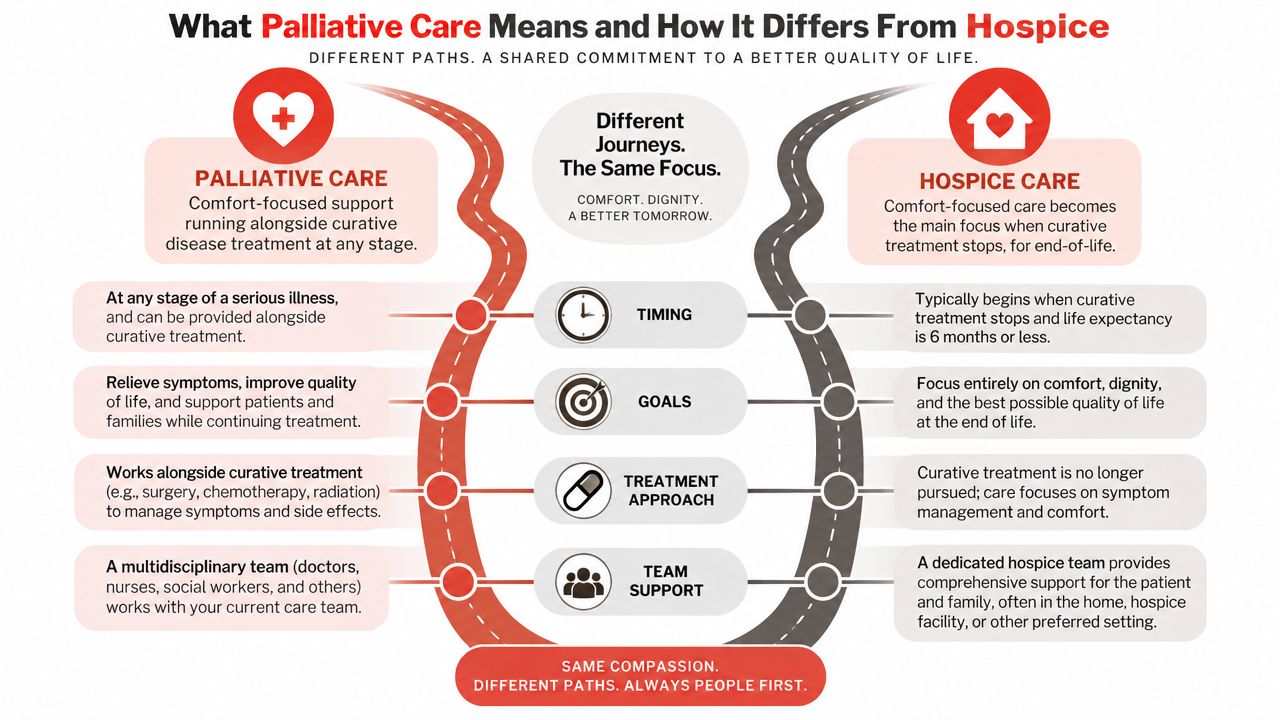
Palliative care supports comfort and daily function during serious illness. It can begin while treatment continues. A person may still see an oncologist, cardiologist, pulmonologist, or primary care clinician, while a palliative team helps address pain, fatigue, shortness of breath, anxiety, medication problems, and caregiver strain.
Hospice follows a different care and payment path. It applies when a beneficiary has a terminal illness, a physician certifies a life expectancy of 6 months or less if the illness follows its normal course, and the beneficiary elects comfort-focused care for that terminal condition. The hospice benefit includes services such as pain relief, nursing, supportive medical and social services, physical therapy, and symptom management, as described in Medicare hospice coverage.
Two comfort-focused paths
The clearest comparison is whether disease-directed treatment continues:
- Palliative care: Comfort support runs alongside treatment. The patient may continue care intended to control or treat the serious illness.
- Hospice: Comfort becomes the central plan for the terminal condition. After hospice election, Medicare does not pay for curative treatment of that terminal condition through the regular payment route.
Choosing hospice is not the same as giving up. It changes the care plan, team responsibilities, and billing arrangement. A hospice team may provide nursing, physician services, counseling, symptom-management drugs, equipment, aide support, and other services connected to the terminal illness.
Palliative care can take place in an office, through a specialist visit or telehealth, in a hospital, or during a house call. The setting is only one part of the coverage question. The service provided, the provider submitting the claim, and whether hospice has been elected determine which payment path applies.
Families can review this guide to the difference between hospice and palliative care for a fuller comparison. The practical distinction is simple: palliative care describes a comfort-focused approach, while hospice is a defined Medicare benefit with eligibility, election, and billing rules.
How Medicare Pays for Palliative Care Before Hospice Election
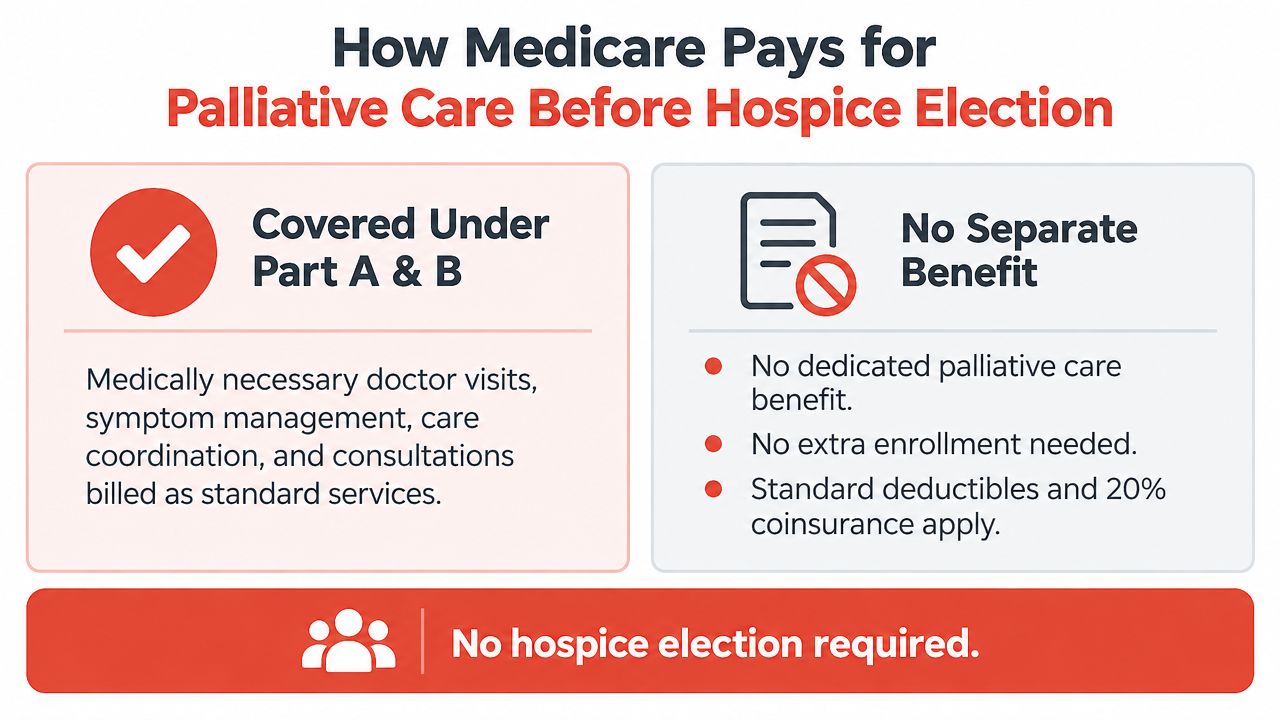
A patient in New Jersey may receive a home visit to ease pain, review medications, or plan care while continuing treatment for the underlying illness. Before hospice election, Medicare usually pays for each service through its ordinary coverage rules, rather than through one separate palliative-care benefit.
A medically necessary physician visit, symptom evaluation, care-coordination service, consultation, or diagnostic service may be billed under the applicable Part A or Part B rules. The word “palliative” describes the goal of care, such as better comfort and function. It does not determine the claim category by itself.
The bill may therefore identify a primary care visit, specialist service, home visit, outpatient service, medication, laboratory service, or another covered benefit. The provider's documentation must support the service, and the patient's Medicare arrangement determines how the claim is processed.
Before and after in plain language
| Coverage Feature | Before Hospice Election | After Hospice Election |
|---|---|---|
| Main payment route | Ordinary Medicare Part A or Part B rules, based on the service | Medicare hospice benefit under Part A |
| Care focus | Comfort may accompany disease-directed treatment | Comfort-focused care is elected for the terminal illness |
| Billing responsibility | The applicable physician, facility, pharmacy, or service provider bills Medicare or the plan | The hospice provider coordinates and pays for services related to the terminal illness |
| Patient cost exposure | Standard deductibles, coinsurance, and service-specific rules may apply | No hospice deductible, with small coinsurance possible for drugs and inpatient respite care |
| Home support | Depends on the covered service, medical necessity, provider, and setting | Hospice plan may include nursing, equipment, drugs for symptom management, counseling, and related support |
| Enrollment decision | No hospice election is required | The beneficiary must elect hospice after the required certification |
The same comfort-focused service can produce different answers for different patients. One person may have Original Medicare, another Medicare Advantage, and another may already have elected hospice. The clinician's service, the billing provider, the care setting, and any plan authorization can all affect payment.
For someone who is not hospice-eligible or who continues disease-directed treatment, coverage may involve Part B physician services, prescription coverage, durable medical equipment rules, or home health requirements. Medicare Advantage plans may apply network and authorization rules or offer supplemental benefits. Before care begins, ask both the provider and the plan to identify the benefit category and expected cost-sharing.
Home-based care follows the same principle. A house call is not automatically hospice, and calling a visit “palliative” does not make every part of it covered. Ask for the billing category: “Will this be billed as a medically necessary home visit, home health, outpatient care, or hospice?” That answer is usually clearer than asking whether Medicare covers palliative care in general.
What the Medicare Hospice Benefit Covers and What It Does Not
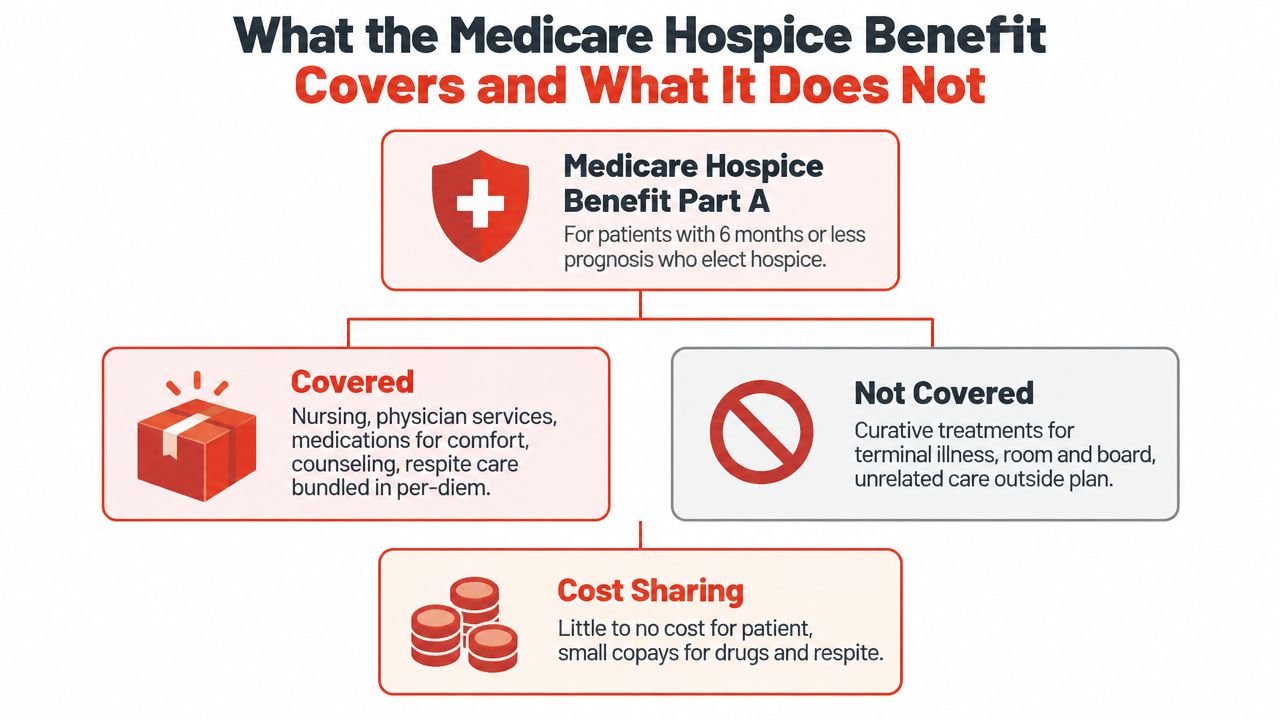
For a New Jersey family, hospice changes the Medicare payment path. A beneficiary must have a terminal illness, receive the required certification, and elect comfort-focused hospice care. After that election, Medicare hospice generally pays for care related to the terminal illness. The beneficiary gives up Medicare payment for curative treatment of that condition, although treatment for unrelated conditions can follow other Medicare rules.
Hospice works like a coordinated package rather than a series of separate ordinary Part A and Part B claims. The benefit can include pain and symptom relief, nursing and physician services, social services, symptom-management drugs, durable medical equipment, aide and homemaker help, and counseling. Inpatient respite care may also be arranged through the hospice benefit.
What families should expect
Once hospice is elected, the hospice organization generally coordinates services tied to the terminal illness. Its team organizes symptom control, comfort-related medications, nursing support, equipment, and communication with other clinicians. That coordination helps families know which organization to call when needs change.
Hospice has a different cost structure from ordinary Part B care. The beneficiary pays no deductible for hospice, although small coinsurance may apply to drugs and inpatient respite care (Medicare hospice benefit publication). Part B services can involve deductibles and coinsurance based on the service and the patient's coverage.
Room and board often creates confusion. Medicare hospice generally does not pay for room and board when hospice is provided at home or in a nursing facility. Families may still need to arrange housing, custodial care, personal assistance, and other services outside the hospice package.
Hospice also differs from Medicare home health. Home health is narrower, tied to skilled intermittent care ordered by a physician for a homebound patient. It may cover skilled nursing, therapy, and certain aide services, while hospice can organize a wider comfort-focused package, including respite care and bereavement counseling. Families reviewing eligibility can read this guide to qualifying for hospice and discuss the choice with treating clinicians and a hospice organization.
Palliative Care at Home and How House Call Visits Fit Medicare Rules
A patient recovering from a hospital stay may be too weak to travel, yet still want treatment for the underlying illness. A house-call clinician can provide comfort-focused primary care at home while the patient remains outside hospice. The visit may include symptom review, an examination, medication reconciliation, chronic-condition monitoring, review of hospital instructions, coordination of laboratory or diagnostic services, and communication with specialists. These services can support palliative goals through ordinary medically necessary Medicare care.

The home can also show details a clinic visit misses. The clinician may observe how the patient moves between rooms, where medications are kept, whether oxygen equipment is positioned safely, and which caregiver manages the daily schedule. Those observations can guide coordination, but Medicare coverage still depends on the service, medical necessity, and supporting documentation.
Why documentation matters
For physician house calls, Medicare home-visit CPT codes 99341–99350 apply to medically necessary home visits. The clinician must document why the patient needed a home visit instead of an office or outpatient appointment, as explained in this house-call billing guidance. These codes do not use the same homebound requirement as Medicare home health.
That difference affects families in New Jersey and elsewhere. A senior may be unable to travel safely or reasonably because of limited mobility, weakness, cognitive impairment, oxygen needs, or lack of transportation, while still not qualifying for the separate home health benefit. A physician home visit and a skilled home health episode follow different Medicare payment paths.
Medicare also covers a yearly Wellness visit once every 12 months, according to the official Medicare Wellness visit rule. It is a preventive visit, not a standard physical examination. A home-based practice may use it for prevention planning, while medically necessary problems are billed under the rules that apply to those services.
Families can review what to expect from palliative care at home before the appointment. The Carevo Home Health Care palliative support resource offers further background for conversations with the care team.
A short educational video can help families visualize home-based conversations:
Documentation Certification and Billing Basics Families Should Understand
Coverage decisions begin with documentation. For non-hospice care, the clinician records the patient's condition, symptoms, examination findings, treatment plan, and why the service was medically necessary. For a home visit, the record must also explain why care was provided at home rather than in an office or outpatient setting.
Hospice adds formal certification and a change in financial responsibility. The hospice physician and the attending physician, if the patient has one, must certify that the patient is expected to live 6 months or less if the illness runs its normal course. After election, hospice assumes responsibility for services related to the terminal illness and related conditions.
Related and unrelated care
The phrase “related to the terminal illness” carries practical importance. Pain medication, nursing, equipment, and symptom management connected to the terminal condition generally belong in the hospice plan. A separate medical issue not related to the terminal illness may follow another Medicare pathway, but the family should ask the hospice team and provider to clarify who is responsible before arranging care.
Medicare Advantage can add confusion. Once an enrollee elects hospice, hospice care remains covered by Original Medicare rather than the Medicare Advantage plan. The MA plan may still matter for care unrelated to the terminal illness, so coordination between the hospice, plan, and other clinicians remains important.
The benefit has also changed over time. Congress created Medicare's hospice benefit in August 1982 under TEFRA. Early versions used three benefit periods with a 210-day lifetime cap. Congress later removed that cap effective January 1, 1990, replacing it with two 90-day periods followed by an unlimited 30-day period (Medicare hospice legislative history). The history helps explain why hospice evolved into a recognized Medicare pathway for comfort-focused end-of-life care.
Before signing paperwork or starting services, ask:
- Medical necessity: What condition and symptoms support this service?
- Billing route: Is the provider billing Part A, Part B, Medicare Advantage, home health, or hospice?
- Cost-sharing: Could a deductible, coinsurance, drug copay, or respite copay apply?
- Certification: If hospice is being discussed, who will complete the required certifications?
- Equipment and medications: Which organization supplies and pays for them?
Families arranging mobility equipment may also find it useful to review this mobility insurance policy page, while confirming coverage directly with Medicare, the plan, and the treating provider.
Practical Next Steps to Get Covered Palliative Support at Home
Start with a short description of the problem rather than an insurance label. Tell the primary care clinician what has changed, such as worsening pain, medication confusion, breathlessness, repeated hospital visits, difficulty traveling, or caregiver strain. Ask whether home-based palliative support can run alongside current treatment, and ask whether hospice eligibility should be evaluated.
Then collect the information a home-care practice will need:
- Prepare the medication list. Include prescription drugs, over-the-counter products, inhalers, supplements, and medications from every specialist.
- Gather recent records. Keep discharge instructions, specialist notes, imaging reports, laboratory results, and the names of treating clinicians available.
- Describe the home situation. Note mobility barriers, stairs, oxygen use, caregiver availability, assisted living arrangements, and the patient's ability to reach an office.
- Verify the benefit. Ask whether the planned visit is a medically necessary house call, a Wellness visit, home health, or hospice, and ask what cost-sharing may apply.
- Coordinate communication. Confirm who will update the hospital, specialists, pharmacy, and family members.
For families comparing Visiting Doctors NJ, Dr House calls NJ, Doctor house calls NJ, House calls for seniors, In Home Doctor for Elderly, in-home medical care, Visiting Docs, Doctor home visits for elderly, or Doctor House Calls for Seniors, the important comparison is not the phrase used in marketing. Ask whether clinicians provide primary care at home, accept the patient's insurance, document medical necessity, coordinate diagnostics, review medications, and communicate with the existing care team.
Life Primary Care provides primary care exclusively in patients' homes across Morris, Essex, Union, Somerset, Passaic, and Bergen counties. The practice states that it accepts Medicare and most major insurers and doesn't charge travel, concierge, or membership fees, but families should still verify the specific service and coverage before scheduling.
Life Primary Care offers in-home primary care, chronic disease management, medication reviews, Wellness visits, diagnostics, and palliative support for patients who need comfort-focused care alongside ongoing treatment. Visit Life Primary Care to request an evaluation, confirm service availability in your New Jersey county, and discuss how Medicare or your health plan may handle the visit.
Ready for a visit at home?
Call and speak with a real person. We will confirm your insurance, find a time and come to you.
973-607-4911 Call now