
Guide · 17 min read
Palliative Care vs Curative Care: A Practical Guide
When a parent is declining at home, most families don't ask for a philosophy lesson. They ask a much tighter question. Should we keep pushing treatment, or should we make life easier now?
That question often lands at the kitchen table after a discharge, a bad scan, a rough night of breathing, or a week when getting to the bathroom suddenly looks harder than getting to the specialist. In those moments, palliative care vs curative care sounds like a fork in the road. In real practice, it often isn't.
The more useful question is whether both can run together, and if so, what that looks like in an actual home. CMS is clear that palliative care can be provided at any stage of disease and can accompany care from diagnosis onward. For homebound older adults, that distinction matters because the decision rarely happens in a hospital conference room. It happens next to the pillbox, the walker, the recliner, and the calendar with missed appointments circled in pen.
Table of Contents
- Two Families, Two Decisions
- What Each Type of Care Actually Does
- Five Criteria That Set Them Apart
- Real Situations and How They Unfold
- Bringing Both Care Types Into the Home
- When Families Wait Too Long to Ask
- Your Next Conversation With the Clinician
Two Families, Two Decisions
One daughter is standing at the counter with discharge papers spread out beside a half-finished cup of coffee. Her father had been getting cancer treatment, then had a stroke, then lost ground in rehab. She wants to know if another round of chemotherapy still makes sense. Not because she doesn't understand that he's weaker now, but because stopping feels like quitting on him.
A few miles away, a son is watching his mother with advanced COPD sleep upright again. The hospital helped each time she got fluid overloaded or couldn't catch her breath, but each trip took something out of her. This time she says she wants to stay home if she can. He hears that and worries he's agreeing to less care.

The Trade-Offs Families Actually Weigh
These conversations aren't abstract. They sound like this:
- Another hospital trip or a full weekend at home: A family may be choosing between more testing and preserving enough energy for a birthday dinner with grandchildren.
- More IV diuretics or sleeping in her own bed: Treatment may help symptoms, but the logistics and fatigue can be heavy.
- One more disease-directed treatment or fewer side effects: Some treatments may still fit the patient's goals. Others no longer earn the burden they bring.
In both homes, the family is asking the same thing. Are we still trying to reverse this, or are we trying to live as well as possible with it?
The hardest part usually isn't choosing between care types. It's saying out loud that the goal of care may have changed.
Why This Question Shows Up So Often
Palliative care isn't a niche service. The World Health Organization estimates that 56.8 million people need palliative care each year, including 25.7 million in the last year of life, yet only about 14% currently receive it, according to the WHO palliative care fact sheet. That gap shows up in homes long before it shows up in policy.
Families often arrive at this question late, after they've already been carrying both burdens alone. They are managing symptoms at home while still trying to keep up with specialist visits, medication changes, and tests meant to control the disease. The rest of the discussion gets easier once those two lanes are named clearly.
What Each Type of Care Actually Does
The cleanest way to separate these two is by intent.
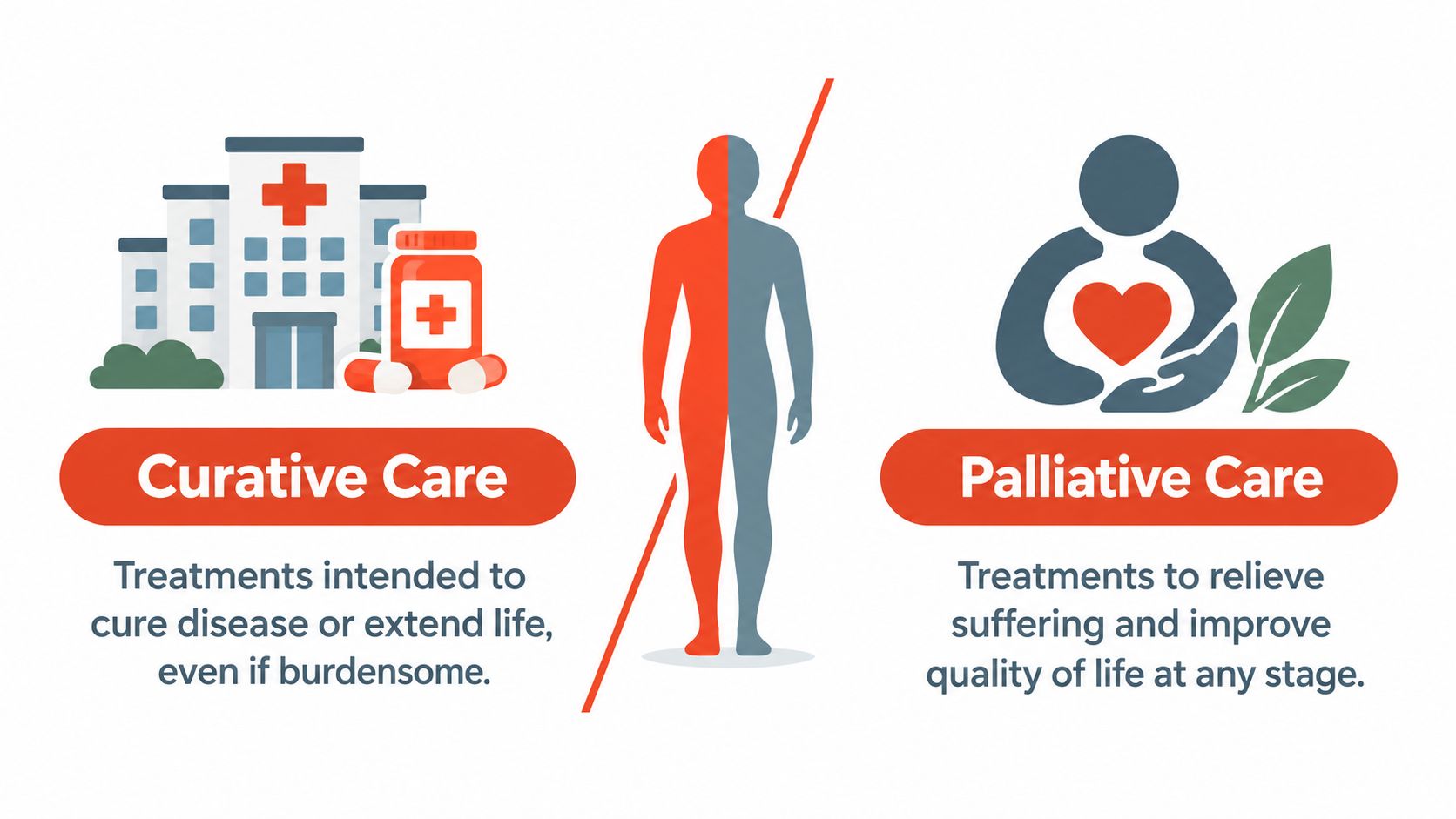
Curative care is treatment whose main goal is to reverse, eliminate, or stop the disease. Palliative care is treatment whose main goal is to relieve symptoms, reduce stress, and support daily life with serious illness.
Curative Care Means the Disease Is the Main Target
If the primary question is, "How do we control the illness?" you're in the curative lane.
That can include chemotherapy, dialysis, valve procedures, antibiotics for pneumonia, or other treatment aimed at changing the course of the disease itself. In the home, a curative-focused visit might involve reviewing new medications after a fresh diagnosis, checking whether the patient can safely follow a specialist's plan, and making sure the treatment is being carried out as intended.
A simple example: a clinician comes after a hospital stay for a pulmonary embolism and reviews the blood thinner, bleeding precautions, follow-up labs, and warning signs. The visit is happening at home, but the intent is still disease-directed.
Palliative Care Means the Person's Burden Is the Main Target
If the primary question is, "How do we make this easier to live with?" you're in the palliative lane.
CMS describes palliative care as care that focuses on relieving suffering and addressing physical, mental, social, and spiritual well-being rather than trying to cure the underlying illness, and notes it may start at any stage of disease, as outlined in this CMS overview of palliative care. In practice, that includes pain relief, treatment for breathlessness, nausea control, bowel support, sleep support, family meetings, and advance care planning.
A home example is just as concrete: the clinician notices a patient stopped walking to the bathroom after a fall because she's afraid of another one. Coaching on safer transfers, adjusting the bowel regimen because pain medicine caused constipation, and setting up a bedside commode is palliative care. No one is curing the underlying illness in that moment. They are reducing suffering and preserving function.
Both Can Happen on the Same Afternoon
Palliative care is not hospice. It is not surrender. And it is not limited to the final days of life.
Practical rule: If a treatment helps control disease, it may still belong. If another treatment relieves suffering, it may belong too. The patient doesn't have to earn comfort by running out of options first.
For family caregivers and aides who want a better foundation in this language, a short palliative care course for care workers can help make these conversations less confusing.
Five Criteria That Set Them Apart
Most families don't need more vocabulary. They need a way to compare the two care types without getting lost in jargon. This side-by-side tends to help.
Five Criteria That Set Palliative and Curative Care Apart
| Criterion | Curative Care | Palliative Care |
|---|---|---|
| Primary goal | Reverse disease, eliminate it, or slow its progression. Ask: "What is this treatment trying to change in the disease?" | Relieve symptom burden and reduce stress. Ask: "What is this doing to make daily life easier?" |
| Target patient | Anyone whose treatment plan is still centered on controlling illness. | Anyone with a serious illness who has symptoms, stress, or difficult decisions. Ask: "Are we overlooking support because we're assuming this only applies at the end?" |
| Timing relative to diagnosis | Usually starts early because disease treatment begins quickly. | Often delayed by mistake, even though it can fit at any stage. Ask: "Why are we waiting to address symptoms and family strain now?" |
| Treatment menu | Chemotherapy, antibiotics, procedures, dialysis, rehab, and specialist-directed plans meant to change disease course. | Pain control, oxygen support for breathlessness, nausea treatment, bowel regimens, sleep support, counseling, and goals-of-care work. Some supports like rehab, nutrition, and counseling can overlap. Ask: "Which parts of this plan are for the disease, and which are for comfort?" |
| Measure of success | Scans, lab trends, blood pressure targets, infection control, and other disease markers. | Better comfort, steadier function at home, less distress, and fewer crisis-driven decisions. Ask: "What would tell us this plan is helping in the home, not just on paper?" |
The Row Families Misread Most Often
The most common mistake is timing.
People assume palliative care is a last resort. That's exactly where many families lose ground. A patient may still be seeing oncology, cardiology, pulmonology, or nephrology and still need serious symptom support at home. Those aren't competing ideas.
Existing public material often leaves families unsure whether they can ask for both at once. Yet clinician guidance says they can. That gap matters because treatment goals often slide from cure, to control, to comfort without a clean handoff.
Why the Timing Problem Matters at Home
Recent trend data cited in a patient decision aid show palliative care use rose from 21% in 2014 to 35% in 2019, while roughly one-quarter of the sample received any palliative care in the last six months of life, according to this patient decision aid summary. In plain terms, use has grown, but many people still get support late.
For a homebound older adult, late support usually means symptoms have already piled up, the caregiver is already stretched thin, and the family is making decisions in crisis mode instead of ahead of it.
Real Situations and How They Unfold
Families rarely face a clean fork in the road. In the home, these plans usually overlap for a while. Disease treatment continues, symptoms still need attention, and the daily question becomes practical. What helps this person function better in the house they live in now?
Cancer Care While Treatment Continues
A 72-year-old with stage III colon cancer wants to keep going with chemotherapy. He also has predictable nausea after infusions, poor sleep before scan days, and a wife who can tell you exactly which evenings he stops eating.
That situation does not call for a debate about hope versus comfort. It calls for a plan that respects both. On a home visit, the first job is to map the week as it happens. Which day is the worst after treatment? What medications get skipped because they upset his stomach? Is he drinking enough? Is the family calling the oncologist early enough, or waiting until the misery is already full-blown?
Curative care stays aimed at the cancer. Palliative care works on the cost of getting through treatment.
Over the next several weeks, the work is concrete. The anti-nausea plan may need to be easier to follow. Meals may need to shift to smaller portions at better times of day. Sleep may need its own treatment plan instead of being written off as part of cancer care. Then the harder question comes into view. Is treatment still giving him enough to justify what it takes out of him at home?
Sometimes the answer is yes. Sometimes a family starts saying, "He still wants treatment, but not at any price." That is often the point where the two care tracks need a more honest reset.
Heart Failure When the Pattern Keeps Repeating
An 80-year-old with heart failure has been to the hospital twice in a few months. Her daughter notices she now sleeps upright in the recliner, leaves the walker untouched, and gets short of breath halfway to the bathroom.
A chart can show weight, labs, and medication doses. A home visit shows the sodium-heavy canned soups in the kitchen, the pill bottles from three specialists, the swollen feet that appear after a long day, and the fear that rises every time breathing gets worse at night.
In that setting, curative care and palliative care are not opponents. One tries to control the disease and prevent another flare. The other tries to make breathing, sleep, appetite, bowel habits, and day-to-day stamina more manageable while that treatment continues.
The trade-off becomes clearer with time. Some patients want every reasonable step to avoid another admission, even if it means more monitoring and medication changes. Others reach a point where the burden of chasing every possible intervention outweighs the benefit they feel. Families often describe that shift in plain language long before anyone uses formal terms. They say they want fewer ambulance rides, less panic, and more stable days at home.
That change in priorities should change the care plan.
Dementia When the Main Problem Isn't on the Medication List
A 77-year-old with moderate dementia is still taking the same blood thinner, cholesterol pill, and blood pressure medications he took years ago. His wife gives them on schedule because no one has recently stepped back and asked a harder question. Do these medicines still fit the life he is living now?
In dementia care, the gap between paper decisions and home reality can get wide. The medication list may look tidy. The actual problems may be wandering, poor sleep, resistance to bathing, trouble swallowing, weight loss, agitation at sundown, and a spouse who has not had a full night's sleep in months.
A home visit changes what gets noticed. Can he follow a one-step instruction? Does he know what the pills are for? Is he coughing with liquids? Is the caregiver spending the whole day trying to keep him safe? Those details often matter more than whether his long-term prevention plan still looks good on a specialist note.
Over time, palliative care in this setting often means reducing friction. Fewer pills. Simpler routines. Less arguing over treatments that create distress without much present-day benefit. Curative care may still have a role, but it usually narrows as function falls and supervision needs rise.
That is not giving up. It is choosing care that matches the person in front of you, not the version of him from five years ago.
Bringing Both Care Types Into the Home
Home-based care works best when the curative plan and the comfort plan are reviewed together, not in separate silos.
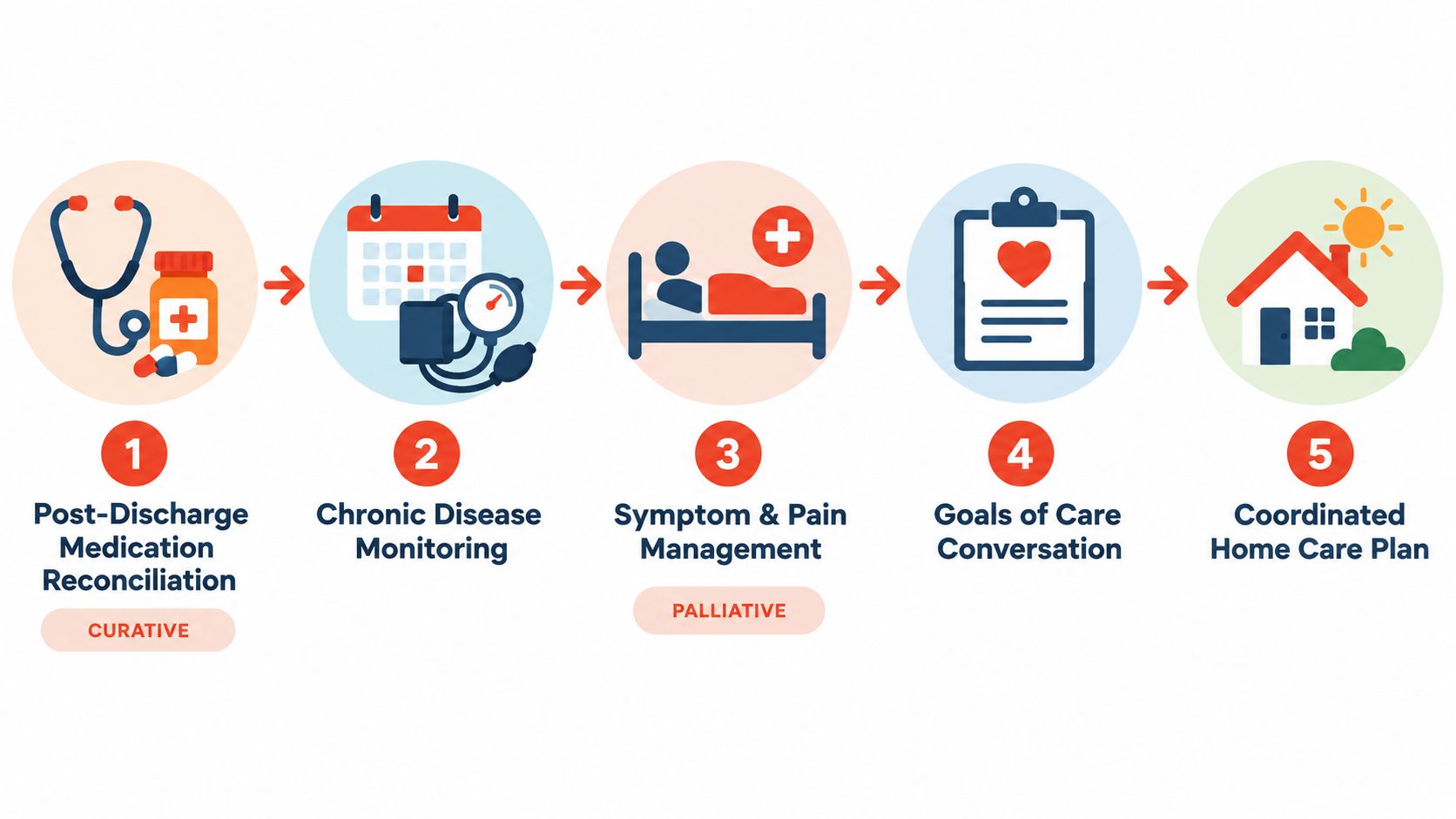
Start With the Medication Reconciliation
The first place these plans collide is the pillbox.
A patient gets discharged with one list from the hospital, another from the cardiologist, and refill bottles from older prescriptions that never got thrown away. In-home primary care can catch where a disease-directed medication is worsening dizziness, constipation, confusion, or low appetite, and where a comfort medication is being used in a way that creates new problems.
This is especially important after hospitalization. A post-discharge visit lets the clinician compare every bottle in the home against the current plan and ask a simple question about each one. Is this helping enough to justify the burden?
Use the Home to Guide the Goals Conversation
Goals-of-care conversations land differently in a living room than they do in a rushed exam room.
A patient sitting in the chair where she spends most of the day often says things more clearly. "I want to stay out of the hospital." "I still want treatment if it can keep me steady." "I don't want to be so groggy that I miss my family when they visit." Those statements are medically useful because they can shape what gets continued, what gets simplified, and what gets stopped.
One home-based option families in northern New Jersey may encounter is Life Primary Care's guide to palliative care at home, which describes how comfort-focused support can run alongside disease-directed treatment in a house-call setting.
Treat Symptoms in the Room Where They Happen
A home visit makes symptom management concrete.
- Pain: The clinician can ask where the pain hits during transfers, bathing, or lying flat, then match the plan to those moments.
- Breathlessness: Watching how far the patient walks from chair to bathroom tells you more than a brief office pulse check.
- Constipation and nausea: These are often medication-related and often underreported until someone asks directly.
- Anxiety and insomnia: Families frequently describe these as personality changes when they're really part of serious illness and treatment burden.
Here is a brief overview that captures how this layered approach works in practice.
Build One Team Around One Plan
The handoff matters as much as the visit.
A good home plan usually includes the primary clinician, the visiting nurse when ordered, a medical social worker when family strain or resource needs are high, a pharmacist when the medication list is unwieldy, and a chaplain if the patient wants spiritual support. What works is one shared plan with one clear point of contact. What fails is when the disease-directed plan and the symptom plan drift apart and the family is left to reconcile them alone.
When Families Wait Too Long to Ask
Most families don't delay because they don't care. They delay because they think palliative support means the doctors will stop treating.
That misunderstanding costs people time they don't get back. The warning signs are usually visible well before anyone names them. The second hospitalization in a short stretch. The first grandchild's event skipped because getting dressed, getting downstairs, and getting in the car feels like too much. The weight loss everyone notices but no one tracks out loud. The night a patient says, "I'm tired of this," and the room goes quiet.
What Usually Gets Lost in the Waiting
When comfort support is delayed, families often lose ground in several ways at once:
- Symptoms stay undertreated: Pain, breathlessness, nausea, constipation, and poor sleep get normalized instead of addressed.
- Caregivers burn out: A spouse or adult child keeps managing pills, meals, and transfers without anyone checking what that load is doing to them.
- Medication burden grows stale: Drugs that once made sense may no longer match the patient's goals or tolerance.
- Important conversations get postponed: The family avoids discussing what matters most until the next crisis forces it.
Ask for palliative support when the burden of the illness is rising, not only when treatment options are shrinking.
A Simple Prompt That Opens the Door
Families don't need perfect language to start this conversation. They need one sentence they can say.
Try this at the next visit: "We're still treating the illness, but we also need more help with comfort, function at home, and planning ahead. Can we address both?"
That prompt gives the clinician room to respond without forcing the family into an all-or-nothing choice. It also makes clear that you're not asking to stop care. You're asking to align it.
Why Earlier Access Still Matters
Need continues to outpace access globally. The historical shift has been toward earlier integration, not end-of-life-only use. WHO and the Worldwide Hospice Palliative Care Alliance reported a global need of 56,840,123 people per year, split into 31,100,719 non-decedents and 25,739,404 people in the last year of life, and found that palliative care was needed for 45.3% of all deaths in 2017, according to the Global Atlas of Palliative Care/csy/palliative-care/whpca_global_atlas_p5_digital_final.pdf?sfvrsn=1b54423a_3). A later Lancet Global Health analysis cited in that same source summary reported that global need rose 74% over three decades, reaching 73.5 million people in 2021.
Families don't need to memorize those figures. The practical takeaway is simpler. Waiting for a formal handoff usually means waiting too long.
Your Next Conversation With the Clinician
The next visit goes better when the family arrives with a decision map instead of a pile of fear.
Start with one question tonight: What matters most right now? Staying home longer. Keeping treatment going. Reducing pain. Thinking clearly enough to talk with family. Sleeping through the night. There isn't a universally correct answer. There is only the answer that fits this patient, in this home, at this point.
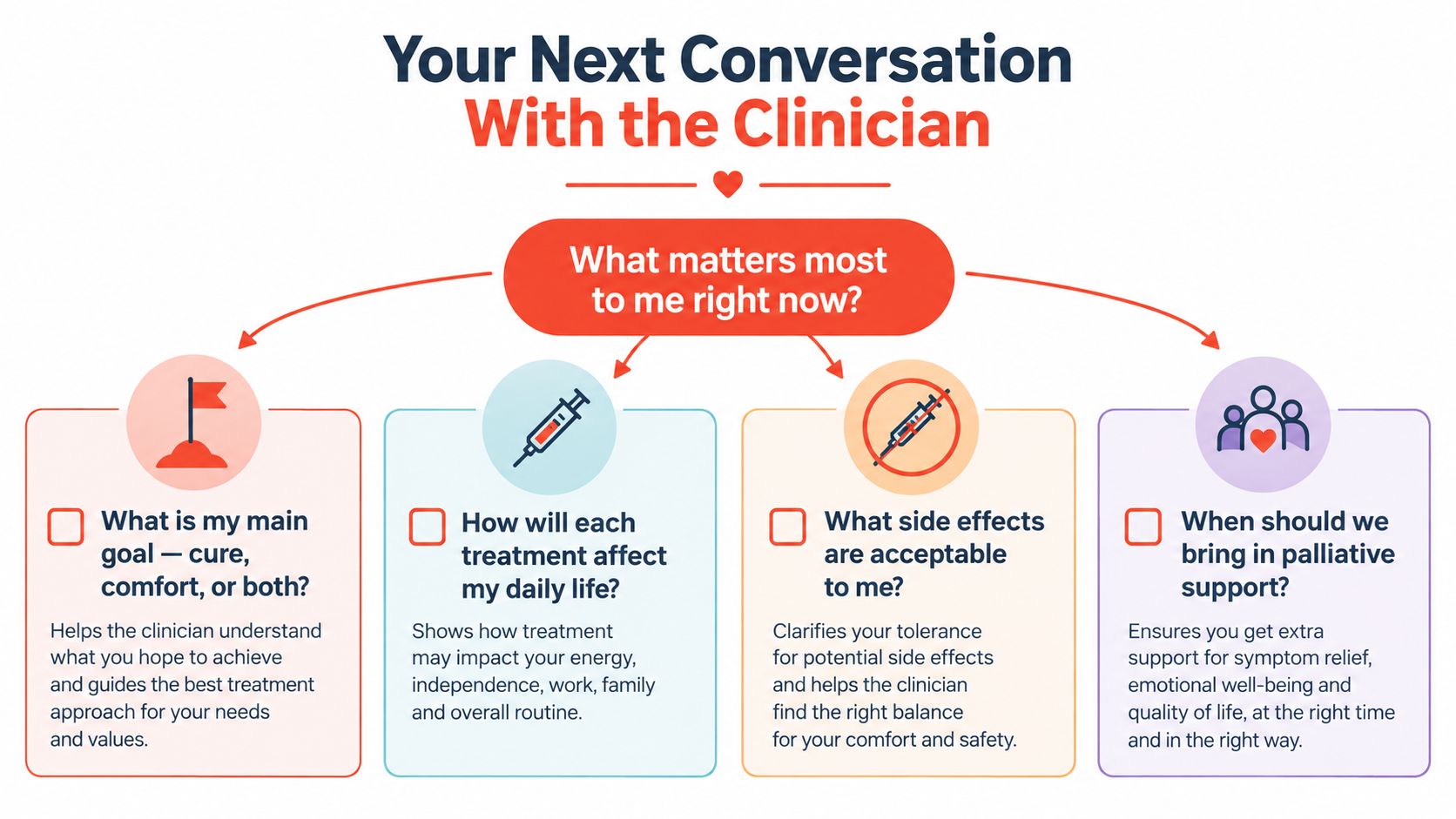
Four Questions Worth Bringing to the Visit
Write these down before the clinician arrives.
- Does the current disease-directed treatment still match the patient's goal? If the goal is more time, ask how the plan supports that. If the goal is steadier days at home, ask whether the current burden still makes sense.
- Which symptoms are outpacing the plan right now? Be specific. Pain during transfers, waking short of breath, no appetite after treatment, constipation, panic at bedtime.
- Who needs to be in the room for decisions to stick? Sometimes the patient speaks most freely alone. Sometimes the daughter who manages medications or the son out of state needs to hear the plan firsthand.
- What is a reasonable next sixty days? Not in abstract terms. In concrete ones. More appointments? Fewer ER trips? Better sleep? A simplified medication list? A family meeting?
Put the Answers in Plain Language
The most useful notes aren't technical. They sound like this:
"He still wants treatment, but not if it keeps him in bed all week."
Or this:
"She wants to stay home unless a hospital trip is likely to clearly help."
Families who want a broader framework for these talks may find this piece on shared decision making in healthcare helpful, especially when several relatives and multiple clinicians are involved. Coverage questions also come up quickly, so it helps to review what may apply in advance, including this guide on whether palliative care is covered by Medicare.
Naming the path matters more than whether the path is purely curative, purely palliative, or a mix of both. The clinician's job is to make that conversation easier, clearer, and more honest.
Life Primary Care provides house-call primary care across northern and central New Jersey for homebound adults who need this kind of conversation where it matters most, at home. That includes chronic disease management, post-discharge visits, medication review, and palliative support that can run alongside ongoing treatment when comfort and disease control both need attention. If that sounds like the situation you're managing now, visit Life Primary Care to see how home-based care works.
Ready for a visit at home?
Call and speak with a real person. We will confirm your insurance, find a time and come to you.
973-607-4911 Call now