
Guide · 14 min read
Medical Care at Home: A Complete Guide for Families
70% of older Americans manage chronic health conditions, while privacy concerns remain the largest barrier to technology adoption for about one-third of older adults. Human-centered house calls matter because medical care at home shouldn't depend on a patient mastering an app, carrying a phone everywhere, or asking a family member to manage every alert.
Perhaps you're trying to help a parent get to an appointment, but the trip now involves arranging transportation, lifting a walker into a car, carrying oxygen, navigating stairs, and hoping they won't become exhausted before the clinician even enters the room. Afterward, you may still need to sort prescriptions, explain new instructions, and decide whether a worsening symptom can wait.
Medical care at home can reduce those practical barriers, but convenience is only the beginning. The safest model matches the right patient with the right level of care, examines the living environment, defines what happens after hours, and respects the time, privacy, and limits of family caregivers. It can include routine primary care, chronic disease management, medication review, diagnostics, urgent visits, and post-hospital follow-up, but it isn't a universal substitute for an office, urgent care center, or hospital.
Table of Contents
- When Traditional Doctor Visits Become Too Much
- Understanding What In-Home Medical Care Actually Includes
- The Evidence Behind Home-Based Primary Care Outcomes
- Safety, Patient Selection, and When Home Care Isn't Enough
- Managing Technology, Privacy, and Caregiver Burden
- Why Families Choose Life Primary Care for House Calls
- Getting Started with Doctor House Calls for Your Family
When Traditional Doctor Visits Become Too Much
A daughter takes time off work to drive her father to the clinic. She helps him from the parking lot to the waiting room, carries his oxygen equipment, and watches him become short of breath before the appointment begins. The visit may be clinically useful, yet the journey has become part of the medical problem.
For an older adult with limited mobility, cognitive impairment, oxygen dependence, or several chronic conditions, a clinic visit can require careful coordination. Dressing, transferring, remembering paperwork, and tracking instructions may all require help. A family member arranging care from another state may be left trying to solve each problem by phone.
The emotional cost can be just as real. A patient may feel embarrassed about needing assistance, fear a fall, or resent losing an entire day to a short conversation. Some begin skipping appointments because the process feels physically and logistically overwhelming, not because they no longer value medical care.
Who benefits most from a house call
Home-based primary care can suit people who cannot travel safely or reliably. This may include older adults with frailty, people recovering after hospitalization or surgery, patients living with dementia, and adults whose chronic illnesses need closer follow-up.
Patient selection matters. A house call works best when the clinician can provide the needed evaluation and follow-up in the home, with a clear plan for tests, urgent changes, and escalation when symptoms exceed what can be managed there. The home also reveals risks an office can hide, such as unsafe stairs, confusing medication storage, or a caregiver taking on more work than the care plan acknowledges.
The historical roots are deep. The Boston Dispensary established what is described as the nation's first home-care program in the 1790s. Organized care outside hospitals therefore predates modern insurance by more than 160 years. After Medicare and Medicaid were created in 1965, Medicare coverage helped expand home health services, although the original design focused largely on shortening hospital stays rather than providing longitudinal primary care. By 1985, approximately 5.5 million functionally disabled Americans aged 65 and older lived in the community, while another 1.3 million lived in nursing homes. Among functionally disabled older adults living in the community, 7.3% had used home health services during the preceding month in the 1984 National Long Term Care Survey. Use reached 11.7% among people aged 85 and older. (U.S. Department of Health and Human Services)
Practical rule: A house call makes the most sense when reaching the clinic has become a barrier to consistent care, not simply when a patient prefers being at home.
Its value extends beyond removing travel. A clinician can compare medication bottles with the chart, observe whether stairs create a fall risk, check bathroom access, and ask what caregiving looks like between visits. That information can change the treatment plan and show whether home care is helping the patient remain safely supported or whether another level of care is needed.
Understanding What In-Home Medical Care Actually Includes
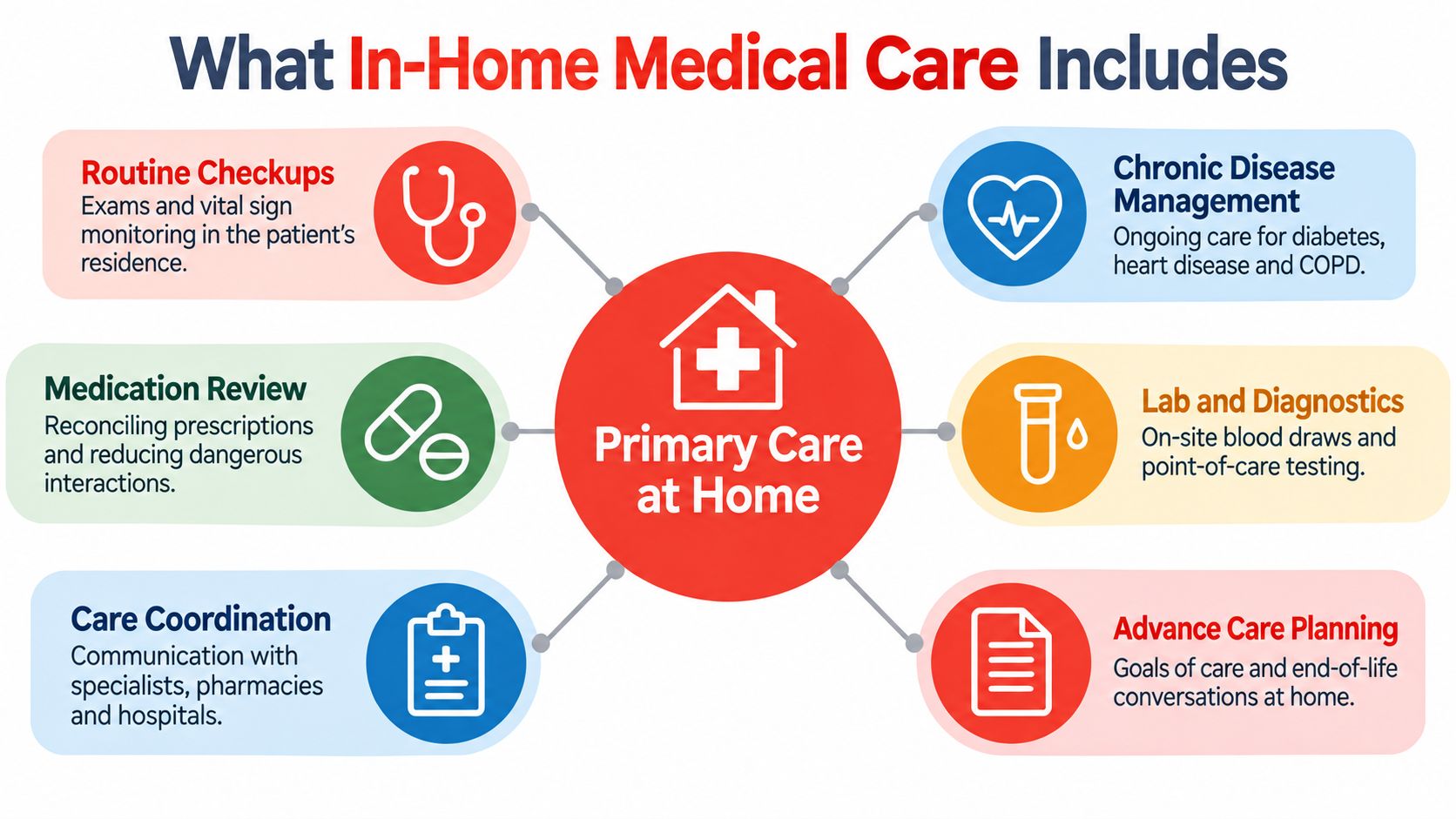
A complete house-call practice is different from occasional home health nursing or non-medical home care. The clinician can perform a primary care visit in the residence, assess symptoms, review history, conduct a physical examination, create a treatment plan, and coordinate follow-up.
Start with ongoing primary care
Routine visits may address preventive care, blood pressure, diabetes, heart disease, COPD, chronic kidney disease, and high cholesterol. A Medicare Annual Wellness Visit can take place at the kitchen table, where the clinician can discuss prevention, screenings, functional changes, and the patient's actual support system.
Chronic disease management works best as a continuing relationship rather than a single urgent encounter. The clinician can monitor symptoms, review home readings when available, adjust treatment when appropriate, and communicate with specialists, pharmacies, and family members involved in the plan. Families looking for a deeper explanation of this model can also review this guide to chronic disease management at home.
Add medication and diagnostic support
Medication review is often one of the most practical parts of a visit. The clinician can compare every prescription bottle, over-the-counter product, and supplement with the current record, then identify duplications, confusing instructions, or possible interactions for appropriate clinical review.
Diagnostics can also happen without a clinic trip. Depending on the practice and the patient's needs, services may include blood draws, EKGs, urine testing, and coordination of mobile X-ray or ultrasound services. These tools don't turn the home into a hospital, but they can provide useful information for routine monitoring and selected urgent problems.
Use home visits for transitions and non-emergency symptoms
A post-hospital visit focuses on what changed. The clinician reviews discharge instructions, compares medications with the discharge list, checks whether recommended testing and follow-up are scheduled, and looks for symptoms that may require escalation.
Some practices also provide urgent same-day visits for non-emergency concerns. That can be useful when a patient develops a new respiratory symptom, urinary concern, wound issue, or medication problem that needs assessment but doesn't appear to require emergency services. The practice must still define its limits clearly.
A good house-call service doesn't promise to manage everything at home. It explains what it can assess, how quickly someone responds, and when emergency care remains necessary.
Administrative access affects clinical continuity. A practice that uses structured patient call handling can make it easier to capture symptoms, route urgent concerns, and keep scheduling questions from interrupting clinical work. The system should support human follow-up, not pretend that an automated response is a medical evaluation.
The Evidence Behind Home-Based Primary Care Outcomes
The evidence supports a targeted role for home-based primary care, especially for medically complex and functionally limited patients. It doesn't support saying that every patient will do better at home than in a clinic.
A systematic review indexed by the U.S. National Library of Medicine found moderate-strength evidence that home-based primary care interventions reduce hospitalizations and hospital days. The review described the overall research as generally positive, while finding weaker evidence for total health-care costs, other service use, and patient or caregiver experience. (National Library of Medicine)
A separate review of interventions for high-need, high-cost patients found fewer hospitalizations for ambulatory-care-sensitive conditions, particularly among frail patients with previous hospitalizations whose illnesses could be managed in ambulatory settings. That distinction matters. A patient with limited mobility and repeated admissions may gain more from longitudinal home monitoring than a healthy adult who can easily attend a clinic.
One systematic review of nine studies involving 46,156 homebound older adults associated home-based primary care with fewer hospitalizations, hospital days, emergency-department visits, long-term-care admissions, and long-term-care days. The American Academy of Family Physicians noted that the evidence included both observational and randomized research, so the findings support the model without proving that every program produces identical results. (American Academy of Family Physicians)
What the hospitalization numbers mean
A peer-reviewed study found that intervention patients had a 17.9% lower rate of incident hospitalization than controls, with a 95% confidence interval ranging from 31.0% lower to 1.0% lower and a reported p-value of 0.001. The study calculated a number needed to treat of 6, meaning approximately six eligible patients would need to receive the intervention to prevent one additional patient from experiencing an incident hospitalization under the study conditions. Patients also reported greater satisfaction, with an effect size of 0.74. (Peer-reviewed study in PMC)
Another systematic review of hospital-avoidance interventions for older patients found that interventions including home visits reduced hospital admissions by approximately 6% to 14%. Those interventions varied, so the range shouldn't be treated as a guaranteed result for every doctor house call. (Cambridge University Press systematic review)
Why results vary
The evidence becomes less certain when researchers examine universal superiority, total costs, and mortality. One review found low-strength evidence for fewer readmissions, mixed cost results, and no significant mortality difference. A nationwide Veterans Health Administration analysis estimated a 28.1% reduction in costs during the first six months of enrollment in home-based primary care, but that result shouldn't be generalized to every population or practice. (NCBI Bookshelf evidence review)
Families should ask whether the program measures hospitalizations, emergency visits, readmissions, medication-related events, and functional outcomes. A lower visit bill alone doesn't establish lower total cost or better care.
Safety, Patient Selection, and When Home Care Isn't Enough
The phrase “care at home” can sound automatically safer. It isn't. The home setting may work well for carefully selected patients, but outcomes vary with diagnosis, frailty, previous hospitalizations, cognitive impairment, illness severity, and caregiver availability.
Hospital-at-home programs show why infrastructure matters. In selected older adults, one COPD trial reported six-month readmissions of 42% versus 87%, while another trial involving infection, heart-failure exacerbation, COPD, or asthma reported 30-day readmissions of 7% versus 23% for home treatment compared with hospital inpatient care. These programs depended on reliable clinician availability, rapid diagnostics, medication delivery, continuous observation, and a defined route to hospital escalation. (Centers for Medicare & Medicaid Services)
That isn't the same as sending a clinician for a routine house call. A primary care practice may identify deterioration, arrange testing, and coordinate transfer, but it can't provide hospital-level monitoring in every residence.
Questions that define a safe plan
Before choosing in-home care, ask:
- Patient fit: Is the condition stable enough for outpatient management, and can the patient communicate changes or receive dependable observation?
- Response time: Who answers during office hours, and what happens overnight or on weekends?
- Escalation: Which symptoms require calling emergency services rather than waiting for a house call?
- Care setting: Does dementia, severe frailty, oxygen dependence, recurrent falls, or limited caregiver support change the plan?
- Continuity: Who receives hospital records, test results, and medication changes?
A 2025 systematic review found inconsistent outcomes when hospital-in-the-home care was compared with traditional hospital treatment. Readmission risk was shaped by patient age, prior hospitalizations, illness severity, geriatric complications, and cognitive impairment. A separate 2025 study involving nursing-home patients found substantially higher risks of emergency visits and post-discharge mortality than among community-based patients, with adjusted emergency-visit risk approximately twice as high. (2025 systematic review)
Families can learn more about the practical meaning of homebound status through this guide to what it means to be homebound. If someone has severe breathing difficulty, chest pain, signs of stroke, uncontrolled bleeding, sudden severe confusion, or another potentially life-threatening symptom, don't wait for a routine house call. Call emergency services.
Managing Technology, Privacy, and Caregiver Burden
A blood-pressure monitor may send an alert at midnight, but an alert is only the beginning of the work. Someone must receive it, decide whether it matters, contact the patient, and know when a clinician should be involved. For an exhausted spouse, an adult child with a full-time job, or a relative in another state, technology can add duties rather than reduce them.
A 2025 qualitative study identified caregiver burnout, limited training, financial sustainability problems, privacy risks, and the digital divide as recurring barriers to community and smart-home care for people with mild cognitive impairment. A sensor can report movement or a reading, but it cannot independently interpret the patient's condition or provide a complete clinical response.
Build a human-centered system
Assign responsibilities in plain language before choosing devices. Decide who checks messages, who may speak with the practice, which information the patient agrees to share, and what happens if the main caregiver is unavailable. The arrangement should work on an ordinary difficult day, not only during a successful technology demonstration.
A low-tech plan may include scheduled phone calls, a written medication list, a symptom diary, and an emergency contact sheet placed where everyone can find it. These tools may suit a patient with unreliable internet, low digital confidence, sensory impairment, or cognitive decline better than continuous monitoring. They also give caregivers a clear routine instead of leaving them to interpret every notification.
The figures discussed in the introduction point to the same practical lesson: consent, accessibility, and human follow-up should come before device selection. Privacy questions deserve specific answers. Families should know what the device records, who can view it, how information is stored, and how the patient can withdraw permission.

When video follow-up fits the situation, families may prefer online consultations without app installs, particularly when downloads, passwords, or unfamiliar interfaces create obstacles. The clinician should explain what video can and cannot assess and offer a phone-based alternative when video is impractical. Technology should support the care relationship, not become another task the family must manage alone.
Why Families Choose Life Primary Care for House Calls
Families comparing Visiting physicians NJ, Visiting Doctors NJ, or Doctor house calls NJ services should look past the phrase “we come to you.” The useful questions concern scope, geography, visit length, diagnostics, insurance, communication, and escalation.
Life Primary Care serves patients across Morris, Essex, Union, Somerset, Passaic, and Bergen counties in New Jersey. Its clinicians provide primary care, chronic disease management, wellness visits, urgent care for non-emergency problems, and diagnostics in private homes, family residences, apartments, and assisted living communities.
What makes the model practical
Visits typically last 45 to 60 minutes, giving the clinician time to examine the patient and observe relevant conditions such as stairs, bathroom access, oxygen setup, and medication bottles. That environmental assessment connects the medical plan to the place where the patient manages daily life.
The practice accepts Medicare and most major insurers, and its stated service model includes no travel fee, concierge fee, or membership charge. The coordination office in East Hanover handles scheduling, insurance verification, and follow-up, while patient care occurs in the home.
For families arranging care after discharge, the workflow can include medication reconciliation, review of hospital instructions, follow-up testing, and communication with specialists or hospitals. For an older adult with dementia, a familiar setting may make the examination and conversation calmer, but the clinician still needs to account for cognition, caregiver capacity, and the possibility of rapid deterioration.
The operational details matter because house calls for seniors are not merely office visits relocated to a different address. A clinician arrives with a portable examination kit and the patient's chart prepared, then communicates results and care plans by phone and arranges referrals, labs, or the next visit before leaving.
A short video can help families understand how a house-call model fits into everyday care:
Search terms such as In Home Doctor for Elderly, At-Home Doctor Visits, Visiting Docs, Doctor home visits for elderly, and Doctor House Calls for Seniors describe a broad category. The right choice still depends on whether the practice can provide the services your family needs, accepts your coverage, serves your location, and explains its after-hours plan.
Getting Started with Doctor House Calls for Your Family
Begin with the patient's actual barrier, not the marketing label. Write down why clinic care has become difficult, what conditions need follow-up, whether there was a recent hospitalization, and who will be available between visits.
Prepare before scheduling
Have the following information ready:
- Location: Confirm the home, apartment, or assisted living address and whether the service area includes it.
- Coverage: Ask the practice to verify Medicare or commercial insurance benefits and explain any expected patient responsibility.
- Medical history: Gather discharge papers, specialist names, recent test results, allergies, and pharmacy details.
- Medication bottles: Put every prescription, over-the-counter product, and supplement on a table. The actual bottles are more reliable than memory.
- Caregiver contacts: Identify who should receive updates and whether the patient has authorized information sharing.
New patients are generally scheduled within a few business days, while established patients can often receive same-day urgent visits for appropriate non-emergency problems. Availability doesn't mean every symptom qualifies for a house call, so describe the concern clearly during scheduling.
Know what happens at the first visit
The clinician typically reviews the patient's history and current concerns, performs a physical examination, evaluates medications, and creates a treatment plan. Depending on the situation, the visit may include blood collection, an EKG, urine testing, or coordination of mobile imaging.
Ask direct safety questions before care begins. Who should the family call after hours? Which symptoms require emergency services? How are results delivered? Who coordinates with specialists? What happens after a hospital discharge? Clear answers prevent a routine house call from becoming the family's only emergency plan.
Families considering a new provider can also review practical questions in this guide to whether doctors can make house calls. The goal isn't to avoid every facility. It's to choose the setting that matches the patient's needs and has a reliable path to a higher level of care when circumstances change.
Life Primary Care provides primary care, chronic disease management, diagnostics, wellness visits, and non-emergency urgent visits in patients' homes across northern and central New Jersey. Visit Life Primary Care to review service areas, insurance information, and how to arrange a house call for your family.
Ready for a visit at home?
Call and speak with a real person. We will confirm your insurance, find a time and come to you.
973-607-4911 Call now