
Guide · 13 min read
At Home Diagnostic Tests: What You Can Really Do
You're trying to figure out whether a nurse can come to the house, run a few tests, and save you another exhausting trip across town. Maybe it's for a parent who's recovering from surgery, a spouse whose breathing changes from one week to the next, or a relative who's tired of waiting rooms and parking lots. The core question isn't just whether at home diagnostic tests exist, it's whether they can be done accurately, legally, and in a way a licensed clinician can practically use.
Table of Contents
- Why At-Home Diagnostics Matter for Seniors and Caregivers
- What Actually Counts As A Home Diagnostic Test
- Common Diagnostic Tests Available In The Home
- DIY Home Tests Versus Clinician-Supervised In-Home Testing
- How Medicare And Insurance Cover Home Diagnostics
- How To Arrange Home Diagnostic Testing Through A Visiting Doctor
- Common Myths About Accuracy And Access At Home
- When Home Diagnostics Are The Right Choice
Why At-Home Diagnostics Matter for Seniors and Caregivers
A daughter calls after her father comes home from the hospital with a new medication list, a blood pressure cuff, and a stack of follow-up papers. She lives three towns away, works full time, and knows the next clinic visit will be hard to manage. The search for home testing usually starts right there, with one practical need, fewer trips and less confusion.
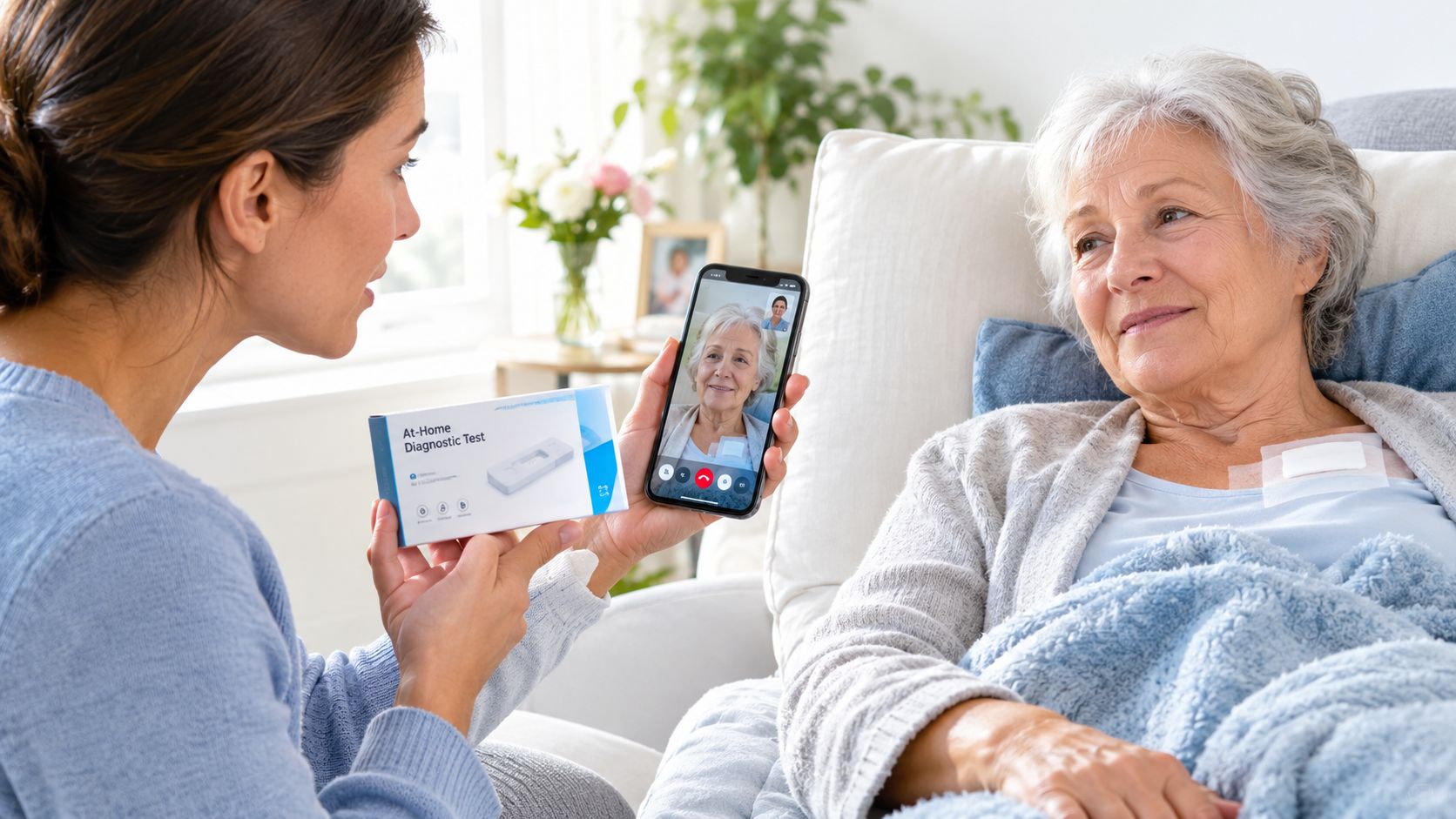
The value of home diagnostics is simple. They can bring measurement, screening, and follow-up into the place where the patient already lives, which matters when mobility, transportation, fatigue, or caregiver distance make office care harder. That's why house-call care often sits inside broader in-home primary care, not as a separate gimmick but as part of a full clinical workflow.
The point is not convenience alone. The point is getting a result a clinician can trust enough to act on.
For seniors, that distinction matters. A home glucose check, a urine test, or a portable EKG is only useful if it answers a real clinical question, like whether symptoms are changing, whether a treatment is working, or whether follow-up needs to happen sooner. The best home testing fits into a plan, it doesn't replace the plan.
Home diagnostics also help families who are juggling more than one need at once. A spouse may be watching for worsening heart failure, while a caregiver wants preventive screening, medication review, and a check on symptoms after discharge. In those situations, the test is rarely the whole story. It's one part of a larger visit that includes history, exam, and next-step decisions.
What Actually Counts As A Home Diagnostic Test
A home diagnostic test is not just any device you can buy online. It's a test done outside a clinic that produces information a licensed clinician can interpret in context, whether that's a blood result, a heart tracing, a urine analysis, or a mobile image. The difference between a medical test and a consumer gadget is purpose, supervision, and what happens after the result comes back.
Clinical purpose comes first
Historical home diagnostics started with simple but meaningful tools. A short, rapid-reading clinical thermometer introduced by Thomas Clifford Allbutt in the 1860s made temperature measurement practical outside hospitals, and it's widely treated as the first true home test for infectious disease. Later milestones included home urine glucose testing and home pregnancy tests, which reached the market in the 1970s and offered earlier detection plus more privacy (historical overview).
That history matters because home testing has always been about a specific medical question, not general curiosity. If a result changes diagnosis, treatment, or follow-up, it belongs in the diagnostic category. If it only produces wellness content with no clear clinical path, it's something else.
Regulation and interpretation change the meaning of the result
Two tests can look similar and still have very different value. A kit sold for self-use may be fine for basic screening, while a clinician-supervised test may be designed for follow-up, confirmation, or ongoing management. In practice, the question is, can the result be tied to a treatment decision, a repeat test, or a specialist referral.
Practical rule: If the result can't be used in a care plan, it's probably not a true diagnostic tool in the clinical sense.
That's why context matters so much. Some home tests are highly reliable when used for the right question, while others are better at raising a flag than closing a case. A legitimate home diagnostic doesn't just detect something, it fits into the medical record, the next visit, and the clinician's decision-making.
Common Diagnostic Tests Available In The Home
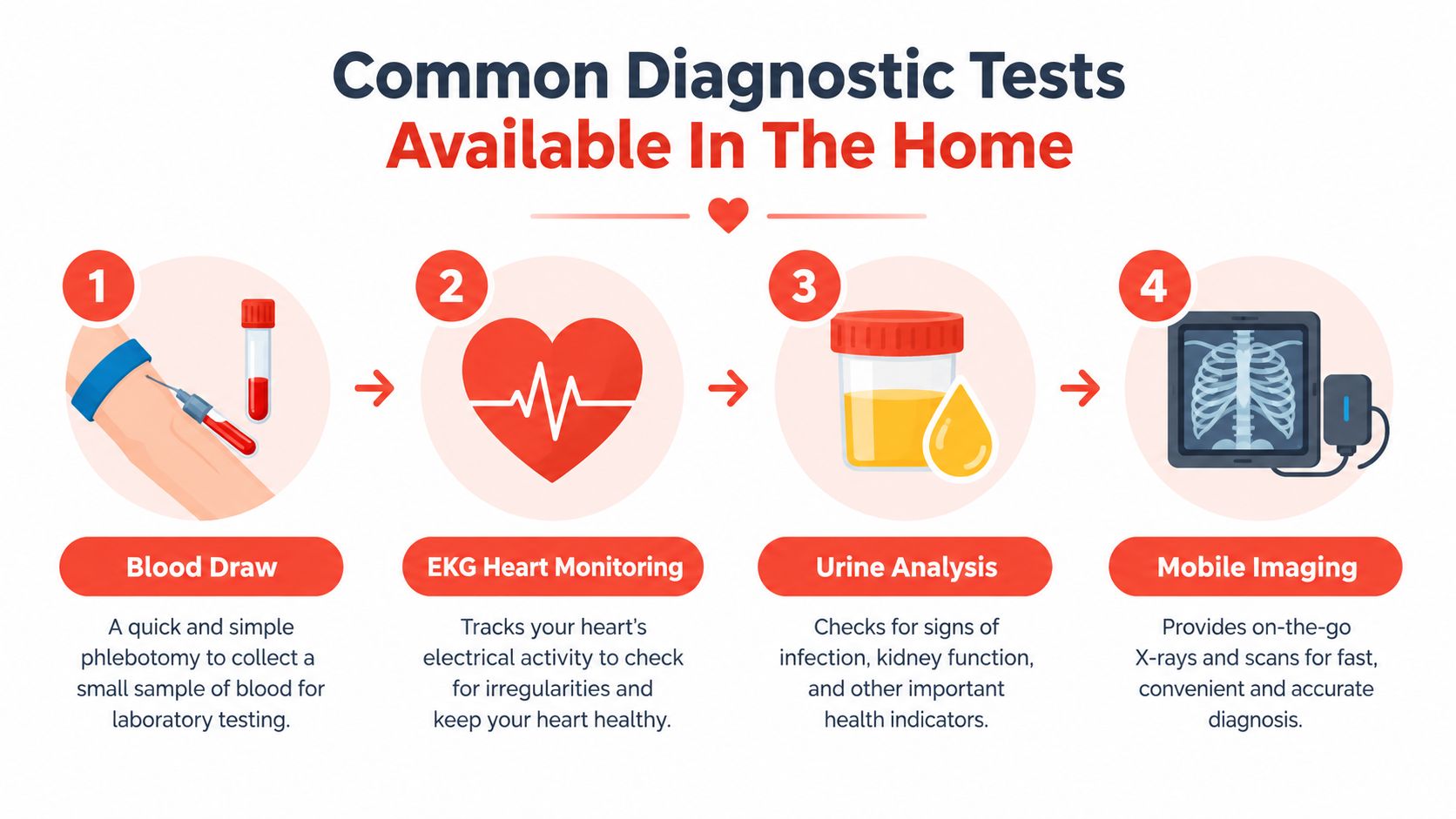
A patient wakes with swelling, fatigue, or an irregular heartbeat and cannot easily reach a clinic. During a home visit, a licensed clinician can examine the problem, choose an appropriate test, collect the sample, and arrange the next step. The work usually falls into four groups: blood draws, heart monitoring, urine testing, and mobile imaging.
Blood, urine, and heart data each answer a different question
A blood draw is familiar, but the home setting changes the logistics. A clinician or mobile laboratory technician collects the sample, labels it, and sends it to a laboratory for the ordered analysis. The results may support chronic disease follow-up, medication monitoring, or decisions about whether a symptom needs further evaluation. Medicare explains that diagnostic laboratory tests are covered when a treating provider orders them and uses the findings to manage the relevant medical problem (Medicare diagnostic laboratory tests).
Blood testing can also involve infectious disease questions. Depending on the suspected illness, timing, and purpose of testing, the clinician may help with choosing between antigen and PCR rather than treating every home kit as interchangeable. A fast result may answer one question, while laboratory testing may be needed for another.
Urine testing takes less equipment, yet collection and interpretation still matter. During a visit, a clinician may check for signs related to infection, hydration, or another routine concern. A positive or abnormal reading becomes useful when it is considered alongside symptoms and medical history, rather than treated as a color change that explains itself.
An electrocardiogram, or EKG, records the heart's electrical activity with a portable device. It can help assess intermittent palpitations or other symptoms without requiring travel to a cardiology office. The clinician can decide whether the recording is sufficient or whether the patient needs additional evaluation.
Mobile imaging extends the home visit
Some diagnostic imaging can be performed where the patient lives. Medicare Part B covers certain diagnostic non-laboratory tests, including portable X-ray services, when a physician or qualified practitioner orders the service and it fits covered procedure categories. Those categories include skeletal films involving the extremities, pelvis, vertebral column, or skull (Medicare diagnostic non-laboratory tests).
The equipment and workflow are explained in this guide to mobile X-ray and ultrasound. Home imaging does not reproduce every hospital service. It provides a focused option when the clinical question can be answered with equipment brought to the patient.
These tests often support chronic disease care, post-hospital checks, and preventive evaluation. Together, they give the visiting clinician more than symptoms alone.
DIY Home Tests Versus Clinician-Supervised In-Home Testing
A store-bought kit can be useful when the question is narrow and the instructions are followed exactly. A clinician-supervised home test is better when the result needs interpretation, confirmation, or immediate action. The difference shows up in sample quality, storage, timing, and what happens next.
Side by side comparison
| Feature | DIY Home Test | Clinician-Supervised In-Home Testing |
|---|---|---|
| Purpose | Quick screening or consumer curiosity | Medical decision-making |
| Sample collection | Done alone, often without oversight | Collected with clinical guidance |
| Result interpretation | Usually self-read or sent online | Read in context of symptoms and history |
| Confirmation | Often unclear or optional | Repeat or lab confirmation is built in |
| Handling errors | More likely if kit is expired or stored poorly | Reduced by clinician workflow |
| Follow-up | May end with the result | Linked to treatment or further testing |
Accuracy depends on more than the test brand. A 2023 systematic review of SARS-CoV-2 self-testing and self-sampling found pooled sensitivity of 70.5% and specificity of 99.4%, with pooled Cohen's kappa of 0.91 (systematic review). That kind of profile shows why a home test can be good at confirming a likely positive, but a negative result may not be enough when the pretest probability is high.
Home testing also breaks down when the process is sloppy. MedlinePlus notes that even authorized tests can fail if the sample is collected badly, the kit is expired, or the specimen is stored incorrectly (MedlinePlus at-home medical tests). A small double-checked study cited by Harvard Health found about 40% false positives in home-based results, which is a reminder that some positives still need lab confirmation.
How to think about the choice
A DIY kit makes sense when the answer is simple and the next step is obvious. Clinician-supervised testing makes more sense when the result could change medication, trigger imaging, or lead to a diagnosis that needs follow-up. One other issue matters a lot, direct-to-consumer products sometimes market themselves as wellness tools even when the evidence is thin, especially in categories like food sensitivity and certain hormone tests (emerging trends commentary).
If the test is going to shape care, supervision isn't extra. It's part of the test.
How Medicare And Insurance Cover Home Diagnostics
Coverage confusion stops a lot of families before they even start. The cleanest way to think about Medicare is this, the test has to be medically necessary, ordered by the treating provider, and used in managing the patient's condition. Location matters, but location alone doesn't create coverage.
The order is what connects the test to coverage
Medicare Part B covers medically necessary diagnostic laboratory tests when a health care provider orders them (Medicare diagnostic laboratory tests). Medicare's ordering rule is specific, diagnostic x-ray tests, diagnostic laboratory tests, and other diagnostic tests generally must be ordered by the physician treating the beneficiary and using the results to manage that medical problem.
That's why home phlebotomy or urine testing can fit into covered care. The sample is collected at home, but the test still belongs to a treatment plan. It isn't just a convenience service sitting outside the medical record.
Preventive care has its own rules
Medicare also covers preventive and screening services, including annual wellness visits, and some at-home screening tests are covered only if the beneficiary meets the listed conditions (Medicare preventive and screening services). That matters because families often assume “home visit” and “covered” mean the same thing. They don't.
Coverage follows the benefit category, the order, and the documentation, not the address alone.
For situations that involve remote coordination, documentation can get complex quickly. A useful outside resource on remote cardiology consult documentation tips can help readers understand why notes, ordering, and result routing matter so much when care crosses settings.
Skilled home health is narrower than many people think
Medicare-covered home health services require the patient to need part-time or intermittent skilled services and to be homebound. Medicare defines part-time or intermittent skilled nursing and aide care as up to 8 hours per day combined, for a maximum of 28 hours per week in most cases (home health services). That's a hard boundary, and it's easy to confuse skilled home health with broader house-call primary care.
In plain English, the test may happen at home, but the rules still come from Medicare's coverage categories. If those boxes aren't checked, the location doesn't matter.
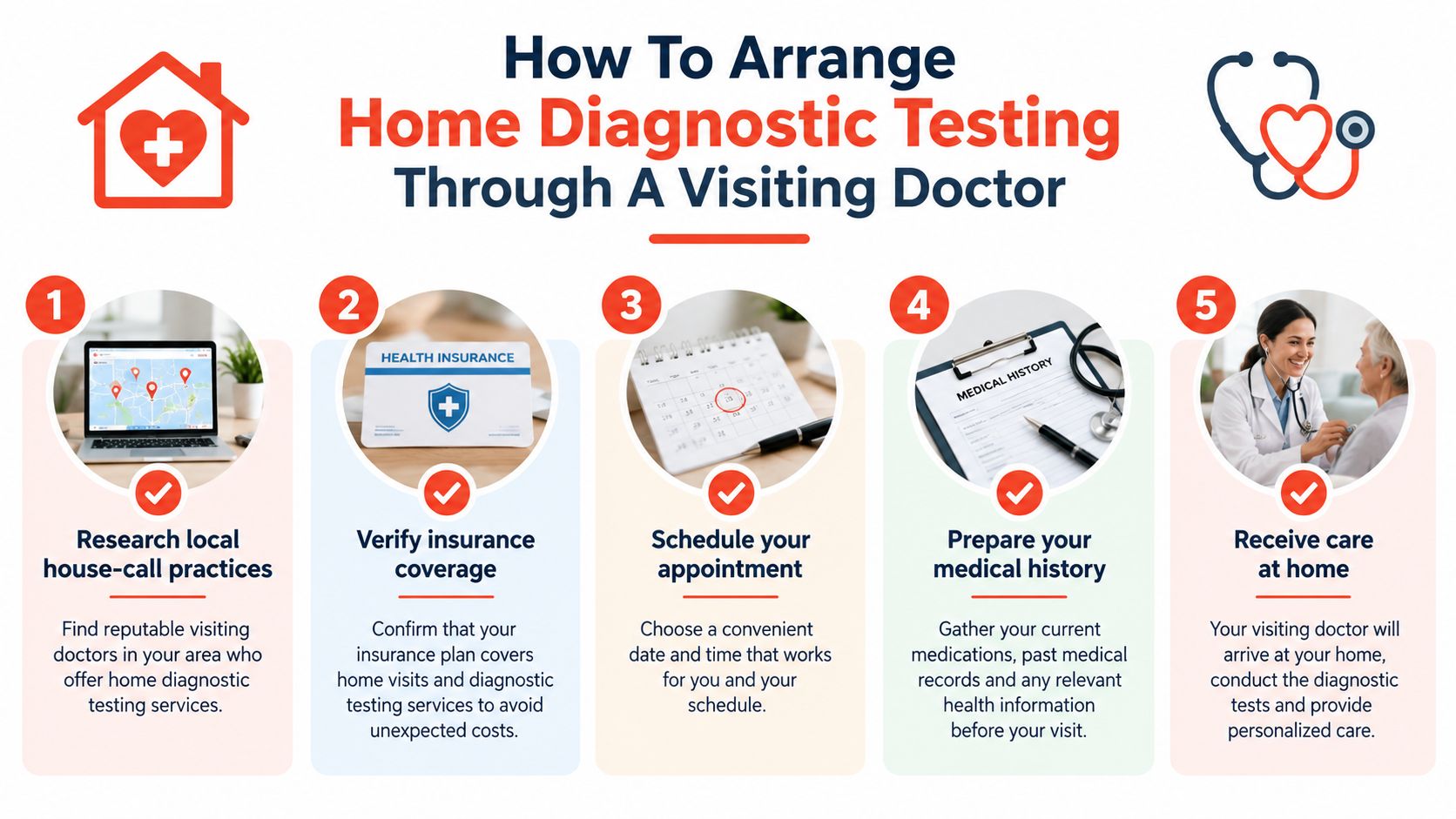
How To Arrange Home Diagnostic Testing Through A Visiting Doctor
A home diagnostic visit usually starts with one phone call or online request, then moves through scheduling, insurance review, and a clinician deciding which tests belong in the visit. The best house-call practices treat diagnostics as part of the appointment, not as a side service bolted on at the end.
The visit starts before anyone walks through the door
The office staff usually confirms the patient's location, insurance, and reason for care. Then the clinician reviews the chart, so the visit isn't just a blank slate. That preparation matters because a home diagnostic appointment often has to solve more than one problem, symptoms, medication reconciliation, and pending follow-up can all sit on the same table.
If you want to see how an in-home diagnostic workflow is organized, in-home labs and diagnostics shows the kinds of services that can be coordinated during a visit.
What happens once the clinician arrives
The clinician brings a portable exam kit and checks the home environment as part of the assessment. That can include looking at medication bottles, stairs, oxygen equipment, or the setup around the patient's usual daily routine. The point is to connect symptoms and test results to the place where the patient lives.
The process often looks like this:
- History first: The clinician asks what changed, what's new, and what the caregiver has noticed.
- Exam second: Vitals, lungs, heart, or other findings shape which tests are worth doing.
- Testing next: Blood draw, urine testing, EKG, or mobile imaging is coordinated if needed.
- Results routing: Findings are sent back to the clinician so they can be explained and acted on.
- Follow-up last: Medications, referrals, or another visit are arranged before the team leaves.
A good home diagnostic visit ends with a plan, not just a specimen.
For some practices, results are communicated by phone after the visit. That keeps the test tied to the care plan, which is what families usually need most.
Common Myths About Accuracy And Access At Home
The loudest myth says every home test is unreliable. That's too broad. Some at-home diagnostics are highly reliable when they're validated for the right use, while others are weak because the sample, timing, or interpretation is poor.
The second myth says clinics are always necessary. That's also too broad. Medicare covers some diagnostic laboratory testing, some non-laboratory diagnostics, and preventive services when the clinical and coverage rules are met, so home care isn't automatically outside the system (diagnostic laboratory tests, diagnostic non-laboratory tests, preventive and screening services).
A third myth is that wellness products and true diagnostics are the same thing. They aren't. Recent expert coverage warns that some direct-to-consumer wellness tests are inaccurate, unnecessary, or even harmful, and it specifically notes that IgG food-sensitivity testing lacks strong evidence and is recommended against by multiple allergy societies (expert commentary). That's why the label matters less than the evidence behind the test.
Practical rule: Don't trust the marketing language. Ask whether the result changes care, who ordered it, and whether it needs confirmation.
Accuracy and access can both be real, but neither is automatic. Home diagnostics work best when they're part of a clinician-led process with clear follow-up, not when they're treated like a standalone purchase.
When Home Diagnostics Are The Right Choice
Home diagnostics make the most sense when travel adds risk, stress, or delay to care. That includes post-discharge monitoring, chronic disease follow-up, dementia care, limited mobility, and situations where a caregiver is trying to coordinate everything from afar. The home setting doesn't weaken the work, it can make the work more realistic.
A home-based diagnostic visit is especially useful when the clinician needs to see the whole picture. A medication list on paper is one thing, but medication bottles on a kitchen counter tell a different story. The same goes for oxygen use, stairs, clutter, or the setup of a bathroom that affects safety and function.
The best sign that home diagnostics are a good fit is simple, the result will change management and the patient can't easily get to the office. If that's true, a clinician-led home visit can solve more than one problem at once. It can test, examine, document, and plan without forcing a fragile routine into a clinic schedule.
Life Primary Care brings house-call primary care, in-home labs, EKGs, urine testing, and mobile imaging coordination into the patient's home across northern and central New Jersey. If you're trying to arrange care that keeps testing tied to real follow-up, visit Life Primary Care and see how home-based primary care can fit your situation.
Ready for a visit at home?
Call and speak with a real person. We will confirm your insurance, find a time and come to you.
973-607-4911 Call now