
Guide · 12 min read
What Does Primary Care Include at Every Stage of Health
An older adult feels unusually tired and has a new cough. Their daughter has rearranged her workday to drive them to a brief medication appointment, and both are wondering whether the trip is necessary. That question points to a common misunderstanding: primary care isn't defined by a clinic room or a particular procedure. It's defined by the responsibility to understand and manage a person's health over time.
So, what does primary care include? It starts with assessing new concerns, treating common illnesses, and managing ongoing conditions. It also includes prevention, medication review, and coordination with other clinicians. Those functions can take place in a clinic, by phone or video, or in a patient's home, depending on the need and the service available.
The Institute of Medicine's definition describes primary care as accessible, integrated care from clinicians accountable for addressing a large majority of a person's health needs, building lasting relationships, and considering family and community context. The National Academies later emphasized whole-person, equitable care delivered by interprofessional teams across settings and over time. In everyday terms, a primary-care clinician may review blood pressure, ask about mood or falls, update prevention plans, and coordinate a specialist referral as part of one continuing relationship. (National Academies' description of primary care)
Table of Contents
- The Real Scope of Primary Care Beyond the Waiting Room
- Six Core Functions Every Primary Care Clinician Covers
- Preventive Care Wellness Visits and Routine Screenings
- Chronic Disease Management at Home
- Transitions of Care After a Hospital Stay
- Urgent Same-Day Visits and When to Call
- How In-Home Primary Care Delivers These Services
- Bringing It All Together for Families
The Real Scope of Primary Care Beyond the Waiting Room
A clinic is one place to receive primary care, but it isn't what makes care "primary." The defining features are accessibility, coordination, continuity, and accountability. Together, these describe a clinician's responsibility to be a first point of contact, address a broad range of needs, and help keep care connected over time.
That responsibility spans more than treating a single symptom. A primary-care clinician can evaluate a new problem, manage ongoing conditions, support prevention and recovery, and help determine whether specialty or emergency care is needed. The World Health Organization describes primary care as covering health promotion, protection, prevention, treatment, rehabilitation, and palliative care throughout life. (WHO's overview of primary care)
This broader view helps families judge whether a service is meeting a patient's needs. Is there a way to discuss a new concern? Does someone track chronic conditions and medication changes? Are test results and referrals followed through? The answers matter more than whether the visit happens in an exam room or at home.
For an older adult who struggles with stairs, oxygen equipment, or transportation, in-home primary care may provide a practical way to receive many of the same core functions without making the clinic trip. The setting changes. The work of understanding the whole person, making a plan, and staying involved should remain.
Six Core Functions Every Primary Care Clinician Covers
Primary care can be understood as a set of connected jobs. Each one answers a different kind of health need, but they work best as parts of one ongoing relationship.
First-contact evaluation. When a new symptom appears, a clinician takes a history, examines the patient as appropriate, and considers what may be causing the problem. A new cough, for example, calls for more than a guess based on one symptom.
Treatment of acute problems. Primary care addresses many short-term illnesses and injuries. A clinician may assess a minor infection, discuss treatment options, and plan what to do if symptoms change.
Chronic disease management. Conditions such as diabetes, hypertension, asthma, COPD, and heart failure often need continuing monitoring and adjustments. Reviewing home blood-pressure readings is one example of this work.
Prevention and wellness. Care can include health-risk assessments, immunizations, screening, counseling, and education. The point is to identify health needs and plan appropriate preventive services, not just respond after illness begins.
Medication management. A clinician reviews what the patient takes, checks for possible duplication or problems, and helps clarify how prescriptions fit together. That review is especially useful when several prescribers are involved.
Coordination and patient education. Primary care includes referrals and communication with specialists, hospitals, home-health agencies, and community services. It also means explaining the plan in language the patient and family can use.
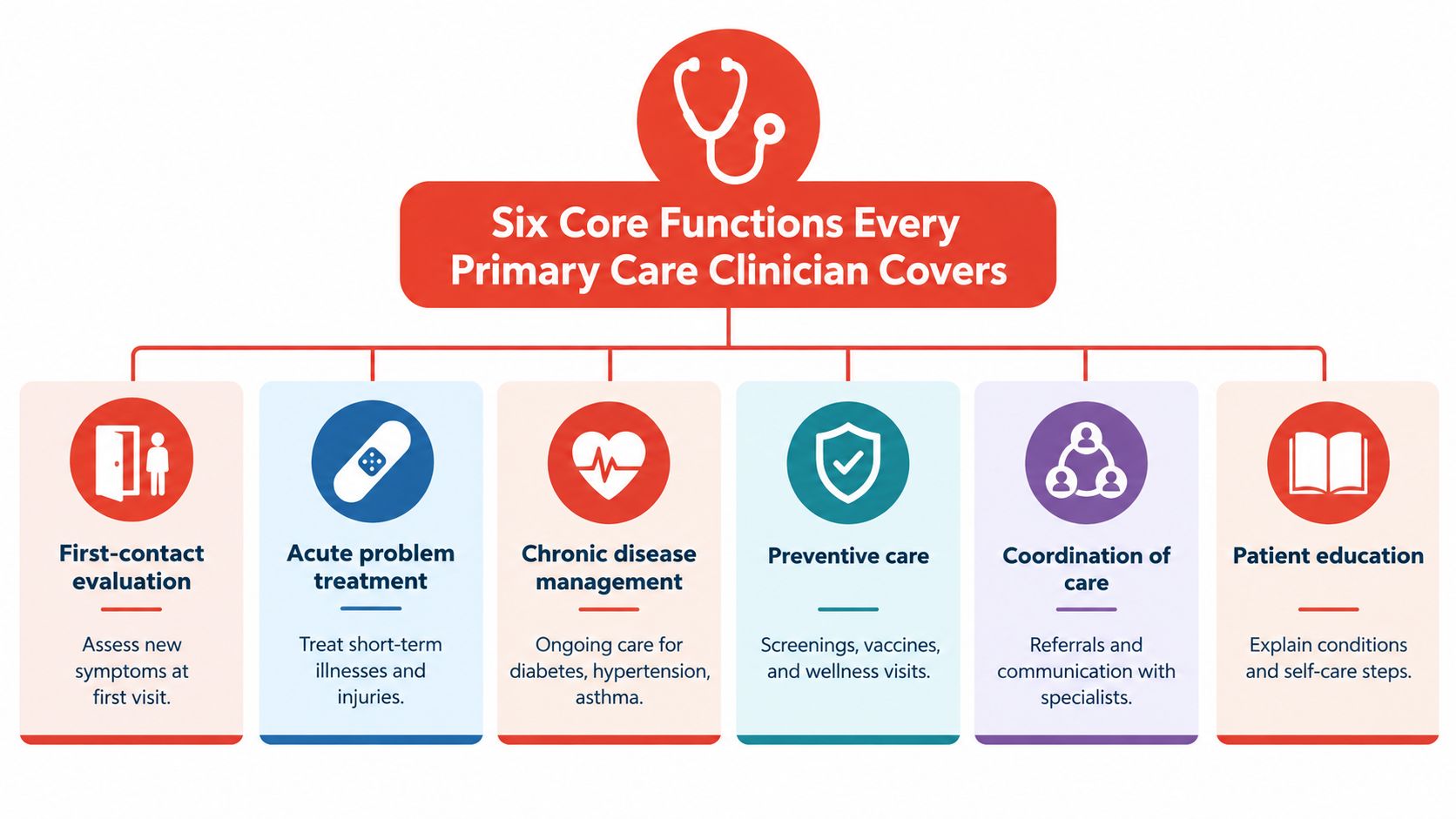
A useful way to read a primary-care note is to ask which job it represents. An assessment may address a new symptom; a follow-up may track a chronic condition; a referral may be part of coordination. Many appointments involve several functions at once.
Preventive Care Wellness Visits and Routine Screenings
Prevention is more than a quick question about whether someone feels well. It can include health-risk assessment, immunization and screening review, counseling, and a plan for what should happen next. A Medicare Annual Wellness Visit, or AWV, is a structured preventive service. It isn't the same as a routine physical examination.
During an AWV, the clinician documents the patient's medical, family, surgical, hospitalization, allergy, medication, supplement, and treatment history, along with the current list of healthcare providers and suppliers. The visit also includes measurements such as height, weight, body-mass index or waist circumference, and blood pressure. Medicare requires a written screening schedule for the next 5–10 years, based on applicable recommendations and the patient's health and screening history. (CMS requirements for the Medicare Annual Wellness Visit)

The setting can shape what a clinician notices. At home, a conversation at the kitchen table may make it easier to review medication containers, discuss how the patient moves through the home, or consider whether stairs and bathroom access affect daily routines. That context can inform planning, though it doesn't replace a separate test or service when one is needed.
Medicare generally covers an AWV once every 12 months for eligible beneficiaries. The visit can help organize prevention, but it doesn't automatically include every separately covered screening, diagnostic test, or problem-focused evaluation. Families can review Medicare Annual Wellness Visit requirements to understand what the visit covers and what may need to be arranged separately.
This video offers another overview of preventive visits and their purpose.
Chronic Disease Management at Home
After a hospital stay, a patient may return home with changed prescriptions, new instructions, and questions about how to manage an existing condition. For someone with heart failure, for example, the plan may involve understanding medication changes, monitoring symptoms, and knowing whom to contact if recovery doesn't go as expected. A consistent primary-care relationship helps bring these pieces together.
Chronic care at home can involve reviewing the patient's experience and functional status, checking medications and adherence, arranging appropriate tests or referrals, and setting up follow-up. Depending on the practice and the patient's needs, in-home services may include phlebotomy, EKGs, urine testing, or coordination of mobile imaging. Phone or telehealth check-ins can help keep communication open between visits.
The important distinction is that a home visit isn't automatically a full substitute for every test or specialist appointment. Rather, home-based primary care can deliver ongoing generalist care where the patient lives, while arranging additional services when needed. For a patient managing diabetes, hypertension, COPD, chronic kidney disease, or high cholesterol, that may make it easier to discuss the daily realities that shape a care plan.
A practical question for families: Who is keeping track of the whole plan, including medication changes, follow-up, and communication with other clinicians?
A practice offering chronic disease management can help families understand which ongoing services are available and how those services fit with a patient's existing care. The right plan depends on the individual's condition and clinical needs.
Transitions of Care After a Hospital Stay
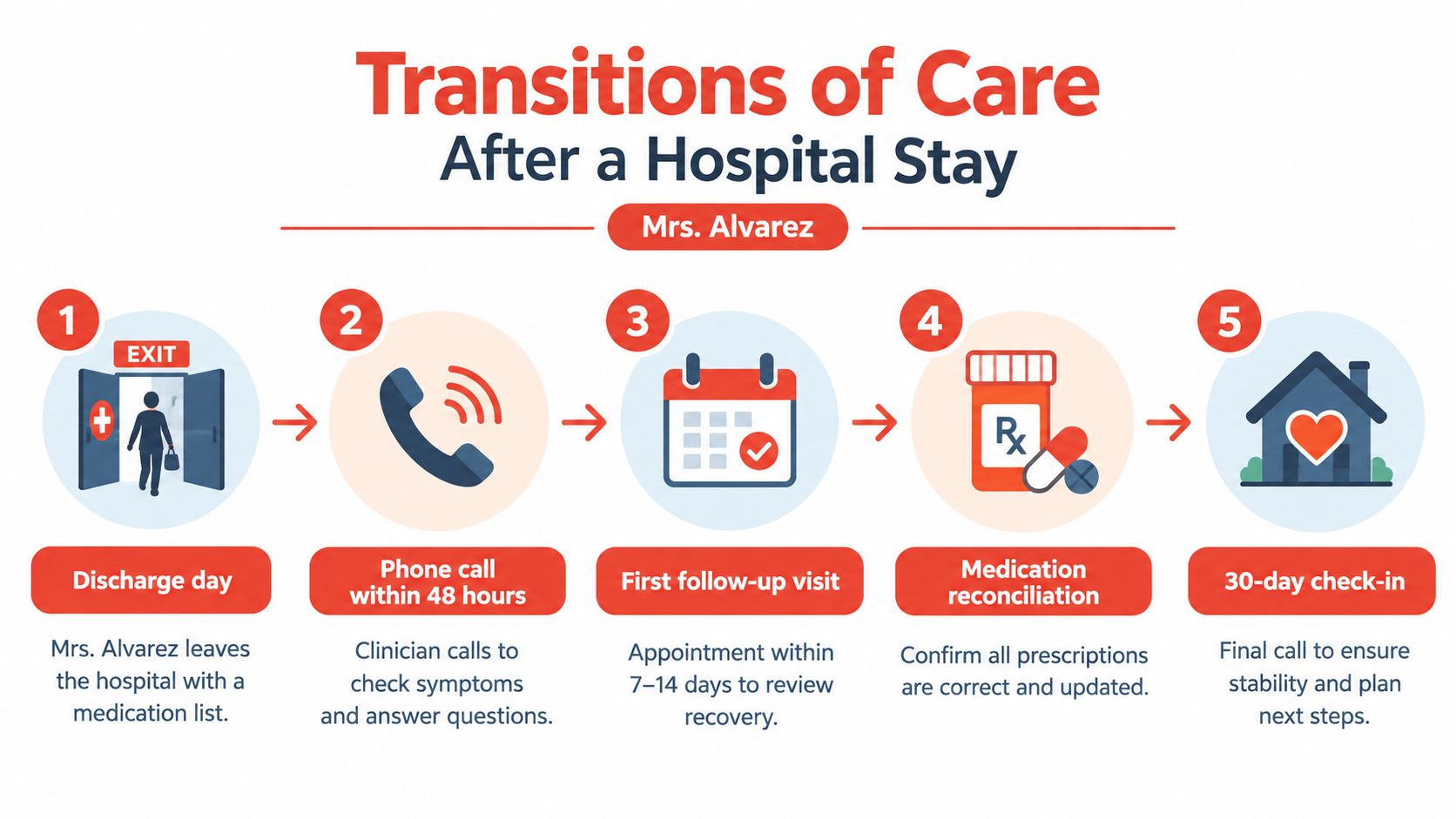
Mrs. Alvarez comes home after a hospital stay with discharge instructions and an updated medication list. Her family has questions: which prescriptions changed, when should she see a clinician, and what should they do if a symptom worsens? A primary-care team can help turn those papers into a workable plan.
Medicare transitional care management, or TCM, provides a defined framework for follow-up after discharge. The clinician or clinical staff must make interactive contact with the patient or caregiver within 2 business days. A face-to-face evaluation must occur within 14 calendar days when medical decision-making is moderate complexity, or within 7 calendar days when it is high complexity. (CMS guidance on transitional care management)
At the follow-up, the clinician can compare the discharge list with prescriptions the patient took before hospitalization, clarify instructions, and check whether appointments or tests remain outstanding. If Mrs. Alvarez's family spots an unexpected medication or doesn't understand a new direction, the team can work to clarify the plan with the relevant clinicians. The goal is to prevent information gaps from becoming care problems.
Continuity matters beyond the first review. A patient may also need help managing a chronic condition, discussing a new non-emergency symptom, or coordinating care related to memory or mood. When one primary-care clinician helps hold the full picture, families have a clearer point of contact instead of trying to connect disconnected instructions on their own.
For practical information on hospital-to-home care transitions, families can review how follow-up, medication review, and communication may be organized after discharge.
Urgent Same-Day Visits and When to Call
A same-day primary-care visit may be appropriate when a problem needs prompt assessment but doesn't appear to be an emergency. For example, a patient using home oxygen develops a new fever, a medication seems to cause a concerning reaction, a cough is worsening, or someone falls without a head injury or an apparent broken bone. A clinician can assess the situation and decide what kind of follow-up or escalation is needed.
Call emergency services for emergencies. Chest pain, stroke symptoms, severe difficulty breathing, major bleeding, and suspected fractures require emergency assessment. Don't wait for a routine appointment or assume a home visit is a substitute for emergency care.
Practical rule: If the problem may be life-threatening or the person is rapidly deteriorating, contact emergency services. For a concerning but non-emergency change, call the primary-care practice and explain what has changed.
Families often ask what “coordination” means in day-to-day life. It can mean reviewing medication bottles, checking whether prescriptions from different clinicians overlap, arranging a referral, coordinating mobile imaging, or communicating results and next steps by phone. The clinician can also document the plan and help connect the patient's care with other providers. AHRQ describes coordination as deliberately organizing care activities and sharing information among those involved, guided by the patient's needs and preferences. (AHRQ's description of care coordination)
| What changes | Clinic primary care | In-home primary care |
|---|---|---|
| Where the visit happens | The patient travels to a clinic. | The clinician sees the patient where they live, if the service area and clinical needs allow. |
| What the clinician can review | The patient can bring a medication list or questions. | The clinician may be able to review medication containers and aspects of the home environment in context. |
| What care can include | Assessment, treatment planning, prevention, and follow-up. | The same broad functions may be delivered at home, with tests or referrals coordinated when needed. |
| When emergency care is needed | Emergency symptoms still require emergency services. | A home visit isn't a replacement for emergency services. |
This is also why a primary-care clinician may refer a patient rather than manage every concern alone. A specialist can provide focused expertise, while primary care helps connect that expertise with the patient's other conditions and priorities. For a separate discussion of pain management for migraines in Orland Park, Midwest Pain & Wellness offers information about which clinicians treat migraine headaches.
How In-Home Primary Care Delivers These Services
For a family considering a home visit, the first step is to ask whether the practice serves the patient's location, accepts their insurance, and can address the reason for the appointment. Share a medication list, recent discharge instructions, and any immediate concerns when scheduling. These details help the care team prepare for the visit.
Life Primary Care provides house-call primary care in northern and central New Jersey, with care delivered at patients' homes rather than in a clinic. Its service area includes Morris, Essex, Union, Somerset, Passaic, and Bergen counties. The practice serves private homes, apartments, family residences, and assisted living communities. Medicare and most major insurers are accepted, and the practice states that it doesn't charge a travel fee, concierge fee, or membership charge.
A clinician arrives with a portable exam kit and the patient's chart prepared. A visit typically lasts 45–60 minutes, which allows time for an assessment and discussion of the patient's home routines and health needs. The coordination office handles scheduling, insurance verification, and follow-up; results, referrals, and next steps can be discussed before the clinician leaves or communicated afterward.
| Dimension | Clinic Primary Care | In-Home Primary Care (Life Primary Care) |
|---|---|---|
| Visit location | Clinic | Patient's home, apartment, family residence, or assisted living community |
| Getting to the appointment | Patient arranges transportation | Clinician travels to the patient |
| Visit preparation | Patient brings relevant records and medication information | Clinician brings a portable exam kit and prepared chart |
| Follow-up | Arranged through the clinic | Scheduling and follow-up are managed by the coordination office |
New patients are generally scheduled within a few business days, and established patients can often receive same-day urgent visits, depending on availability and need. Families comparing home-care services can also see NJ coverage from Liberty Insurance Associates for a related perspective on coverage in New Jersey.
Bringing It All Together for Families
Primary care includes more than checkups. It means assessing new concerns, treating common illnesses, managing ongoing conditions, planning prevention, reviewing medications, and coordinating with other clinicians. A strong primary-care relationship also gives patients and families a place to bring questions as health needs change.
An in-home model may suit someone who has difficulty traveling, is recovering after surgery or hospitalization, lives with dementia, or relies on a family caregiver who can't easily attend every appointment. It can also make practical details visible to the clinician, such as how medications are organized or whether the patient's home setup affects daily routines. The care team should still arrange referrals, tests, or emergency services when the situation calls for them.
Keep a simple checklist in mind: Can the clinician assess new symptoms? Help manage ongoing conditions? Review prevention and medications? Coordinate care and explain the next steps? If the answer is yes, the service may be providing the broad functions of primary care, regardless of where the visit takes place.
For chest pain, stroke symptoms, severe breathing difficulty, major bleeding, suspected fractures, or other emergencies, call emergency services. For non-emergency concerns, contact the primary-care practice to discuss what kind of assessment is appropriate. Primary care is defined by responsibility for a person's overall health over time, not by the room where the clinician sees them.

Life Primary Care provides full-scope primary care at home, including chronic disease management, wellness visits, post-hospital follow-up, and urgent visits for non-emergency concerns across parts of northern and central New Jersey. If home-based care could make it easier to coordinate your family member's health needs, visit Life Primary Care to learn about the service area and scheduling.
Ready for a visit at home?
Call and speak with a real person. We will confirm your insurance, find a time and come to you.
973-607-4911 Call now