
Guide · 14 min read
Hospital to Home Transition: A Complete Guide
You've finally brought your parent, spouse, or loved one home after a hospital stay. The bags are on the floor, the discharge papers are spread across the kitchen table, and several new prescription bottles sit beside medicines that were already in the house. Everyone feels relieved, but nobody is completely sure what should happen next.
That uncertainty is the core hospital to home challenge. Discharge is an event, but recovery at home is a process. The first few days require clinical attention, practical organization, and someone who can notice when the written plan doesn't match the patient's actual condition or the family's ability to provide care.
Table of Contents
- Navigating the First 72 Hours After Discharge
- Mastering Medication Reconciliation and Follow-Up Scheduling
- Recognizing Red Flags and Knowing When to Call a Doctor
- The Role of In-Home Primary Care in Preventing Readmission
- Long-Term Support for Chronic Disease and Caregiver Wellness
Navigating the First 72 Hours After Discharge
The first evening often looks deceptively calm. A patient may be tired from the ride home and eager to sleep, while the caregiver is trying to locate the walker, prepare food, sort the prescriptions, and understand instructions written for several different problems at once. The family may also be carrying out a second shift of care that the hospital paperwork barely acknowledges, helping with toileting, transfers, meals, bathing, wound observation, and reassurance.
Start by making one recovery area practical rather than perfect. Put the patient's phone, water, glasses, medication list, and call button or alert device within reach. Remove loose rugs and unnecessary furniture from the route to the bathroom. If stairs, oxygen equipment, a shower, or a recently operated body area creates a problem, write that concern down instead of assuming the patient will manage it safely.
Make the first evening manageable
Don't try to solve the entire recovery plan in one night. Focus on four immediate questions:
- Where will the patient sleep? Choose the safest room and make the route to the bathroom clear.
- What must happen tonight? Identify only the medicines, meals, fluids, exercises, or wound steps specifically listed for the evening.
- Who is responsible for each task? Assign medication reminders, transportation, meals, and calls rather than leaving them to “the family.”
- What remains unclear? Mark confusing instructions for the pharmacist, nurse, or physician.
Keep every medication container, the hospital discharge list, pharmacy paperwork, and over-the-counter products together. Don't discard an old bottle or start combining pills in a weekly organizer until a qualified clinician or pharmacist has confirmed which medicines remain active. A patient who was independent before admission may now need help opening containers, reading labels, standing, or remembering instructions.
Practical rule: The caregiver should be able to explain what happens tonight, what happens tomorrow morning, and whom to call if the plan fails.
The first three days should also include a simple rhythm. Wake, wash, eat, take medicines as directed, rest, move only as permitted, and check the agreed symptoms at roughly consistent points in the day. A written log can reduce arguments and memory gaps, especially when more than one relative is involved. Record questions, missed doses, changes in alertness, breathing concerns, pain, swelling, and the names of clinicians contacted.
Build around the patient's real function
Discharge instructions often describe what the patient may do medically, but the home reveals whether that activity is realistic. Can the patient get from the bed to the bathroom? Can the caregiver help without lifting unsafely? Is the kitchen accessible? Does the patient understand how to use a walker, inhaler, glucose meter, or dressing supplies?
Recovery after a procedure also changes over time. Families supporting someone after gynecologic surgery may benefit from a practical guide to returning to activity after hysterectomy when they need to distinguish ordinary gradual recovery from activity that should be discussed with the care team. The same principle applies after any hospitalization: match the written plan to the person's actual strength, environment, and support.
The first 72 hours aren't the time to prove that the household can manage everything alone. They're the time to identify what must be clarified, what support needs to start, and whether the patient is following the expected recovery path.
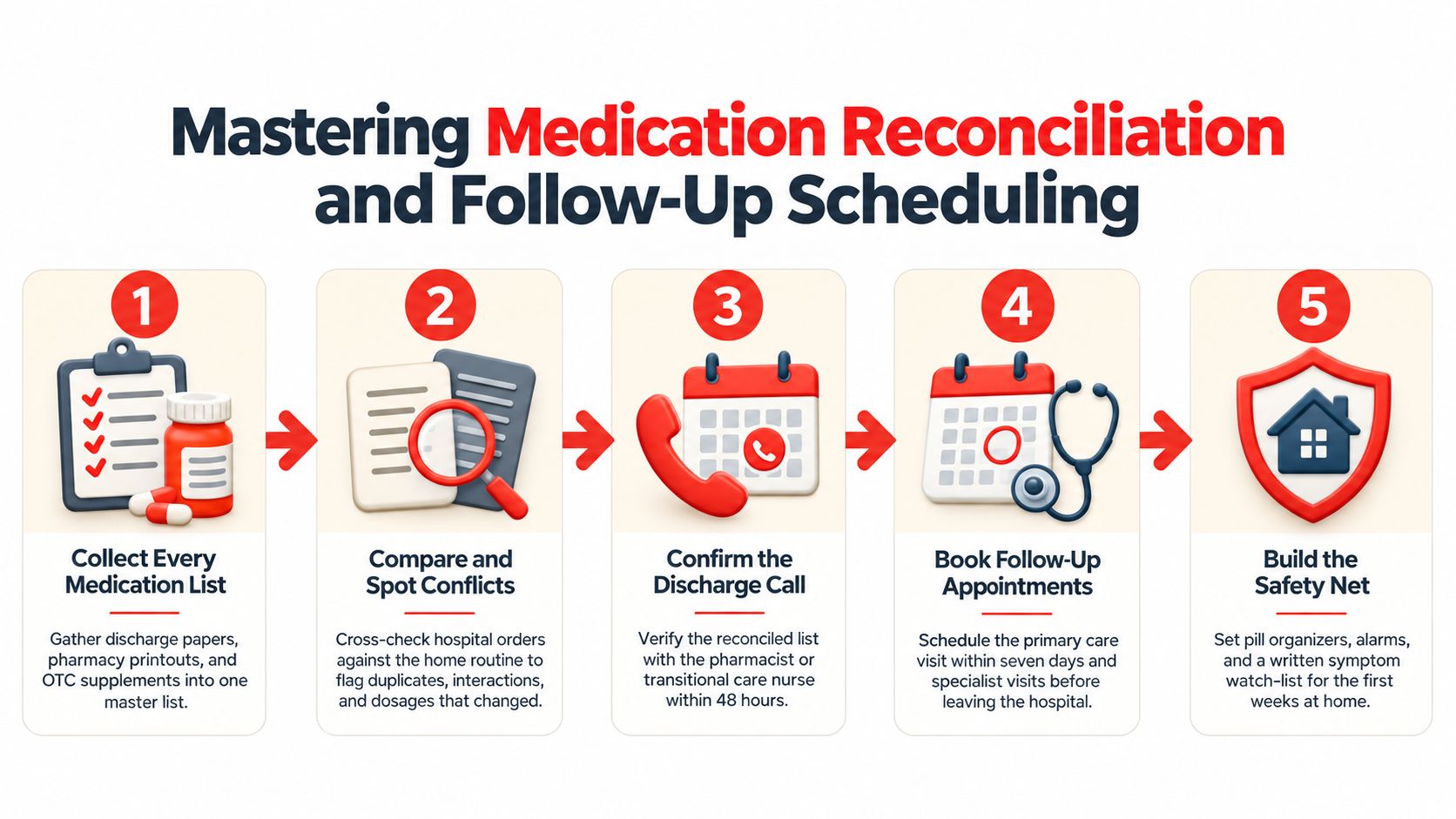
Mastering Medication Reconciliation and Follow-Up Scheduling
Medication reconciliation means comparing the medicines the patient was taking before admission with the medicines prescribed at discharge, then confirming which drugs were started, stopped, continued, or changed. It is not just reading the hospital list aloud. The comparison must include prescription medicines, inhalers, injections, vitamins, herbal products, pain relievers, and medicines prescribed by specialists.
A structured transition model may include a home visit within 48 to 72 hours of discharge, medication reconciliation during that visit, and continued home and telephone contact during the first 30 days, as described in the AHRQ transition coaching model. The timing matters because a discrepancy that seems minor on paper can become a missed treatment, duplicate dose, side effect, or avoidable call to emergency services once the patient is home.
Use one master list
On the first day, place the discharge medication list beside the pre-hospital list and the actual bottles in the home. For every item, confirm:
- Name and purpose: Ask what the medicine is intended to treat.
- Dose and timing: Check whether the strength or schedule changed.
- Start and stop instructions: Look for medicines meant to last only a short time.
- Duplicate products: Watch for two medicines with similar names or effects.
- Prescriber ownership: Identify whether the hospitalist, surgeon, cardiologist, primary care clinician, or another specialist should answer questions.
- Practical barriers: Note whether the pharmacy filled the medicine and whether the patient can swallow, open, measure, or administer it.
Don't guess when two instructions conflict. Call the discharging team, primary care office, pharmacist, or transitional care nurse and document the answer. The caregiver's job is to surface the discrepancy, not independently redesign the regimen.
Follow-up scheduling should happen just as deliberately. Before leaving the hospital, ask which clinician needs to see the patient first, what testing is required, and who receives the results. If the appointment wasn't arranged, call promptly from home and give the office the discharge date, diagnosis, medication changes, and any immediate concern.
Why intensity and timing affect results
A systematic review of 26 randomized controlled trials found that only high-intensity transitional care programs consistently reduced short-term readmissions. Effective short-term models combined nurse-led coordination, communication between hospital and primary care clinicians, and a home visit within three days of discharge, according to the Health Affairs review of transitional care. Lower-intensity programs and poorly integrated handoffs were less reliable for early readmission prevention.
A home visit within one week after discharge from a skilled nursing facility was associated with a lower 30-day hospital readmission risk, with an adjusted hazard ratio of 0.61, in a large observational study of post-SNF patients (study of post-SNF home health timing). That finding doesn't mean every patient needs the same service or that an office visit has no value. It does show why the setting and timing of follow-up deserve attention.
Use the first call to confirm the list, the first visit to assess the patient in context, and later contacts to check whether the plan is still workable. A single appointment can't compensate for an unresolved medication conflict or a caregiver who has no way to carry out the instructions.
A detailed medication reconciliation checklist for post-hospital care can help families prepare questions before speaking with a pharmacist or clinician.
Recognizing Red Flags and Knowing When to Call a Doctor
A safe transition depends on more than knowing the diagnosis. It depends on recognizing a meaningful change and choosing the right level of response. A caregiver shouldn't have to decide alone whether a symptom is harmless, but the household should have a written plan for contacting the clinical team.
Call emergency services for severe breathing difficulty, blue or gray lips, sudden collapse, new one-sided weakness, an inability to speak normally, severe chest pressure, or a sudden major change in consciousness. Don't drive a person in obvious danger to an office or wait for a routine home visit. Keep the discharge papers and medication list available for responders.
Some problems need same-day clinical assessment rather than immediate emergency transport. These can include worsening shortness of breath, a rapid increase in swelling, repeated vomiting that prevents medicines or fluids, a new fever after surgery, increasing redness or drainage at an incision, uncontrolled pain, fainting, a significant fall, or new confusion. The appropriate response depends on the patient's diagnosis, discharge instructions, vital signs, and baseline condition.
Match the response to the pattern
A person recovering from heart failure may show deterioration through breathlessness, swelling, a change in sleep position, reduced appetite, or unusual fatigue. A person recovering from lung disease may struggle with inhaler use, increased work of breathing, or a noticeable decline in activity. Someone with dementia may not describe symptoms clearly, so a caregiver's observation of new agitation, sleepiness, refusal to eat, or a change in walking can be clinically important.
The early warning signs guide for home recovery can help families organize observations, but it doesn't replace emergency evaluation when symptoms are severe or rapidly worsening. Write down when the change began, what the patient was doing, which medicines were taken, and whether the symptom is getting better or worse.
In a national review, home-visiting programs for heart failure were associated with 18% to 33% relative reductions in readmission in the home-visiting arms it summarized (VA review of transitions-of-care programs). The review also noted uncertainty about whether home visits are always necessary for every transitional care program. The practical conclusion is narrower and more useful: patients with high-risk conditions may benefit from timely in-person assessment, but the visit must be connected to a clear escalation process.
A home clinician is appropriate when the patient is stable enough to remain at home but needs assessment, medication review, or rapid coordination. Emergency services are appropriate when the patient may be unstable.
The Role of In-Home Primary Care in Preventing Readmission
An office follow-up assumes the patient can travel, transfer safely, carry every medication bottle, remember the discharge story, and describe the home environment accurately. Those assumptions often fail after a hospitalization. An in-home primary care visit puts the clinician where the care plan must work, beside the pill bottles, walker, oxygen equipment, stairs, bathroom, refrigerator, and caregiver.
That setting changes the assessment. A clinician can see whether the patient is taking medicines from several prescribers, whether the walker fits through the hallway, whether a caregiver is performing an unsafe transfer, and whether the patient understands the plan. The visit can include a physical examination, medication review, treatment planning, and communication with specialists or hospital teams.
What a home visit can uncover
A patient with diabetes may have difficulty eating normally or measuring glucose after discharge. Someone with hypertension or heart failure may not understand which symptoms require a call. A person with COPD may have the prescribed inhaler but use it incorrectly. These are not failures of motivation. They're common mismatches between a hospital-centered plan and a home-centered reality.
A clinician can also examine the conditions that repeatedly destabilize chronic illness:
- Medication burden: Multiple prescribers may create duplicate therapies or conflicting instructions.
- Mobility limits: Pain, weakness, dizziness, or an unsafe bathroom can lead to falls and inactivity.
- Breathing changes: New cough, wheezing, fatigue, or difficulty lying flat may require prompt assessment.
- Nutrition and hydration: Poor intake can affect strength, medication tolerance, and recovery.
- Caregiver capacity: One exhausted person may be managing tasks that require nursing, therapy, or additional family support.
The goal isn't to replace emergency care. It's to intervene while the patient is stable enough for evaluation at home, before a manageable problem becomes a crisis. Families researching how in-home primary care supports transitional recovery should look for a clear process for medication reconciliation, communication with other clinicians, follow-up scheduling, and escalation when the findings are urgent.
Why the home setting matters clinically
A major analysis of more than 17 million Medicare hospitalizations found that patients discharged to home health care made up roughly 30% of home discharges. Their 30-day readmission rate was 15.8%, compared with 17.8% for patients discharged to a skilled nursing facility, and their adjusted readmission rate was 5.6 percentage points higher than the SNF group. At the same time, 30-day mortality was 2.3% for home-health patients versus 6.9% for SNF patients, while 80.2% improved in activities of daily living compared with 29.3% in SNFs, according to the Medicare hospitalization analysis.
These figures don't prove that home care is automatically safer. They show that patients sent home represent a large, clinically measurable part of post-acute care, with outcomes shaped by patient selection, service intensity, communication, and the quality of support available after discharge.
Families comparing professional services may also find it useful to review practical guidance on how to avoid hospital readmission with home nursing. Nursing, rehabilitation, personal care, and primary care aren't interchangeable. The safest plan assigns each task to the appropriate professional and gives the family one reliable way to report changes.
Long-Term Support for Chronic Disease and Caregiver Wellness
By the second week at home, the family may be managing refills, specialist instructions, transportation, diet, mobility, lab results, changing symptoms, and the emotional strain of watching an older adult lose independence. The incision may look better and the first follow-up may be complete, yet the second shift of caregiving is only beginning. A transitional visit can steady the initial recovery. Long-term chronic disease management determines whether the household can keep functioning.
For a straightforward recovery, standard office follow-up may be entirely appropriate. The patient travels safely, understands the plan, has a manageable medication list, and has a caregiver who can attend appointments. The calculation changes for a person with dementia, oxygen dependence, severe mobility limitations, heart failure, COPD, diabetes, or several prescribers. In-home primary care can be a time-sensitive clinical intervention when travel, missed information, or an unsafe home routine could delay needed treatment.
| Standard office follow-up | Professional in-home primary care |
|---|---|
| The patient travels to the clinic and describes the home routine from memory. | The clinician observes the patient's routine and environment directly. |
| Medication review depends on what the patient remembers to bring. | Medication bottles and instructions can be reviewed where they're stored. |
| Mobility, stairs, bathroom access, and caregiver technique may remain unseen. | The clinician can identify practical barriers affecting safety and adherence. |
| Family members may need to coordinate multiple offices separately. | A care team can help organize scheduling, insurance questions, results, and communication. |
| Follow-up is often centered on the diagnosis. | Follow-up can include function, cognition, nutrition, home safety, and caregiver capacity. |
Continuity for complex patients
Older adults with dementia may communicate differently at home than in a clinic. Familiar surroundings can make ordinary behavior easier to observe and changes from baseline easier to identify. The person providing most of the daily care can also participate more fully. That caregiver may report skipped meals, nighttime wandering, falls, or confusion about pills that the patient cannot recall.
Chronic conditions call for repeated adjustment, not a single rescue visit. Diabetes care may involve medication tolerance, meals, glucose monitoring, foot concerns, and access to supplies. Heart failure management may involve symptoms, activity, swelling, diet, and communication with cardiology. COPD care may involve breathing, inhaler technique, oxygen use, infection concerns, and endurance. The clinician has to connect these details, because treating each problem as a separate appointment can leave the underlying home routine unchanged.
A synthesis of 25 randomized controlled trials in adults aged 65 and older found that hospital-to-home transitional care improved functional status, mood, and nutritional outcomes. Short-term reductions in readmissions and emergency visits were modest, and few effects lasted beyond six months (evidence synthesis of transitional care in older adults). The finding sets a practical limit on what one visit can accomplish. Durable progress usually depends on repeated touchpoints, clear self-management support, and timely adjustment when the plan begins to fail.
Supporting the person who provides care
Caregiver wellness is part of clinical safety. A family member who cannot sleep, leave the house, understand the medication plan, or get help with transfers may eventually miss doses or delay reporting a change. The patient's needs and the caregiver's limits need to be discussed openly, before exhaustion turns into a safety event.
A coordinated home-based practice may handle scheduling, insurance verification, follow-up communication, referrals, lab coordination, and results calls. This administrative support does not remove the work of caregiving, but it can reduce separate phone calls and keep important tasks from residing only in one exhausted person's memory. It also gives the family a clearer route for reporting a new problem.
Medicare home health has specific eligibility rules. The patient must be homebound and need part-time or intermittent skilled services. Medicare defines part-time or intermittent care as typically up to 8 hours per day combined, with a maximum of 28 hours per week in most cases, according to Medicare's home health coverage guidance. Coverage rules for home health, physician house calls, personal care, therapy, and private-duty services differ. Families should verify the service, eligibility, and payer requirements before assuming a visit is covered.
Families searching for in-home doctor services may encounter many listings and service descriptions. The useful distinctions are whether the clinician provides ongoing primary care, communicates with the broader care team, and can respond when the home plan stops working. In-home care may involve visiting physicians, nursing, physical therapy, occupational therapy, family support, and telehealth. The right combination depends on the patient's conditions, function, caregiver capacity, and access to other services.
Life Primary Care provides in-home primary care, chronic disease management, urgent visits, diagnostics, and post-hospital transitional visits for patients across northern and central New Jersey. Families seeking a clinician to review medications and recovery needs where the patient lives can visit Life Primary Care to learn more and arrange the next step.
Ready for a visit at home?
Call and speak with a real person. We will confirm your insurance, find a time and come to you.
973-607-4911 Call now