
Guide · 9 min read
What Are Quad Sets and How to Use Them Safely

A quad set is usually a gentle isometric exercise: you tighten the front of your thigh while keeping your knee straight and still. The same phrase can also mean doing four sets of a resistance exercise, which is a different training format, not an exercise specifically for the quadriceps.
At the kitchen table, a family caregiver may be sorting through discharge papers while an older adult rests nearby, unsure which exercises are safe to try at home. If the instructions mention quad sets, it helps to know which meaning they intend. For knee rehabilitation, the phrase usually means a simple thigh contraction; a four-set workout prescription is a separate use of the term.
Table of Contents
- A Simple Definition You Can Use Today
- Why the Quadriceps Deserves Attention After Injury or Surgery
- How to Perform a Quad Set Step by Step
- Choosing the Right Dose for Your Situation
- Progressing From Activation to Real Strength
- Safety Signals and When to Call a Clinician
- Bringing It Home and Planning Your Next Step
A Simple Definition You Can Use Today
For a person recovering from a knee problem, a quad set means tightening the muscle at the front of the thigh while the knee stays straight and doesn't visibly move. You might lie on your back with your leg extended, tighten the thigh, and gently press the back of your knee down into the bed or floor. The muscle works, but the knee doesn't bend and straighten.
Think of it as gently switching the thigh muscle on without asking the knee to travel through a movement. A successful contraction may feel like a firm squeeze or tightening in the front of the thigh. You may also feel the knee press down; the kneecap can glide slightly upward as the thigh tightens. Hospital for Special Surgery's guide to isometric exercises describes this type of muscle contraction without joint movement.
The phrase can also have a different meaning in strength training. There, a quad set can refer to completing four sets of an exercise, such as squats or leg presses. The four describes the number of sets, not the four-muscle group at the front of the thigh. Historical American College of Sports Medicine guidance places many adults' strength-and-power training within a range of 2–4 sets, so four sets can be the upper end of a conventional prescription when the exercise and the person's circumstances make it appropriate.
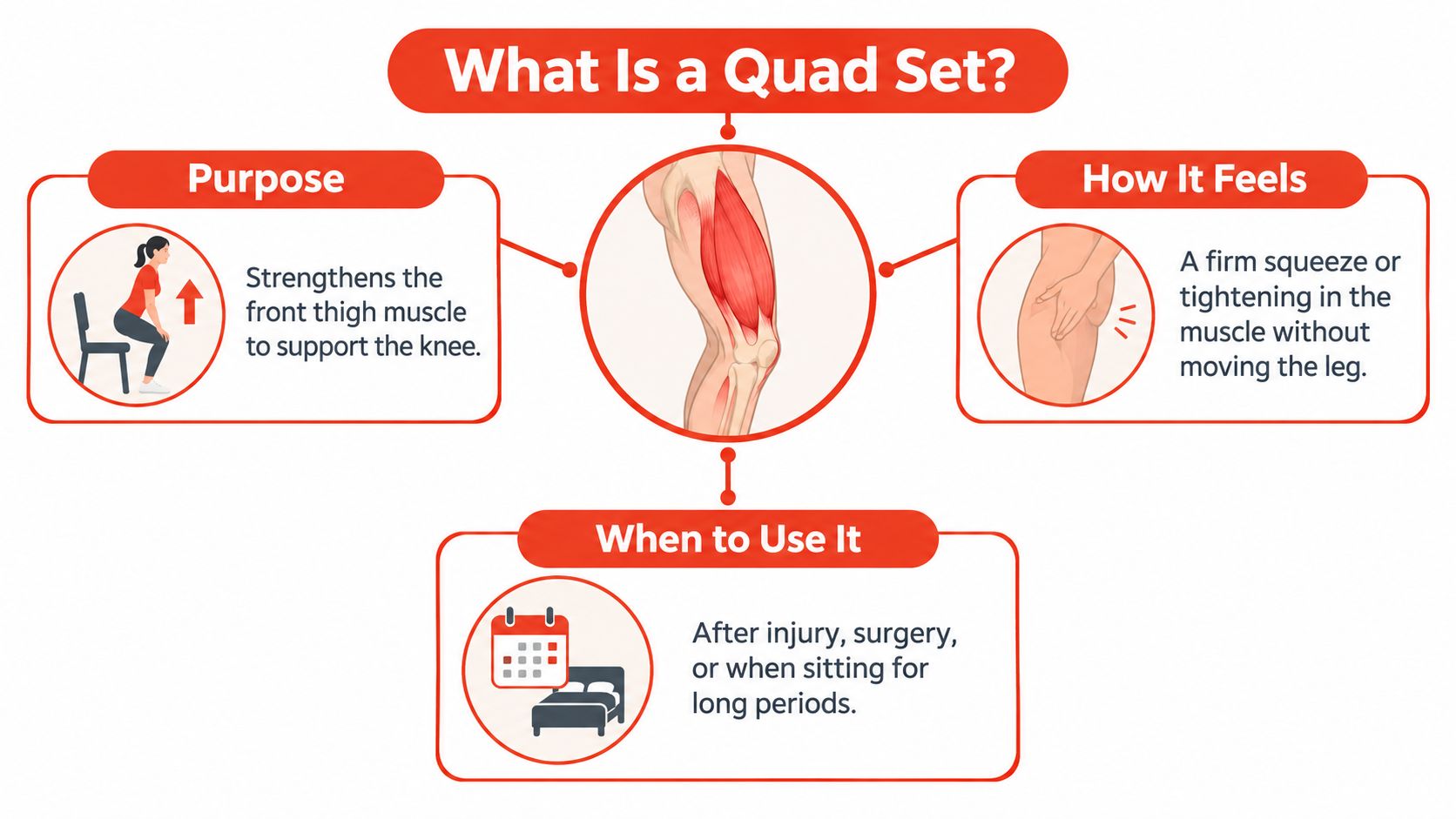
If you're reading rehabilitation instructions after an injury or surgery, the isometric knee exercise is probably the meaning you need. If you're looking at a gym program that lists sets and repetitions, check whether “quad sets” describes the workout volume instead. In one sentence: a rehabilitation quad set is a still-knee thigh contraction, while a four-set prescription is a way of organizing resistance exercise.
Why the Quadriceps Deserves Attention After Injury or Surgery
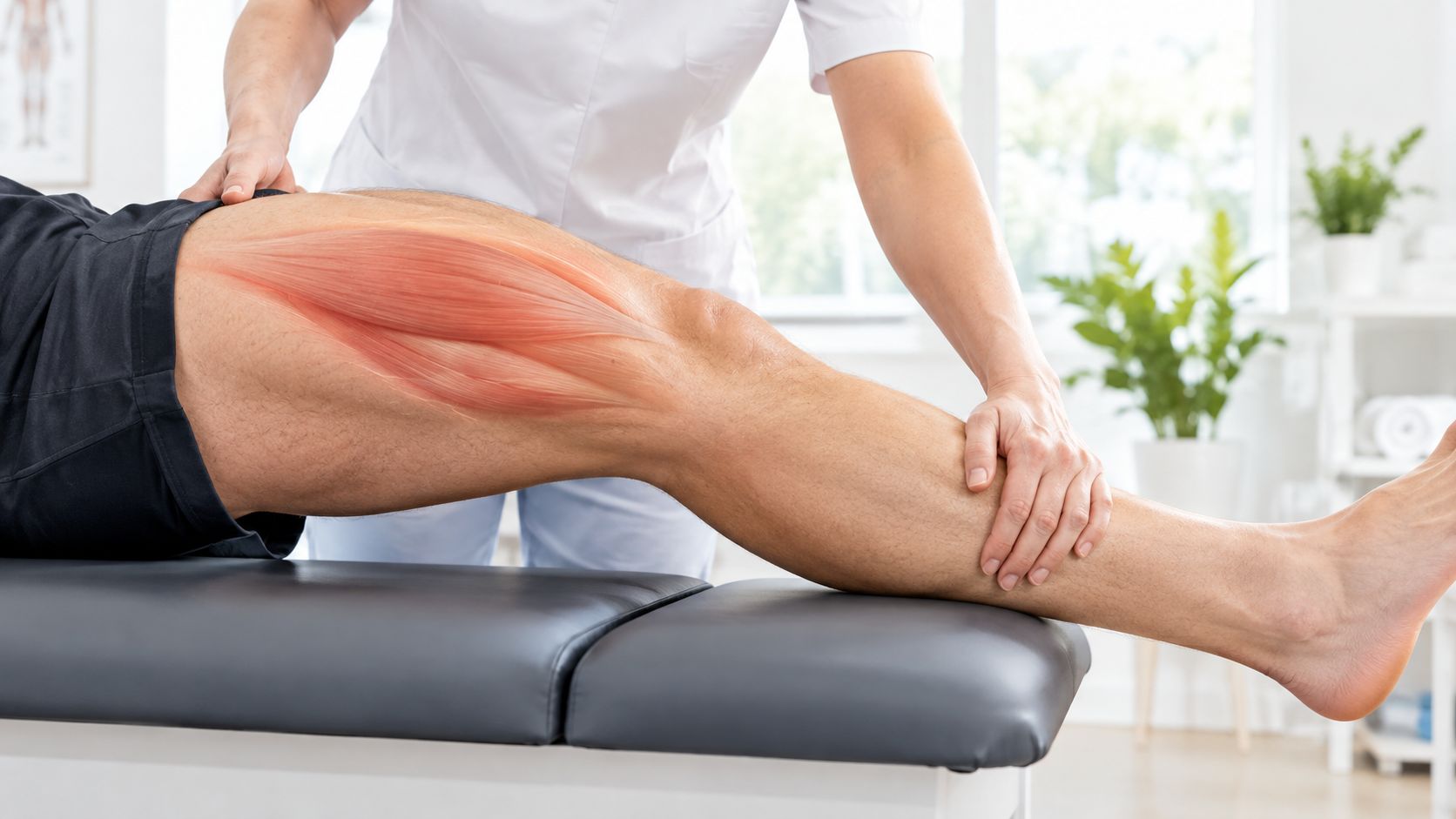
The quadriceps is the large muscle group at the front of your thigh. It helps straighten the knee and supports everyday actions such as standing from a chair and climbing stairs. When the muscle isn't activating well, the knee can feel weak or unsteady, even if the person is trying hard.
Pain, swelling, injury, surgery, or a period of reduced movement can interfere with the signal between the brain and the quadriceps. Clinicians call this arthrogenic muscle inhibition. A useful analogy is a light switch connected to a working bulb, but with an unreliable switch: the muscle is still there, yet pain or swelling can make it difficult to turn on effectively. A hard effort doesn't always produce a strong contraction.
A quad set gives the person a simple way to practice that activation while keeping the knee still. A therapist or caregiver can watch for thigh tightening and gentle pressure behind the knee, rather than judging success only by how many repetitions someone completes. If the person can't create a clear contraction, doing more repetitions may not solve the problem. Pain and swelling can be part of the reason, and a clinician can assess what's getting in the way.
This exercise is often an early step, not a complete plan for rebuilding strength. What comes next depends on the person's condition, goals, and recovery instructions. For people returning home after a hospital stay, guidance on the transition from hospital to home can help families think through follow-up, instructions, and support. For broader context on supporting recovery, recovery guidance from Aspen Falls Wellness offers another resource to discuss with the care team.
How to Perform a Quad Set Step by Step
Choose a firm bed or a comfortable place on the floor where the person can lie safely. The leg should be supported and straight, without forcing the knee into a painful position. If it feels more comfortable or helps the person feel the movement, place a small rolled towel beneath the knee.
Settle the upper body first. Keep the back comfortable and shoulders relaxed. Avoid arching the back or hunching the shoulders to help with the effort. Those compensations don't make the thigh contraction more effective.
Next, flex the foot gently, then tighten the front of the thigh. Imagine drawing the kneecap upward while pressing the back of the knee down toward the bed or towel. Keep the hip and knee still; this is a squeeze, not a leg lift.
Hold the contraction for 5 to 10 seconds, then let the thigh relax. UMass Memorial Health's patient instructions give this sequence and emphasize a relaxed, supported posture. The person should keep breathing rather than holding their breath during the effort.
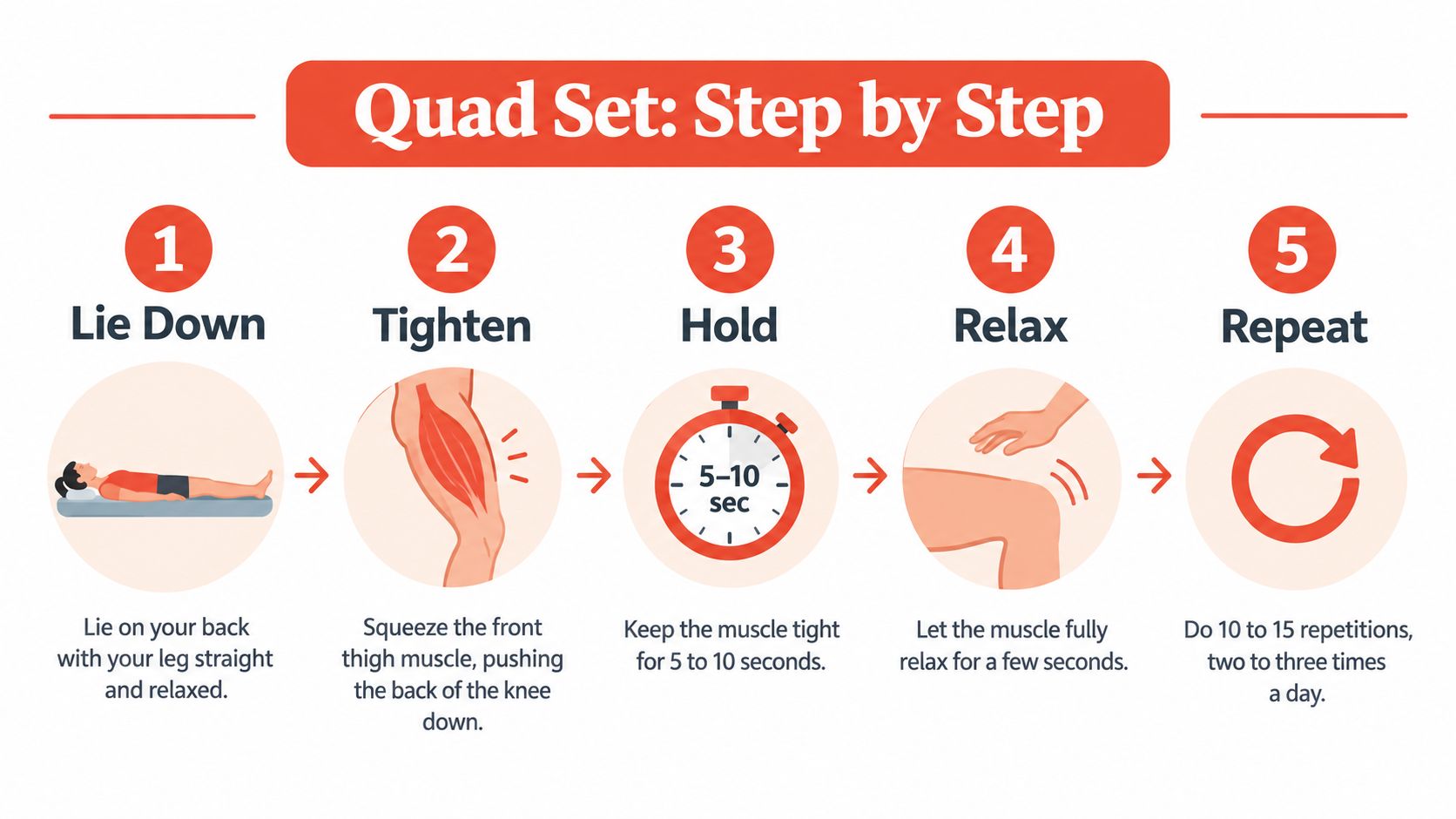
To check whether the contraction is happening, a family member can look for or gently feel the front thigh becoming firm. The back of the knee should press downward, while the buttock and lower back stay relaxed. If the leg shifts, the hip lifts, or the person holds their breath, pause and reset rather than pushing harder.
Here's a video demonstration of the exercise:
Choosing the Right Dose for Your Situation
A dose that suits one person may be too much or too little for another. The right amount depends on the injury or operation, recovery stage, pain, swelling, fatigue, and whether the thigh can make a clear contraction. After surgery, follow the treating clinician's instructions rather than using a general example.
The examples show how plans can differ. A Twin Cities Orthopedics and Minnesota Orthopedic Sports Medicine Institute rehabilitation handout recommends one set of 10 repetitions, holding each for 5 seconds, three times daily. A Mass General tendon-repair protocol describes 20 repetitions with 5-second holds at least three times daily. It also leaves postoperative restrictions to the treating clinician.
| Source | Hold Time | Repetitions | Frequency | Setting |
|---|---|---|---|---|
| Twin Cities Orthopedics / MOSMI rehabilitation handout | 5 seconds | 10 | Three times daily | Total-knee rehabilitation |
| Mass General tendon-repair protocol | 5 seconds | 20 | At least three times daily | Quadriceps or patellar tendon repair |
| Supervised clinical-trial protocol | 5 seconds, with 5-second rests | 3 sets of 10 | Two supervised sessions daily for five days | Supervised trial |
These are examples, not competing instructions for everyone. Dose is individualized: someone who tires quickly or struggles to make a steady contraction may need a different plan from someone who can perform it comfortably. A tendon repair may also come with restrictions that change the usual approach.
A useful question is: “Can I make a clear contraction at this dose without worsening my symptoms?” If not, adding repetitions may not help. The goal is a contraction the person can control, not a high count.
“Quad sets” can also mean something different in strength-training research: four sets of an exercise, rather than the isometric quadriceps-setting exercise. An umbrella review of resistance-training volume reports that a cited meta-analysis found no clear additional muscle-growth advantage from 4–6 sets compared with 2–3 sets. That evidence concerns resistance-training volume. It does not establish a standard dose for a knee-rehabilitation quad set.
Progressing From Activation to Real Strength
A clean quad set is a useful starting point, but it may not prepare someone for every task at home. Standing from a chair, managing a doorway threshold, and walking safely ask the leg to do more than tighten while lying still. Progression should follow the person's recovery and any movement restrictions, not a calendar or a family member's guess.
A clinician may consider a sequence like this:
- Quad set: Practice switching on the thigh while the knee stays still.
- Straight-leg raise: If the person can tighten the thigh and keep the knee straight, lifting the leg may add a new challenge. A clinician can help decide whether it's appropriate.
- Sit-to-stand practice: Working from a firm, stable chair connects leg effort to getting up safely.
- Step practice: With suitable support and clearance, stepping can relate directly to managing a threshold or stairs.
- Resistance exercise: More demanding strengthening may become part of the plan when the knee, symptoms, and recovery instructions allow it.
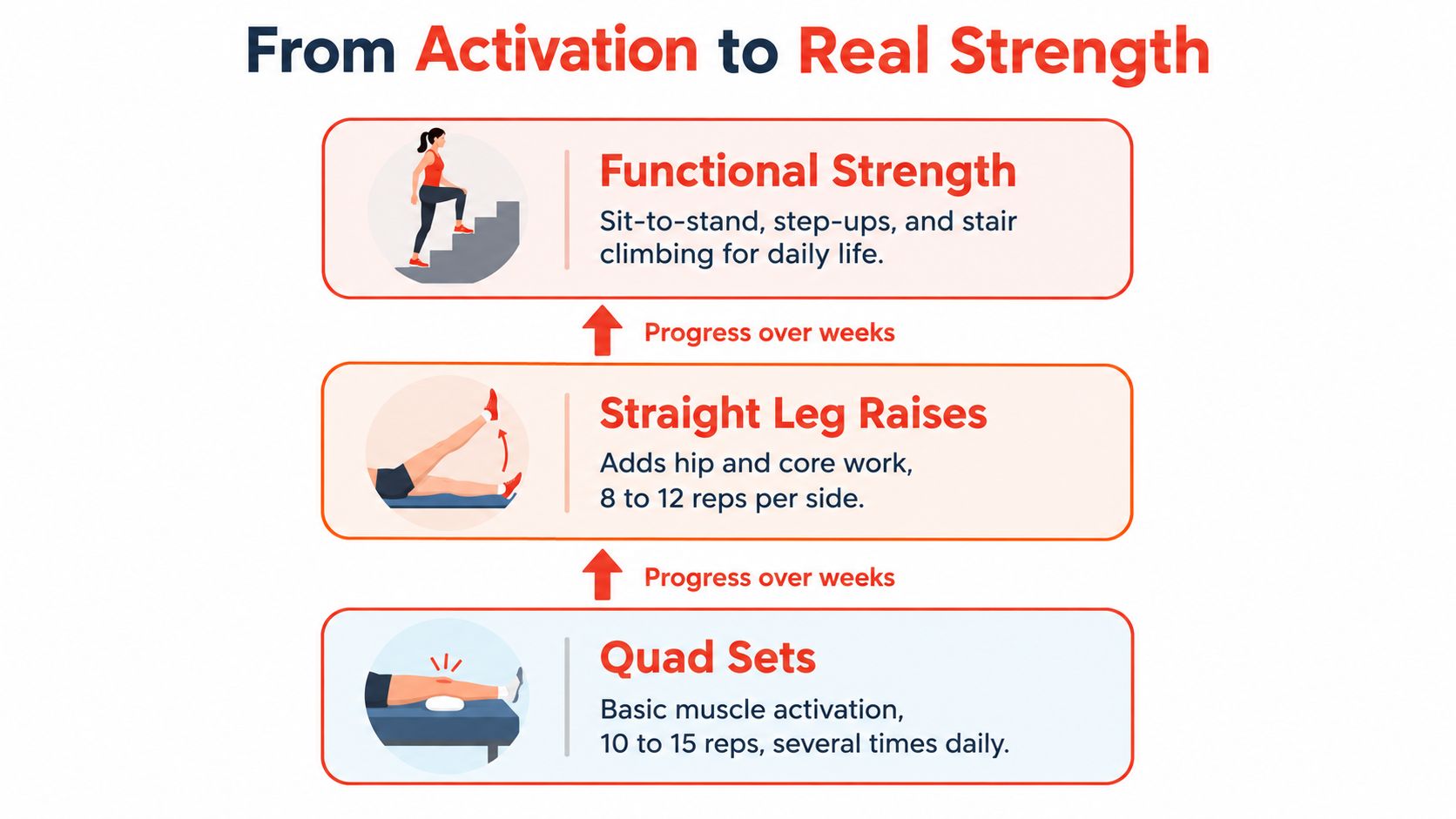
The practical goal is not to collect exercises. It's to build capacity for the movements that matter to the person, such as rising from a chair with less help or walking through the home with confidence. Pain, swelling, knee movement, and surgical instructions all affect which step makes sense. Information about arthritis and mobility may help families understand how joint symptoms can shape daily movement and care planning.
Safety Signals and When to Call a Clinician
A good quad set should feel controlled. Look for a tightening or firming in the front thigh, gentle pressure from the back of the knee, easy breathing, and no obvious lifting of the hip or tightening of the buttock to substitute for the thigh.
Don't treat every symptom as a reason to worry, but don't try to push through a clear change either. Pause and contact the treating clinician if swelling worsens, pain becomes sharp or catching, the knee starts buckling, or the person can't fully straighten it. If the thigh won't contract despite a careful effort, ask for guidance rather than adding repetitions.
A sudden or marked change in the person's ability to use the leg may need prompt assessment. If you're concerned about steadiness around the home, this fall-prevention checklist for the home can help families consider the environment alongside exercise.
Bringing It Home and Planning Your Next Step
For an older adult recovering at home, an exercise is only one piece of the picture. Limited transportation, confusing medication instructions after discharge, and a caregiver's schedule can make follow-up difficult. A clinician who sees the person at home can observe how the exercise is performed in its real setting and coordinate questions about the broader recovery plan.
Remember the main distinction: a rehabilitation quad set is a still-knee thigh contraction; four sets in a workout describes exercise volume. The knee exercise can help with activation, but it isn't a complete strengthening program. Follow the plan provided for the person's condition, and ask the care team about persistent symptoms or uncertainty about progression.
FAQ
Is a quad set the same as a quadriceps workout? Not necessarily. It can mean the isometric knee exercise or, in a training plan, four sets of an exercise.
Can a caregiver help? Yes. A caregiver can help the person get comfortable and notice whether the thigh tightens, but should follow the person's clinical instructions and avoid forcing movement.
What if I can't tell whether the thigh is tightening? Pause and ask a clinician or physical therapist to check the technique and advise on the next step.
Life Primary Care provides in-home primary care, post-hospital follow-up, chronic disease management, and urgent visits for patients across northern and central New Jersey. If travel makes it hard to get help with knee recovery or related health needs, visit Life Primary Care to learn about care at home.
Ready for a visit at home?
Call and speak with a real person. We will confirm your insurance, find a time and come to you.
973-607-4911 Call now