
Guide · 14 min read
Personalized in Home Care for Seniors: A Practical Guide
Your mother has a clinic appointment at 10 a.m., but getting there starts at 8. She needs help dressing, a walker folded into the car, oxygen checked, and someone strong enough to steady her on the front steps. By the time she reaches the exam room, she's tired, her blood pressure is up, and she's forgotten half the questions she meant to ask. That's the moment many families start searching for something different, not just closer care, but care that fits how a person lives at home.
Table of Contents
- What Personalized In Home Care Actually Means
- The Four Types of Services That Come to Your Door
- How an In-Home Assessment Really Works
- Building an Individualized Care Plan
- Benefits for Seniors and Post-Discharge Patients
- How Life Primary Care Delivers House-Call Primary Care
- Common Misconceptions and Eligibility Questions
- Deciding Whether Personalized In-Home Care Is Right for You
What Personalized In Home Care Actually Means
A clinic visit sees a snapshot. Personalized in home care sees a routine. That's the core difference families often miss when they first hear terms like house calls for seniors, in-home medical care, and at-home doctor visits used interchangeably.
Convenience matters, of course. No waiting room, no transport scramble, no rushed parking lot transfer. But convenience alone isn't personalization. A clinician could do a brief, single-issue check in a living room and still leave without understanding why medications are missed, why meals are skipped, or why a recent fall happened near the bathroom at night.
Personalization Starts With Context
Real personalization means the home becomes part of the assessment. The clinician notices the loose rug between bed and bathroom, the pill bottles stored in three different rooms, the refrigerator with little fresh food, and the spouse who looks exhausted while answering every question. None of that is visible in an office, yet all of it can change what a safe plan looks like.
This is also where families get confused about who does what. A doctor home visit for elderly patients is medical primary care. It's different from hiring a private nurse at home for skilled nursing tasks, and different again from an aide who helps with bathing or meals. Those services can complement each other, but they aren't substitutes for each other.
Moving a clinic visit into a house doesn't make it personalized. Personalization happens when what the clinician sees at home changes the plan.
An estimated 4.2 million Medicare beneficiaries were homebound in 2020, up from 5% of beneficiaries in 2011 to 13% in 2020, according to details in a Duke-Margolis policy memo on home-based primary care. That growth helps explain why visiting physicians NJ practices focus on coordination, not just location. Without coordination among primary care, specialists, caregivers, and community services, care at home can simply relocate fragmented care into the living room.
A useful working definition is this. Personalized in home care is ongoing medical care shaped by a person's conditions, function, cognition, medications, home layout, caregiver capacity, and goals, then revisited as those things change. It's not a one-off visit for a single symptom, and it isn't defined by the address where it happens.
The Four Types of Services That Come to Your Door
Families often ask for home care when they need a physician, or ask for a physician when they need daily hands-on help. Sorting the four main service types prevents that expensive confusion.
Four Services Four Different Jobs
Visiting physician primary care is what people mean by visiting doctors NJ, doctor house calls NJ, or an in home doctor for elderly patients. A physician or advanced practice clinician acts as the primary care provider, manages chronic conditions, orders labs, reconciles medications, and coordinates referrals. Visits are scheduled, ongoing, and clinical.
Medicare home health is different. It's usually short-term, skilled care ordered after a hospitalization or a change in condition. Nurses, physical therapists, and occupational therapists visit for defined goals like wound care, injections, or regaining strength. They don't replace your primary care clinician, and they work under a plan tied to a specific skilled need.
Personal care aides help with daily living. They assist with bathing, dressing, meals, light housekeeping, and companionship. They don't diagnose, prescribe, or adjust medications. Many families need this support alongside medical care, especially when a spouse can't safely help with transfers.
Hospice and palliative care focus on comfort and quality of life. Palliative care can run alongside disease-directed treatment at any stage of serious illness. Hospice is for people near the end of life who've chosen comfort-focused care.
For a deeper side-by-side explanation, this guide to home health, home care, and house calls walks through how the categories overlap and where they diverge.
| Service Type | Who Provides It | What It Covers | Typical Trigger |
|---|---|---|---|
| Visiting physician primary care | Physician or advanced practice clinician | Diagnosis, prescribing, chronic disease management, labs, coordination | Difficulty traveling, complex conditions, need for ongoing primary care |
| Medicare home health | Nurses and therapists | Skilled nursing, wound care, physical and occupational therapy | Hospital discharge or new skilled need |
| Personal care aides | Home health aides | Bathing, dressing, meals, mobility help, companionship | Trouble with daily activities or caregiver strain |
| Hospice or palliative care | Interdisciplinary comfort-focused team | Symptom control, comfort, family support | Serious illness or end-of-life care |
Practical rule: If the question is who manages my conditions and medications, you need a clinician. If the question is who helps me shower and eat safely, you need daily support. Many households need both, coordinated.
How an In-Home Assessment Really Works
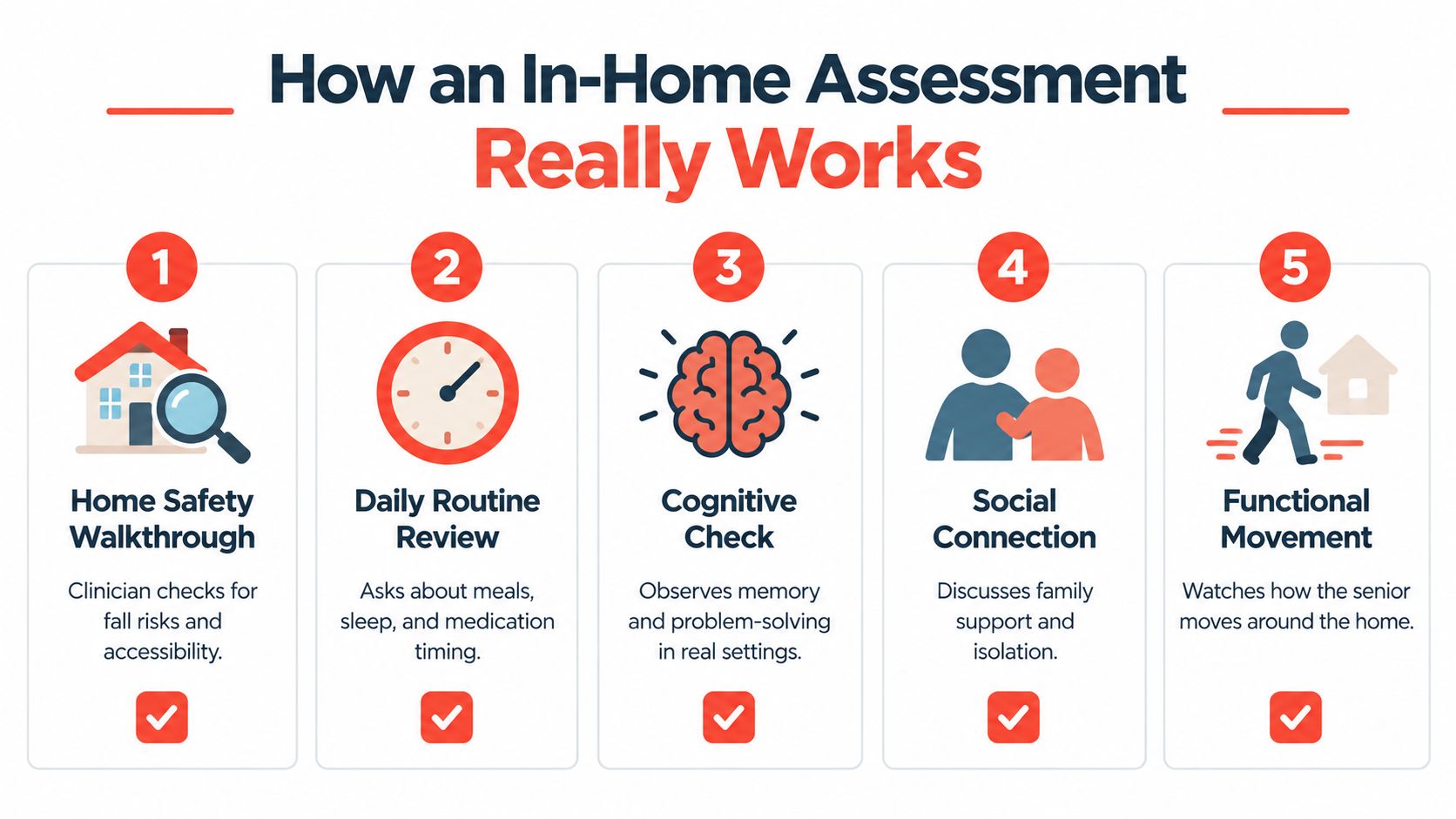
A structured home visit isn't a longer version of an office exam. For frail older adults, the strongest model is a full geriatric assessment, often shortened to CGA. It evaluates medical conditions, function, cognition, medications, mobility, nutrition, psychosocial needs, caregiver capacity, and environmental hazards, then turns those findings into an individualized plan.
The sequence below shows how those pieces fit together during a visit.
What the Clinician Watches Room by Room
At the door, the clinician notices stairs, railings, lighting, and whether a walker fits through the entry. In the living room, they watch how the patient rises from a favorite chair, turns, and walks to the bathroom. That transfer tells more about fall risk than asking whether walking feels steady.
In the kitchen, the conversation turns practical. What's in the refrigerator, who shops, who cooks, and are meals being skipped because standing at the stove is painful? On the counter, pill bottles reveal the real regimen. Some are open and current, some are duplicates from different prescribers, and some haven't been touched because the cap is hard to open or the cost went up.
The bathroom often holds the highest risk. Grab bars, shower seating, toilet height, and nighttime lighting all matter. Oxygen tubing, if present, raises its own questions about trip hazards and safe storage.
Questions You Won't Hear in a Clinic
Cognition is checked in context, not just with a score. Can the patient explain the current medication routine, find the phone, or describe what they'd do if they felt dizzy alone? Caregiver strain is assessed too, because a plan that depends on an overwhelmed spouse isn't a workable plan.
Families who want to prepare can review what to expect during a first home visit and gather medication bottles, discharge papers, and a list of specialists before the clinician arrives.
The reason this matters is prevention. Unsafe transfers, duplicate medications, and an inability to follow a regimen are often invisible in clinic encounters. Finding them at home lets the clinician correct them earlier, before they become a fall or an emergency department visit. That's the causal logic behind doctor house calls for seniors when they're done as a full assessment rather than a relocated exam.
Building an Individualized Care Plan
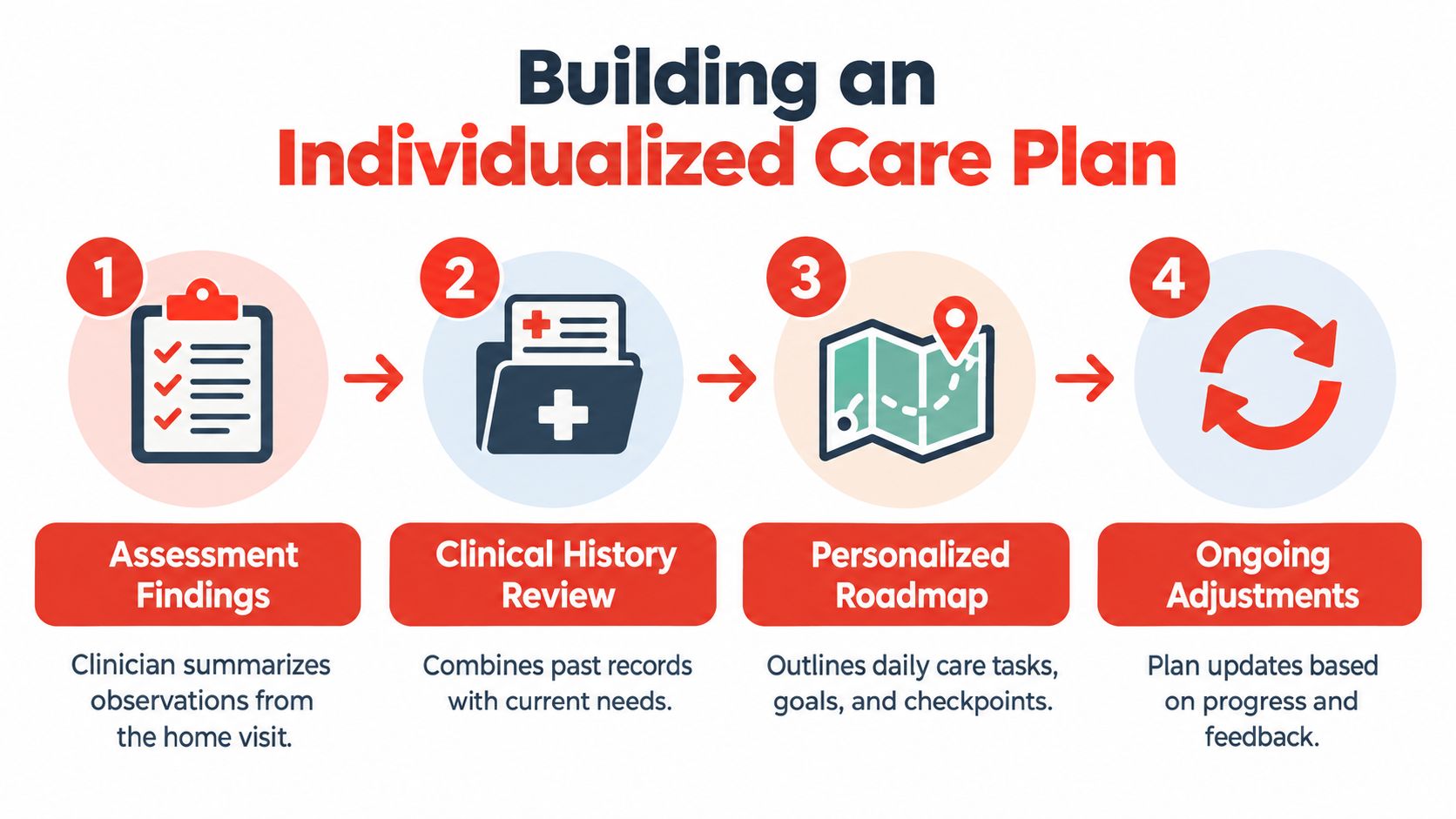
An assessment only helps if it becomes a written roadmap. A personalized plan translates observations from the home and the clinical history into priorities, clear medication instructions, follow-up timing, and warning signs everyone understands.
The flow from findings to an updated plan looks like this.
From Findings to Priorities
A good plan starts with a prioritized problem list, not a long unranked list of diagnoses. Uncontrolled blood pressure, repeated falls, poor appetite, and a confusing medication schedule can't all be solved at once. The clinician, patient, and caregiver decide what matters most, what can be monitored, and what needs a specialist or community service.
Goals should reflect what the patient values. For one person, that's staying out of the hospital. For another, it's walking to the mailbox, sleeping through the night, or reducing the number of daily pills. Those goals shape trade-offs a generic office note rarely captures.
Evidence supports building plans this way. A 2025 systematic review and meta-analysis found home-based CGA reduced hospitalization likelihood over 6 to 36 months compared with usual care (risk ratio 0.89; 95% confidence interval 0.81 to 0.98), while also improving function, quality of life, and satisfaction, as reported in the Journal of the American Geriatrics Society analysis of home-based comprehensive geriatric assessment. The same analysis didn't show a clear mortality benefit at 6 to 24 months, which is a useful reminder to judge these programs mainly on function, safety, and avoiding preventable hospital use.
Medications Get Reconciled Not Just Listed
Medication reconciliation is often the most impactful first step. The clinician builds the most accurate pre-visit list, compares it with discharge instructions and the bottles physically in the home, and looks for omissions, duplications, dose changes, and affordability or adherence barriers. The final regimen is then confirmed with the patient, caregiver, and other prescribers.
- Start and hold instructions: Written in plain language so there's no guessing after the visit.
- Follow-up cadence: When to recheck blood pressure, glucose, symptoms, or lab work, and by phone, telehealth, or in person.
- Escalation triggers: Specific changes that should prompt a call the same day rather than waiting for the next visit.
- Caregiver education points: What the family should watch, record, and report between visits.
That structure is what separates personalized in home care from reactive, single-issue visits. The plan is proactive, it's tied to the home, and it changes as the patient's function and goals change.
Benefits for Seniors and Post-Discharge Patients
Two groups benefit in different ways, and mixing them up leads to unrealistic expectations. A frail senior managing several chronic conditions needs steady monitoring over months. A patient home from the hospital needs a tight, structured transition over days.

For Seniors Managing Chronic Conditions
Consistency is the main advantage. When the same clinical team sees the patient at home on a schedule, small changes get noticed earlier. Swelling that's slightly worse, appetite that's slipping, a new bruise after a near fall, or a chair that's become too low to rise from safely. Practical details matter here, and families researching seating that supports safer standing may find Gorins Furniture & Mattress elderly chair advice useful context alongside a clinician's mobility assessment.
Earlier intervention doesn't guarantee a hospital stay is avoided. It does give the clinician a chance to adjust treatment, order in-home labs, or arrange therapy before a small problem compounds. For people with heart failure, COPD, diabetes, chronic kidney disease, or dementia, that steady oversight is the point of house calls for seniors as primary care, not as an occasional convenience.
For Patients in the First Days After Discharge
The post-hospital window is where medication errors do real harm. Discharge lists change doses, stop some drugs, and add others, while the bottles at home still reflect the old routine. A transitional visit that checks actual bottles and administration routines closes that gap. A structured hospital-to-home transition should also confirm warning signs, follow-up appointments, and who to call first.
The evidence needs careful reading. AHRQ's primer on medication reconciliation notes that pharmacist-led reconciliation can prevent discrepancies and potential adverse drug events, but reconciliation alone hasn't consistently reduced readmissions. Stronger results come when it's combined with education, clinical review, and proactive follow-up.
One evaluated intervention in a review of hospital-based medication reconciliation practices reduced the odds of all hospital visits by 16% over 12 months (odds ratio 0.84; 95% confidence interval 0.72 to 0.99), with a 47% reduction in emergency department visits and an 80% reduction in drug-related readmissions in that particular study. Those figures don't apply to every program, but they show why careful review matters most for older adults with several prescribers.
Reconciliation by itself is a list-cleaning exercise. Reconciliation plus education and follow-up is transitional care.
How Life Primary Care Delivers House-Call Primary Care
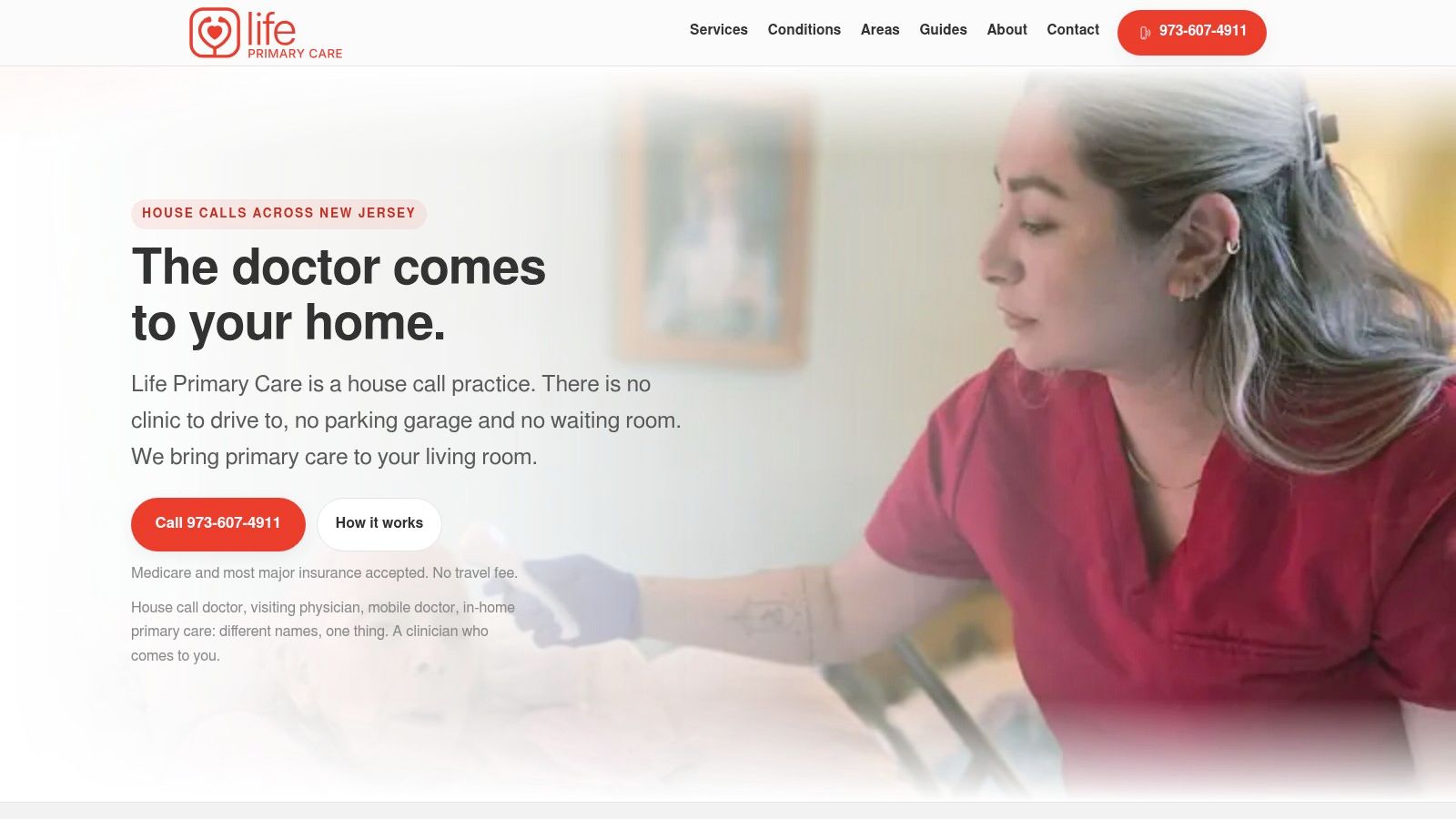
To make this concrete, here's how one visiting physicians NJ practice structures the model. Life Primary Care is a house-call primary care practice serving northern and central New Jersey, with a coordination office in East Hanover that handles scheduling, insurance verification, and follow-up. Patient care happens exclusively at home, in private houses, apartments, family residences, and assisted living communities.
The screenshot below shows the practice's home page and how families start the intake process.
What a Visit Includes
Visits typically last 45 to 60 minutes. A clinician arrives with a portable exam kit and the patient's chart prepared, takes a history, performs an exam, reviews the home environment, and checks medication bottles. Services include primary care, chronic disease management for conditions such as diabetes, heart failure, COPD, hypertension, chronic kidney disease, and high cholesterol, plus Medicare Annual Wellness Visits, post-hospital transitional care, geriatric and dementia care, and palliative care focused on comfort alongside disease-directed treatment.
Diagnostics happen at home where possible. That includes phlebotomy, EKGs, urine testing, and coordination of mobile X-ray and ultrasound. Urgent same-day visits for non-emergency problems are available for established patients, and telehealth follow-ups check progress between in-person visits. New patients are generally scheduled within a few business days.
Watch the short video below for an overview of how dr house calls NJ visits are coordinated from first call to follow-up.
Coverage and Payment in Plain Terms
Coverage spans Morris, Essex, Union, Somerset, Passaic, and Bergen counties. Medicare and most major insurers are accepted, with no travel fee, concierge fee, or membership charge. The practice is independent of hospital systems and coordinates with any hospital or specialist already involved, which matters when a patient has cardiology, nephrology, and primary care all prescribing at once.
Whether families search for visiting docs, doctor home visits for elderly relatives, or doctor house calls for seniors, the day-one picture is the same. Care is delivered where the patient lives, results and plans are communicated by phone, and referrals, labs, and next visits are arranged before the clinician leaves.
Technology has a defined, limited role in this model. Telehealth works well for checking symptom response, reviewing results, and confirming a medication routine is holding. It can't watch a transfer, inspect pill bottles, draw blood, or assess a bathroom. For patients with dementia or limited digital access, that distinction is protective. A JMIR Aging discussion of digitally enabled direct care notes that more than half of commonly identified direct-care tasks were considered potentially digitally enabled, while also flagging privacy, dignity, consent, and reduced human contact as risks. Monitoring should stay optional, with a clear answer to who receives alerts, how fast they're reviewed, and what happens when the internet fails.
Common Misconceptions and Eligibility Questions
Most families delay calling because of three assumptions. They think they're not sick enough, they think Medicare won't cover it, or they think accepting house calls means giving up every other doctor. Each assumption deserves a direct answer.
Homebound Has a Specific Medicare Meaning
Homebound doesn't mean bedbound, and it doesn't mean never leaving the house. Under Medicare's home health compliance guidance, a patient generally must need a cane, walker, wheelchair, crutches, special transportation, or another person's assistance to leave home, or have a condition for which leaving is medically inadvisable. The person must also be normally unable to leave home, and doing so must require a considerable and taxing effort.
Occasional departures don't automatically disqualify someone. Trips for medical care, religious services, adult day care, or infrequent events are allowed within that definition. If getting to an office requires substantial effort, help from another person, or worsens the condition, it's worth asking rather than self-disqualifying.
Other Questions Families Ask First
- Does this replace my current doctor? A visiting physician usually becomes the primary care clinician and coordinates with specialists. Ask how records and results will be shared so nothing falls between practices.
- Is it only for the very ill? No. It's built for people with mobility limits, oxygen needs, transportation barriers, multiple chronic conditions, or dementia, including people who are stable but can't reliably reach an office.
- Is a house call the same as an urgent visit? No. A one-time urgent visit treats a single problem. In-home primary care is longitudinal, with scheduled follow-up, preventive care, and medication oversight. Emergencies still belong in an emergency department.
- What does it cost with Medicare? Coverage depends on the service and your plan, so insurance verification before the first visit matters. Ask specifically about travel, concierge, or membership fees, since models differ.
Three questions cut through most uncertainty on a first call. Which counties do you cover, how quickly can a first or post-discharge visit happen, and who do we call between visits when something changes? Clear answers signal a coordinated practice. Vague answers signal a visit service, not primary care.
Deciding Whether Personalized In-Home Care Is Right for You
Consider personalized in-home care when travel to appointments requires substantial effort or another person's help, when several chronic conditions and prescribers overlap, after a recent hospitalization, or when caregiver strain is becoming unsafe. It's less fitting for emergencies or for someone who travels easily and prefers office-based care.
Before a first call, gather medication bottles, recent discharge paperwork, and your specialist list. Then ask about coverage area, timing, insurance verification, and between-visit contact. That preparation turns a general inquiry into a specific next step, and it gives the clinician what they need to build a plan around your home, not just your diagnoses.
If getting to a clinic has become the hardest part of staying healthy, Life Primary Care brings full-scope primary care, chronic disease management, in-home labs, and post-hospital follow-up directly to homes across six New Jersey counties, with Medicare accepted and no travel or membership fees. Visit Life Primary Care to check coverage in your county, verify insurance, and request a first in-home assessment built around how you live.
Ready for a visit at home?
Call and speak with a real person. We will confirm your insurance, find a time and come to you.
973-607-4911 Call now