
Guide · 11 min read
Medications Review Guide for In-Home Care
A parent calls after an older relative returns home from the hospital. The discharge folder is on the counter, three new prescriptions are in a pharmacy bag, and the kitchen cabinet still contains bottles from several specialists. One label says to stop a medicine. Another bottle contains what appears to be the same drug under a different generic name. No one is certain which instructions are current.
That situation is common in home-based care, and it shows why a medications review must go beyond copying a pharmacy list into an electronic record. Safe medication management depends on seeing what the patient possesses, how the medicines are stored, who administers them, and whether the patient or caregiver understands the plan. For families searching for Visiting physicians NJ, Visiting Doctors NJ, or Doctor house calls NJ, the most useful question is not whether a clinician can review the chart. It is whether the clinician can review the medication environment where daily care takes place.
Table of Contents
- Why In-Home Medication Safety Requires More Than Chart Review
- Inspecting the Physical Medication Environment
- Reconciling Conflicting Prescriber Instructions
- Setting Realistic Expectations for Deprescribing
- Coordinating Post-Discharge Transitional Care
- Preparing for a Visiting Doctor and Ongoing Safety
Why In-Home Medication Safety Requires More Than Chart Review
During a home visit, a caregiver may describe a correct regimen while handing over a pill organizer filled from an outdated prescription. The hospital record shows the intended treatment, but it cannot show the half-used inhaler in the bathroom, expired tablets in a drawer, or an old bottle still being used because the medication change was unclear. A pharmacy profile may also omit samples, supplements, over-the-counter products, medicines filled elsewhere, and prescriptions from specialists outside the same health system.
A visiting clinician can compare the bottles, pill organizer, and discharge paperwork in the place where medications are given. The patient can demonstrate how pills are sorted, whether a tablet is difficult to swallow, and which instructions cause hesitation. The caregiver can explain the morning and evening routine, including which prescriber gave each instruction.
Practical rule: A medication list is a starting document, not proof that the patient is taking the medicines safely.
This work is a clinical safety process, not a transcription task. A systematic review found that medication reconciliation identified unintentional discrepancies in 3.4% to 98.2% of patients, while medication reviews identified medication-related problems or possible adverse drug reactions in 17.2% to 94.0% of patients. The review also explains how omissions, duplications, and dosing conflicts can arise during admissions, transfers, and discharges. (Evidence on medication reconciliation and medication review)
For an older adult who cannot travel easily, an In Home Doctor for Elderly service can assess the conditions that shape medication use. Mobility, oxygen equipment, lighting, stairs, bathroom access, food intake, and caregiver routines may determine whether a written regimen works safely at home. These observations give the clinician a basis for clarifying instructions with the appropriate prescribers.
Families can prepare for an in-home appointment with this medication management guide for seniors. If treatment involves lines or access devices, an IV infection prevention guide can explain why clean handling matters. Doctor home visits for elderly patients bring medication review to the setting where instructions become daily actions.
Inspecting the Physical Medication Environment
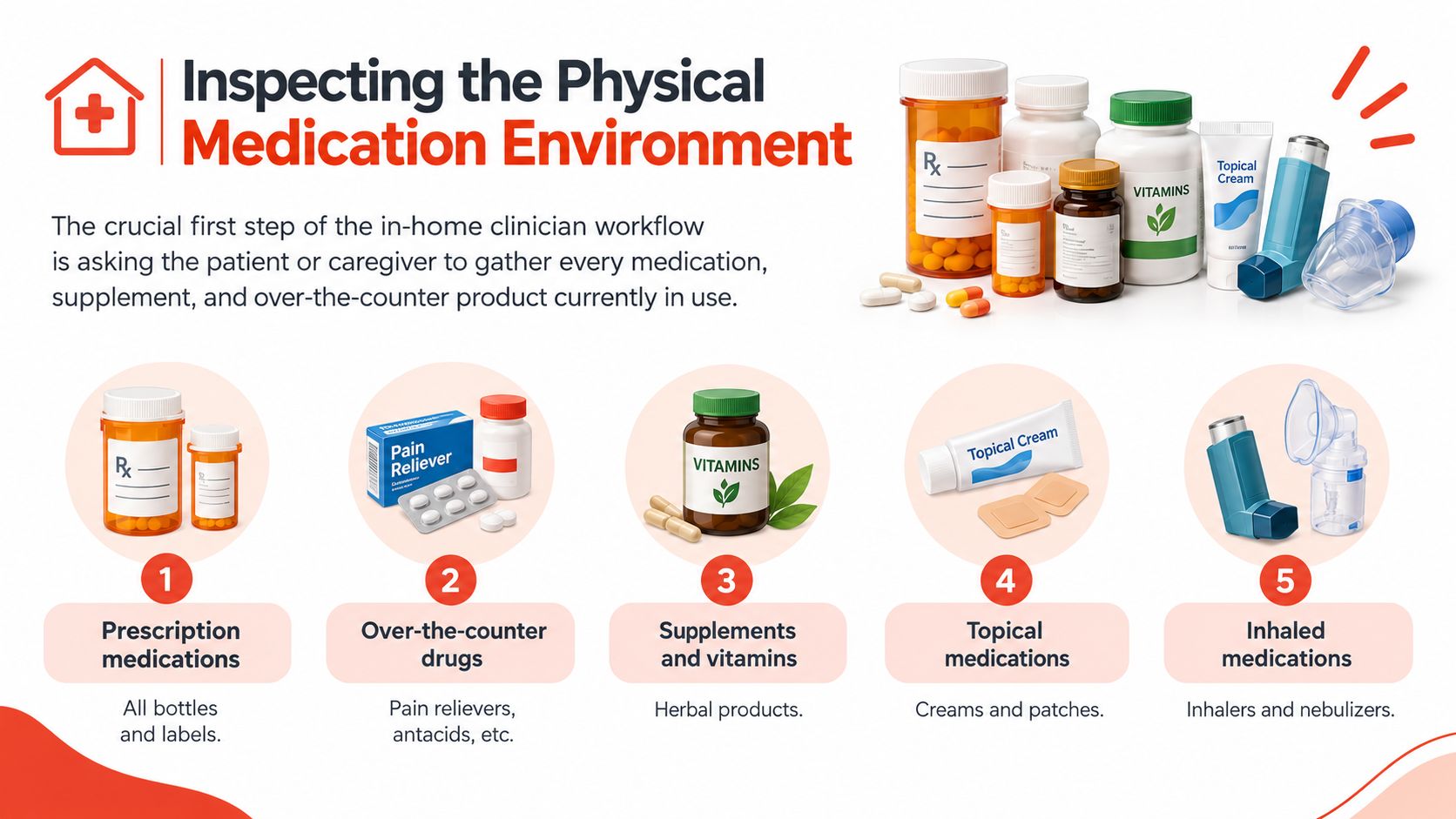
A proper home medications review starts with one request: gather everything. Don't bring only the medicines listed on the discharge summary. Ask the patient or caregiver to place every prescription bottle, pill organizer, inhaler, patch, cream, eye drop, vitamin, herbal product, pain reliever, antacid, and other over-the-counter medicine on one table.
This approach exposes problems that a chart-only review can miss. In a community study of older patients, 42.0% reported adverse events, 27.6% had difficulty preparing, administering, or swallowing medicines, 40.7% had expired medications, 20.4% had redundant medications, and 19.9% had multiple generic versions of the same drug. The study also identified potentially inappropriate medications in 15.0% of participants. (Study of the medication environment in older adults' homes)
What the clinician checks
The review should be physical and deliberate, not a quick glance at the labels.
- Prescription bottles: Compare the medicine name, strength, directions, and prescribing clinician with the current medication list.
- Over-the-counter products: Look for duplicate pain relievers, sedating products, stomach medicines, and cold remedies that the patient may not consider “medications.”
- Supplements and vitamins: Record herbal products and vitamins because patients often leave them off formal lists.
- Topical and inhaled treatments: Include creams, patches, inhalers, nebulizer solutions, eye drops, and other products that don't appear in a pill organizer.
- Storage and dates: Check expiration dates, heat and moisture exposure, child safety, and whether the patient can open and read each container.
The clinician should ask the patient to show how each medicine is taken. A bottle can have accurate directions while the actual routine differs because the patient can't swallow the tablet, mistakes morning and evening doses, or believes an old instruction still applies. A caregiver may also be splitting tablets, combining pills in an unlabeled container, or administering a medicine that was discontinued during hospitalization.
Families can review the medication reconciliation steps before the visit so they know what to collect. Don't discard questionable medicines on your own if you're unsure whether they remain necessary. Set them aside for the clinician or pharmacist to identify, then follow the disposal plan they provide.
Reconciling Conflicting Prescriber Instructions
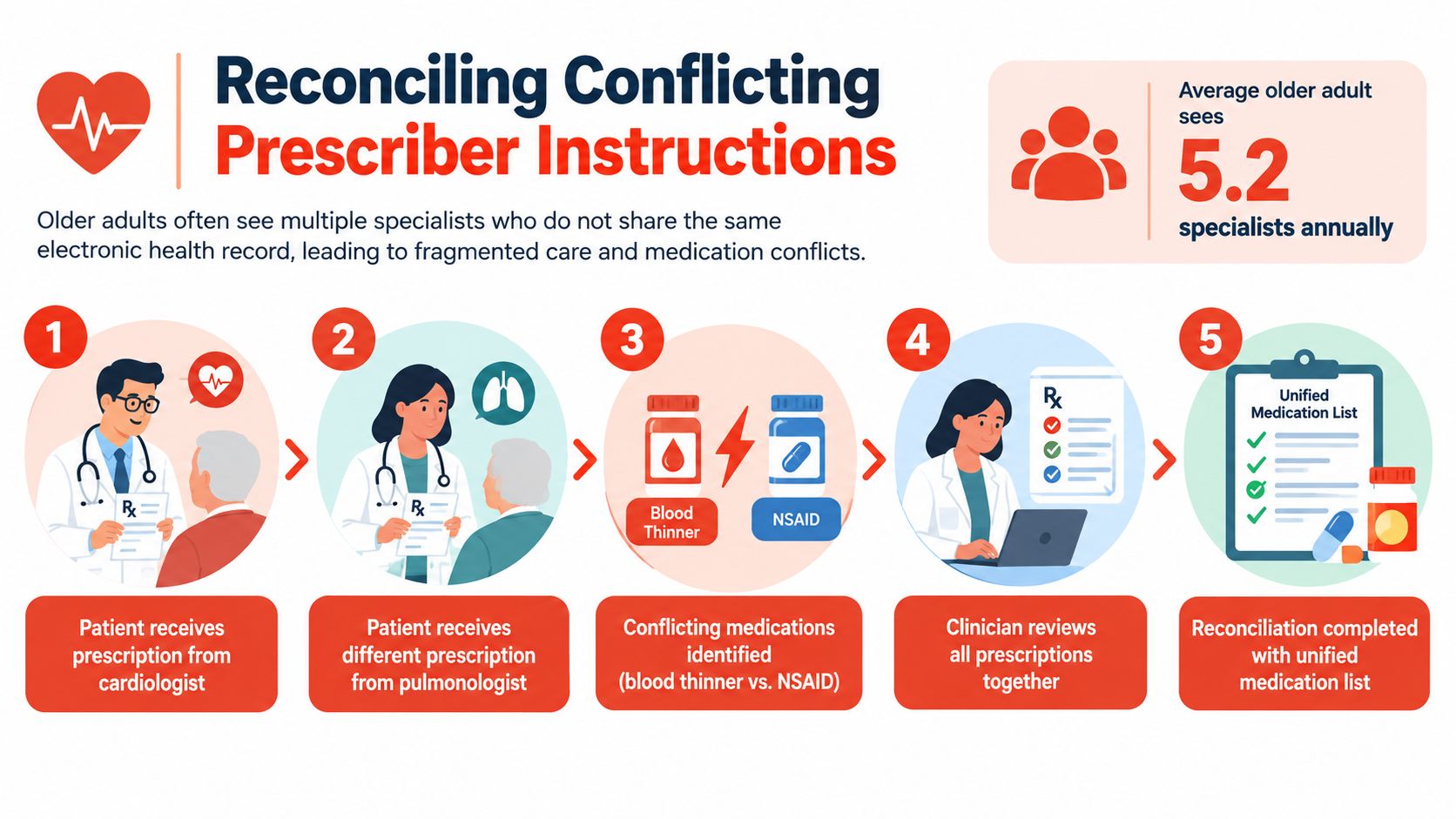
At the kitchen table, a patient may have a cardiology medication list, a pulmonology instruction, and an older bottle being used as usual. Each prescriber may have made a reasonable decision for one condition. The risk appears when those decisions meet in the home and nobody has confirmed which instructions belong together.
The clinician builds a best possible medication history from the patient's actual routine, not from one record. Bottles, pharmacy information, discharge papers, specialist notes, caregiver observations, and the patient's account all provide pieces of the history. The practical questions are: What is being taken? When is it taken? Who instructed it? What does the patient believe it treats?
A systematic review of pharmacist-led reconciliation reported fewer medication discrepancies than standard care, reinforcing the value of checking instructions across sources rather than just printing a cleaner list. (Systematic review of pharmacist-led medication reconciliation) The review supports a method of comparison and clarification, not automatic changes to treatment.
A kitchen-table reconciliation
A visiting clinician may find that one prescriber continued a medicine another intended to replace, or that a discharge instruction never reached the patient's regular doctor. The clinician contacts the appropriate prescriber or pharmacist before the patient changes anything. Some medicines are intended together. Others require a clear stop date, revised dose, or explanation of which instruction takes priority.
The final plan should use plain categories:
- Continue: Take the medicine as directed.
- Stop: The prescriber has confirmed that it is no longer part of the plan.
- Change: The dose, timing, route, or frequency is different.
- Clarify: Hold the change until a prescriber or pharmacist confirms the instruction.
Teach-back tests whether the plan works in real life. Ask the patient or caregiver to explain what will be taken tomorrow morning, what happens later in the day, and what changed after discharge. Their answer can expose conflicting labels, forgotten instructions, or an impractical schedule before harm occurs.
A unified written list should name the medicine, purpose, instructions, and prescribing clinician. Families can use this medication reconciliation form to record where each instruction came from and which questions remain open. The form organizes the evidence, but clinical judgment and direct prescriber communication determine the safe plan.
Setting Realistic Expectations for Deprescribing
A family may ask during a home visit, “Can we get rid of these pills?” The bottles on the kitchen table can make the goal feel obvious, especially when the patient is tired of swallowing medicines or a caregiver is struggling with the schedule. Fewer medicines may help, but pill count alone does not show whether treatment is working. Kidney function, mobility, cognition, swallowing ability, and changing health goals can all alter the balance between benefit and burden.
Deprescribing is not a medication purge. It is a structured decision about whether each medicine still provides enough benefit to justify its risks, side effects, and practical demands. Depending on that assessment, the prescriber may stop a medicine, reduce it gradually, change its timing, replace it, or continue it because the expected benefit remains meaningful.
Recent reviews found only small reductions in medication count among community-dwelling older adults. A 2025 review concluded that structured medication review often lowers polypharmacy or the use of potentially inappropriate medicines, while showing little consistent effect on hospital admission, falls, quality of life, or mortality. (Review of medication review and deprescribing outcomes)
Families should use that evidence to set a realistic goal. Removing one duplicative medicine, reducing sedating effects, or resolving a dosing conflict may prevent a particular problem without producing a dramatic change in every health outcome. A smaller regimen is useful only when it remains safe and workable in the patient's home.
Shared decisions should address practical questions: Does the medicine support a current health goal? What benefit should the patient expect, and over what period? Could it worsen dizziness, confusion, constipation, appetite, sleep, or swallowing? Does stopping require a taper or monitoring plan? Which clinician will reassess the change?
Patients should not stop prescription medicines independently, particularly those that can cause withdrawal or rebound symptoms. The plan should identify the responsible prescriber, the next monitoring point, and symptoms that require a call.
For some patients, success means a schedule the caregiver can follow, clearer labels, fewer duplicate products, and treatment that matches the patient's priorities. Medication review works best as individualized harm reduction, not as a promise of a clinical miracle.
Coordinating Post-Discharge Transitional Care
A patient can leave the hospital with a correct discharge list and still face medication danger that evening. An old bottle may remain beside the new one, the caregiver may misunderstand the revised timing, and the outpatient clinician may not receive the hospital's reasoning. Transitional care connects the written plan to the patient's actual home, with education, communication, and follow-up built around what the patient can do.
A 2021 systematic review found that medication review alone did not significantly reduce readmissions. A bundled approach combining medication reconciliation, patient education, and transitional care lowered all-cause readmission risk by 55%, while a broader bundle that included professional education and transitional care lowered risk by 36%. (Systematic review of medication review and transitional care)
The practical question is whether the plan works after the clinician leaves. Can the patient identify the medicines that changed? Can the caregiver prepare the doses correctly? Are symptoms improving, and does the outpatient team know what happened?
The first days at home
During an early post-hospital visit, inspect the bottles in the home and compare them with the discharge list and specialist instructions. Review the diagnosis, medication changes, pending tests, refill access, swallowing ability, mobility, cognition, food access, and the patient's ability to follow the schedule. Ask the patient or caregiver to demonstrate the routine through teach-back rather than merely asking whether it is understood.
Unresolved questions should go to the hospital team, primary clinician, pharmacist, or specialist. Follow-up should be arranged before a complicated plan is left entirely to the patient or family.
Guidance on hospital-to-home transitions identifies medication management, communication with outpatient clinicians, and patient outreach by telephone or home visit as core parts of safer discharge planning. (Guidance on hospital-to-home transitional care)
The Joint Commission advises referral for home health services when appropriate for patients discharged with new medicines, along with a primary-physician appointment within the next week when the patient is physically able. (The Joint Commission guidance on post-discharge follow-up) Patients who cannot travel may use At-Home Doctor Visits to review medications in the living room instead of waiting for transportation.
Language differences can create errors during discharge. Families coordinating care across languages can use a practical resource to avoid medication errors with translation when reviewing instructions with a patient or caregiver. Clear communication is part of medication safety.
Preparing for a Visiting Doctor and Ongoing Safety
A productive home visit begins before the clinician arrives. Put every medication in one place, including items stored in another room or carried in a purse. Keep the latest discharge summary, specialist notes, pharmacy printout, insurance information, and hospital contact details nearby.
Write down what the patient experiences. A short symptom diary can show whether dizziness follows a morning dose, whether nausea affects eating, or whether confusion appears after a medication change. Don't rely on memory during a stressful appointment.
A simple preparation checklist
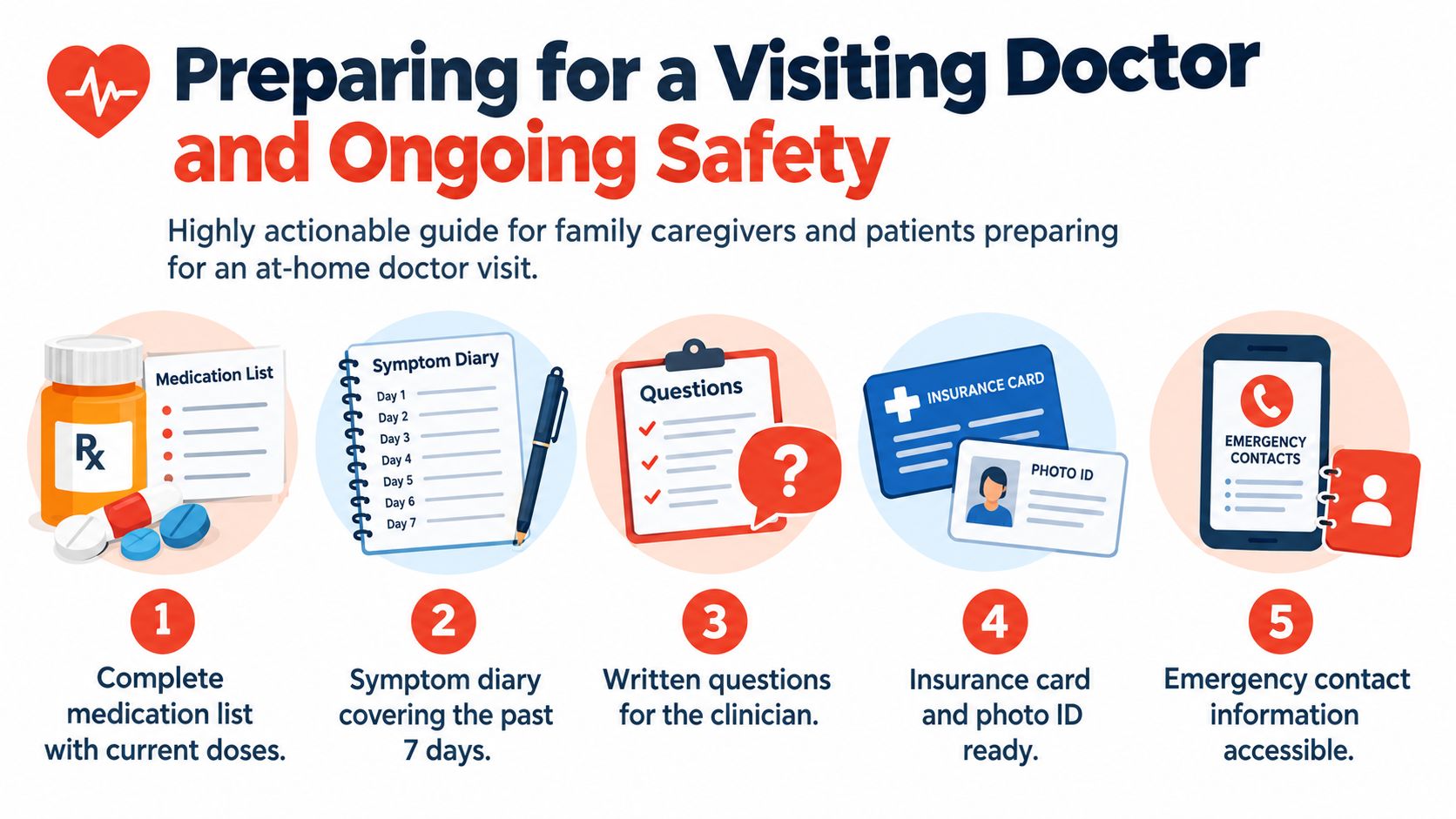
- Gather the complete supply: Include prescriptions, over-the-counter products, vitamins, supplements, inhalers, patches, creams, and eye drops.
- Record current use: Note the dose and time the patient takes each medicine, not only the directions printed on the bottle.
- Write specific questions: Include suspected side effects, missed doses, swallowing problems, refill concerns, and instructions that conflict.
- Prepare documents: Have the insurance card, photo ID, discharge papers, and specialist contact information available.
- Keep emergency details accessible: Provide caregiver names, phone numbers, allergies, and the preferred emergency contact.
Between visits, use one updated medication list and remove discontinued instructions from the places where caregivers may find them. Ask the clinician or pharmacist how to dispose of medicines that are no longer used. Telehealth follow-ups can help check progress, answer questions, and coordinate prescription refills, while the East Hanover scheduling office can manage appointments, insurance verification, and follow-up concerns for patients receiving care through the practice.
For families comparing Visiting Docs, House calls for seniors, or Doctor House Calls for Seniors, the important distinction is whether the service examines the whole home routine and communicates with every relevant prescriber. A medication review should leave the patient and caregiver with a plan they can explain, follow, and safely revisit as health needs change.
Life Primary Care provides in-home primary care, post-discharge medication reconciliation, chronic disease management, diagnostics, and telehealth follow-ups for patients across northern and central New Jersey. Visit Life Primary Care to arrange coordinated care at home and discuss a medications review with a visiting clinician.
Ready for a visit at home?
Call and speak with a real person. We will confirm your insurance, find a time and come to you.
973-607-4911 Call now