
Guide · 15 min read
Medication Reconciliation Form Template and Guide
Your parent comes home after a hospital stay with a new discharge list in one hand and several pill bottles on the kitchen counter. The names don't match perfectly. One bottle isn't on the list, a familiar medication has a different dose, and nobody can remember whether the evening dose was already taken. This is the moment when a medication reconciliation form becomes more than paperwork. It becomes a practical safety tool for comparing what the patient uses with what the care team intends.
Table of Contents
- Introduction to Medication Reconciliation and Why Forms Matter
- What a Medication Reconciliation Form Is and What It Must Capture
- Essential Categories and Fields for a Complete Form
- Printable Medication Reconciliation Template You Can Use at Home
- Filled Example Showing How to Reconcile Multiple Lists
- How to Use the Form Across Transitions of Care
- Common Pitfalls and How to Avoid Them
- In Home Medication Reviews and Quick Reference Resources
Introduction to Medication Reconciliation and Why Forms Matter
A discharge list sits beside pill bottles, pharmacy printouts, and a caregiver's routine. The names or doses may differ, and someone may be unsure whether the evening medicine was already taken. Medication reconciliation provides a step-by-step way to compare these sources, resolve differences, and record the plan.
The process applies during admission, transfer, and discharge, when information moves between hospitals, specialists, primary care practices, pharmacies, rehabilitation settings, and home. The AHRQ medication reconciliation primer describes it as compiling and comparing medication information so discrepancies can be identified and resolved.
Medication reconciliation became a formal patient-safety priority in major health systems in the mid-2000s. The Joint Commission added it to its National Patient Safety Goals in 2005, then incorporated it into National Patient Safety Goal #3 in July 2011, which focused on safer medication use. That history explains its place in hospital, home-health, and outpatient workflows.
A medication list records what someone reports taking. A reconciliation record also shows the name, dose, route, frequency, purpose, last dose, information source, comparison with new orders, and action taken when the lists disagree. At the kitchen table, the form works like a checklist: verify each bottle, ask how the caregiver gives it, and mark whether the medicine is continuing, changing, or stopping.
Practical rule: A blank or copied-forward list does not prove reconciliation occurred. The record should show what was compared, what changed, and who verified it.
Transitions of care are especially vulnerable to discrepancies. One systematic review found discrepancies involving 61.2% of medications on admission, including 18.3% unintentional discrepancies that met the definition of medication error, and found that 88% of admission discrepancies persisted through hospitalization (AHRQ medication reconciliation primer). The form therefore needs to guide an active conversation, not merely store a list.
For families arranging House calls for seniors, an accurate form gives the visiting clinician a shared starting point. It connects discharge instructions with the bottles at home, the caregiver's regimen, and records held by other providers. Patient-completed forms can miss stopped medicines, duplicate bottles, or instructions the caregiver follows differently, so verification at home remains part of the workflow.
What a Medication Reconciliation Form Is and What It Must Capture
A medication reconciliation form is a structured record used to document the patient's current regimen, verify the information, compare it with new therapy, and record how discrepancies were handled. It should include prescription medications, over-the-counter products, vitamins, herbal products, and other remedies the patient uses, not only the prescriptions visible in an electronic chart.
CMS defines medication reconciliation as identifying the most accurate list of medications a patient takes, including the name, dosage, frequency, and route, by comparing the medical record with an outside list obtained from the patient, hospital, or another provider (CMS medication reconciliation guidance). The outside source matters because a chart may not reflect a recent specialist change, a hospital instruction, or a medication that the patient stopped taking.
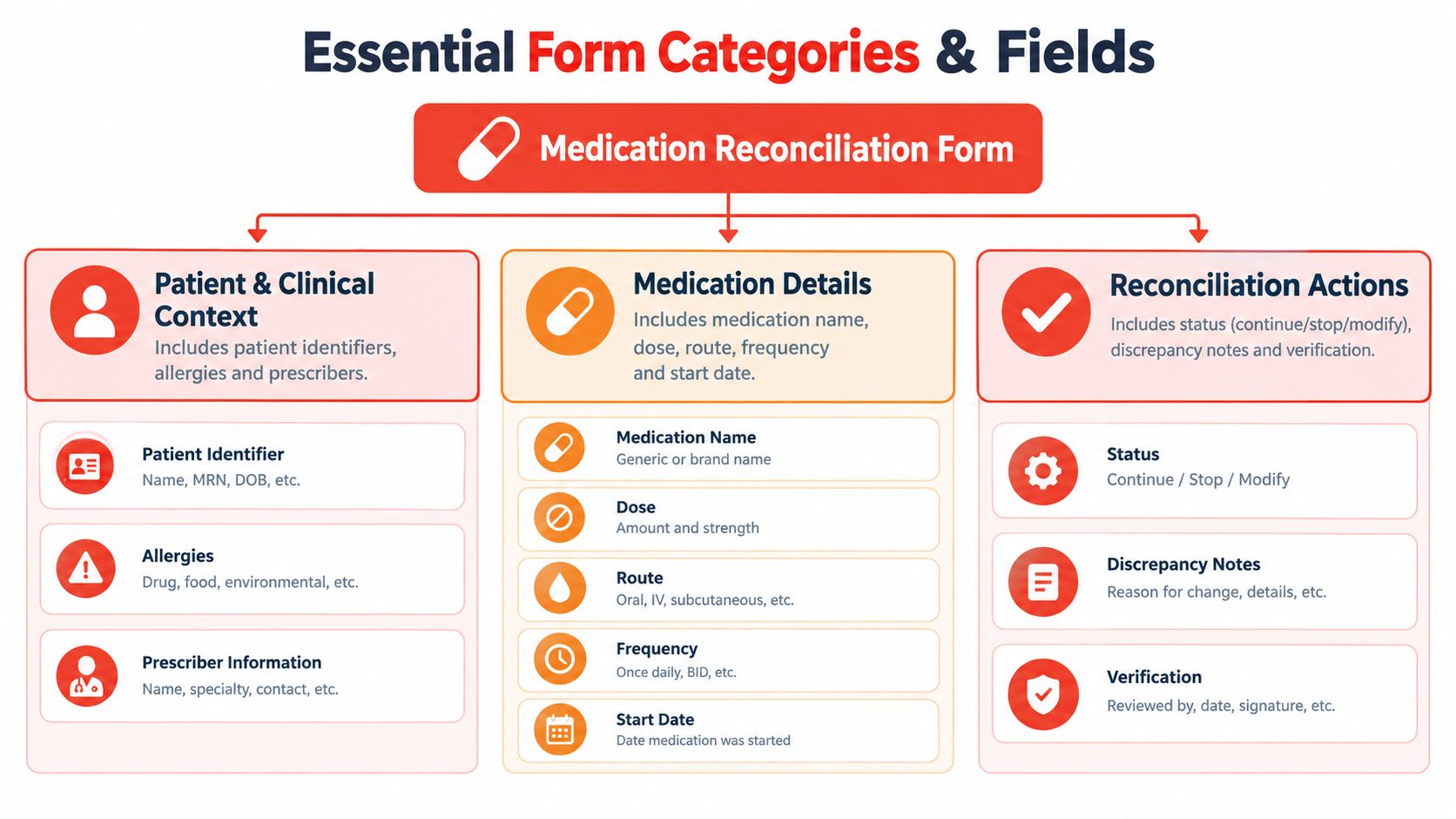
The core fields
At minimum, write each medication as a complete instruction rather than as a name alone:
- Medication name: Record the full name, including brand or generic wording when needed for identification.
- Dosage: Include the strength and the amount the patient takes.
- Route: Note how it is administered, such as by mouth, inhaled, topical, or another documented route.
- Frequency: Record the schedule, including any as-needed direction.
- Purpose: State the condition or symptom the medication is intended to address.
- Last dose: Write when the patient last took it, including the date and time when known.
- Source: Identify whether the information came from the patient, caregiver, pill bottle, pharmacy, hospital record, or prescriber.
CMS and quality-measure guidance also calls for the date the reconciliation was performed, the current medication list, and evidence that current and discharge medications were reconciled or that the discharge medications were explicitly referenced (CMS measure guidance).
What makes it different from an informal list
An informal list might say, “blood pressure pill, morning.” A reconciliation record asks which medication, what dose, which route, how often, why it is used, when it was last taken, and how the information was verified. It also includes a status such as continue, stop, hold, or modify, with the responsible clinician documenting the decision.
The Joint Commission frames reconciliation as comparing what the patient is taking with what is ordered, resolving discrepancies, and giving the patient written medication information at discharge (Society of Hospital Medicine medication reconciliation guide). Families don't need to make prescribing decisions themselves. Their role is to bring accurate information, identify uncertainty, and make sure unresolved questions reach the appropriate clinician.
Essential Categories and Fields for a Complete Form
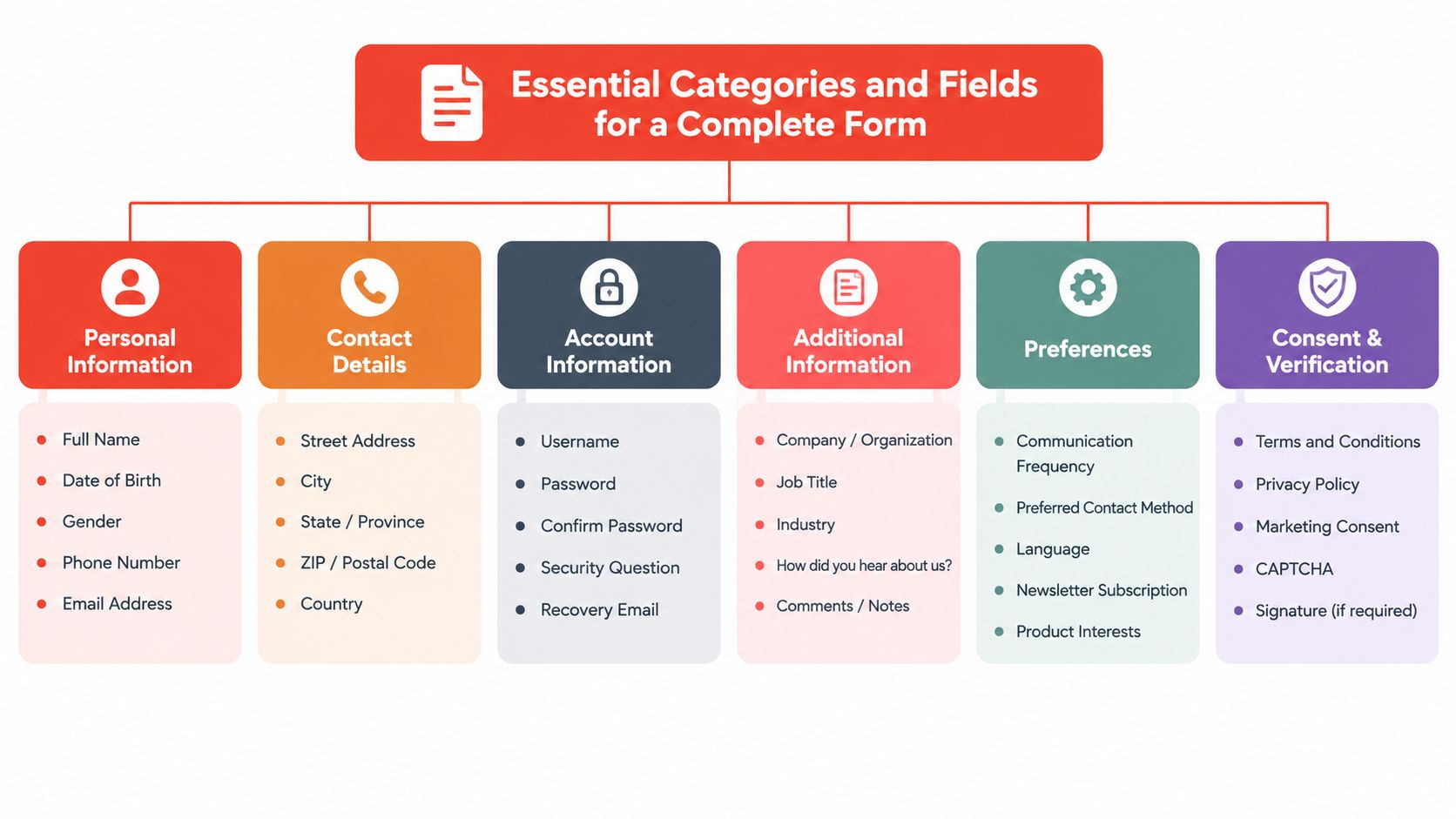
At the kitchen table, the form should guide a safety check, not merely store a list of pills. Start by confirming the person, then compare the bottles, caregiver routine, and clinical instructions. Record what is being taken, what was intended, and what still needs a clinician's answer. A medication-only list cannot show those differences.
Patient and support information
The first fields identify the person and explain who manages the routine:
- Patient identifiers: Record the name, date of birth, address, and review date so the form is matched to the correct record.
- Allergies and intolerances: Enter the substance and reaction when known. Use “No known allergies” only after that status has been confirmed.
- Prescriber contacts: List the primary care clinician, specialists, and phone numbers needed to resolve a discrepancy.
- Pharmacy details: Include the pharmacy name and contact information for checking products, directions, and dispensing history.
- Medication responsibility: State whether the patient takes medicines independently, receives reminders, or depends on a caregiver for administration.
The FIP toolkit includes fields for identifiers, allergies and intolerances, pharmacy and primary care contacts, responsibility for medication management, adherence, health literacy, recent changes, and lifestyle factors such as smoking and alcohol use.
A caregiver's routine belongs on the form because the prescribed schedule and the actual home routine may differ. The form should make that difference visible without assigning the caregiver a prescribing role.
Medication details and recent changes
For each medicine, record the name, dose, route, frequency, purpose, and last dose. Add the start or change date when available, particularly after a hospital stay or specialist appointment. A separate “recent changes” area should state what changed, when, who instructed the change, and whether the patient is following the new direction.
Use the exact product name from the bottle rather than a description such as “the water pill.” The purpose can reveal a misunderstanding, while the last-dose field shows whether a medicine has not started, was stopped, or was taken earlier that day.
Reconciliation and communication fields
The comparison portion should include:
- Source verification: Pill bottle, pharmacy record, hospital discharge list, patient report, caregiver report, or another provider.
- Comparison result: Matches, omission, addition, duplication, dose difference, frequency difference, route difference, or unclear.
- Action: Continue, discontinue, modify, hold, clarify, or refer to the responsible prescriber.
- Reason for intentional change: Record the documented clinical decision so a planned change is not mistaken for an error.
- Handoff confirmation: Note who received the updated list and whether the patient or caregiver received written instructions.
These fields show the path from information to decision. The medication reconciliation standard describes using a standardized paper or electronic form at each transition, covering medication-history collection, discrepancy resolution, intentional changes, and communication to the next provider. Families gather and verify information, mark uncertainty clearly, and send unresolved questions to the responsible clinician.
Printable Medication Reconciliation Template You Can Use at Home
A home template should be easy to print, easy to update, and detailed enough that another clinician can understand it without guessing. Keep one current master copy in a visible, secure location, and bring it to visits with primary care clinicians, specialists, hospitals, pharmacists, and Visiting Docs.
Patient and verification section
Start with:
- Patient name and date of birth
- Date and time of reconciliation
- Preferred contact person
- Caregiver who helps with medications
- Allergies and intolerances, including reactions
- Primary care and specialist contacts
- Pharmacy name and phone number
- Sources reviewed, such as bottles, discharge papers, pharmacy records, and caregiver report
Use a separate line for uncertainty. “Patient unsure” or “bottle not available” is more useful than guessing.
Current medication table
Copy this structure into a document or spreadsheet:
| Category | Field to Include | Purpose |
|---|---|---|
| Patient context | Name, date of birth, review date | Identifies the correct person and review |
| Safety history | Allergies, intolerances, reactions | Communicates known medication-related risks |
| Medication identity | Full medication name | Prevents confusion between similar products |
| Medication instructions | Dose, route, frequency | Describes how the medication is intended to be used |
| Clinical context | Purpose or indication | Helps identify misunderstandings and duplications |
| Timing | Last dose and recent change date | Shows current use and timing at the transition |
| Verification | Source of information | Shows where each detail came from |
| Reconciliation | Status and discrepancy notes | Records what matches and what needs clarification |
| Handoff | Recipient and date shared | Demonstrates communication of the updated list |
For each medication, add columns for before hospitalization, discharge instructions, and currently used at home. A three-state layout makes differences visible without forcing the reader to compare separate pages.
Recent changes and actions
Below the table, add a change log:
- Medication involved
- Previous instruction
- New instruction
- Date of change
- Prescriber or source
- Action documented
- Question still requiring clarification
Write “discontinued per discharge instructions” or “dose changed on discharge” when that is what the record says. Don't erase the old entry. Keeping the earlier instruction visible helps the care team understand why the current bottle doesn't match.
A printable form can be built in a word processor, spreadsheet, or a general form library such as FormBackend form templates. The tool matters less than using consistent fields and preserving the source and action for every discrepancy.
Before each appointment, place all current bottles, discharge papers, pharmacy printouts, and caregiver notes together. Don't alter a medication based only on the template. Use the form to organize questions for the prescribing clinician.
Filled Example Showing How to Reconcile Multiple Lists
Consider an older adult, Elena, who returns home after hospitalization. Her daughter helps with medications, Elena's primary care clinician manages several long-term conditions, and a cardiologist recently changed one medication. At the kitchen table, the family gathers the discharge list, the pre-hospital list from the primary care record, the bottles in the home, and the daughter's written schedule.
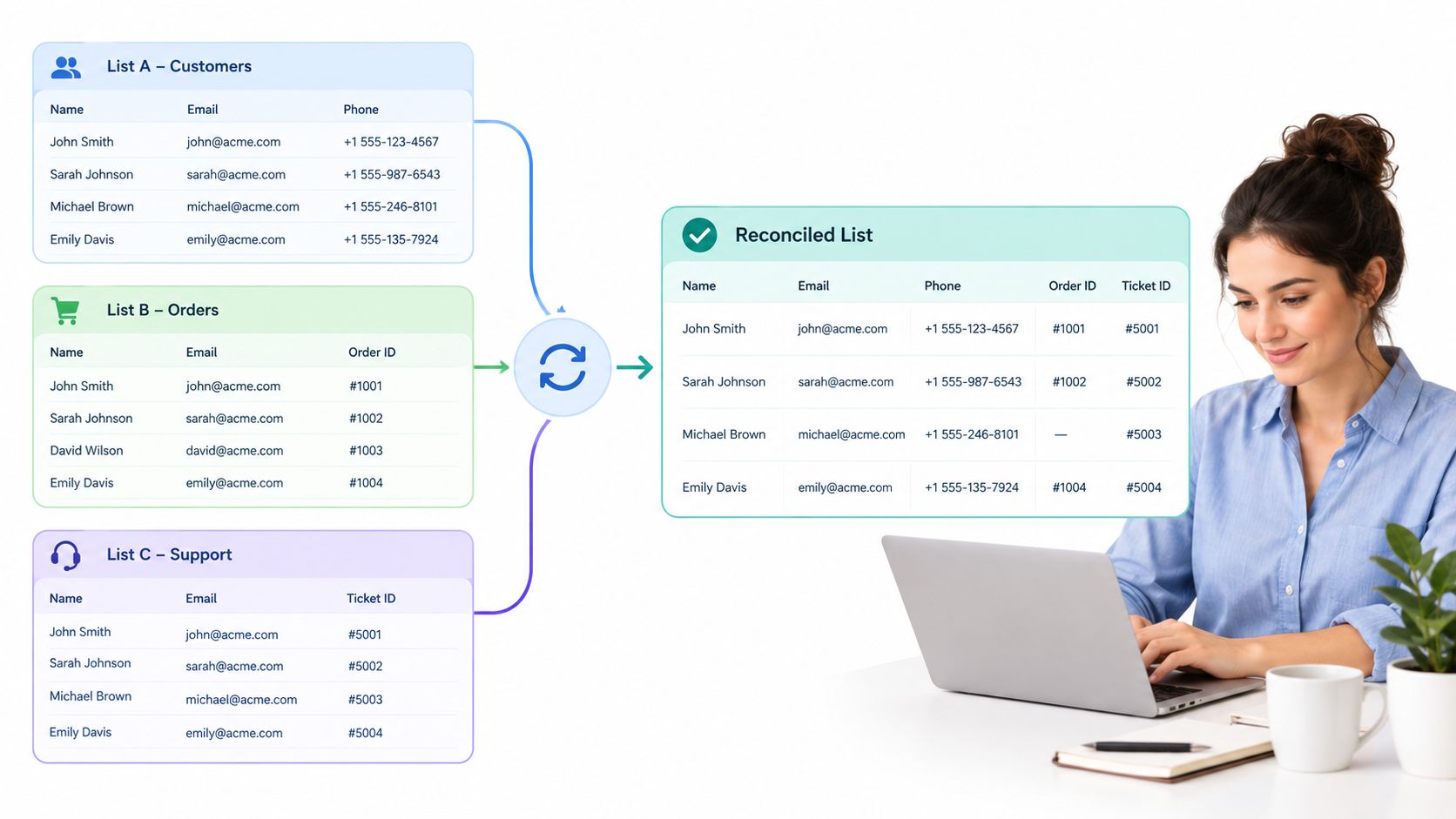
The form doesn't hide the differences. It places them side by side:
| Medication | Before hospitalization | Discharge instructions | Current home use | Reconciliation note |
|---|---|---|---|---|
| Medication A | Listed at one dose each morning | Listed at a different dose each morning | Bottle matches the older dose | Dose mismatch. Verify discharge instruction and document the prescriber's decision. |
| Medication B | Listed on the primary care record | Missing from discharge list | Bottle is present and caregiver gives it each evening | Possible omission. Confirm whether it was intentionally stopped or accidentally omitted. |
| Medication C | Not on the primary care list | Newly listed after hospitalization | New bottle is present, but Elena hasn't started it | New therapy. Record that it hasn't been started and direct questions to the prescribing clinician. |
| Medication D | Listed by the cardiologist | Listed on discharge paperwork | Two bottles with different labels are present | Possible duplication or outdated bottle. Keep both visible for clinician or pharmacist review. |
What good documentation looks like
For Medication A, the family records the exact dose on each source and notes the last dose taken. They don't choose the dose themselves. The action field says, “Clarification required from responsible prescriber,” followed by the date and person contacted.
For Medication B, the caregiver's report is recorded as a source, but it isn't treated as final proof of the intended discharge plan. The discrepancy remains open until the appropriate clinician confirms whether the omission was intentional.
For Medication C, “not started” is important information. It distinguishes a new prescription from a medication the patient is already taking. For Medication D, the form identifies the two labels, pharmacy information, and the possibility that one bottle is outdated.
The completed record should show the final status for every line, the reason for any intentional change, and who received the updated list. A signature by itself doesn't explain the work. The useful part is the visible trail from source, to comparison, to action.
The following video can help families visualize why separate medication lists need to be compared rather than copied:
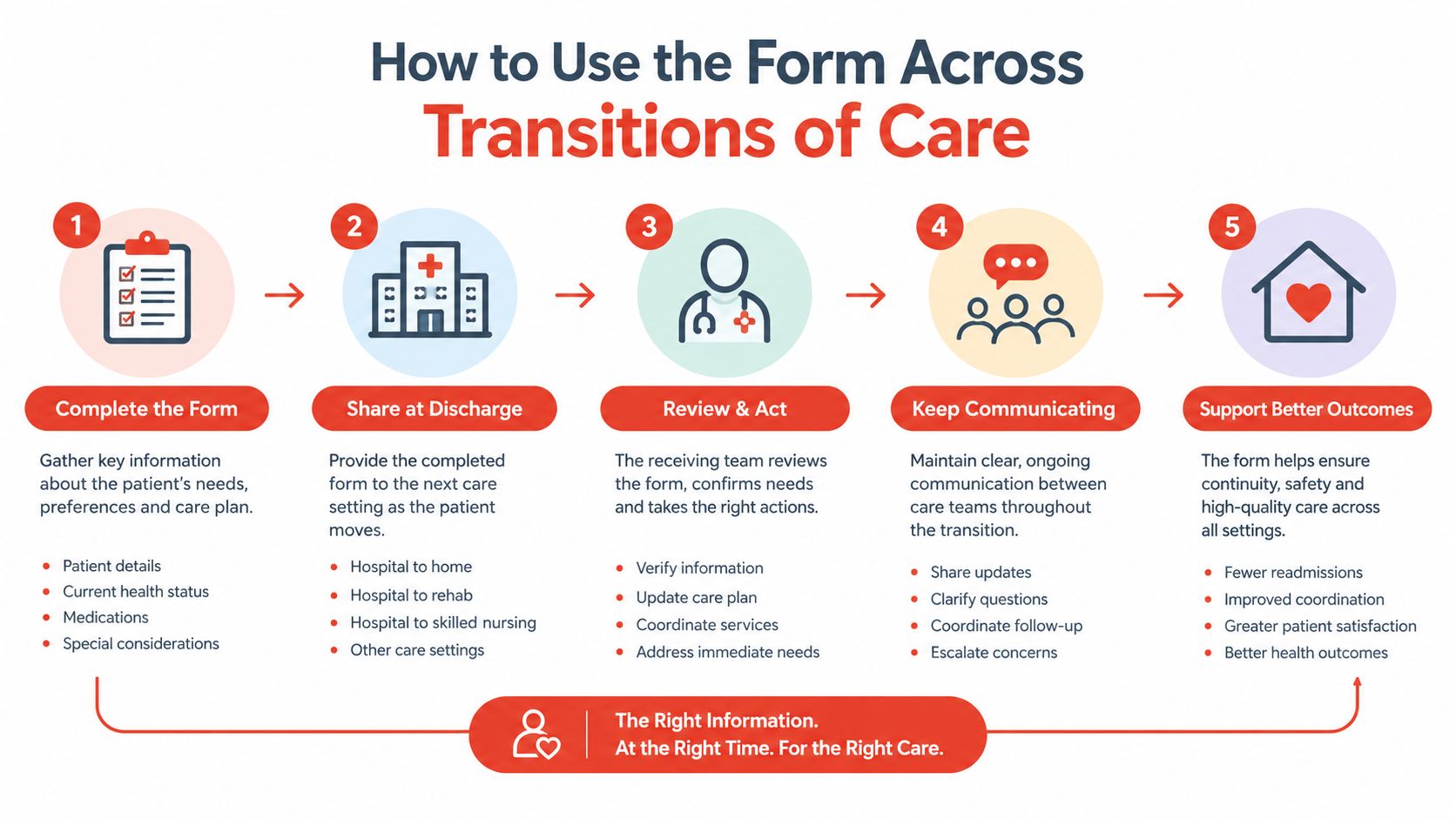
How to Use the Form Across Transitions of Care
The workflow begins before anyone decides what should change. First, collect the best possible medication history from the patient, caregiver, bottles, pharmacy, hospital records, and other providers. Then compare that history with the orders or discharge instructions for the next stage of care.
The three-state home comparison
Home healthcare uses a particularly practical comparison:
- Before hospitalization: What the patient was using before entering the hospital.
- Discharge instructions: What the hospital says the patient should use after leaving.
- Current home use: What the patient and caregiver are using now.
The home reviewer documents the action taken to resolve each difference. This rule prevents a common mistake, treating the discharge list as the only relevant source when the patient may still be using an older regimen.
A complete transition sequence
At admission, the team builds the most accurate pre-admission list. During a transfer, the receiving team compares the active orders with the prior list and clarifies changes. At discharge, the responsible clinician establishes the post-discharge regimen, creates home instructions, educates the patient and caregiver, and sends the reconciled list to the follow-up clinician.
A peer-reviewed review of hospital-to-home transitions recommends documenting dosage, frequency, route, planned duration, and purpose for medications at discharge, sending the reconciled list with indications to the outpatient provider on the day of discharge, and having a detailed discharge summary reach that provider within 7 days (NCBI Bookshelf review).
The AHRQ discharge workflow describes the physician updating the home medication list, the nurse confirming that the patient leaves with an updated list, and discrepancies being resolved before discharge instructions are finalized (AHRQ discharge workflow study). Families can support that process by asking for a readable copy, keeping it with the bottles, and showing it at the next appointment.
For clinics that need standardized documents, an online PDF toolkit for healthcare can help organize printable workflows. A family preparing for recovery can also review the first two weeks after hospital discharge while keeping medication questions on the reconciliation form.
Common Pitfalls and How to Avoid Them
The patient can provide valuable information, but a patient-completed form isn't automatically complete. One study of patient-completed forms found 33% had omission errors, 12.7% had addition errors, 18.1% had both types of errors, and only 36.3% were error-free (medication toolkit). These findings don't mean patients shouldn't participate. They show why participation needs support and verification.
A person with memory problems may forget a recently prescribed medication. Someone with low health literacy may not understand that two bottles contain the same medication. A caregiver may administer the correct pills but be unaware that a specialist changed the schedule. The form should ask who helps with administration and whether the patient can read and understand the document.
Where forms commonly break down
- Missing last-dose information: Without timing, the care team can't tell whether a medication is new, delayed, or already taken.
- Old lists copied forward: A familiar list may contain medications the patient stopped or doses that changed.
- Intentional changes left unexplained: A hold or discontinuation can look like an accidental omission unless the reason and source are recorded.
- Bottles not checked: Verbal recall may not match the label, strength, or actual home supply.
- Caregiver routines omitted: The written list may not show that someone else organizes or administers the medication.
- Unreadable instructions: Small print, unexplained abbreviations, and crowded tables create avoidable confusion.
Before contacting the clinician, gather the bottles, discharge papers, current list, pharmacy information, and caregiver schedule. Mark each discrepancy without deciding the clinical answer. The clinician or pharmacist can determine the appropriate action.
A safer question is: “Which source should we verify, and what action should be documented?” Not, “Which list looks right?”
Families managing a complex regimen can use medication management services for seniors to understand how a broader review may address caregiver involvement, adherence barriers, and communication across providers.
In Home Medication Reviews and Quick Reference Resources
A form works best when someone can verify it against the patient's real routine. During an in-home review, the clinician can sit at the kitchen table, examine pill bottles, compare them with discharge papers, ask who fills the pill organizer, and document what the caregiver administers. That setting can reveal practical differences that a phone interview or copied electronic list may miss.
Life Primary Care provides house-call primary care across northern and central New Jersey, including medication reviews, chronic disease management, post-hospital transitional care, geriatric care, and diagnostics in the home. Its visits typically last 45 to 60 minutes, and clinicians can review medication bottles, assess the home context, coordinate with multiple prescribers, and communicate results and referrals by phone. Coverage includes Morris, Essex, Union, Somerset, Passaic, and Bergen counties.
The practice's in-home medication review service can be relevant for families looking for Visiting Physicians NJ, Visiting Doctors NJ, Dr House calls NJ, Doctor house calls NJ, an In Home Doctor for Elderly, Doctor home visits for elderly, or Doctor House Calls for Seniors. The same home-based workflow may also support patients seeking At-Home Doctor Visits, in-home medical care, or Visiting Docs when travel is difficult.
Quick reference checklist
Keep this short list with the form:
- Bring every source: Bottles, discharge paperwork, pharmacy information, prior lists, and caregiver notes.
- Record three states: Before hospitalization, discharge instructions, and current home use.
- Write complete directions: Name, dose, route, frequency, purpose, and last dose.
- Mark uncertainty: Use “needs verification” instead of guessing.
- Track every action: Continue, stop, modify, hold, or clarify, with the responsible source.
- Share the final list: Give it to the patient, caregiver, and next provider.
Common terms are straightforward once separated. A discrepancy is a difference between sources. An intentional change is a documented decision to alter therapy. An unintentional discrepancy is a mismatch that wasn't planned. A source of truth is the verified information used for comparison, not necessarily the oldest or most familiar list.
Families arranging Doctor house calls for seniors in New Jersey can prepare the form before the visit, place the medication bottles together, and write down questions. That preparation gives the clinician a clearer picture of what happens at home and creates a more reliable handoff afterward.
Life Primary Care brings in-home primary care and medication reconciliation to patients across northern and central New Jersey, including post-hospital reviews at the kitchen table. Visit Life Primary Care to arrange an At-Home Doctor Visit and discuss a medication review for an older adult, caregiver, or family member managing multiple providers.
Ready for a visit at home?
Call and speak with a real person. We will confirm your insurance, find a time and come to you.
973-607-4911 Call now