
Guide · 11 min read
Medicare Annual Wellness Visit vs Annual Physical Explained

A daughter schedules what she thinks is her mother's annual physical. The office calls it a Medicare Annual Wellness Visit. Her mother expects a head-to-toe examination, while the daughter wants someone to review a growing medication list, check whether screenings are current, and address a recent concern about balance. The confusion is common, and it can lead to both missed preventive work and unexpected charges.
The practical question in Medicare Annual Wellness Visit vs annual physical isn't which appointment sounds more thorough. It's what the clinician is being asked to do, what Medicare covers, and whether the visit can be completed in a way that works for the older adult and family caregiver. At home, that distinction becomes especially important because prevention planning can include the patient's actual medications, stairs, bathroom setup, fall hazards, and caregiver support.
Table of Contents
- Understanding the Core Difference in Preventive Care
- What Happens During a Medicare Annual Wellness Visit
- Why Medicare Does Not Cover Routine Annual Physicals
- Navigating Billing Rules and Potential Out of Pocket Costs
- Overcoming Access Barriers with In Home Primary Care
- How to Prepare for a Successful Home Based Wellness Visit
- Choosing the Right Preventive Care Strategy for Seniors
Understanding the Core Difference in Preventive Care
Families often use “wellness visit,” “physical,” and “checkup” as if they mean the same thing. Medicare doesn't. Medicare introduced the Annual Wellness Visit, or AWV, on January 1, 2011, under the Affordable Care Act. Its purpose is to create or update a personalized prevention plan based on a health-risk assessment, medical history, family history, current risks, and preventive needs. CMS describes the Annual Wellness Visit as a preventive planning service, not a conventional head-to-toe physical examination.
Consider an older adult who has stopped driving. During an AWV, the clinician may identify mobility limitations, review whether cognitive screening is appropriate, reconcile medications, assess fall risk, and organize future screenings. A routine physical, by contrast, is generally understood as a broader examination of the body, such as listening to the heart and lungs or examining areas of the body. Medicare defines a routine physical as an exam not connected to treating or evaluating a specific illness, symptom, complaint, or injury, and Medicare doesn't cover that service as an AWV benefit.
Practical distinction: An AWV builds a prevention plan. A physical examines the patient. A problem-focused visit evaluates a symptom or active condition.
The AWV is generally available once every 12 months for people enrolled in Part B for more than 12 months, when the clinician accepts Medicare assignment. The patient pays nothing for the covered AWV itself when eligibility and coverage conditions are met. That benefit can support a useful conversation about seniors screenings and vaccinations, but it shouldn't be described as a substitute for evaluating a new symptom or treating an active disease.
What Happens During a Medicare Annual Wellness Visit
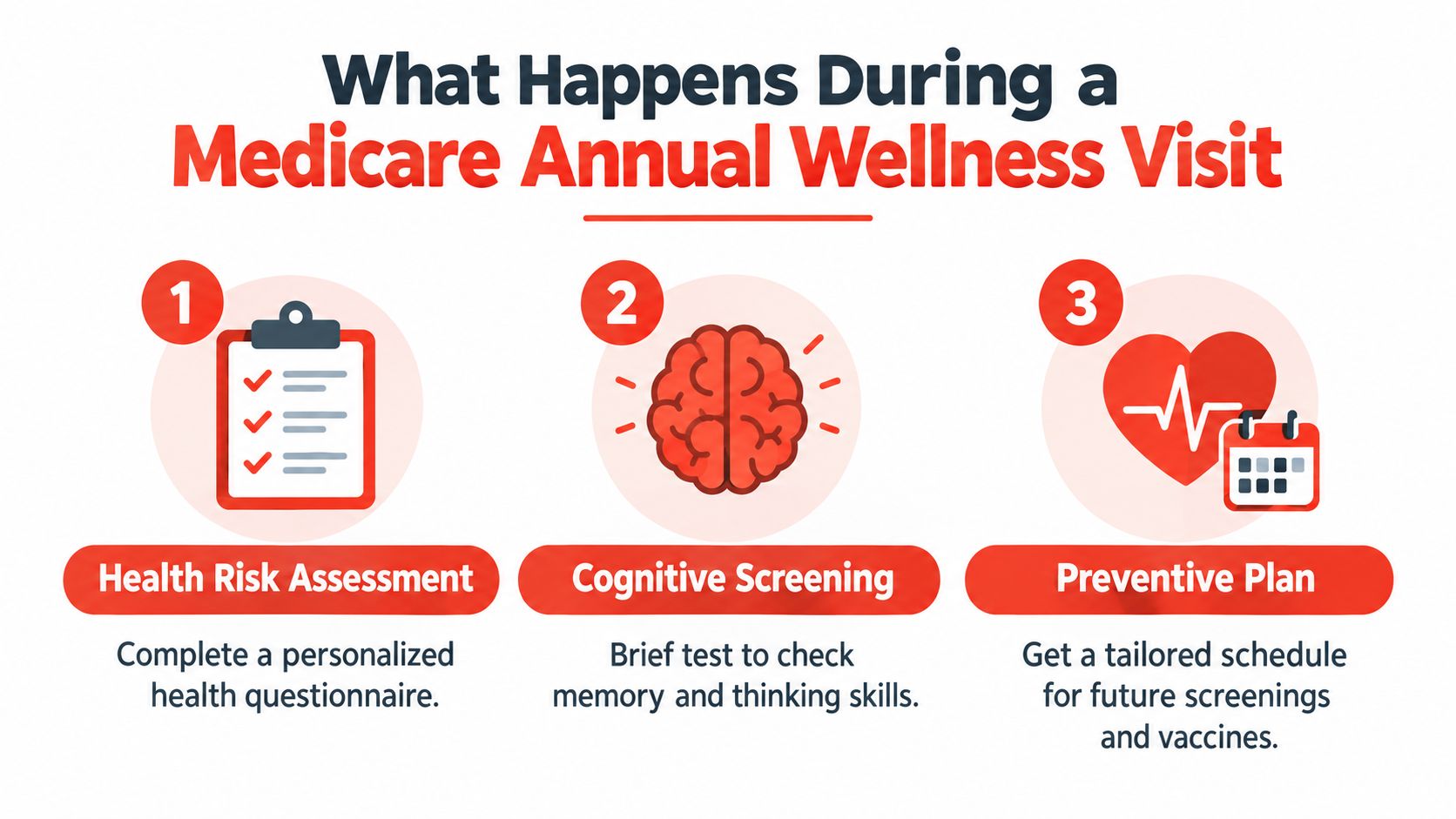
An AWV follows a structured process. The clinician isn't just asking whether the patient feels well. The visit gathers information that can shape preventive care over time and creates a written personalized prevention plan.
The required clinical elements
The clinician completes or updates a health-risk assessment and reviews the patient's medical and family history. The visit also includes documenting current clinicians and medications, measuring height, weight, body-mass index or waist circumference, checking blood pressure, and assessing cognitive impairment. These elements help identify risks that may not appear in a short conversation about a single complaint.
The clinician then reviews risk factors and interventions, develops a five- to ten-year preventive screening schedule, and provides personalized health advice or referrals. The AWV itself doesn't include routine laboratory testing, although the clinician can order or refer for tests that are clinically appropriate.
In an office, the checklist may be completed in a standard exam room. During an in-home visit, the surroundings add information that a form can't capture. A clinician may notice an unstable path to the bathroom, poor lighting near stairs, a walker placed out of reach, or medication bottles spread across several rooms. These observations don't replace formal assessment, but they make the prevention plan more realistic.
Why the home setting changes the conversation
Medication reconciliation is more reliable when the family can show the actual bottles, blister packs, supplements, and discharge instructions. A caregiver can explain which prescriptions the patient takes, which ones are sitting unused, and where confusion began after a hospital stay. The clinician can also discuss caregiver support and functional limitations in the environment where those challenges occur.
A home AWV remains a prevention-planning encounter. If the patient reports chest discomfort, worsening shortness of breath, a new fall injury, or another active concern, the clinician must determine whether separate diagnostic evaluation or treatment is needed. The AWV can coexist with clinically necessary care, but the additional work must be documented and billed according to Medicare rules.
For families who want a plain-language explanation of the required elements, this guide to what a Medicare Annual Wellness Visit includes can help them prepare for the conversation.
The following video offers another visual overview of the appointment:
Why Medicare Does Not Cover Routine Annual Physicals
Medicare's coverage boundary is administrative as well as clinical. The AWV is a defined preventive benefit. A routine physical examination performed without a relationship to a specific illness, symptom, complaint, injury, or treatment isn't covered under that benefit. If a practice schedules or performs a non-covered physical, the patient may be responsible for 100% of the charge.
The difference can be easier to understand by comparing the purpose of each service:
| Feature | Annual Wellness Visit | Routine Annual Physical |
|---|---|---|
| Main purpose | Create or update a personalized prevention plan | Perform a general physical examination |
| Health-risk assessment | Included | Not the defining feature |
| Medical and family history | Reviewed or updated | May be reviewed as part of the examination |
| Cognitive impairment assessment | Included | Not the defining feature |
| Preventive schedule | A five- to ten-year plan is developed | Not required as the central product |
| Routine laboratory testing | Not included, although tests may be ordered when appropriate | Depends on the service and clinical purpose |
| Medicare coverage | Covered once every 12 months when eligibility and assignment requirements are met | Medicare doesn't cover a routine physical as a Medicare benefit |
| Patient cost | No cost for the covered AWV itself when conditions are met | The patient may owe the full charge |
The distinction doesn't mean a physical examination is medically inappropriate. A clinician may need to examine a patient while evaluating an active condition or supporting treatment. That service differs from the preventive AWV, and the documentation and billing should reflect what occurred.
Medicare also treats additional services during an AWV separately. If a patient asks the clinician to evaluate a new rash, worsening swelling, or another problem, the clinician may perform a separate problem-oriented assessment. The AWV remains covered when eligible, but the additional service can create ordinary cost-sharing.
Medicare's explanation of yearly wellness visits is useful for families comparing the covered prevention-planning service with a non-covered routine physical. Before scheduling, ask the office to state clearly whether the appointment is an AWV, a physical, or both.
Navigating Billing Rules and Potential Out of Pocket Costs
The safest billing conversation starts before the clinician arrives. Tell the practice that the patient is seeking a Medicare Annual Wellness Visit, then disclose any new or worsening symptoms separately. That allows the practice to plan the preventive documentation and determine whether additional problem-oriented work may be necessary.
How the codes fit the visit
CMS identifies HCPCS G0438 for the first AWV and HCPCS G0439 for subsequent AWVs. The first AWV isn't automatically the first preventive visit the patient has ever had in life. Eligibility depends on Medicare history, including whether the patient has had Part B for more than 12 months and whether an Initial Preventive Physical Examination or AWV occurred during the preceding 12 months.
A practice should verify the patient's Medicare history before billing. It should also determine whether the patient received the one-time Welcome to Medicare visit, because that affects the timing of the first AWV. Families can review the Medicare Annual Wellness Visit requirements before the appointment and bring any relevant coverage information.
Why an extra charge can appear
The covered AWV itself has no Part B deductible, copayment, or coinsurance when eligibility and assignment requirements are met. That protection doesn't automatically apply to every service performed during the same encounter.
For example, the clinician may complete the prevention plan and then evaluate a new wound, adjust treatment for an active condition, or investigate a symptom. The practice should document that problem-oriented work separately. Depending on coverage and the service provided, the patient may have normal cost-sharing for that additional evaluation or treatment.
Ask these questions when scheduling:
- Which appointment is being scheduled? Confirm that the practice is using an AWV rather than calling a routine physical by another name.
- Has the patient had a Welcome to Medicare visit or AWV? The date can affect eligibility for the initial or subsequent service.
- Does the clinician accept Medicare assignment? The no-cost AWV condition depends on assignment and eligibility.
- Could the reported concern require separate evaluation? Explain symptoms in advance so the practice can discuss potential billing.
- Will the statement separate the services? A clear claim should distinguish preventive planning from additional medical evaluation.
Clear communication protects the family from assuming that every service delivered during an AWV is automatically free.
Overcoming Access Barriers with In Home Primary Care
Coverage doesn't guarantee completion. A patient may be eligible for an AWV and still miss it because traveling to a clinic requires wheelchair transport, oxygen management, a caregiver's workday, or a difficult transfer from the home to a vehicle. Dementia, frailty, and limited transportation can make a supposedly simple appointment a major logistical project.
Utilization has improved over time, but access remains incomplete. A longitudinal analysis of 24,549 continuously managed Medicare patients aged 66 and older found that 66.1% had an AWV in 2018 and 67.7% had one in 2022; across the full 2018 to 2022 period, 86% received two or more AWVs (longitudinal AWV analysis). The same analysis classified 58.6% as regular AWV users, 27.7% as moderate users, and 13.7% as low users. Those figures describe utilization, not a guarantee that a particular patient can obtain care conveniently.

What the home environment contributes
At the kitchen table, the clinician can review medication bottles directly, speak with the caregiver who manages appointments, and see how the patient moves through the home. A family member who couldn't leave work for a clinic visit may be able to participate by phone or sit in during the home appointment.
This setting can also expose barriers that a questionnaire misses. The clinician may learn that the patient avoids the upstairs bathroom, can't safely reach the walker, or has no reliable way to attend a recommended screening appointment. The prevention plan can then include practical coordination rather than a generic list of recommendations.
Access differences also affect specific groups. Recent evidence reported that Medicare Advantage enrollees were 4.4 percentage points more likely than Traditional Medicare beneficiaries to receive an AWV, with larger gaps among dual-eligible patients, Black beneficiaries, adults older than 85, and people with Alzheimer's disease or related dementias (reported AWV subgroup differences). A separate cited analysis found lower completion among Black and Latino or Hispanic patients than among White patients, with each group showing a relative risk of 0.85. Coverage alone doesn't resolve transportation, language access, caregiver coordination, or dementia-sensitive care needs.
For a practical overview of the model, in-home primary care services can show how a home-based practice organizes preventive and ongoing care without requiring the patient to wait in a clinic.
How to Prepare for a Successful Home Based Wellness Visit
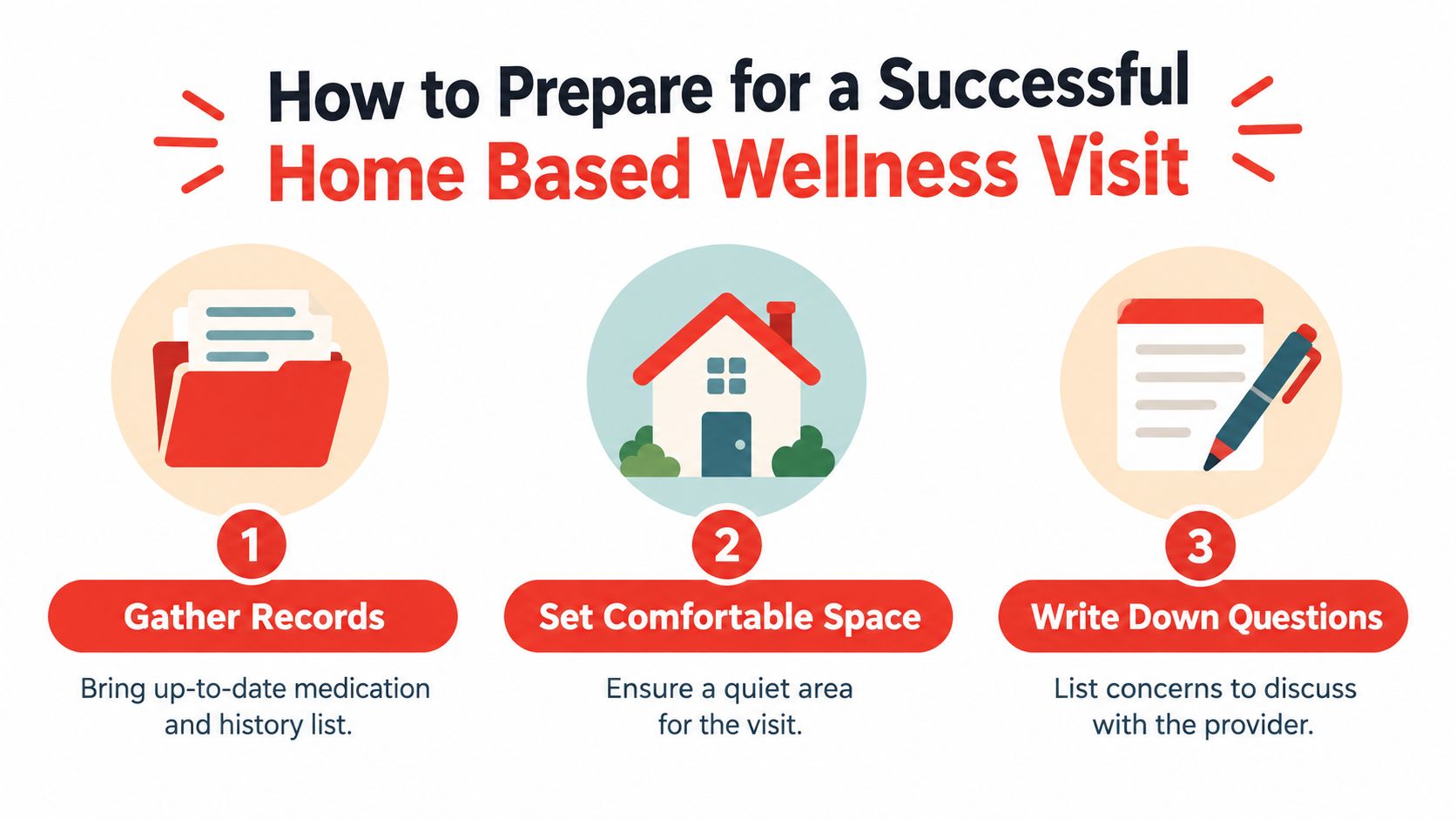
Good preparation keeps the AWV focused on the patient rather than on reconstructing missing information. Put the following items in one place before the appointment:
- Medication bottles: Include prescriptions, over-the-counter products, vitamins, and supplements. The actual containers help the clinician identify duplicate medicines, outdated instructions, and prescribing changes.
- Specialist list: Write down the names and roles of current clinicians, along with pharmacies and important contact information.
- Medical history: Gather hospital discharge papers, recent test results, immunization records, advance directives, and insurance information when available.
- Family observations: Note falls, memory changes, missed doses, changes in appetite, difficulty bathing, or concerns about driving and daily activities.
- Questions: Keep a written list so the patient and caregiver can raise concerns without relying on memory during the visit.
Prepare a quiet, well-lit area with enough room for the clinician to work. The patient should have a comfortable place to sit, and medication containers should be easy to reach. If the patient uses a walker, cane, oxygen, hearing aids, or glasses, keep those items nearby.
The one-time Welcome to Medicare visit is separate from the AWV and is available during the first 12 months of Part B enrollment. Medicare doesn't allow an AWV code within 12 months of that visit, so the timing of the initial AWV depends on the patient's Part B enrollment and preventive-visit history (Medicare prevention and diabetes coverage publication). A patient who never had the Welcome to Medicare visit can still become eligible for an AWV after the first 12 months of Part B, subject to the applicable timing rules.
Choosing the Right Preventive Care Strategy for Seniors
The useful choice isn't AWV versus physical as if one service replaces the other. The right approach matches the encounter to the patient's need. Use the AWV for structured prevention planning, risk assessment, cognitive screening, medication review, and coordination of future screenings. Arrange a physical or problem-focused evaluation when the clinician needs to examine or treat a specific condition.
Before booking, verify the patient's Part B timeline, ask whether a Welcome to Medicare visit or prior AWV was billed, and confirm that the clinician accepts Medicare assignment. Tell the practice about active symptoms rather than hiding them to preserve a “free” appointment. Accurate disclosure helps the clinician plan appropriate care and helps the billing team explain potential cost-sharing.
For a homebound older adult, the prevention plan should fit daily life. A screening recommendation that no one can coordinate, or a medication plan the caregiver can't manage, isn't a finished plan. An in-home clinician can connect the preventive schedule with chronic disease management, specialist communication, medication organization, fall-risk observations, and caregiver involvement.
The practical language families should use is simple: “We'd like to schedule the Medicare Annual Wellness Visit, and we also need to discuss these specific concerns.” That sentence gives the practice the information needed to separate prevention planning from medical evaluation.
Life Primary Care provides in-home Medicare Annual Wellness Visits, routine physicals, chronic disease management, medication reviews, and diagnostic coordination for older adults across northern and central New Jersey. If traveling to a clinic is difficult, visit Life Primary Care to learn how to arrange a home-based appointment and verify coverage.
Ready for a visit at home?
Call and speak with a real person. We will confirm your insurance, find a time and come to you.
973-607-4911 Call now