
Guide · 13 min read
Medicare Annual Wellness Visit Questionnaire: Guide
Your father is at the kitchen table, waiting for a home visit. His daughter has gathered a clipboard, a medication list, and a pair of reading glasses, but she still wonders whether something important has slipped through the cracks. Has he fallen recently? Is he taking every prescription correctly? Can he manage the stairs, the bathroom, and the telephone safely?
That's where the Medicare Annual Wellness Visit questionnaire becomes more than paperwork. Completed before or during the visit, it gives the clinician a structured way to identify risks and turn the answers into a personalized prevention plan. At home, those answers can be checked against the actual setting, including medication bottles, rugs, lighting, kitchen safety, and caregiver routines.
Table of Contents
- Why the Questionnaire Matters Before a Home Visit
- What the Medicare Annual Wellness Visit Really Covers
- The Topic Domains the Questionnaire Explores
- Sample Questions You Will Actually Be Asked
- How to Prepare for the Visit at Home
- How Answers Become a Prevention Plan at Home
- Common Misconceptions About the Questionnaire
- A Practical Takeaway and Family FAQ
Why the Questionnaire Matters Before a Home Visit
The daughter may know that her father “isn't getting around as well,” but that phrase leaves important questions unanswered. Does he need help bathing? Has he stopped shopping because transportation is difficult? Is he skipping doses because the bottles are hard to open, or because several specialists changed the instructions?
The questionnaire creates a calm starting point. It asks about daily activities, mood, memory, safety, medications, social support, and preventive needs. CMS describes the assessment as a Health Risk Assessment, or HRA, built around beneficiary-reported information and designed to support a personalized prevention plan (CMS Health Risk Assessment guidance).

What changes inside the home
A waiting-room form captures what a patient remembers. A kitchen-table visit can also reveal what the patient is living with.
A clinician may notice that the hallway is dim, the bathroom has no stable handhold, or the medication drawer contains bottles from several prescribers. A caregiver may explain that the patient says he takes his medicines independently, but regularly confuses morning and evening doses. Those observations don't replace the patient's answers. They add context and help the clinician document what needs follow-up.
Practical rule: An answer matters most when the care team records what will happen because of it.
Medicare introduced the AWV in 2011 as a preventive benefit centered on an HRA and a personalized prevention plan. National AWV volume increased from approximately 2.58 million visits in 2011 to 9.56 million in 2018, based on an analysis of Medicare services delivered nationwide (national AWV utilization analysis). That scale makes the questionnaire an important planning tool, but completion alone isn't the finish line.
The sections ahead explain what the AWV covers, which questions families should expect, how to prepare for an in-home visit, and how concerns about falls, mood, memory, or medication confusion can become concrete next steps.
What the Medicare Annual Wellness Visit Really Covers
The AWV is a preventive planning visit, not a traditional head-to-toe physical. Its central tasks are completing the HRA, reviewing risks and preventive needs, and creating or updating a personalized prevention plan. The plan can identify screenings, immunizations, referrals, safety priorities, and follow-up needs based on the patient's history and risk factors (Medicare Annual Wellness Visit coverage).
Medicare Part B covers an AWV once every twelve months when the patient isn't within the first twelve months after Part B begins and hasn't received an IPPE or AWV that included Personalized Prevention Plan Services during the preceding twelve months. The AWV isn't the same benefit as a routine annual physical examination.
Initial and subsequent visits
The first AWV that includes Personalized Prevention Plan Services uses HCPCS code G0438. CMS describes that service as a once-per-beneficiary-lifetime initial AWV. Later AWVs use G0439 (CMS coding reference).
This distinction matters when a family schedules an appointment. The practice should verify the patient's Part B start date and prior IPPE or AWV history before billing. Medicare's timing rules aren't something the patient needs to calculate alone, but the practice needs accurate information to avoid scheduling the wrong service.
The HRA can be completed independently by the patient or administered by a health professional before or during the visit. CMS says it should be customized to communication needs, limited English proficiency, and health literacy, and it should take no more than 20 minutes to complete (CMS HRA guidance).
A clinician may document the questionnaire efficiently with tools such as speech recognition for clinicians, provided the record still distinguishes the patient's own report, caregiver observations, clinician findings, and planned actions. Families can also review Medicare Annual Wellness Visit requirements before the appointment.
The Topic Domains the Questionnaire Explores
The questionnaire works best when families understand what each group of questions is trying to uncover. It isn't asking for perfect answers. It's looking for changes, barriers, and risks that could affect the patient's ability to stay safe and follow a prevention plan.
Function and everyday independence
Activities of daily living, or ADLs, include bathing, dressing, feeding, toileting, grooming, ambulation, and fall risk. IADLs include transportation, shopping, food preparation, medication management, housekeeping, telephone use, and finances.
The important pattern is often a change. A patient who once prepared meals independently but now relies on frozen food may have weakness, fatigue, memory concerns, or difficulty standing safely. A person who manages finances but can no longer use the telephone may need a closer look at hearing, cognition, vision, or access to help.
Mood, social connection, and physical symptoms
The HRA also asks about depression risk, stress, loneliness, pain, and fatigue. These questions help the clinician see whether the patient is withdrawing from activities, losing motivation, or struggling with symptoms that interfere with movement and self-care.
A short answer such as “I'm fine” may not tell the whole story. A caregiver might add that the patient stopped attending religious services, rarely answers the phone, or spends most of the day in bed. That difference deserves respectful discussion, not an automatic label.
Behaviors and home safety
Behavioral topics include tobacco use, physical activity, nutrition, alcohol use, oral health, sexual health, seat-belt use, and home safety. The clinician is looking for practical obstacles. A patient may want to exercise but feel unsteady, or may eat poorly because shopping and food preparation have become difficult.
For families discussing movement and falls, a clinician may suggest an appropriate follow-up plan or referral. General resources about balance exercises for older adults can help families understand why balance and environmental safety belong in the same conversation.
Cognitive concerns
Cognitive questions aren't a diagnosis by themselves. CMS recommends considering direct observation, the patient's concerns, and information from family members, caregivers, or other informants. When appropriate, a clinician may use a brief structured tool such as the Mini-Cog, Montreal Cognitive Assessment, Saint Louis University Mental Status Examination, AD8 informant interview, Functional Activities Questionnaire, or Mini-Mental State Examination.
The key clue may be functional. Missed medications, unsafe finances, difficulty using the telephone, or problems arranging transportation can appear before a patient describes memory trouble. The USPSTF says evidence is insufficient to recommend for or against routine cognitive-impairment screening in asymptomatic older adults, so concerning answers should lead to thoughtful assessment and follow-up, not a conclusion based only on a questionnaire score (USPSTF cognitive impairment recommendation).
Sample Questions You Will Actually Be Asked
At the kitchen table, the questions may sound simple:
- “Do you need help bathing, dressing, or using the bathroom?”
- “Have you fallen, felt unsteady, or worried about falling?”
- “Who handles your medications?”
- “Can you use the phone, arrange transportation, and manage bills?”
- “Have you felt down, isolated, stressed, or unusually tired?”
- “Do you use tobacco or alcohol?”
- “How often do you move around during the day?”
- “Do you have trouble hearing, seeing, chewing, or preparing meals?”
A useful answer includes an example. Instead of saying “sometimes” to medication difficulty, a family might say, “He missed his evening dose twice last week because he thought the bottle was for the morning.” Instead of saying “no falls,” the patient might explain, “I haven't fallen, but I hold the walls when I walk to the bathroom at night.”

When a caregiver answers
A caregiver can help when the patient has cognitive impairment, hearing difficulty, language barriers, or trouble recalling recent events. The clinician should still preserve the patient's voice and identify who provided each piece of information.
A daughter might say, “Dad says he manages his medicines, but I find unopened bottles in the cabinet.” That isn't an argument to win. It's a discrepancy to document and explore. The clinician may ask the patient about his routine, review the bottles, and decide what follow-up is appropriate.
What concerning answers may trigger
A fall-risk answer may prompt questions about stairs, rugs, bathroom setup, footwear, and nighttime lighting. A medication concern may lead to a review of every prescription, supplement, and over-the-counter product. A memory concern may lead to caregiver history and a structured tool, rather than a diagnosis from the form alone.
A patient with fluctuating capacity may answer some questions independently and need support with others. The family should bring concerns openly and avoid coaching answers toward what they think Medicare or the clinician wants to hear.
How to Prepare for the Visit at Home
A little preparation makes the visit more useful. Place the following items in one bag or on the table:
- Medication containers: Include prescriptions, vitamins, supplements, and over-the-counter medicines. The actual bottles are more useful than a handwritten list when instructions may have changed.
- Vision and hearing aids: Bring glasses, hearing aids, chargers, and communication devices the patient normally uses.
- Health records: Gather immunization records, recent lab results, hospital discharge papers, and the names of other clinicians involved in care.
- Planning documents: Set out any advance directive, living will, or health care proxy forms if the family has them.
- Questions and changes: Write down recent falls, missed medicines, appetite changes, mood changes, or trouble with transportation.
The patient should be present whenever possible. A trusted family member or caregiver can add observations, and the family should request language assistance or an interpreter if needed. The HRA must account for communication, language, and health-literacy needs, so difficulty reading a form shouldn't prevent meaningful participation.
An in-home practice commonly plans 45 to 60 minutes for the visit. That allows time for the questionnaire, conversation, relevant examination, medication review, and observation of the home setting. The exact flow depends on the patient's needs and the practice's process.
Families can read about the first appointment in what to expect during a first home visit. The questionnaire may be completed in advance, during the visit, by telephone, through a web-based program, or through another accessible method that protects privacy. The patient should understand what is being asked and consent to caregiver participation.
How Answers Become a Prevention Plan at Home
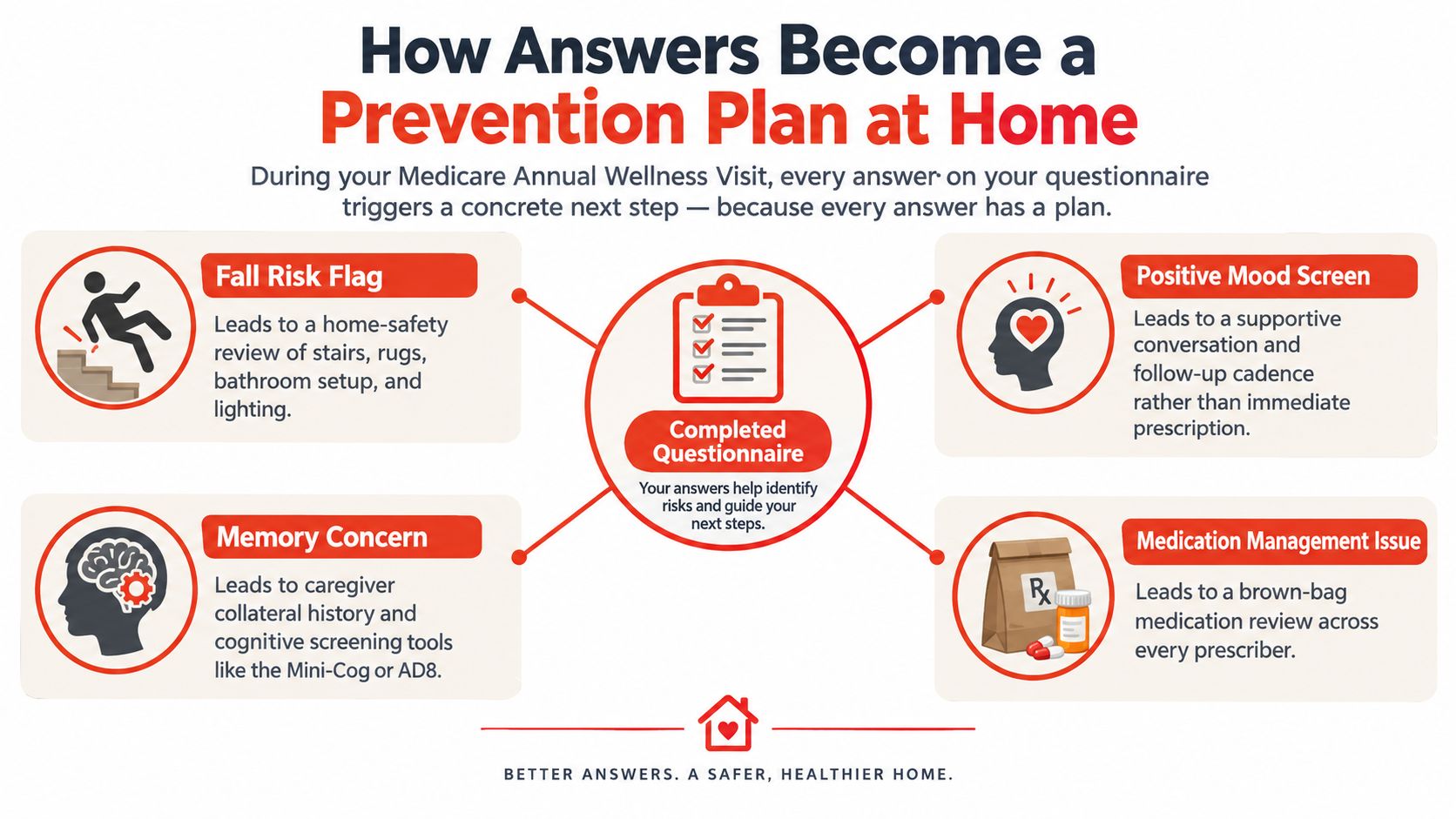
A completed questionnaire is useful only when the clinician connects findings to actions. The plan should state what was identified, what will happen next, who is responsible, and when the issue will be revisited.
Four common pathways
Fall risk: If the patient reports unsteadiness, the clinician can look at stairs, rugs, bathroom setup, lighting, and the route to the bedroom. The resulting plan may include home-safety changes, appropriate education, or coordination with other services.
Mood concerns: A positive mood screen should open a supportive conversation. It may lead to closer follow-up, communication with a caregiver, or referral, rather than an immediate prescription based only on a form.
Memory concern: The clinician can compare the patient's report with caregiver observations and functional details. Tools such as the Mini-Cog or AD8 may support a focused assessment, while the home visit allows the clinician to observe medication bottles, appointment management, kitchen safety, and other daily tasks.
Medication-management problem: A “brown-bag” review brings every prescription, supplement, and over-the-counter medicine together. Reviewing the full collection across all prescribers can reveal duplicate therapies, confusing instructions, or products the medical record doesn't include.
The plan may also identify transportation difficulty, food access, loneliness, oral-health needs, or caregiver strain. Those answers should lead to concrete referrals, resource coordination, screening arrangements, or a documented follow-up date. Families who want general background can explore blood testing advantages, while remembering that the AWV itself doesn't turn every possible test into an automatic requirement.
A prevention plan should be understandable to the patient who will use it, not only to the clinician who writes it.
The home setting adds information that a clipboard can't provide. The clinician can ask permission to look at the bathroom route, observe how the patient rises from a chair, and see whether the medication storage system matches the patient's abilities. The patient remains the source of self-reported information, while the home provides context for interpreting practical risks.
Common Misconceptions About the Questionnaire
Myth one: completing the form means preventive care is complete. It doesn't. Medicare requires an individualized prevention plan and screening schedule based on the patient's history, risk factors, age, and covered services. The answers need to become screenings, referrals, safety work, education, or follow-up.
Myth two: most eligible people already receive an AWV. Utilization has grown, but participation remains incomplete. One national analysis found AWV use increased from 7.5% of eligible beneficiaries in 2011 to 18.8% in 2015, while a 2020 study of 5,840 beneficiaries found that 49.1% had received an AWV (Health Affairs analysis of AWV use and outcomes). Those figures show why scheduling and follow-through still matter.
Myth three: a patient can hide every safety issue by answering “no.” Patients may forget, minimize, misunderstand, or feel embarrassed. At home, a clinician can compare the answers with the environment and caregiver observations. A medication drawer, loose rug, dark hallway, or difficult bathtub may reveal a practical concern without blaming the patient.
Myth four: the AWV replaces care for new symptoms. It doesn't. The AWV focuses on prevention and planning. New chest discomfort, sudden confusion, shortness of breath, injury, or another urgent change needs appropriate clinical attention, not a promise to mention it only on a questionnaire.
Families can review what a Medicare Annual Wellness Visit is so they don't mistake preventive planning for a full physical or a problem-focused appointment.
A Practical Takeaway and Family FAQ
Keep these points in mind before the clinician arrives:
- The AWV is preventive planning. It uses an HRA to identify risks and create or update a personalized prevention plan.
- The questionnaire can come before or during the visit. The patient may complete it independently, with professional assistance, by telephone, online, or through another accessible method.
- Answers should trigger action. Falls, medication confusion, mood concerns, memory changes, and caregiver gaps need documented next steps.
- The home adds useful context. The clinician can see the environment and review the medicines the patient keeps at home.
- The plan should be shared. The patient and family should understand the priorities, referrals, screening schedule, and follow-up arrangements.
Family questions
When is the AWV covered? Medicare covers it once every twelve months when the patient is outside the first twelve months after Part B begins and hasn't had an IPPE or qualifying AWV during the preceding twelve months. The practice should verify eligibility and prior claims.
Is it the same as a physical? No. The AWV centers on risk assessment and prevention planning. It isn't a substitute for evaluating new symptoms or managing every chronic condition in one appointment.
Can a caregiver help answer? Yes. A caregiver may provide information, especially about medications, finances, transportation, daily activities, and changes in memory. The record should distinguish the patient's report from the caregiver's observations.
What happens next year? The clinician updates the HRA, medical and family history, provider and medication lists, risks, and prevention schedule. New concerns can change the plan.
Bring the bottles, records, questions, and the person who knows the patient's day-to-day routine. A clear conversation at home can give the prevention plan a much stronger foundation.
Life Primary Care provides in-home Medicare Annual Wellness Visits across northern and central New Jersey, including the health risk assessment, medication and provider review, cognitive and depression screening, fall-risk discussion, and preventive planning at home. Visit Life Primary Care to request an appointment and learn whether an in-home clinician serves your area.
Ready for a visit at home?
Call and speak with a real person. We will confirm your insurance, find a time and come to you.
973-607-4911 Call now