
Guide · 14 min read
In-Home Care for Seniors: A Practical Guide for Families
Your mother's appointment is fifteen minutes away, but getting her there takes most of the day. The wheelchair van arrives late, she misses the specialist, and you spend the evening trying to work out whether she took the new medication from the hospital. This is usually the moment families start searching for in-home care for seniors.
The urgent question isn't only whether someone can come to the house. It's who needs to show up, what they should do, and how the family will know the plan is working. In-home care works when those responsibilities connect. It falls apart when an aide, nurse, doctor, pharmacy, hospital, and family caregiver each hold a different piece of the story.
Table of Contents
- The Moment Families Start Looking Into In-Home Care
- What In-Home Care Actually Means for Seniors Today
- Who In-Home Care Is Best Suited For
- Medical Vs Non-Medical In-Home Care Compared
- What Medicare And Insurance Actually Cover
- What A Full-Scope House-Call Primary Care Visit Looks Like
- How To Choose The Right In-Home Care Provider
- Supporting The Caregiver Is Part Of The Care Plan
The Moment Families Start Looking Into In-Home Care
Most families don't begin with a formal care plan. They begin with a disruption. A parent can no longer tolerate the trip to the doctor. A missed appointment leaves a chronic condition unchecked. A daughter rearranges work, school, and childcare to drive fifteen minutes each way, only to discover that the visit itself requires a long wait.
The family may still describe the situation as temporary. “We just need help after the hospitalization.” “We only need someone to check on her.” “He's fine at home if somebody can manage the stairs.” Those statements often hide several separate needs: transportation, medication supervision, medical assessment, personal care, and relief for the person coordinating everything.

The question behind the search
Families looking for Visiting physicians NJ, Visiting Doctors NJ, or Doctor house calls NJ usually want a practical answer: can a qualified clinician evaluate the patient where they live, and can that clinician coordinate what happens next?
Sometimes the answer is a home-health agency. Sometimes it's a personal care attendant. Sometimes it's a house-call primary care practice. Often, the safest arrangement combines more than one provider, with one person clearly responsible for clinical coordination.
Practical rule: Don't choose a service because it sounds convenient. Choose it because it solves the specific failure happening at home.
The rest of this guide treats House calls for seniors as part of an operating system, not a menu of services. You'll need to identify the person who assesses the patient, the person who helps with daily tasks, the person who reconciles medications, and the person who contacts the family when the condition changes. That clarity matters more than a glossy list of amenities.
What In-Home Care Actually Means for Seniors Today
In-home care has two distinct layers. Confusing them is one of the fastest ways to book the wrong service.
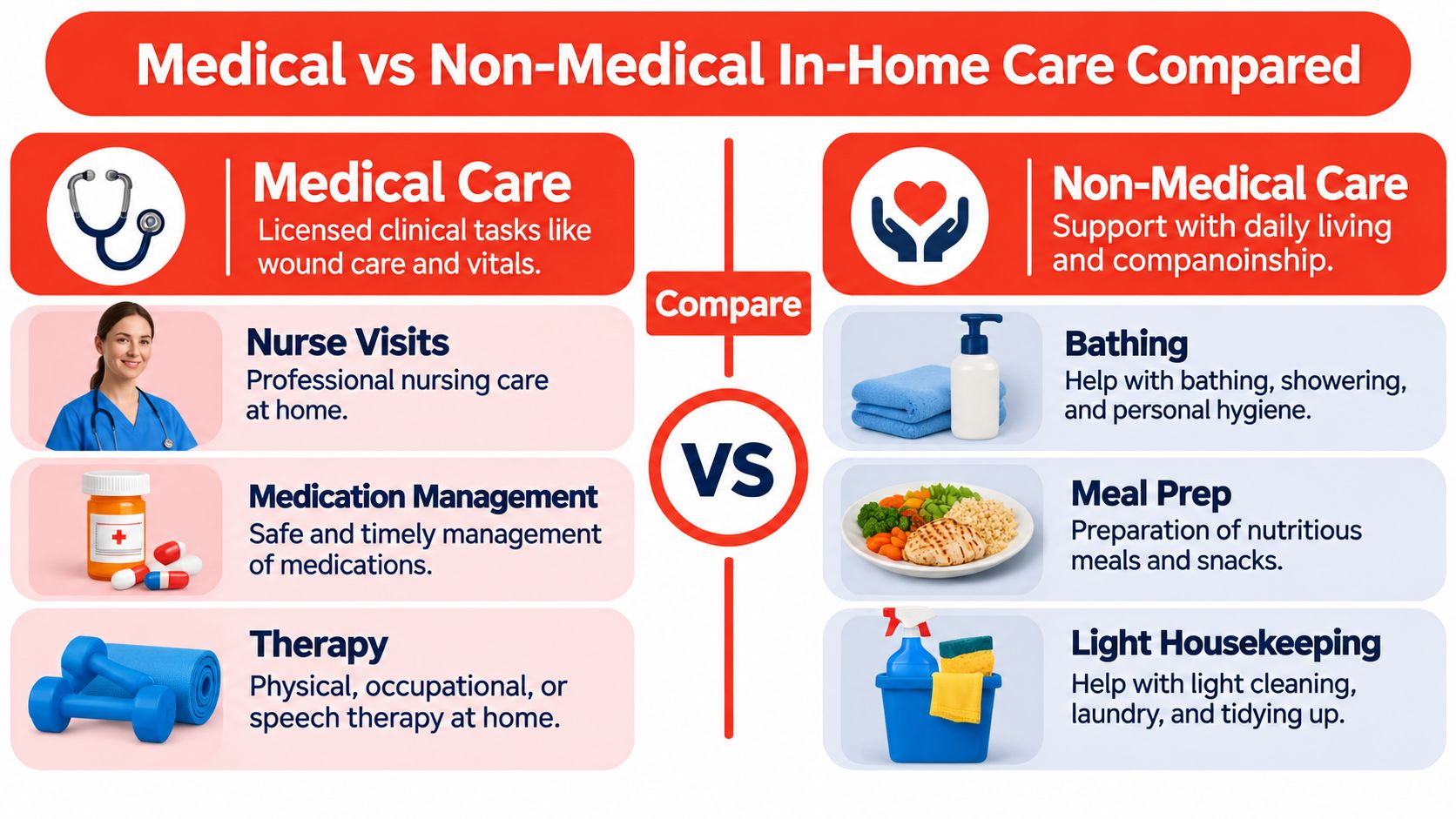
Non-medical care supports daily living. A home-health aide or personal care attendant may help with bathing, dressing, toileting, meal preparation, light housekeeping, companionship, and safe movement around the home. These workers can observe changes and report concerns, but they generally aren't the people who diagnose a new problem, prescribe medication, or change a treatment plan.
Medical in-home care brings licensed clinical work into the home. Depending on the provider and the service, that may include a physician or nurse evaluating symptoms, managing chronic disease, reviewing medications, ordering tests, coordinating referrals, and creating a treatment plan. A visiting nurse agency and a house-call primary care practice aren't interchangeable, either. One may operate under a skilled home-health episode, while the other provides primary care in the patient's residence.
Medical vs non-medical in-home care at a glance
| Dimension | Non-Medical In-Home Care | Medical In-Home Care |
|---|---|---|
| Main purpose | Daily living support, safety, and companionship | Assessment, diagnosis, treatment planning, and clinical follow-up |
| Typical provider | Home-health aide or personal care attendant | Physician, nurse practitioner, physician assistant, nurse, or therapist |
| Common tasks | Bathing, dressing, meals, light housekeeping, reminders | Examinations, medication management, chronic disease care, wound care, therapy, and diagnostics |
| Prescription changes | Reports concerns to the clinical team | Qualified clinician evaluates and manages treatment |
| Family role | Coordinates schedules and shares observations | Participates in decisions and receives the clinical plan |
| Best use | Ongoing assistance with daily routines | Medical needs that are difficult to manage through office visits |
Think of the arrangement as a care stack. Daily living help forms the foundation. Medical care sits on top when symptoms, medications, disease management, or post-hospital recovery require clinical oversight.
Comfort can also matter. If joint discomfort makes dressing or moving around the home harder, families may review practical resources such as daily comfort wear for joint pain, while keeping treatment decisions with the patient's qualified healthcare professional.
Who In-Home Care Is Best Suited For
In-home care makes the most sense when the home contains information that an office visit can't capture, or when travel creates a barrier that prevents reliable follow-up.
The older adult whose mobility has changed
A patient who has fallen twice in six months, avoids the stairs, or needs help moving from a chair to the bathroom may not need a hospital. They do need someone to examine the full system around the fall risk. That includes gait, transfers, vision, medication effects, lighting, stairs, bathroom access, and the way the patient uses a cane or walker.
Falls among adults aged 65 and older caused more than 43,000 deaths and approximately 4.5 million emergency-department visits in the United States in 2024, according to the CDC's fall information. The same source notes roughly 300,000 hip-fracture hospitalizations annually among older adults. A home visit can turn those broad risks into a prioritized list of changes, referrals, and follow-up tasks.
The person living with dementia
A waiting room can trigger agitation, confusion, or refusal. At home, the clinician can observe routines, communication, medication storage, wandering risks, and caregiver strain in the setting where the problems occur. The visit may also give a family member enough time to explain what has changed without trying to do so in a crowded exam room.
The patient returning from the hospital
A person with heart failure may come home with a new medication list, changed doses, and instructions that compete with an older routine. A clinician who comes to the home can compare the discharge paperwork with the bottles present, the patient's understanding, and the family's ability to carry out the plan.
The family coordinating from another state
Distance doesn't remove responsibility. It often makes verification harder. A remote daughter may need a provider who sends written summaries, identifies who owns each follow-up task, and communicates when the patient's condition or support needs change.
When home care isn't the right answer
Emergency symptoms require emergency services, not a scheduled house call. Some patients travel comfortably and may receive more efficient care in an office. Certain specialist procedures and equipment can't be brought into a living room. The correct question isn't whether home care sounds preferable. It's whether the home setting can safely support the assessment and treatment the patient needs.
Medical Vs Non-Medical In-Home Care Compared
The decision usually comes down to three questions: what work needs to happen, who is qualified to do it, and how will it be paid?
Non-medical care is usually arranged through a personal care agency or directly with a caregiver. The work may be scheduled around bathing, meals, companionship, dressing, errands, or supervision. Payment often comes from the family, long-term-care insurance, or another benefit, depending on the policy and eligibility rules. Don't assume that a medical insurance card automatically pays for ongoing custodial support.
Medical care follows a different structure. A nurse may provide skilled services through a Medicare-certified home-health agency when the patient meets the benefit's requirements. A physician or other qualified clinician may provide a house-call primary care visit and bill it as a professional medical service. Transitional Care Management and a Medicare Annual Wellness Visit have their own definitions and documentation requirements.
Where families commonly get confused
A caregiver can remind someone that a medication is due. That doesn't mean the caregiver should independently alter the prescription. A nurse can identify a concerning symptom and report it. That doesn't automatically mean the nurse replaces the prescribing clinician. A doctor can manage the medical plan. That doesn't mean the doctor provides daily bathing, meal preparation, or continuous supervision.
Use this decision grid:
- If the problem is daily function, start with non-medical support.
- If the problem is a new symptom or unstable condition, arrange a clinical assessment.
- If the problem followed a hospital discharge, ask about transitional care and medication reconciliation.
- If several services are involved, appoint one person to maintain the current care plan.
Families comparing medical vs non-medical in-home care can also use this guide to home health, home care, and house calls before calling agencies. The point isn't to select one category permanently. Many older adults need a layered plan that changes as recovery, mobility, cognition, and caregiver capacity change.
What Medicare And Insurance Actually Cover
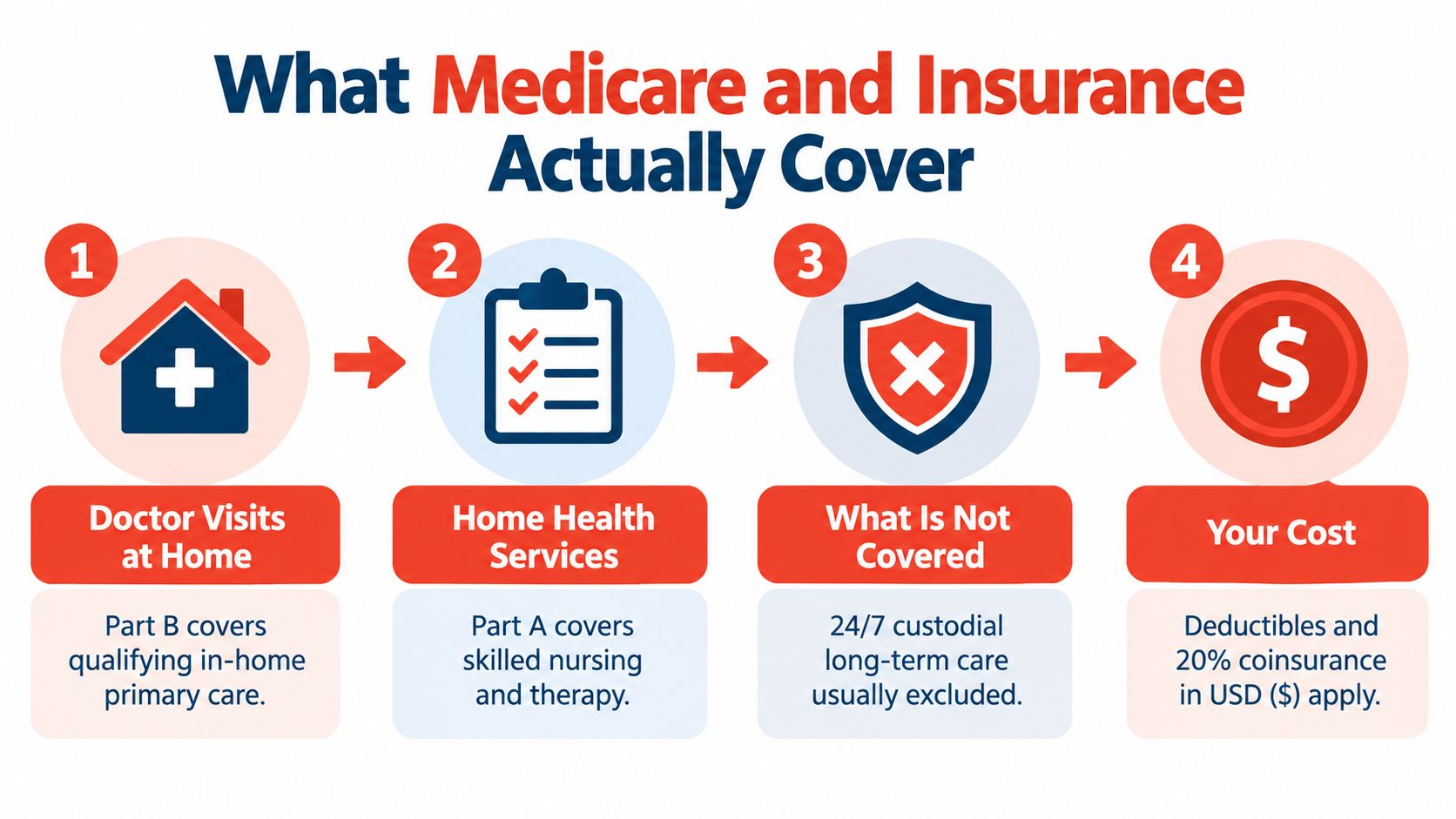
Coverage depends on the service, the patient's eligibility, the provider, and the documentation. Start by asking the provider to name the exact benefit or billing arrangement, not just whether they “take Medicare.”
Medicare home health
For the Medicare home-health benefit, the patient generally must be homebound and need part-time or intermittent skilled services ordered and periodically reviewed by a physician. Medicare describes homebound status through two connected tests. Leaving home must be medically inadvisable or require assistance because of illness or injury, and the patient must normally be unable to leave without considerable and taxing effort.
Occasional trips for medical treatment, adult day care, religious services, or infrequent nonmedical events don't automatically disqualify someone. The benefit also requires a provider-established care plan and care from a Medicare-certified home-health agency. It isn't the same thing as a routine physician house call.
Transitional Care Management
Medicare's Transitional Care Management rules create a defined 30-day episode after discharge from an acute-care, psychiatric, rehabilitation, or long-term-care hospital. During that episode, medication reconciliation must be completed on or before the required face-to-face visit, as described in the CMS Transitional Care Management guidance.
That makes post-discharge care more specific than a casual check-in. The clinician needs to compare what the hospital instructed with what the patient is taking and coordinate unresolved issues.
Annual Wellness Visits
A Medicare Annual Wellness Visit is a prevention-planning service, not a routine head-to-toe physical. CMS requires a health-risk assessment that addresses areas such as mood, loneliness, pain, fatigue, tobacco use, physical activity, nutrition, oral health, alcohol use, home safety, and fall risk. It also includes activities of daily living and instrumental activities such as managing medications, transportation, shopping, finances, and telephone use, as outlined by CMS's Annual Wellness Visit requirements.
For a plain-language overview of Medicare and in-home care costs, families can review the coverage questions before calling a provider. Also ask directly whether the practice accepts the patient's plan, whether prior authorization applies, and whether any separate membership or travel charge exists. A guide to doctors making house calls can help clarify the difference between home health and primary care at home.
What A Full-Scope House-Call Primary Care Visit Looks Like
A full-scope house call starts before the clinician knocks on the door. The practice prepares the chart, reviews the reason for the visit, and brings a portable examination kit. Inside the home, the clinician can assess the patient's symptoms while also seeing the environment that shapes daily care.
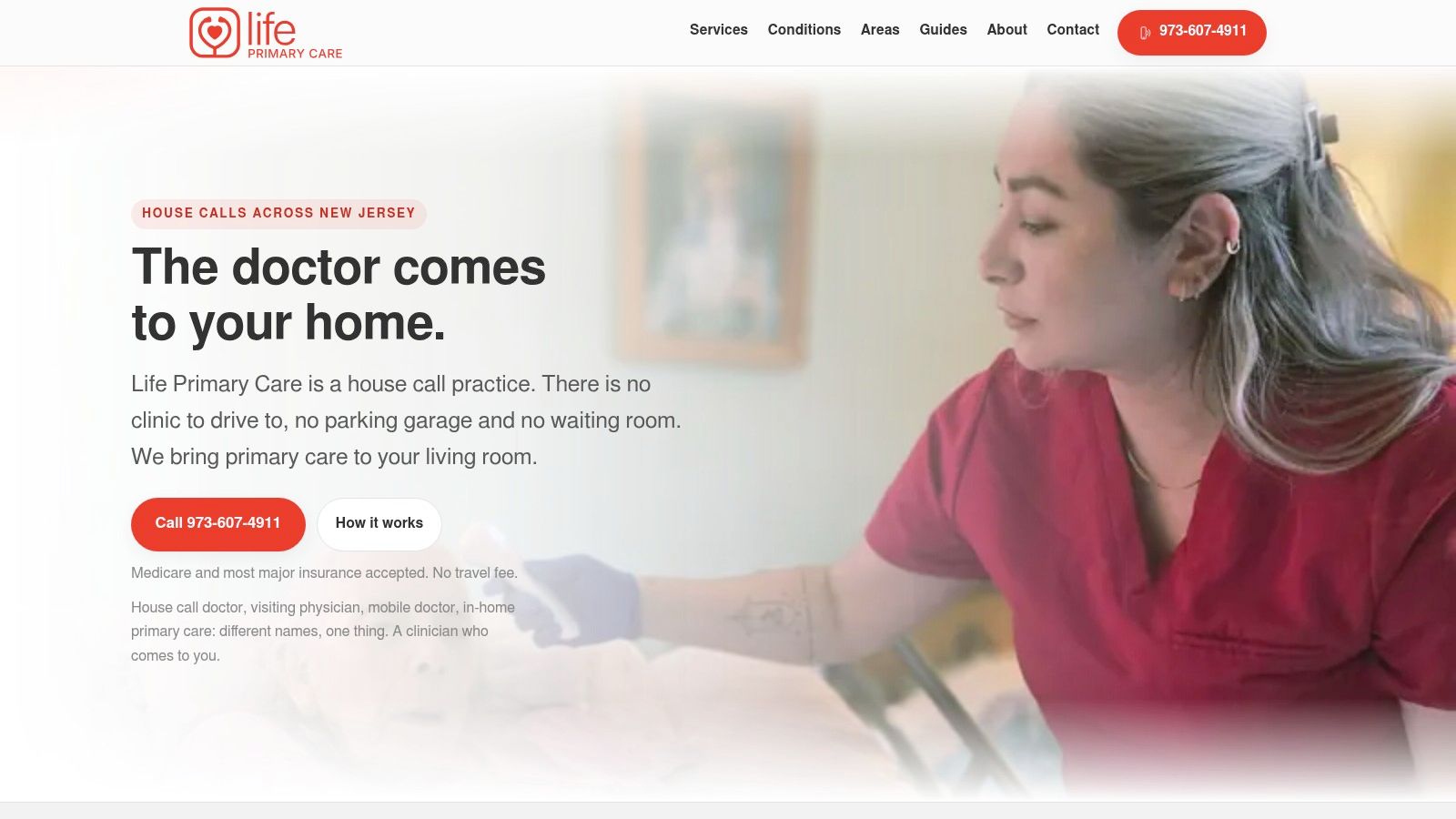
A visit typically lasts 45 to 60 minutes, according to Life Primary Care's service information. That time allows the clinician to watch a patient move from the couch to the bathroom, inspect medication bottles, review oxygen tubing, notice a loose railing, and ask the spouse what has been worrying them. The clinician can perform a history and examination, manage chronic conditions, review prescriptions, and create a follow-up plan in the place where the plan must work.
What can happen after the examination
The clinician may coordinate blood draws, EKGs, urine testing, mobile X-rays, or ultrasound. Results and referrals can be communicated by phone, while follow-up visits and telehealth check-ins keep the plan active between visits.
A house-call primary care practice isn't the same as a home-health agency. It brings primary care, urgent evaluation for non-emergency problems, chronic disease management, medication review, wellness planning, and diagnostic coordination into the home. It also isn't limited to one hospital network. Life Primary Care describes coverage across Morris, Essex, Union, Somerset, Passaic, and Bergen counties in New Jersey, with Medicare and most major insurers accepted without a travel, concierge, or membership charge.
The practical difference is visibility. An office clinician may hear that stairs are difficult. A home clinician can see the patient pause at the bottom step, observe the railing, and connect that observation to the care plan.
Here's a closer look at how a house-call program can fit into primary care coordination.
The right provider should explain what happens after the visit, who receives the summary, how urgent concerns are handled, and when the next contact occurs. A longer visit has value only when it produces clear ownership and follow-through.
How To Choose The Right In-Home Care Provider
Treat the first phone call as an operational test. A capable provider should answer basic questions without making you chase several departments.
Ask these questions before booking
- Who is coming? Confirm the person's role, license, training, and responsibility for the care plan.
- What will the visit include? Ask whether the provider performs an examination, reviews medications, documents findings, arranges testing, or only offers personal assistance.
- Who pays? Verify the specific Medicare benefit, insurance plan, authorization requirement, private-pay rate, and any separate fee.
- Who coordinates with specialists? Ask how the provider communicates with hospitals, pharmacies, therapists, and existing doctors.
- What happens after hours? Get a clear answer for weekends, worsening symptoms, urgent visits, and emergencies.
- What will the family receive? Request a written visit summary, updated medication list, action items, and follow-up date.
The family caregiver deserves equal attention. The 2025 AARP/National Alliance for Caregiving report found that 63 million U.S. adults provide ongoing care, more than 40 percent provide high-intensity care, and only 22 percent receive training for tasks such as injections, wound care, or equipment management, according to the 2025 caregiving report. Ask whether the provider teaches the family what to watch for and how to escalate concerns.
Red flags include vague pricing, pressure to sign a long contract before the first visit, no named clinical owner, refusal to coordinate with existing specialists, and promises that sound broader than the provider's license or service description. If the answer to “Who calls whom when something changes?” is unclear, keep looking.
Supporting The Caregiver Is Part Of The Care Plan
The caregiver isn't background support. The caregiver is part of the clinical system, and that system can fail when one exhausted person carries every task.
A useful plan divides responsibility. The clinician manages diagnosis and treatment. The pharmacist or prescribing professional resolves medication questions. The aide supports agreed daily activities. The family decides who handles transportation, meals, appointments, insurance calls, and emergency communication. Write those roles down instead of relying on memory.
Build verification into the routine
An out-of-state caregiver can't personally inspect every medication bottle or appointment. They can ask for a written visit summary, request the current medication list after a clinical visit, and schedule a recurring call with the clinician or care coordinator. One named family member should receive updates, but another person should know the plan if that contact becomes unavailable.
Medication transitions deserve particular attention. In one cohort of older adults, discharge commonly involved approximately two new medications, one chronic medication discontinued, and one dosage change. By three days after discharge, many patients had returned to prior chronic regimens and stopped a substantial proportion of newly prescribed drugs, as described in this AHRQ patient-safety review.
That's why a serious home review should compare the discharge documents, the medication containers or home list, and the pharmacy fill history. The clinician should identify duplication, missing drugs, risky doses, fall or sedation concerns, and confusion between prescribers. Family members shouldn't independently change prescriptions, but they should insist that discrepancies reach the qualified professional responsible for treatment.
A workable first month
Use a simple feedback loop:
- Book an initial home assessment focused on the problem that caused the search.
- Request medication reconciliation if there was a recent hospitalization or medication change.
- Ask for a written care plan that names each responsibility and the next follow-up.
- Put one weekly check-in on the calendar with the patient, caregiver, or clinical team.
- Escalate early when missed medications, missed meals, worsening confusion, falls, resentment, depression, or debt show that the workload has become unsafe.
In-home care succeeds when the family can see what happened, who owns the next step, and when someone will check again. It shouldn't create another layer of messages for an already overloaded caregiver.
Life Primary Care provides primary care house calls, chronic disease management, medication reviews, wellness visits, post-hospital follow-up, urgent non-emergency visits, and in-home diagnostics across northern and central New Jersey. If coordinating office travel has become unsafe or unmanageable, visit Life Primary Care to discuss a home-based plan.
Ready for a visit at home?
Call and speak with a real person. We will confirm your insurance, find a time and come to you.
973-607-4911 Call now