
Guide · 11 min read
How to Run Diagnostics at Home Safely and Accurately

Your mother's ankles have started to swell, her medication changed recently, and getting her to a lab is difficult. You may be wondering what a home diagnostic visit can tell you, and what happens if a result comes back abnormal. A test can provide an important clue, but it rarely answers the whole question on its own.
How to run diagnostics at home safely means more than using a device or collecting a sample. It means connecting the patient's symptoms and examination to an appropriate test, checking whether the result is trustworthy, explaining what it means, and making sure the next step happens. That closed loop matters whether you're comparing Visiting Physicians NJ, searching for Visiting Doctors NJ, or arranging Doctor house calls NJ for an older family member.
Table of Contents
- What a Home Diagnostic Visit Actually Involves
- Preparing the Home and Medication List Before a Visit
- Running a 12-Lead EKG at the Kitchen Table
- Collecting Blood and Urine Samples Without Errors
- Deciding When a Home Result Is Reliable Enough
- Closing the Loop from Abnormal Result to Action
- Choosing a House Call Partner and Taking the Next Step
What a Home Diagnostic Visit Actually Involves
A house call begins with a clinical question, not a test kit. For the mother with new ankle swelling, the clinician needs to understand when it started, whether it's changed, and what else is happening. A recent medication change may be relevant, but so may her medical history, other medicines, breathing, mobility, and what the clinician sees during the examination. No single measurement can settle every possibility.
The diagnostic process includes gathering history and examination findings, forming and testing hypotheses, interpreting results, communicating conclusions, and arranging follow-up. The World Health Organization's patient-safety overview reports diagnostic errors in approximately 5–20% of physician–patient encounters and harmful diagnostic errors in at least 0.7% of adult hospital admissions. In U.S. outpatient care, about 5% of adults, roughly 1 in 20, experience a diagnostic error each year; the Agency for Healthcare Research and Quality estimates about 12 million outpatient diagnostic errors annually, with about half potentially harmful. These figures show why technical accuracy alone isn't enough. The clinician also has to ask the right question, account for medications and other conditions, and interpret the result in context.
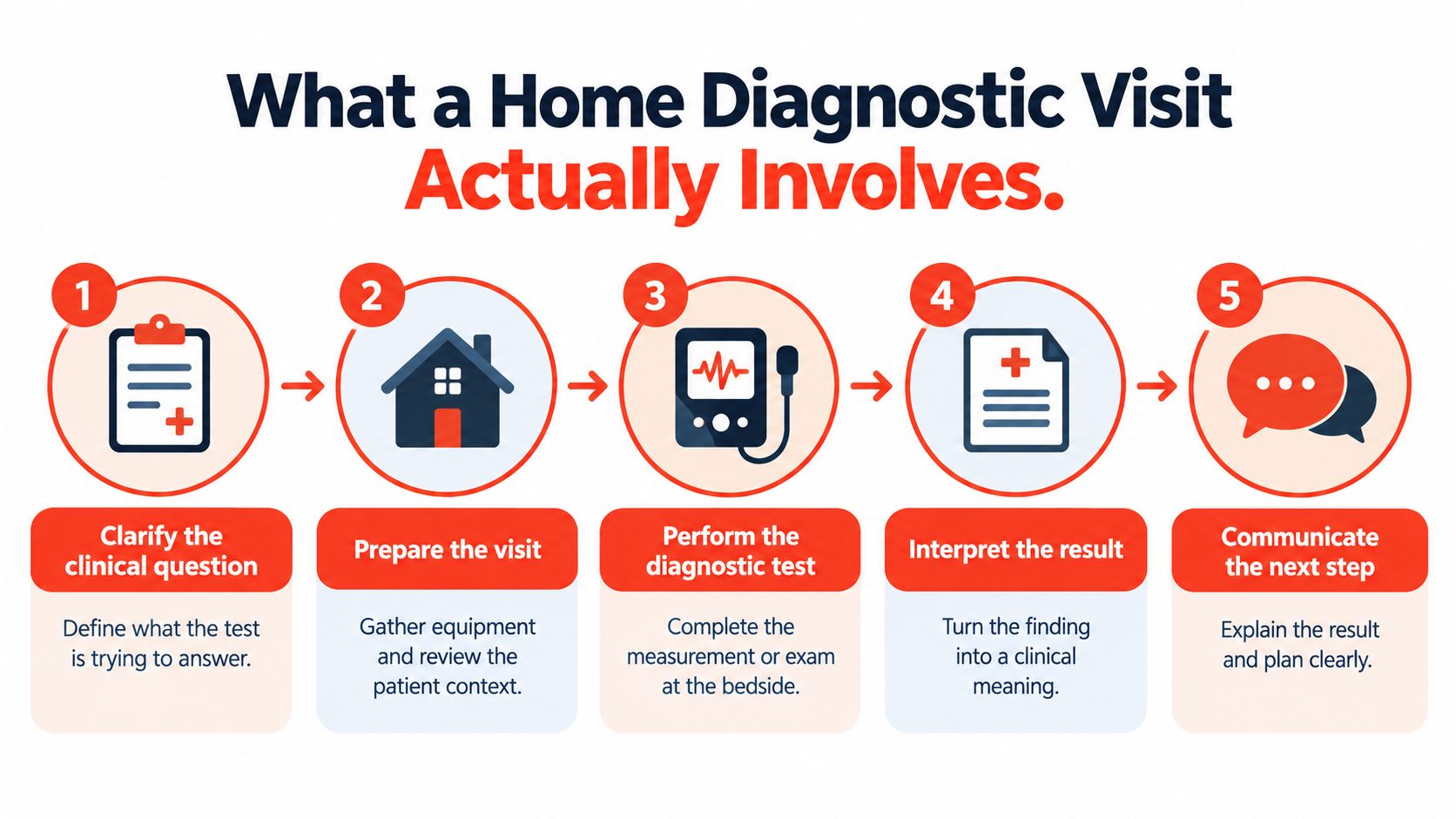
From bedside evidence to a plan
At home, the living space can add useful context. The clinician may review medication bottles, take vital signs, examine the patient, and perform point-of-care testing, an EKG, or specimen collection. If the clinical question calls for imaging, a house call practice may coordinate a mobile X-ray or ultrasound. Mobile X-ray and ultrasound at home can be particularly useful when travel is a barrier, though imaging still needs a clear indication and clinical interpretation.
Before the visit ends, everyone should know what was tested, who will review the result, how the patient or caregiver will hear about it, and what action follows if it's abnormal. A test marked complete in a chart isn't the same as a resolved clinical question.
Preparing the Home and Medication List Before a Visit
A little preparation can help the clinician focus on the patient rather than hunting for paperwork. Clear a well-lit table for equipment, and make sure there's a comfortable chair or accessible bed for the examination. If stairs, a narrow entry, oxygen equipment, or limited space could affect the visit, mention that when scheduling.
Set out the patient's current medication bottles and pill organizer, not just a list copied from an older appointment. Include over-the-counter products, supplements, and any medicines recently started, stopped, or changed. Discharge papers and recent laboratory or imaging reports can help the clinician understand what's already been checked. A reliable medication reconciliation checklist can help families organize the details before the visit.
Before the clinician arrives: Keep the medication containers, discharge papers, and recent results together. If you're unsure whether something matters, bring it rather than leaving it out.
Caregiver observations are part of the history
A person with dementia may not be able to describe when a symptom began or how it has changed. The caregiver's observations can help fill that gap. Note changes in sleep, appetite, confusion, activity, or usual routines, and when you first noticed them. “She was more confused after lunch” is more useful than a general impression that she “seems off,” especially when the patient can't reliably explain how she feels.
Don't try to interpret those observations as a diagnosis. Share what you've seen and what has changed, including whether symptoms come and go. The clinician can decide which details matter, whether an examination or test is appropriate, and whether existing medicines might affect the picture.
Preparation isn't about anticipating a test or directing the visit. It's about making relevant information easy to find. A complete medication history, recent results, and a caregiver's concrete observations give the clinician better context for choosing tests that could change the plan.
Running a 12-Lead EKG at the Kitchen Table
A clear EKG starts with a repeatable setup. The clinician confirms the patient's identity and why the tracing is being taken, then positions the patient at rest. The chest may need to be exposed appropriately, and the skin should be clean and dry so the electrodes make firm contact. Movement, loose electrodes, or poorly prepared skin can make the tracing difficult to read.
The limb electrodes need consistent placement. The chest electrodes, called V1 through V6, must follow anatomical landmarks rather than a rough estimate. In particular, V4 belongs at the fifth intercostal space on the midclavicular line. V5 sits horizontally level with V4, and V6 follows that same horizontal line to the midaxillary line. Consistent placement helps the clinician compare the tracing with a prior EKG.
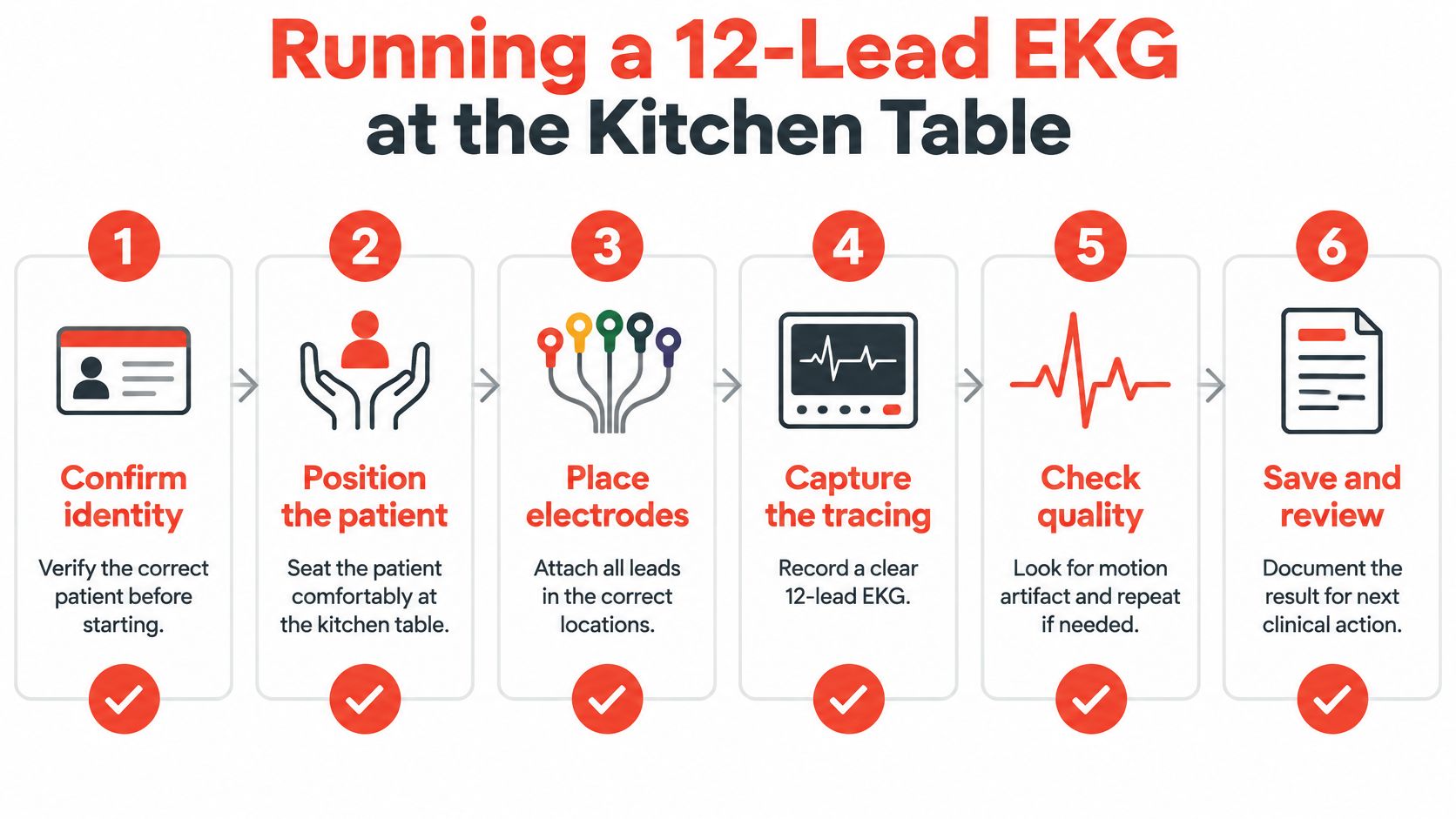
A tracing must pass a quality check
After recording the tracing, the clinician checks for baseline wander, muscle tremor, electrical interference, and implausible-looking patterns. If there's motion artifact, suspected lead reversal, or another problem that makes the recording unreliable, the answer is to correct the setup and repeat it, not to pretend the first tracing is good enough.
That matters because electrode position can change what an EKG appears to show. Incorrect chest-lead placement can create a false infarction pattern, while reversed leads can substantially alter interpretation and lead to unnecessary intervention. Torso placement of limb electrodes isn't interchangeable with a standard EKG and must be labeled clearly if used.
For a patient with an earlier tracing on file, matching lead positions helps make comparisons meaningful. Skin marks may help reproduce placement when serial studies are needed. The practical benchmark is a readable tracing with standardized lead positions, not merely a printout.
For a visual walkthrough of the sequence, see the video below.
Collecting Blood and Urine Samples Without Errors
A blood or urine test is only as dependable as the steps used to collect and handle it. For waived point-of-care tests, the clinician first verifies the order and patient identity, then checks the kit's expiration date, storage conditions, and instrument status. Required internal quality-control checks must be completed before testing. The CDC guidance on waived tests cautions that errors can occur when staff aren't familiar with a system or don't follow the manufacturer's instructions.
Each test has its own requirements for sample type, volume, timing, temperature, and mixing. A urine container that wasn't kept clean, a blood sample that doesn't provide enough volume, or a reading taken after the specified time can change the result. In a home, it's also possible to overlook hand hygiene, work in a room outside the kit's temperature specifications, or record a result under the wrong patient.
Record enough to check the result later
The clinician documents who performed the test, the kit or reagent lot number, the result, and whether the test was invalid or rejected. That record makes it easier to investigate a result if the clinical picture doesn't fit or someone later has a question about how the sample was handled.
Consider a patient whose urine dipstick result doesn't fit the symptoms and examination. Acting on that one value as if it settles the issue would be a mistake. The clinician may repeat the test with a properly collected sample or send a confirmatory specimen to a laboratory. A point-of-care result can guide the next question, but it shouldn't overrule conflicting evidence without review.
The same principle applies to blood testing: collection technique matters, and a number that clashes with symptoms may need confirmation. Good practice is careful handling, clear documentation, and a plan for what to do when a result doesn't make sense.
Deciding When a Home Result Is Reliable Enough
A device displays a number. That number still has to earn the clinician's trust. The right question isn't whether a test can be performed at home. It's whether the sample and method are suitable for the clinical question, whether the result fits the patient's condition, and whether confirmation is needed before acting.
A 2025 validation study in acutely ill older adults found that in-home point-of-care measurements for hemoglobin, white-cell differential, creatinine, sodium, potassium, and urea could be clinically reliable, but venous samples were preferable because capillary tests showed greater variation and inaccuracy. A health-technology assessment found insufficient evidence to determine home point-of-care accuracy for infection or dehydration. It also warned that expanding access could lead to overuse, overtreatment, and higher costs. Those limits matter because dehydration, kidney disease, infection, and medication effects can produce overlapping symptoms and test findings.
If you're weighing a consumer device against a clinician-performed test, this guide to how accurate are home ECG machines offers useful context about interpreting home EKG readings. It doesn't replace assessment of the patient or verification that the test answers the right question.
Home Sampling Checkpoints That Change How a Result Reads
| Checkpoint | Failure Point at Home | Action Before Trusting the Result |
|---|---|---|
| Sample type | Capillary and venous samples may not perform the same way | Document whether the sample is capillary or venous, and ask whether a venous draw is preferable |
| Collection | Contamination or insufficient sample volume | Recollect according to the test instructions |
| Test conditions | Expired kit, improper storage, or unsuitable temperature | Check kit status and environmental requirements before testing |
| Timing | Reading taken too early or too late | Follow the specified read time and record any invalid result |
| Clinical fit | Result conflicts with symptoms or examination findings | Repeat the test or seek confirmatory laboratory testing rather than relying on one value |
- Repeat the test when collection, timing, storage, or an invalid reading raises a concern.
- Ask about a venous sample when the sample type may affect accuracy or a result needs confirmation.
- Escalate for clinical review when an unexpected result or worsening symptoms needs a timely response.
Closing the Loop from Abnormal Result to Action
A home test comes back with an abnormal potassium result. The device reading is not the treatment decision. The responsible clinician must review it in context, including the patient's symptoms, medicines, kidney function, and other available findings, then decide whether confirmation, a referral, or another response is needed. The caregiver should know who is making that decision and when they'll hear back.
The clinician or care team contacts the family by phone, explains what the result means in plain language, and checks that the patient or caregiver understands the plan. If a repeat test or referral is required, someone should arrange it and document who is responsible for completing it. The caregiver can be told what changes to report, without being left to interpret the result or make a treatment decision independently.
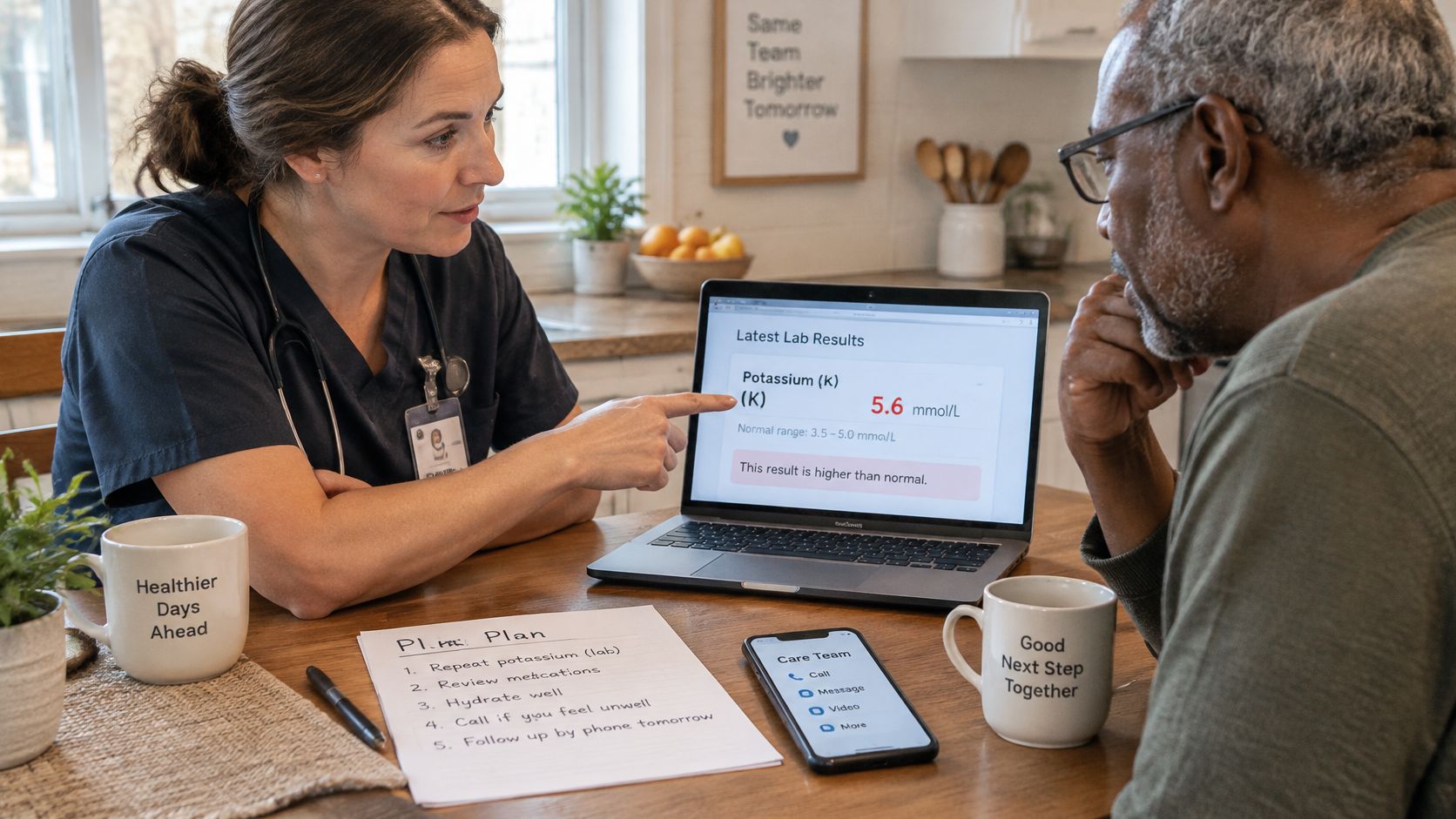
The result isn't closed until someone acts
The World Health Organization's diagnostic-safety materials report that approximately 7% of abnormal test results aren't communicated to patients, creating a path to delayed diagnosis. For a homebound patient, a missed call or an unclear message can leave a finding unresolved. The record should show that the result was reviewed, communicated, acknowledged, and connected to a clinical action.
This is especially important after hospitalization, when medication changes, kidney function, and possible infection symptoms may need reassessment. Medication reconciliation belongs alongside symptom review and communication with the patient's other clinicians, rather than being treated as a complete solution by itself. For ongoing conditions, a coordinated chronic disease management plan can help keep monitoring and follow-up connected.
Patients and families may also wonder how long laboratory processing takes. A general overview of UK blood test result waiting times can help explain why timing varies, but the patient's own care team should clarify when to expect a result and whom to contact if it hasn't arrived.
A result is not closed because it appeared in a chart. It's closed when the right person has communicated it, documented the action, and confirmed what happens next.
Choosing a House Call Partner and Taking the Next Step
A mobile lab service may collect a specimen, while an outpatient department can provide testing at its facility. A house call primary care practice can combine testing with a home examination and coordinate next steps. The practical differences are who interprets the result, who contacts the patient about an abnormal finding, whether imaging can be arranged, and how medication changes from different prescribers are reviewed.
Before choosing a provider, ask:
- Result ownership: Who reviews each result, and how will the patient or caregiver hear about it?
- Abnormal findings: Who arranges repeat testing, referral, or urgent follow-up?
- Testing options: Can the clinician perform blood draws, urine testing, or an EKG at home?
- Imaging coordination: Can the practice arrange mobile imaging when clinically appropriate?
- Medication review: Will the clinician compare medication bottles with discharge instructions and prescriptions from other clinicians?
Life Primary Care provides house call primary care across Morris, Essex, Union, Somerset, Passaic, and Bergen counties in New Jersey. Visits typically last 45–60 minutes. A clinician arrives with a portable exam kit and prepared chart, can perform in-home phlebotomy, EKGs, and urine testing, and can coordinate mobile X-ray and ultrasound. The coordination office in East Hanover handles scheduling, insurance verification, and follow-up; results and next steps are communicated by phone. Care takes place in the patient's home.
If you're looking for Visiting Docs, House calls for seniors, an In Home Doctor for Elderly relatives, At-Home Doctor Visits, or Doctor home visits for elderly family members, ask how the practice manages the entire path from test to action. Before calling, gather the medication bottles and recent results so the care team can understand what's already been checked.
Life Primary Care provides in-home primary care and diagnostics, including blood draws, EKGs, urine testing, and coordination of mobile imaging when appropriate. Gather your medication bottles and recent test results, then contact Life Primary Care to ask about scheduling a house call and how results and follow-up are handled.
Ready for a visit at home?
Call and speak with a real person. We will confirm your insurance, find a time and come to you.
973-607-4911 Call now