
Guide · 11 min read
Can Uti Cause Loss of Appetite
A parent who usually enjoys breakfast may suddenly push the plate away. The water glass stays half full, favorite foods sit untouched, and the only explanation is, “I'm just not hungry.” Families often wonder whether this is ordinary aging, a mood change, medication effect, or something more urgent.
Can a UTI cause loss of appetite? Yes, it can. Appetite loss may occur as part of the body's response to a urinary tract infection, especially when the illness is affecting an older adult more broadly. The important question isn't only whether appetite has changed. It's whether that change appears with fatigue, confusion, vomiting, fever, weakness, dehydration, or a sudden decline in function.
Table of Contents
- When an Older Parent Stops Finishing Meals
- Why a Bladder Infection Can Quiet the Appetite
- How UTIs Look Different in Older Adults
- The Missing Urinary Symptoms Problem
- Red Flag Combinations Worth a Same Day Evaluation
- Getting Checked at Home Instead of the Waiting Room
- A Family Checklist for the Next Few Days
When an Older Parent Stops Finishing Meals
A daughter visits her father for lunch and notices the details before he says anything. Yesterday's soup is still in the refrigerator. His usual sandwich is cut in half, but only one bite is missing. The water beside his chair is barely touched. When she asks whether he feels sick, he shrugs and says, “Nothing's wrong. I'm just not hungry.”
That answer can sound harmless, particularly when there's no obvious pain. Perhaps he's eating less because his activity has slowed. Maybe depression is returning, his teeth hurt, a medication has changed his taste, or he's becoming selective about food. Families may first interpret smaller portions as aging, pickiness, or a normal change in appetite.
The change families notice first
Appetite loss often appears gradually rather than dramatically. A person may:
- Leave more food behind: Meals that were once finished are only partly eaten.
- Lose interest in favorites: Familiar foods no longer attract attention.
- Skip between-meal snacks: The person may say they're full despite eating very little.
- Drink less: A half-filled or untouched glass may be as important as the plate.
- Spend more time sitting: Reduced intake can occur alongside tiredness or lower activity.
Age-related changes can influence hunger, digestion, smell, and taste. A plain-language overview of ageing metabolism explained by Understanding Ageing can help families understand why eating patterns may shift over time. But a new or noticeable decline shouldn't automatically be assigned to age.
A practical observation: A single missed meal tells you little. A pattern of reduced eating, reduced drinking, and reduced energy deserves a closer look.
The concern becomes sharper when the change arrives over a short period or accompanies behavior that feels unlike the person. An older adult may not report burning with urination, pelvic discomfort, or urgency. Instead, the first visible clue may be that meals no longer matter. That raises the question families often ask: what else could be causing this besides getting older?
Why a Bladder Infection Can Quiet the Appetite
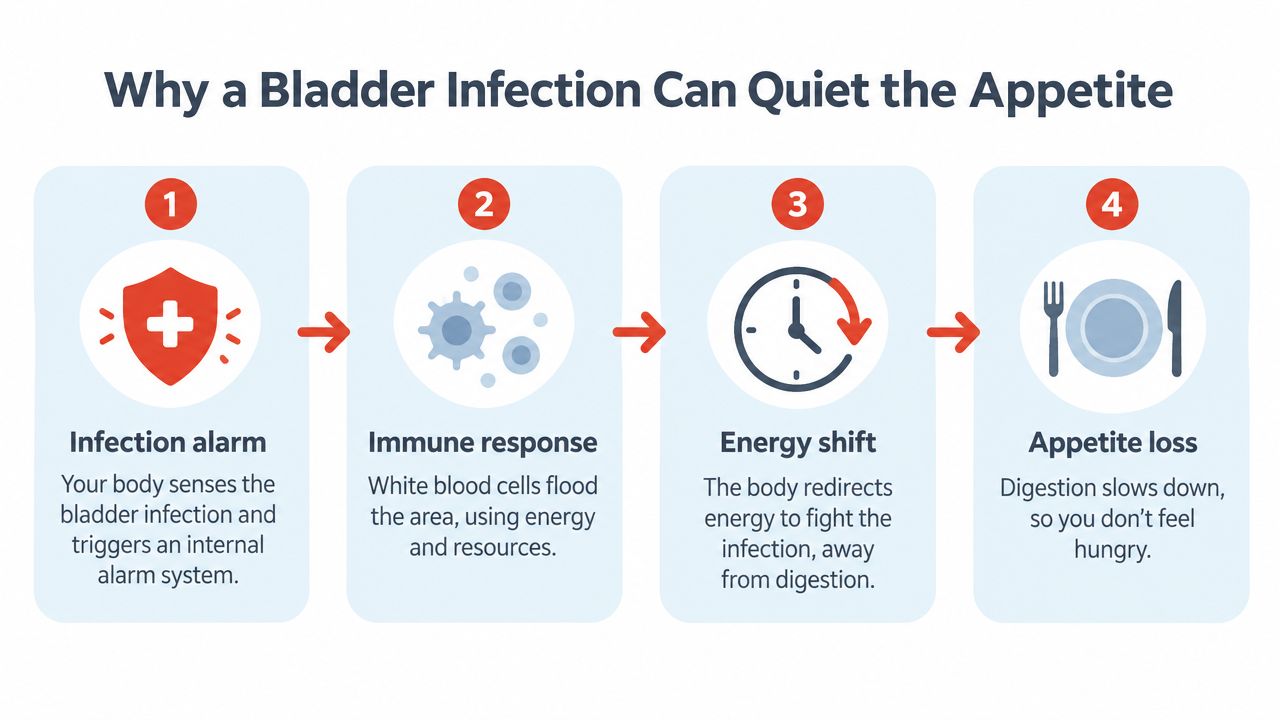
A urinary tract infection begins in the urinary system, but the body doesn't always keep its response confined to the bladder. The immune system recognizes the infection and shifts attention toward protection and repair. That internal response can affect energy, digestion, nausea, and hunger.
Think of the immune response as an alarm system. Once the body detects a problem, it releases inflammatory signals and redirects resources toward fighting it. Those signals can interfere with the ordinary hunger cues that tell someone food smells appealing, the stomach is ready, and a routine meal sounds welcome.
The connection in everyday terms
The sequence often looks like this:
- The body detects infection. The bladder becomes irritated, and the immune system responds.
- Inflammatory signals circulate. These signals can affect the brain and digestive system, not only the urinary tract.
- Energy and attention shift. The person may feel tired, uncomfortable, feverish, or generally unwell.
- Food becomes less appealing. Nausea, discomfort, slower digestion, and altered taste can reduce the desire to eat.
A 2024 study found that “lost appetite” was independently associated with UTI, with adjusted odds ratios around 1.54 and 1.99 depending on the model. The study is available in this clinical research report. That finding doesn't mean appetite loss proves a UTI. It means the symptom can belong to the wider clinical picture and shouldn't be dismissed because it isn't a urinary complaint.
This is not necessarily a primary digestive problem. The infection may be in the urinary tract, while appetite loss is one downstream effect of whole-body illness. Nausea, pain, fever, and dehydration can reinforce the cycle, making it harder for someone to eat or drink.
For a related discussion of fluids and urinary symptoms, families can review whether lemon water is good for a UTI. It shouldn't replace clinical evaluation when an older adult's condition is changing.
How UTIs Look Different in Older Adults
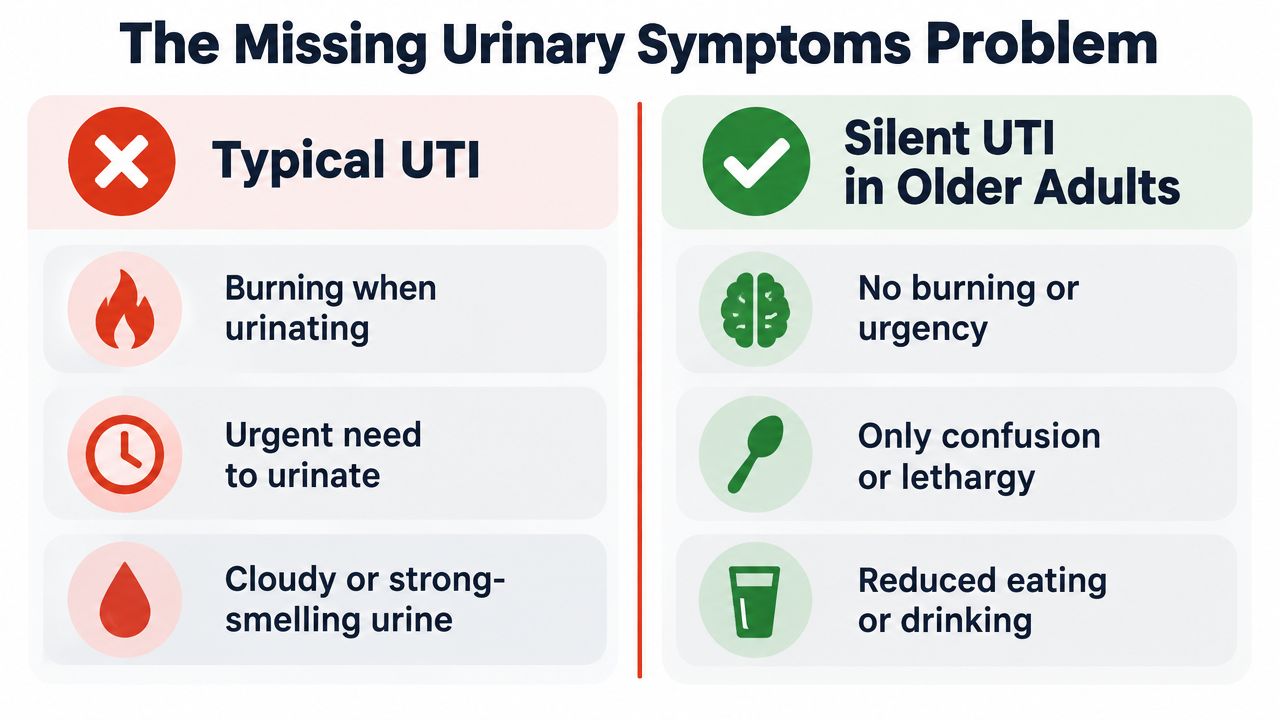
The familiar UTI picture centers on the urinary tract. A person may describe burning, urgency, frequent trips to the bathroom, pelvic discomfort, or a change in urine. Older adults, particularly those who are frail or have cognitive impairment, may show a less local pattern.
Instead of describing bladder symptoms, they may seem tired, weak, confused, withdrawn, restless, or unsteady. Appetite loss can fit into that pattern because the infection is affecting how the person feels and functions, not merely how they urinate.
A pediatric study of 948 children with UTIs found loss of appetite in 17.9% overall, with higher rates in acute pyelonephritis than cystitis, 22.6% compared with 11.5%. The researchers also identified appetite loss alongside abdominal pain, vomiting, loose stools, and lethargy, supporting the point that reduced eating can be part of a broader symptom cluster rather than an isolated complaint. The findings are reported in the 2023 pediatric study.
Typical versus atypical patterns
| Symptom Category | Typical UTI Presentation | Atypical Presentation in Older Adults |
|---|---|---|
| Urination | Burning, urgency, or frequent trips | No clear urinary complaint |
| General condition | Local discomfort with otherwise stable function | Fatigue, weakness, sleepiness, or reduced mobility |
| Thinking and behavior | Usually unchanged | Confusion, disorientation, irritability, or restlessness |
| Eating and drinking | Appetite may remain fairly normal | Reduced appetite, skipped meals, or refusal to drink |
| Functional clues | Normal walking and daily routine | Falls, difficulty walking, or sudden dependence |
Research involving older adults also found appetite loss with nausea or vomiting in 15% of participants overall among 141 older adults with suspected urinary-tract infection. The same study reported that lower Mini Nutritional Assessment scores were independently associated with UTI in the prior year, with β = −0.21 and P = 0.006. These findings are described in the older-adult study.
A localized bladder infection and a more extensive infection can look different, but families can't reliably determine the location from appetite alone. The value of the symptom is that it may signal a change worth assessing, especially when it appears with a change in thinking, strength, hydration, or movement.
The Missing Urinary Symptoms Problem
Many families use burning with urination as a pass-fail test. If there's no burning, they assume a UTI is unlikely. That assumption can fail in an older adult who has difficulty communicating, reduced sensation, memory loss, incontinence, or a baseline pattern that already includes frequent bathroom trips.
Older adults may not identify pelvic discomfort clearly. A person with dementia may deny pain, forget the timing of symptoms, or behave differently. Limited mobility can also obscure urinary changes because a caregiver sees the person less often in the bathroom. Reduced thirst and incontinence can hide changes in drinking and urination at the same time.
What may replace classic urinary clues
The observable changes may be broader:
- Behavior: New irritability, restlessness, withdrawal, or unusual quietness.
- Alertness: More sleep, lethargy, or difficulty sustaining attention.
- Function: A new fall, slower walking, or trouble transferring.
- Intake: Less food and fluid, even without a complaint of nausea.
- Communication: Vague answers, inability to describe discomfort, or seeming unlike oneself.
A clinical review notes that older adults with or without bacteriuria may show nonspecific symptoms such as anorexia, fatigue, malaise, and weakness, and it describes anorexia as an independent predictor in an elderly cohort. The review also emphasizes that older adults may have atypical presentations and a blunted fever response. Those details appear in the clinical review of UTI in older adults.
Appetite loss can act like an early body-wide signal, but it isn't specific to UTI. Medication effects, constipation, dental pain, depression, viral illness, and other conditions can also reduce eating. The absence of burning doesn't rule out infection, and appetite loss alone doesn't confirm one. A clinician needs the full timeline and examination to interpret the change.
Red Flag Combinations Worth a Same Day Evaluation
Appetite loss on its own deserves attention, but it doesn't always indicate an emergency. The urgency rises when reduced eating appears with other changes, particularly in an older adult who is frail, cognitively impaired, recently hospitalized, or already vulnerable to dehydration.
The most useful question is not, “Is appetite loss a UTI symptom?” It's, “What else changed at the same time?”
A simple triage framework
| Tier | Findings | Suggested Response |
|---|---|---|
| Alone | New appetite reduction without other obvious changes | Observe the pattern closely and arrange a clinical conversation if it persists or worsens |
| Paired | Appetite loss with new fatigue, increased sleep, mild confusion, weakness, or a feverish feeling | Seek same-day clinical contact, particularly for an older or frail person |
| Clustered | Appetite loss with fever, shaking, vomiting, severe confusion, flank pain, marked weakness, or sudden inability to walk | Seek urgent evaluation through the appropriate emergency or urgent-care pathway |
A same-day assessment becomes more important when the person is drinking very little, has recently fallen, or has a noticeable change in continence. These details can reveal that the problem is affecting hydration, strength, or function even when urinary symptoms remain vague.
When calling: Say what changed from baseline, when it began, how much the person has eaten and drunk, whether confusion or mobility changed, and whether there has been vomiting, fever, shaking, pain, or a fall.
Families can use this guide to same-day medical care when deciding how to organize prompt evaluation. The goal isn't to diagnose the infection at home. It's to give the clinician a clear, useful picture of the change and avoid losing time because the symptom doesn't match a textbook list.
A person who is difficult to wake, severely confused, unable to keep fluids down, suddenly unable to walk, or rapidly deteriorating needs urgent attention rather than routine scheduling. Appetite loss may be one part of a more serious illness, so the surrounding symptoms matter.
Getting Checked at Home Instead of the Waiting Room
Transport can become the barrier that delays evaluation. An older adult who feels weak or confused may resist getting dressed, climbing stairs, transferring into a vehicle, or sitting through a long clinic wait. A wheelchair, oxygen equipment, incontinence, or caregiver work obligations can make the trip even harder.
A house-call visit changes what the clinician can observe. The visit occurs in the person's usual environment, where mobility, alertness, bathroom access, medication bottles, food intake, and caregiver observations are visible in real time. That context can help distinguish a mild change from a meaningful functional decline.
What an in-home visit can make easier
- Lower physical burden: The patient doesn't need to manage transportation or a waiting room.
- Better baseline comparison: The clinician can see how the person stands, walks, speaks, and interacts at home.
- Practical testing: In-home clinicians may coordinate urine testing, blood work, EKGs, or other diagnostics when appropriate.
- Clearer medication review: The actual medication containers can be available for reconciliation.
- Follow-up planning: Results, referrals, and next steps can be arranged around the patient's needs.
Families who want background on urine testing can read Lola's complete urinary health checkup guide. A urine result still needs clinical interpretation, because urinary bacteria and symptoms don't always mean the same thing in every person.
For families exploring Visiting physicians NJ, Visiting Doctors NJ, or At-Home Doctor Visits, a nurse practitioner or physician home visit can be one route for timely assessment. Information about nurse practitioner home visits explains how in-home primary care can support people who cannot easily reach a clinic.
Home evaluation isn't a substitute for emergency care when symptoms are severe. It's a practical option when the main obstacle is getting a vulnerable person out of the house for assessment.
A Family Checklist for the Next Few Days
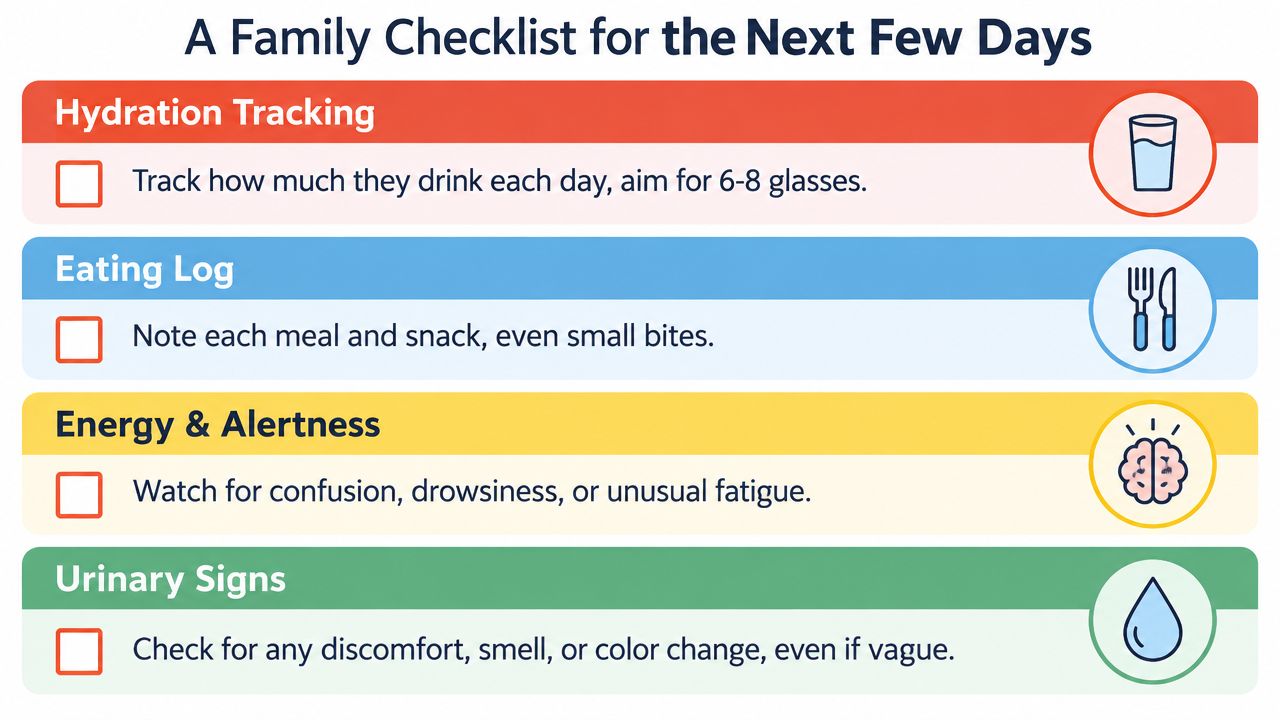
A short daily record can turn a vague concern into useful clinical information. Families don't need to diagnose a UTI. They can track what changed, compare it with the person's usual routine, and report the pattern accurately.
Hydration tracking
Note what the person drinks with meals and between meals. Record whether fluids are being refused, whether the mouth seems dry, and whether urine appears noticeably darker than usual. A trend matters more than a single observation.
Appetite and intake
Write down which meals were offered and how much was eaten. Include small bites, snacks, and early fullness. “Ate less” is useful, but “finished half of breakfast, skipped lunch, and declined a favorite food at dinner” gives a clinician a clearer timeline.
Symptoms that change the plan
Pay attention to new confusion, unusual drowsiness, weakness, a fall, a feverish feeling, vomiting, shaking, flank discomfort, or a sudden change in walking. A person may not describe urinary burning, so behavior and function deserve equal attention.
Logistics for contacting care
Keep the medication list, allergies, major medical conditions, recent hospital paperwork, and symptom timeline together. Know which primary care office, in-home service, urgent-care site, or emergency pathway you'll contact if the pattern worsens.
Persistent appetite loss lasting more than 24 to 48 hours in an older adult generally deserves a same-day clinical conversation, whether through house-call primary care or another appropriate pathway. Families searching for House calls for seniors, Doctor house calls NJ, in-home medical care, or Doctor home visits for elderly can start by explaining the intake change and any accompanying symptoms, rather than waiting for classic urinary complaints to appear.
Life Primary Care offers in-home primary care and same-day urgent visits for non-emergency concerns, including evaluation of urinary symptoms, urine testing, treatment planning, and follow-up at home. If an older adult has stopped eating and a clinic trip feels unsafe or impractical, visit Life Primary Care to learn whether an in-home visit is available in your New Jersey area.
Ready for a visit at home?
Call and speak with a real person. We will confirm your insurance, find a time and come to you.
973-607-4911 Call now