
Guide · 9 min read
Does Medicare Cover Annual Wellness Visits

Medicare Part B covers one Annual Wellness Visit every 12 months at no cost to the beneficiary when the provider accepts Medicare assignment. It isn't a routine physical, but a structured prevention visit that creates or updates a personal health plan.
Why, then, do so many families still ask whether Medicare pays for an “annual physical”? The confusion usually begins with the name. An Annual Wellness Visit, or AWV, sounds like a head-to-toe examination, yet Medicare designed it mainly as a health-risk assessment and planning conversation. For someone receiving care at home, that conversation can happen at the kitchen table, with medication bottles, family questions, and everyday safety concerns close at hand.
Table of Contents
- What Medicare Covers for an Annual Wellness Visit
- What the Annual Wellness Visit Actually Includes
- Eligibility and Timing Rules
- Annual Wellness Visit Compared to a Routine Physical
- When You Will and Will Not Pay Anything
- How a Home-Based Annual Wellness Visit Works
- Practical Steps for Families and Common Questions
What Medicare Covers for an Annual Wellness Visit
Yes, Medicare Part B covers one Annual Wellness Visit every 12 months for eligible beneficiaries. When the clinician accepts Medicare assignment, the covered AWV has no deductible or coinsurance for the patient. Medicare.gov explains that the benefit creates or updates a personalized prevention plan, rather than providing a complete physical examination. Medicare's Annual Wellness Visit coverage guidance describes the benefit and its limits.
The practical question is what happens during the appointment. The visit generally brings together five pieces:
- A health-risk assessment.
- A review of medical and family history.
- Measurements and cognitive-impairment detection.
- A review of preventive screenings and health risks.
- A personalized prevention plan for the year ahead.
That structure matters for older adults who have several clinicians, multiple prescriptions, or difficulty traveling to an office. A clinician can identify missing information, organize screening recommendations, and discuss ways to remain safe and independent without turning the appointment into a rushed illness visit.
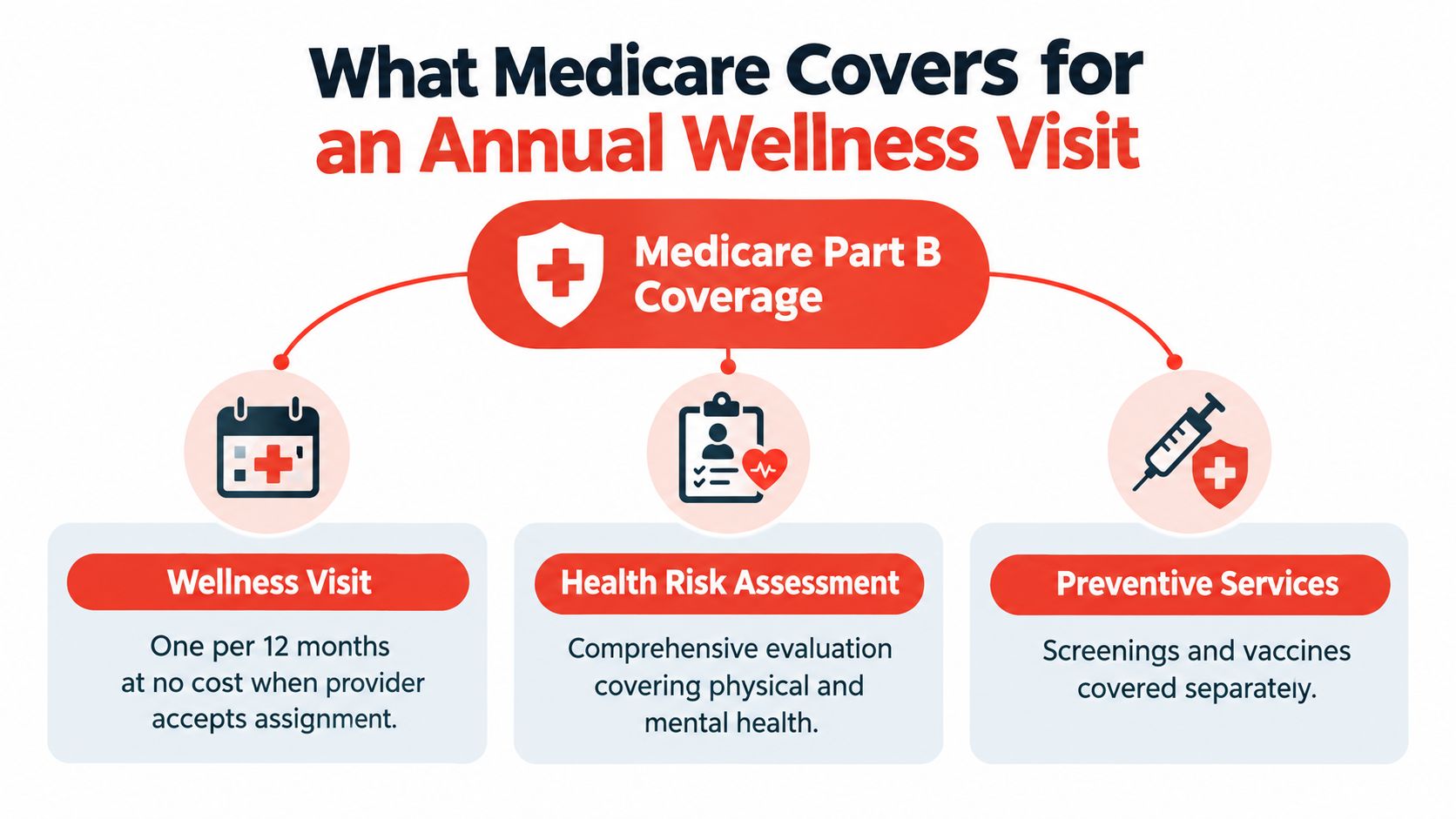
One important boundary comes first: Medicare distinguishes an AWV from a routine physical. The covered service is preventive planning. If a clinician separately evaluates a new symptom, manages an illness, or orders diagnostic testing, those additional services can have different billing rules.
What the Annual Wellness Visit Actually Includes
An AWV follows a required framework, but it should still feel like a conversation about the person's real life. The clinician reviews the health-risk assessment, asking about physical health, mental health, daily activities, safety, and risks that could affect independence.
At the kitchen table, that might mean discussing whether a patient feels unsteady walking to the bathroom, whether prescription bottles match the medication list, or whether memory changes are making it harder to manage appointments. The clinician also reviews medical and family history, current providers, and prescription, over-the-counter, and supplemental medicines.
CMS identifies core elements that include:
- Medical and family history: The clinician looks for information that may shape preventive planning.
- Provider and medication lists: A current list helps connect primary care, specialists, pharmacies, and prescriptions.
- Basic measurements: Height, weight or body mass index, and blood pressure are recorded.
- Cognitive-impairment detection: The clinician checks for possible memory or thinking concerns.
- Preventive planning: Recommended screenings and other prevention needs are organized into a personalized plan.
The AWV may also create a useful opportunity to discuss fall risk, home safety, and questions about daily function. It isn't designed to replace a focused visit for chest pain, a medication problem, an infection, or another active complaint. Those concerns should be mentioned when scheduling so the practice can explain what the appointment may include.
Families who want to understand testing options can review this guide to at-home diagnostic tests. The AWV itself is primarily about assessment and planning, while tests or treatment for a medical problem may be separate.

A short overview can also help families recognize the difference between preventive planning and a conventional physical examination.
Eligibility and Timing Rules
Does Medicare's Annual Wellness Visit follow the calendar year? No. The practical question is whether the patient qualifies and whether 12 months have passed since the last qualifying preventive visit.
Generally, the beneficiary must have had Part B for more than 12 months. They also must not have received a Welcome to Medicare visit, formally called an Initial Preventive Physical Examination, or another AWV during the previous 12 months. The Annual Wellness Visit requirements outline the timing and required components.
| Situation | Medicare billing code | Timing rule |
|---|---|---|
| First Annual Wellness Visit | G0438 | Once per beneficiary's lifetime |
| Later Annual Wellness Visit | G0439 | Once in each 12-month period |
| Welcome to Medicare visit | IPPE | An earlier, separate preventive benefit with its own timing rules |
At a kitchen table in a New Jersey home, this timing check can shape the visit plan before anyone books an appointment. Before scheduling, review the Medicare annual wellness visit requirements and ask the practice to verify the patient's last AWV or IPPE date. That check helps prevent an appointment from being scheduled too soon or under the wrong service.
The first AWV does not have to follow a Welcome to Medicare visit. A beneficiary may qualify after the initial Part B waiting period if the other timing rules are satisfied. Ask one clear question: “When was the patient's last AWV or Welcome to Medicare visit, and which preventive service are we booking?”
Annual Wellness Visit Compared to a Routine Physical
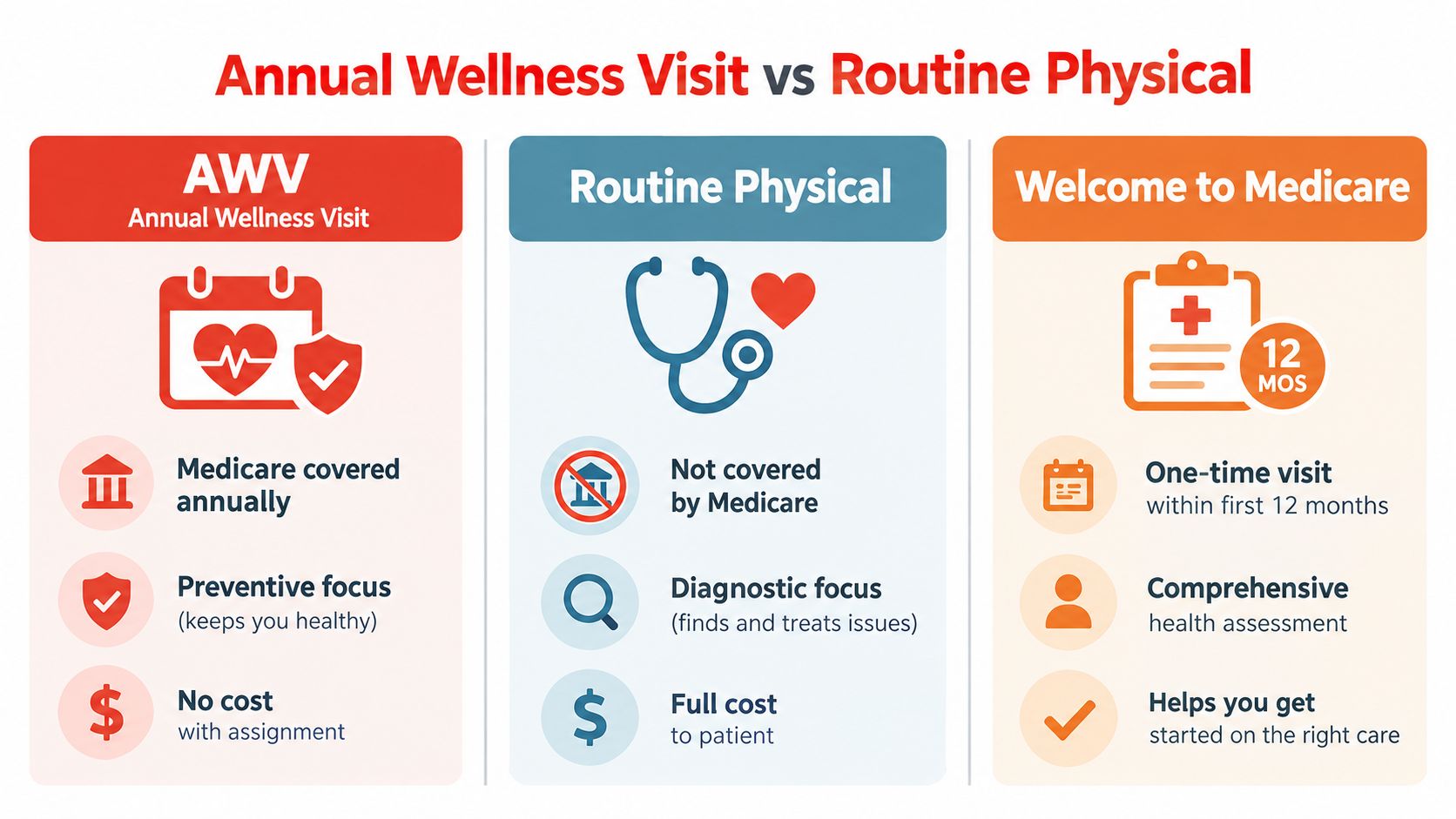
Which appointment should a family request: an Annual Wellness Visit, a routine physical, or a Welcome to Medicare visit? The names sound alike, but each serves a different purpose. At a kitchen table in a New Jersey home, this distinction helps families plan the right conversation before calling the practice.
| Visit type | Main purpose | Medicare treatment |
|---|---|---|
| Annual Wellness Visit | Reviews health risks and creates a personalized prevention plan | A covered preventive service for eligible beneficiaries, generally scheduled once every 12 months |
| Routine physical | Provides a broad examination and diagnostic assessment | A separate service, not automatically included in the AWV benefit |
| Welcome to Medicare visit | Introduces preventive care after initial Part B enrollment | A one-time preventive benefit with separate eligibility and timing rules |
The AWV, routine physical, and Welcome to Medicare visit may happen in the same primary-care setting, yet they are not interchangeable. The CMS preventive-services information treats the AWV and the Initial Preventive Physical Examination as distinct services. A routine physical also follows its own billing rules.
Use precise wording when scheduling: “We'd like to book a Medicare Annual Wellness Visit.” Then list active symptoms separately. For a home-based visit, that script helps the clinician and family decide whether the appointment should focus on prevention, a current concern, or both. It also gives the office a clear starting point for confirming the intended service.
When You Will and Will Not Pay Anything
For an eligible patient, the covered AWV costs nothing out of pocket when the clinician accepts Medicare assignment and provides the service according to Medicare's requirements. The Part B deductible and coinsurance don't apply to the covered preventive visit. CMS's preventive-services reference chart identifies the covered AWV beneficiary cost as zero.
The calculation changes when the clinician provides a separate, medically necessary service during the same encounter. A new symptom, a specific illness evaluation, diagnostic testing, or treatment may be billed separately. Medicare can then apply the usual deductible or coinsurance to that additional service, even though the AWV itself remains a covered preventive benefit.
Practical rule: Ask the practice to separate the preventive planning from any problem-focused care before the appointment begins.
Consider two kitchen-table examples. In the first, the clinician reviews history, medications, blood pressure, cognitive concerns, preventive needs, and the prevention plan. That is the covered AWV. In the second, the patient also reports a new symptom or needs a medication adjustment for an active condition. The clinician may need to perform and document a separate evaluation-and-management service, which can create cost-sharing.
A plain-language explanation protects families from surprises. For broader context on Part B rules for federal retirees, the Federal Benefits Sherpa Medicare guide can be a useful additional resource. Coverage can differ by situation, so patients should still confirm the specific service with the practice and their plan.
How a Home-Based Annual Wellness Visit Works
An in-home AWV can look less formal than an office appointment while following the same preventive purpose. A clinician arrives with a portable kit and a prepared chart, then reviews the patient's medications, health history, providers, risk factors, measurements, and prevention needs in a familiar room.
The home setting adds useful context. A caregiver can bring out every prescription bottle, point out stairs or bathroom concerns, and help answer questions about daily routines. The clinician can discuss fall risk where the patient lives instead of relying only on a description.
At Life Primary Care, a New Jersey house-call practice, visits typically last 45 to 60 minutes, and care is delivered in the patient's home. The practice serves Morris, Essex, Union, Somerset, Passaic, and Bergen counties, accepts Medicare and most major insurers, and states that covered services, including the AWV, have no travel fee, concierge fee, or membership charge. The practice's guide to doctors making house calls provides more detail about the home-based model.
A prevention plan works better when the patient and family understand what happens next.
The clinician can review the plan with the patient and family, communicate results by phone, and arrange follow-up, referrals, or testing as appropriate. For people searching for Visiting physicians NJ, Visiting Doctors NJ, Dr House calls NJ, or Doctor house calls NJ, the key question isn't only whether a clinician travels. Ask whether the practice can provide the preventive planning, documentation, and follow-up that make the AWV useful.
Practical Steps for Families and Common Questions
Families can prepare for an AWV on the same day they call:
- Confirm Part B timing: Make sure the beneficiary has had Part B for more than 12 months.
- Check the last preventive visit: Ask when the last AWV or Welcome to Medicare visit occurred.
- Gather information: Write down current medications, supplements, specialists, pharmacies, and family-history details.
- Ask about added services: Tell the practice about symptoms or medication problems and ask whether separate cost-sharing may apply.
Can an AWV happen at home? Yes. Medicare's coverage rules apply to the eligible preventive service regardless of whether it occurs in a traditional office or another permitted care setting.
Does a caregiver need to attend? No, but a caregiver can help with medication lists, memory questions, and the prevention plan.
Is a physical examination included? The AWV isn't a routine physical. It focuses on assessment, measurements, cognitive-impairment detection, screening plans, and prevention.
Does telehealth count? Ask the practice and Medicare plan about the current rules for the service and setting. Don't assume a virtual appointment is billed the same way as an in-home or office AWV.
For families comparing House calls for seniors, an In Home Doctor for Elderly, At-Home Doctor Visits, in-home medical care, Visiting Docs, Doctor home visits for elderly, or Doctor House Calls for Seniors, start with the benefit you need and the date you last used it.
Life Primary Care provides in-home primary care and Medicare Annual Wellness Visits for eligible patients across northern and central New Jersey. Visit Life Primary Care to learn about scheduling, service areas, insurance verification, and preventive care at home.
Ready for a visit at home?
Call and speak with a real person. We will confirm your insurance, find a time and come to you.
973-607-4911 Call now