
Guide · 13 min read
Home Care for Parkinsons Patients: A Practical Guide

At 7 a.m., the house is already negotiating with Parkinson's. An older adult shuffles from the bedroom toward the bathroom while a spouse watches the clock, waits for the next carbidopa-levodopa dose, and tries not to rush the transfer. Breakfast is ready, but its protein content may need to fit around medication timing. A doorway can stop the morning completely when freezing appears.
That's what makes home care for Parkinson's patients different from a clinic appointment. A 45–60 minute home visit can show how medication response, furniture placement, walking surfaces, bathroom transfers, meals, and caregiver routines interact in real time. The practical question isn't only whether symptoms are present. It's whether the person can safely get through an ordinary day.
Table of Contents
- A Morning in a Parkinson's Home
- Understanding Parkinson's and Why Home Matters
- Getting Medication Timing Right at Home
- Mobility, Falls, and Safer Home Spaces
- Physical and Occupational Therapy at Home
- Caregiver Strategies That Actually Help
- Choosing the Right Home-Based Care Model
- What Good Parkinson's Home Care Looks Like
A Morning in a Parkinson's Home
The first clue may appear before the clinician reaches the front door. The spouse opens it quickly, apologizing that the patient is still getting dressed. Inside, the hallway is familiar but narrow. A rug has curled at one corner. The kitchen counter holds a pill organizer, a glass of water, yesterday's medication list, and the breakfast plate.
At the bedroom doorway, the patient pauses. The feet seem to stick while the upper body leans forward. The spouse says, “Take a big step,” then reaches out. That well-intended cue may help, but the scene also reveals something important: the transfer depends on timing, visual space, and another person's confidence.
The next dose is due soon. Until then, the tremor is more pronounced, movement is slow, and standing takes effort. About 25 minutes after medication, the hands are calmer and walking is less hesitant. The home visit captures that change because the clinician is present for the routine, not just asking the patient to recall it later.
What a house call reveals: The medication list says what should happen. The living room shows what actually happens.
The routine carries the clinical information
Dressing may involve freezing at the closet, trouble with buttons, and fatigue before breakfast. The bathroom may expose a low toilet, poor lighting, or a turn that requires backing up into a tight space. The kitchen may show that medication storage, food preparation, and family reminders all compete for one counter.
This isn't a brief check-in service. A 2022 study of home health nursing for Parkinson's disease recorded a median of 9.0 home visits per month and a median nursing time of 49 minutes 7 seconds per visit across the reported visits (Parkinson's home health nursing study). That repeated contact reflects the daily complexity of advanced disease.
The pressures repeat: getting out of bed, crossing the hallway, using the toilet, dressing without rushing, eating safely, and keeping doses on schedule. The rest of this guide focuses on the details families and clinicians recognize in similar living rooms, medication windows, turning spaces, therapy routines, and the limits of what one caregiver can sustain.
Understanding Parkinson's and Why Home Matters
Parkinson's changes movement, but families experience those changes as disrupted tasks. Resting tremor may make a cup or utensil unstable. Bradykinesia, or slowed movement, can turn dressing and transfers into long processes. Rigidity makes rolling in bed, rising from a chair, or turning in a narrow bathroom harder.
Freezing of gait is different from ordinary slowness. The person may intend to move but feel unable to start, especially near a doorway, when turning, or when moving between surfaces. Postural instability reduces the ability to recover from a misstep. These symptoms make the bed height, chair arms, hallway width, and bathroom layout part of the care plan.
Symptoms have household consequences
Parkinson's often alternates between “on” periods, when movement is easier, and “off” periods, when stiffness, tremor, or freezing returns. A clinic appointment may capture only one point in that cycle. A home visit can show whether the person is safest before breakfast, after medication, or during a predictable late-day decline.
Non-motor symptoms also shape care. Constipation can affect comfort and routine. Low blood pressure on standing can make a fast rise from bed unsafe. Fragmented sleep can worsen daytime fatigue, while anxiety may intensify freezing. Mild cognitive changes can affect medication organization, judgment, and the ability to follow a multistep task.
The home provides evidence that a clinic room can't. The clinician can observe the route to the bathroom, the actual chair used for transfers, and whether the caregiver's instructions are practical under pressure.
Families considering broader accessibility changes can use a resource on how to remodel for aging in place safely. The right modification isn't automatically the most extensive one. It should solve a specific problem, preserve dignity, and remain usable as mobility changes.
Getting Medication Timing Right at Home
Medication timing is an operational routine, not a pharmacy lecture. Delayed or missed dopaminergic doses can worsen rigidity, tremor, freezing, mobility, falls, and participation in rehabilitation. Practical guidance recommends exact clock times, alarms, pill organizers, an updated medication list, and timed reminder systems (Parkinson's medication needs guidance).
A workable setup uses several layers:
- Weekly organization: Keep a weekly pill organizer in a consistent location, away from clutter and moisture.
- Audible reminders: Pair it with a phone alarm or a dedicated timed reminder so the patient and caregiver both receive the cue.
- Visible instructions: Tape a printed schedule inside a kitchen cabinet, including dose times and the name of the prescribing clinician.
- Backup supply: Keep an agreed backup system, such as a sealed blister pack, available for power outages or disrupted routines.
Families often need to plan meals around medication rather than argue with the patient at the table. Protein, dairy, and iron can interfere with levodopa absorption for some people, so the prescribing clinician or pharmacist should help determine the safest meal pattern for the individual. The household goal is consistency, not an unnecessarily restrictive diet.
A delayed dose needs a calm response
A dose taken late isn't automatically the same as a dose that was completely missed. Record the actual time, watch for changes, and follow the prescriber's written instructions. Don't double a dose unless the prescribing clinician specifically directs it. Call the prescribing office when the schedule is repeatedly failing, “off” periods are becoming more disruptive, or a missed dose creates a safety concern.
During a home visit, an in-home clinician can watch a real dose being taken, compare the observed response with the schedule, review bottles from every prescriber, and identify where the routine breaks. Families can also use this medication management service guide for seniors to understand what structured support may involve.
Mobility, Falls, and Safer Home Spaces
A fall rarely comes from one dramatic hazard. More often, it follows a sequence: medication is wearing off, the person turns quickly, a loose rug shifts, and the bathroom is dim. Parkinson's freezing commonly appears at doorways, flooring transitions, and cluttered hallways, not only on stairs.
The safest approach is a room-by-room walkthrough. A low builder-grade toilet may be replaced with a raised toilet seat with armrests. A freestanding tub may be less practical than a shower chair, grab bars, and a handheld showerhead. Loose throw rugs should be removed, and low-pile carpet should be secured at its edges.
A safer layout supports the transfer before the caregiver has to catch the person.
High-Risk Areas and Recommended Fixes
| Home Area | Common Hazard | Recommended Fix |
|---|---|---|
| Bedroom | Bed positioned against a wall or too low for safe rising | Reposition the bed so the stronger side faces the room, and review bed height with a therapist |
| Hallway | Loose rugs, cords, narrow turning space | Clear the route, secure flooring, and preserve wide turning paths |
| Bathroom | Low toilet, slippery floor, poor nighttime lighting | Use a raised seat with armrests, grab bars, shower seating, and motion-activated nightlights |
| Doorways | Freezing at thresholds and flooring changes | Use contrasting edge tape and reduce uneven transitions where feasible |
| Living room | Soft, low sofa without arm support | Choose firm seating with arms and enough clearance for assisted standing |
| Stairs | Dim lighting and unclear step edges | Improve illumination, add secure railings, and mark edges with contrasting tape |
Environmental changes are a clinical intervention, not decoration. Lighting matters after dark, especially along the bedroom-to-bathroom route. A contractor resource for aging in place can help families evaluate larger changes, while a clinician or occupational therapist can define the functional problem first.
Families can also use this fall prevention checklist for the home. The checklist is most useful when applied to the actual route the patient walks, not to a generic floor plan.
Physical and Occupational Therapy at Home
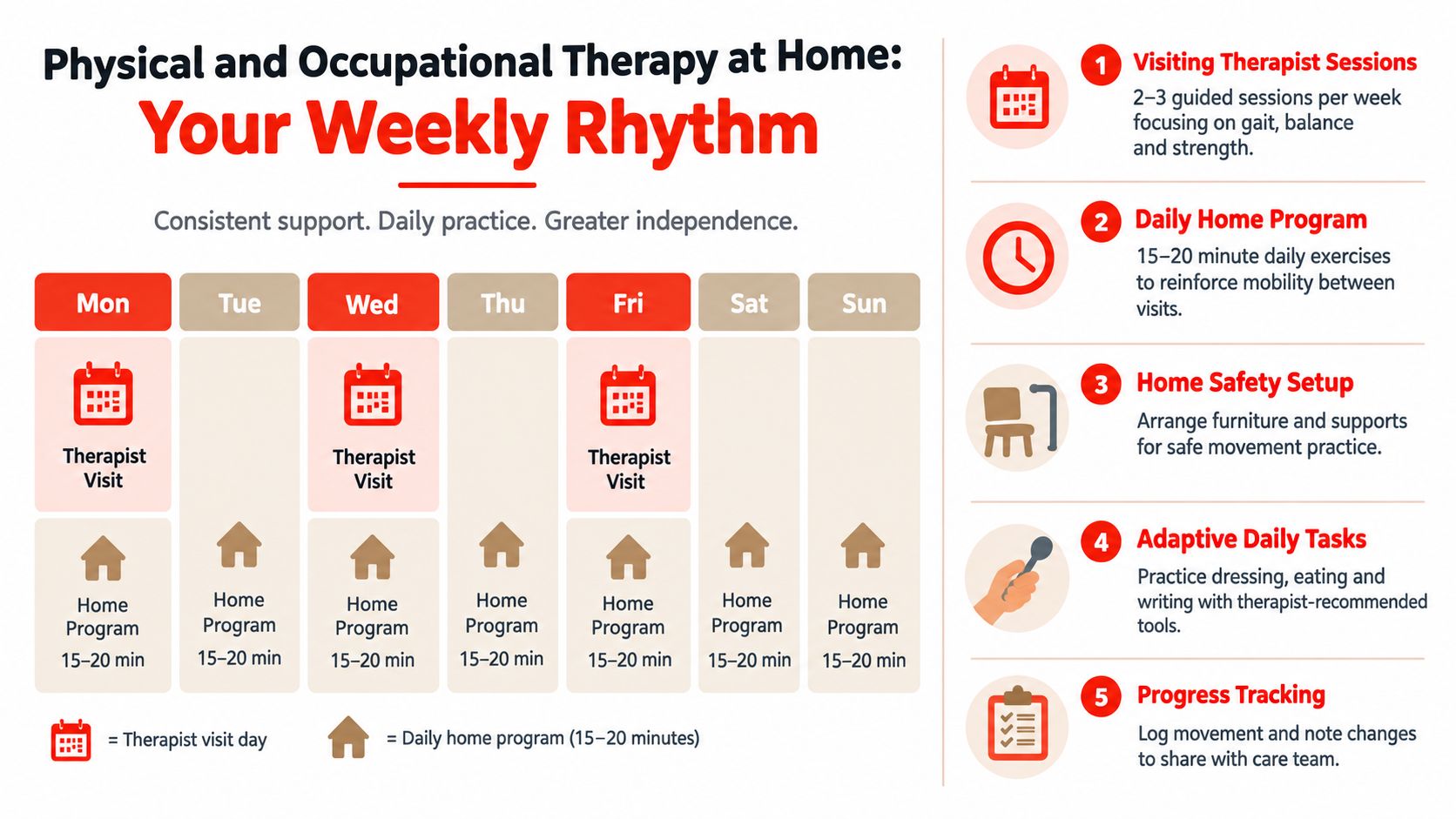
A home therapy week should fit the patient's medication cycle and energy, not imitate a fitness class. A visiting physical therapist may work with the patient two to three times weekly, while the caregiver supervises a short daily program between visits. The therapist may begin with chair-based warmups on a low-energy day, then practice larger steps, turning, balance near the kitchen counter, and controlled sit-to-stand movements.
Occupational therapy addresses the tasks that families often describe as “small,” even though they consume much of the morning. Buttoning a shirt, cutting food, pulling a zipper, rising from a low sofa, or reaching into a closet can determine whether someone remains independent.
The home is part of the therapy equipment
A therapist sees the actual chair height, doorway width, counter edge, and flooring transition. That observation often matters more than completing another exercise on a treatment table. The therapist can also see whether the patient performs better during peak medication effect and whether tremor or fatigue changes the task.
A home program should be brief enough to happen. Fifteen to 20 minutes can include amplitude-based movements, stepping practice, balance work with appropriate support, and one functional task such as dressing or turning. The program should be adapted by the treating therapist for fatigue, tremor, balance, cognition, and supervision needs.
Documentation tools can reduce the time therapists spend reconstructing what happened between visits. An AI scribe for physical therapists may support note-taking workflows, but it doesn't replace clinical judgment or direct observation.
The evidence supports structured home exercise over usual care for balance-related activities and gait speed, with systematic reviews reporting a small but clinically meaningful effect immediately after intervention, including standardized mean differences of about 0.3–0.5 (systematic review of home-based exercise). Higher-intensity programs may perform better than low-intensity approaches when they're safe and individually supervised. For many patients, home-based PT and OT become more useful than center-based programs once transportation, fatigue, and the effort of leaving home are included in the decision.
Caregiver Strategies That Actually Help
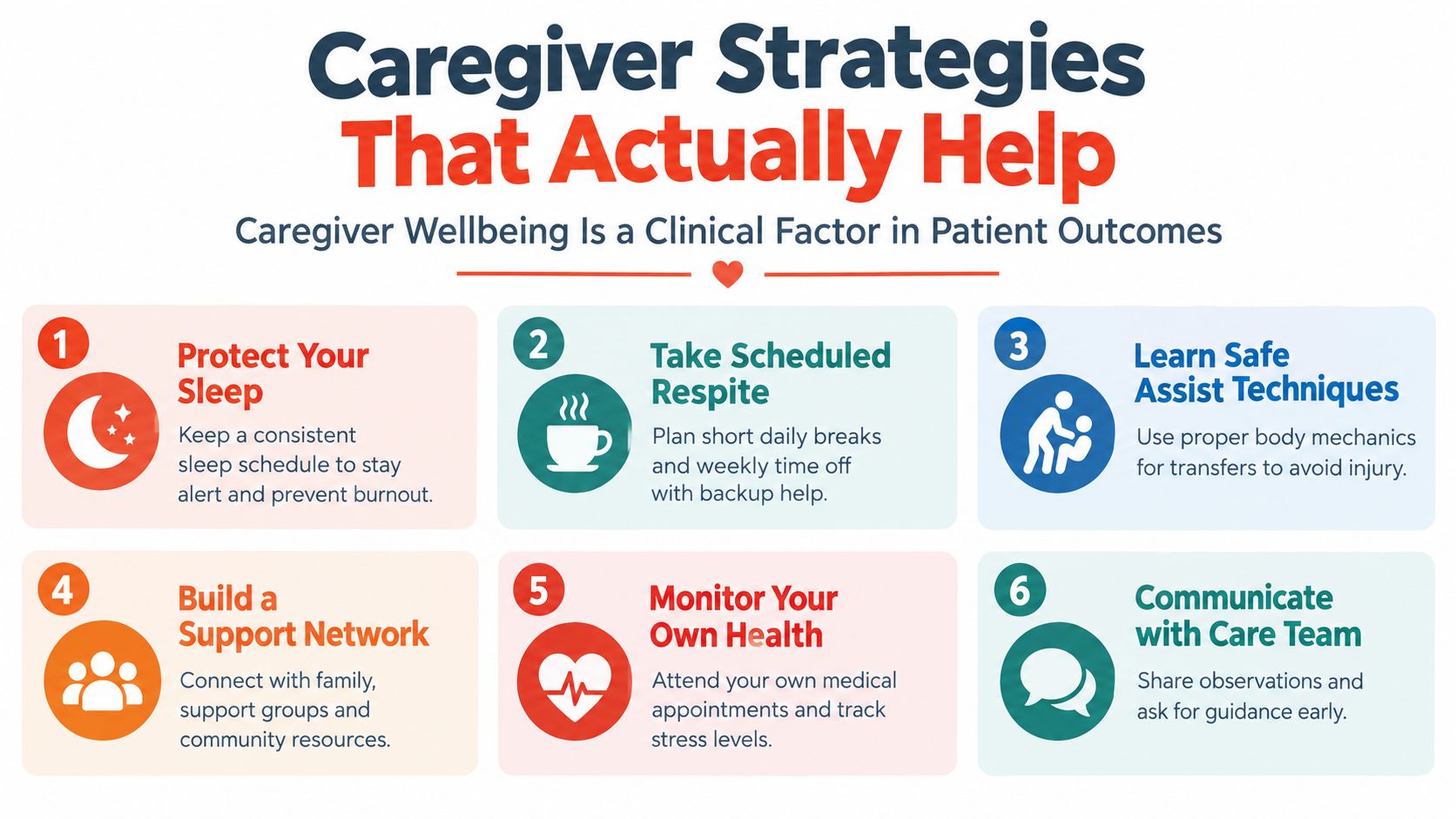
Caregiver wellbeing is a clinical variable. A spouse who sleeps poorly, skips meals, misses appointments, or becomes socially isolated has less reserve for safe transfers, medication oversight, and calm responses to freezing. The burden literature still has major gaps, including limited clarity about which interventions reliably reduce caregiver burden (review of caregiver burden in Parkinson's disease). Families shouldn't wait for perfect evidence before building practical protection into the week.
A shared medication calendar on the kitchen wall gives everyone one reference point. A pre-filled weekly organizer with timers reduces repeated decisions. Visiting aides need written handover notes that state the last dose, recent falls, sleep changes, appetite, bowel concerns, and what assistance was required.
Respite must be scheduled before crisis
Respite works only when it appears on the calendar. Arrange a dependable block of 4–6 hours weekly, and treat the caregiver's own medical appointment as necessary care, not an optional outing. A paid companion for two afternoons a week may provide enough breathing room to prevent exhaustion from becoming an emergency.
- Protect sleep: Address nighttime rigidity, bathroom trips, dream enactment, or hallucinations with the prescribing clinician rather than accepting chronic sleep loss.
- Share decisions: Keep a written handover so another person can take over without calling the primary caregiver for every detail.
- Keep social contact: Schedule a regular call, meal, or short visit. Isolation makes the role feel larger and less manageable.
- Track personal health: Notice weight loss, persistent sadness, anxiety, irritability, or withdrawal, and report these changes.
Parkinson's care partners often carry an unpaid workload that affects employment and their own healthcare. A 2026 caregiver report found that nearly 40% of people with Parkinson's receive unpaid care from a care partner and that patients average 2.3 care partners; it also reported that 20% of care partners took early retirement or reduced work hours and 34% missed or cancelled routine health visits because of caregiving (Parkinson's caregiver and cost report).
The visiting clinician should ask directly about depression and caregiver strain, with screening at least every six months when appropriate. Accepting help early isn't failure. It's how families preserve safe care and ordinary life for longer.
Choosing the Right Home-Based Care Model
No single model fits every stage of Parkinson's. The right choice depends on symptom timing, falls, caregiver capacity, transportation, insurance, and whether the home can support safe visits.
| Care Model | Who Visits | Frequency | Best For | Limits |
|---|---|---|---|---|
| In-home primary care | A primary care clinician visits the home | Scheduled follow-ups plus urgent visits when available | Homebound patients needing a medical anchor, medication review, chronic disease management, and coordination | May not replace a movement-disorder specialist or every therapy service |
| Office-based care | Family transports the patient to primary care or neurology | Based on office scheduling | Patients who can travel safely and benefit from in-person specialty teams | Travel, waiting rooms, and a single visit may hide home-specific hazards |
| Medicare-certified home health | Skilled nurses or therapists visit under a certified episode of care | Based on ordered services and eligibility | Patients who are homebound and need skilled nursing or therapy after decline or hospitalization | It isn't the same as ongoing custodial care, and coverage depends on eligibility |
Medicare home health generally requires the patient to be “confined to home,” meaning leaving is very difficult, along with a need for medically related skilled nursing or therapy (Medicare home health coverage explanation). A standard Medicare house call is covered like an office visit. After the annual deductible, Medicare generally pays 80%, with the remaining 20% billed to secondary insurance if available (medical house call payment guide).
Match the model to the decision point
Falls, worsening dyskinesia, repeated medication gaps, or increasing difficulty getting to appointments may justify adding home-based primary care. Infusion therapy may require specialized nurse oversight and coordination with the treating specialist. A movement-disorder clinic still adds value for complex motor fluctuations, device-based therapies, and specialty decisions.
Advanced disease may also call for palliative care when symptom relief, comfort, goals, and caregiver support become central. Hospice is a separate eligibility conversation with the treating team. Families can use this guide to compare home health, home care, and house calls before choosing a pathway.
What Good Parkinson's Home Care Looks Like
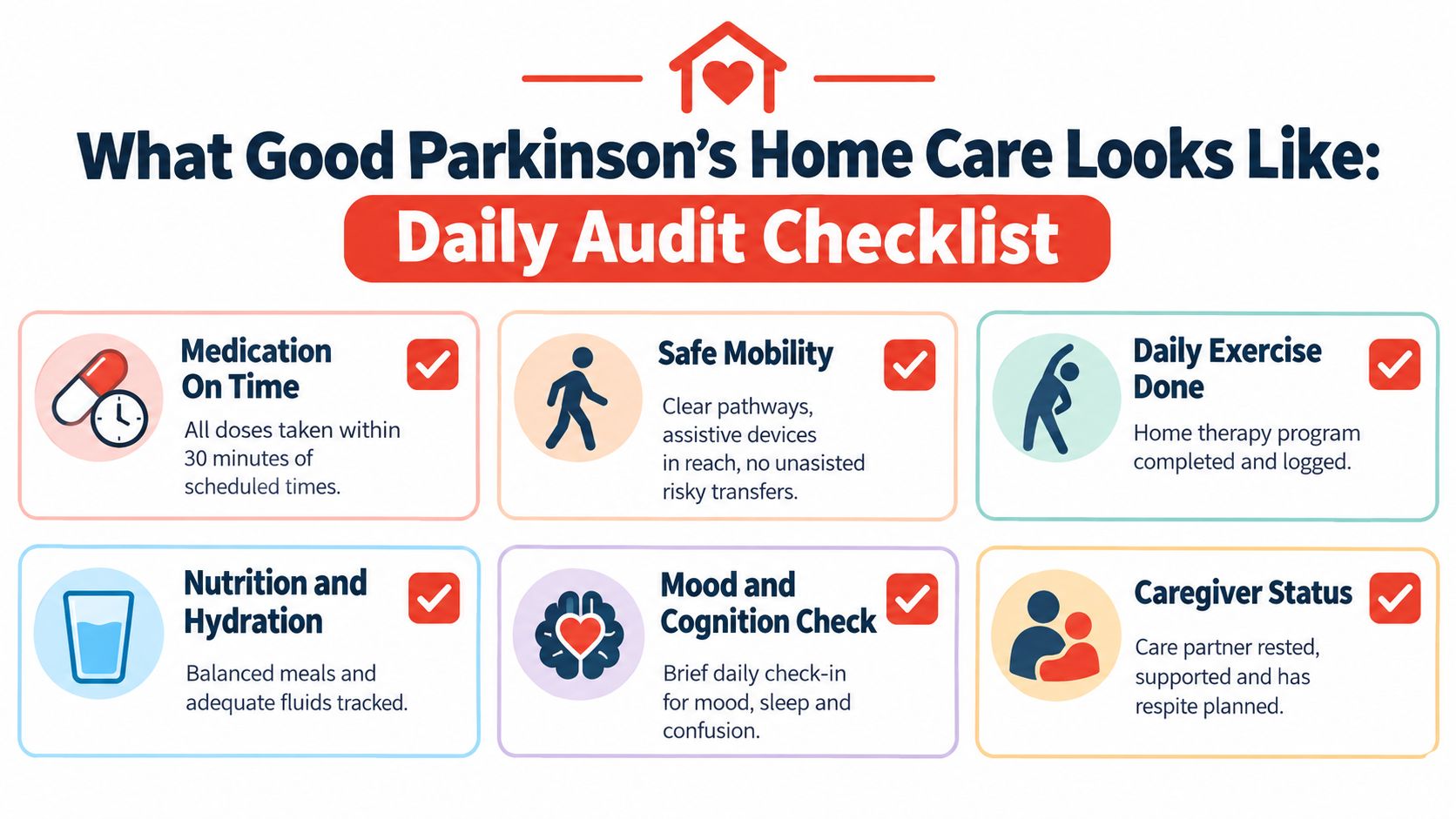
Good care is visible in ordinary moments. Medication doses are taken close to scheduled times, transfers begin with a mobility check, paths are clear, and exercises happen as part of the morning rather than disappearing into a forgotten appointment book. The caregiver knows when to assist and when to allow the patient time to complete a task independently.
A practical daily audit should be short enough to use. Check the actual bedroom-to-bathroom route, not just the rooms in isolation. Ask whether the person's strongest side faces the open room, whether the walker or cane is within reach, and whether fatigue has changed the safest plan.
- Medication: Record the scheduled and actual dose times, along with meaningful “on” and “off” changes.
- Mobility: Check the route before transfers, especially after waking, sitting, or turning.
- Environment: Keep throw rugs, loose cords, and unnecessary furniture out of walking paths.
- Therapy: Log the home program and note whether the patient tolerated it during peak medication effect.
- Caregiver status: Confirm that the care partner has slept, eaten, attended personal appointments, and has respite planned.
Signs of stability include predictable “on” and “off” periods, fewer falls, preserved speech volume, and a patient who can still participate in familiar routines. Warning signs include increased confusion, swallowing changes, new or worsening falls, or a caregiver who is losing weight and withdrawing socially.
Home-based Parkinson's support may combine house calls, telehealth, therapy, medication coordination, and monitoring. An advanced-Parkinson's home study found that interdisciplinary telehealth-enhanced visits with peer mentoring did not improve caregiver strain, but they mitigated the worsening strain seen among caregivers of less advanced patients (telehealth-enhanced home visit study). Good care is rarely tidy. You recognize it when the patient sleeps reasonably, moves with fewer unsafe surprises, and the family still finds moments of ordinary life.
Life Primary Care provides in-home primary care, chronic disease management, medication reviews, diagnostics, transitional visits, telehealth follow-ups, and palliative care for eligible patients across northern and central New Jersey. If traveling to the clinic has become unsafe or exhausting, visit Life Primary Care to learn whether a house call can support your Parkinson's care plan at home.
Ready for a visit at home?
Call and speak with a real person. We will confirm your insurance, find a time and come to you.
973-607-4911 Call now