
Guide · 11 min read
Doctors Home Visits for the Elderly: A Complete Family Guide
Your father has missed another appointment. The trip took planning, the waiting room exhausted him, and by the time he got home, nobody had addressed the medication bottles spread across his kitchen counter. You're left wondering whether the next clinic visit will help or just create another difficult day.
Doctor home visits for elderly patients offer a practical alternative when travel has become unsafe, confusing, or physically draining. A clinician evaluates the patient where daily care happens, including the stairs, bathroom, medications, caregivers, and routines that influence health. The right service can provide primary care, chronic disease management, diagnostics, and follow-up without treating the house call as a lesser version of office care.
Table of Contents
- Understanding the Value of In-Home Doctor Visits
- Finding a Visiting Physician Service in Your Area
- What to Expect During a Home Medical Visit
- How to Prepare for the Doctor's Arrival
- Navigating Insurance and Billing for House Calls
- Continuing Care and Follow-Up After the Visit
Understanding the Value of In-Home Doctor Visits
A missed appointment often reflects a care problem, not a lack of interest. An older adult may need help getting dressed, arranging transportation, managing oxygen equipment, or transferring safely into a vehicle. By the time the family reaches the office, the patient may be too tired to describe symptoms clearly.
That's why house calls for seniors have practical value beyond convenience. The clinician can see whether the patient can move from the bedroom to the bathroom, whether medication bottles match the current list, and whether a caregiver understands the discharge instructions. A clinic captures the patient's condition in a controlled setting. A home visit captures the condition in the setting where decisions about food, medication, mobility, and safety are made.
Practical rule: If travel repeatedly prevents routine care, treat access as part of the medical problem rather than waiting for another missed appointment.
The model also has a long history. In the United States, house calls represented about 40% of patient visits in the 1930s, but that share had fallen to 0.5% by 1996 as reimbursement declined, according to the American Academy of Family Physicians' review of house calls. The number of house calls made by family physicians later doubled from 1996 to 2016, and Medicare Part B paid for nearly 2.6 million house calls in 2015, showing that home-based medical care has returned as a meaningful part of primary care.
What the home reveals
Home visits are especially relevant for frail older adults who can't easily travel. A Dutch audit of 3,133 elderly patients found that 10.7% received a preventive home visit within one year. Receipt increased with age, from 5.63% among people aged 75 to 79 to 9.50% among those aged 80 to 84 and 14.7% among those aged 85 to 89, as reported in Family Practice.
The visit isn't automatically beneficial just because it happens at home. A systematic review found that ongoing, multi-visit programs had stronger effects than one-off outreach, particularly when they combined assessment, longitudinal follow-up, and team coordination. Of nine eligible programs screened from 357 abstracts, eight showed substantial effects on at least one major utilization outcome, according to the systematic review indexed by PubMed.
That distinction matters to families. Ask whether the provider offers a continuing primary-care relationship, not just an isolated visit when the patient is already in distress.
Finding a Visiting Physician Service in Your Area
Start with geography. Visiting physicians NJ services often divide coverage by county, and a practice may serve Morris, Essex, Union, Somerset, Passaic, and Bergen counties without covering every nearby community. Confirm the exact home address before discussing appointment times.
Then verify the financial arrangement. Ask whether the practice accepts Medicare and your private insurance, whether it bills insurance directly, and whether it charges a travel, concierge, or membership fee. A service can appear covered while still adding a separate charge, so request the answer before booking.
Questions to ask before booking
Use the first phone call to test how the practice operates, not just whether it has an available doctor.
- Coverage: Does the practice serve the patient's county and home type, including an apartment or assisted living community?
- Scheduling: How are new patients booked, and are established patients eligible for same-day visits when a non-emergency problem arises?
- Scope: Can the clinician manage chronic conditions, review medications, perform an Annual Wellness Visit, and arrange home diagnostics?
- Coordination: Will the practice communicate with the patient's specialists, hospital, pharmacy, and family caregiver?
- Follow-up: Who calls with results, and how are referrals, labs, imaging, and the next visit arranged?
Families arranging care from another state should also ask how consent, records access, and phone updates work. A strong coordination office reduces the number of calls a caregiver must make.
For broader support at home, families may also need personalised nursing support for loved ones, particularly when daily supervision or skilled nursing needs sit alongside physician care. Nursing support and primary care house calls solve different problems, so clarify which professional manages each part of the plan.
If you're comparing local options, use this guide to finding a doctor for an elderly parent nearby to organize your search. A provider such as Life Primary Care serves northern and central New Jersey, with scheduling, insurance verification, and follow-up handled through its coordination office.
What to Expect During a Home Medical Visit
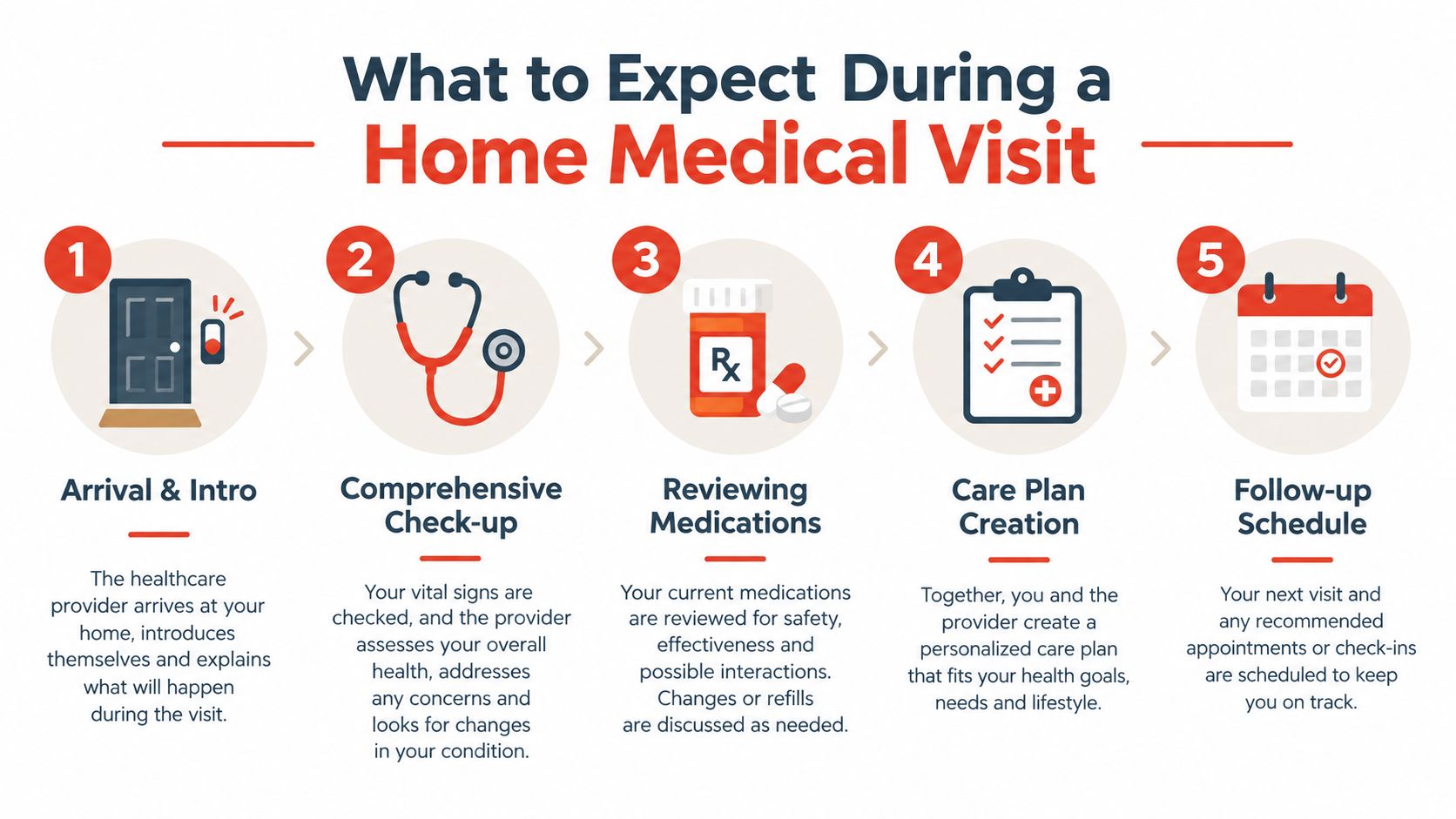
A house call is far more than a clinic appointment moved to the kitchen table. In a clinic, the clinician controls the setting and the patient brings only the information they remember to bring. During At-Home Doctor Visits, the clinician can examine the person, the medication supply, and the care environment together.
Visits typically last 45 to 60 minutes, according to the Life Primary Care service information. That gives the clinician time for a history, physical examination, medication review, and treatment planning without compressing every concern into a rushed conversation.
The home becomes part of the assessment
The clinician may notice a loose rug near the hallway, poor lighting by the stairs, an unsafe bathroom setup, or a medication organizer that doesn't match the prescription list. These observations don't replace medical judgment. They add context that a standard office room can't provide.
A portable examination kit may support phlebotomy, EKGs, urine testing, and other basic diagnostics during or after the visit. Mobile X-ray and ultrasound services can also be coordinated when appropriate. The exact services vary by practice, so ask what the clinician can perform on site and what requires a separate mobile provider.
The comparison is useful:
| Office appointment | Home medical visit |
|---|---|
| The patient travels to a controlled setting | The clinician evaluates the patient in the living environment |
| Medication information depends on what the family brings | Bottles and organizers can be reviewed directly |
| Mobility and fall risks may be described verbally | Pathways, stairs, lighting, and bathroom access can be observed |
| Follow-up may require separate calls | The care plan and next steps can be arranged around the visit |
A home visit can be particularly useful for diabetes, heart failure, COPD, hypertension, chronic kidney disease, high cholesterol, dementia, and post-hospital recovery. It still isn't an emergency response. Severe breathing difficulty, chest pain, sudden weakness, or other urgent symptoms require emergency services rather than waiting for a visiting doctor.
For a detailed preparation guide, review what to expect from a first home visit.
This short video offers another visual explanation of the process:
How to Prepare for the Doctor's Arrival
Preparation doesn't mean making the home look perfect. The clinician needs an accurate view of daily life, including the obstacles that make care difficult. Clear a safe path and create a quiet, well-lit area where the patient can sit or lie down comfortably.
A useful preparation checklist
Gather every medication. Put prescriptions, over-the-counter products, vitamins, supplements, creams, inhalers, and as-needed medicines in one place. Don't rely only on a medication list. The bottles may reveal discontinued drugs, duplicate products, confusing instructions, or prescriptions from different clinicians.
Write down changes. Record new symptoms, appetite or sleep changes, falls, confusion, swelling, pain, changes in breathing, and missed doses. Add when each change began and whether it varies during the day.
Collect recent records. Keep discharge papers, rehabilitation instructions, specialist notes, test results, and pharmacy information available. After a hospitalization, these documents help the clinician compare the hospital plan with what the patient is taking at home.
Invite the right caregiver. If one person manages medications and another handles transportation or meals, arrange for both to join in person or by phone. The visit should answer the questions that affect daily care.
Prepare the space safely. Clear rugs, cords, narrow pathways, and clutter around the examination area. Note oxygen tanks, walkers, wheelchairs, hospital beds, or other equipment before the clinician arrives.
A short written list prevents the most important concern from being forgotten. Keep one person focused on the conversation while another records instructions, follow-up dates, and questions that require clarification.
Navigating Insurance and Billing for House Calls
Families often mistake a physician house call for Medicare home health. The distinction affects eligibility, billing, and what the clinician can provide. Medicare home health requires medical necessity and specific eligibility criteria. Home health aide services are covered only when the patient also receives skilled care, such as skilled nursing or physical therapy, according to Medicare's home health care publication.
A house-call physician bills for evaluation and treatment under the applicable physician benefit. Coverage depends on the clinician's billing arrangement, the service performed, the patient's plan, and any deductible or coinsurance. Ask the practice to explain those terms before anyone arrives.
Ask for a written cost explanation
Request written answers about:
- Network status: Whether the clinician participates in Medicare and the patient's private plan.
- Patient responsibility: Which deductible, coinsurance, or copayment may apply.
- Extra charges: Whether travel, concierge, membership, or administrative fees are added.
- Services included: Whether laboratory work, EKGs, urine testing, mobile imaging, or care coordination are billed separately.
- Claim handling: Who submits the claim and how the office communicates any remaining balance.
The Medicare Annual Wellness Visit requirements guide helps families distinguish preventive planning from problem-focused care. An Annual Wellness Visit does not automatically cover evaluation of a new or worsening complaint, so ask how the practice will classify the appointment.
The home environment can also affect billing. A clinician may identify a need for equipment, laboratory collection, imaging, or another service that requires a separate order or charge. Before agreeing, confirm who supplies it, whether the patient's plan covers it, and whether a separate bill will follow.
CMS's Independence at Home demonstration shows how narrowly defined eligibility can be for certain home-based primary care programs. Beneficiaries need Medicare Part A and Part B, cannot be enrolled in Medicare Advantage or PACE, must have at least two chronic conditions, must have had a hospital admission and acute or subacute rehabilitation within the prior 12 months, and must have at least two functional dependencies requiring help from another person, according to RTI's program overview.
The financial findings support careful program design rather than promises for every patient. An independent review found participating practices saved an average of $3,070 per beneficiary in the first year, equal to 7.7%, with savings driven mainly by reduced hospital use, as reported by The Commonwealth Fund. Those results do not guarantee savings for every practice or household.
Continuing Care and Follow-Up After the Visit
The most important question after a house call is simple: who owns the next step? A clinician may adjust a medication, order laboratory work, request mobile imaging, contact a specialist, or ask the caregiver to monitor a symptom. Unless someone confirms that each task happened, a well-designed plan can still fail at home.
Effective in-home medical care uses more than episodic outreach. A systematic review of preventive home visiting found pooled mortality odds ratios of 0.76 in the general elderly population and 0.72 in frail older adults at risk of adverse outcomes, while long-term care admissions had an odds ratio of 0.65, according to the BMJ review. The same review found no significant reduction in hospital admissions, no significant improvement in health status, and no effect on activities of daily living.
That mixed result should shape expectations. Repeated, multidimensional support may help selected patients, but one preventive visit can't be assumed to improve every outcome.
A reliable follow-up workflow
After the clinician leaves, the practice should communicate results and instructions in language the patient and caregiver understand. Telehealth can handle a brief progress check when an in-person visit isn't necessary, while persistent or worsening symptoms may require another home assessment or emergency evaluation.
The care team may also coordinate mobile labs, EKGs, X-rays, ultrasound, specialist referrals, pharmacy questions, and hospital records. Families should know who calls with results, how quickly they can report a change, and when the next visit will occur.
A recent review notes that only 7% to 10% of homebound beneficiaries receive home-based medical care, indicating a substantial access gap despite Medicare coverage, as reported in this peer-reviewed review of home-based medical care. Another review describes the evidence for preventive home visits in frail older adults as mixed and highlights unanswered operational questions around staffing, reimbursement, specialist integration, telehealth, mobile diagnostics, and post-acute care, as discussed in the 2026 scoping review protocol.
For families, the practical standard is continuity. The process should move from geographic and insurance verification to scheduling, medication and home assessment, documented planning, completed referrals, communicated results, and a clear next contact. Visiting Docs work best when they become part of an organized care relationship rather than an isolated response to a crisis.
Life Primary Care provides full-scope primary care house calls across northern and central New Jersey, including chronic disease management, geriatric and dementia care, post-hospital follow-up, in-home diagnostics, and telehealth check-ins. If your loved one is struggling to travel, visit Life Primary Care to review service coverage, insurance verification, and how to arrange an in-home appointment.
Ready for a visit at home?
Call and speak with a real person. We will confirm your insurance, find a time and come to you.
973-607-4911 Call now