
Guide · 13 min read
Dementia Home Care Services: A Practical Guide for Families
You're standing at your parent's kitchen counter, trying to work out whether the morning pills were taken. Your parent says everything's fine, but the refrigerator is nearly empty, yesterday's appointment was missed, and your sibling lives out of state. You're not necessarily looking for a facility. You're trying to understand what help at home should look like, and whether it's time to bring someone in.
Table of Contents
- What Dementia Home Care Really Means
- The First In-Home Assessment and What It Covers
- Adapting the Home for Safety and Daily Function
- Building a Clinician-Led Care Plan After Diagnosis
- Supporting the Caregiver So Care Can Continue at Home
- Behavior, Medications, and Knowing When to Escalate
- A Staged Pathway From Early Diagnosis to Advanced Dementia
What Dementia Home Care Really Means
Dementia home care services are a combination of supports, not a single visit or job title. A clinician evaluates medical needs. An aide may help with bathing and dressing. Family members handle decisions, companionship, and the gaps between scheduled visits. Good planning makes those responsibilities explicit instead of assuming someone will manage.
About 80% of adults with Alzheimer's disease or a related dementia receive care at home, according to the CDC's overview of dementia caregiving. Home is already where much of this work happens. The question is whether the household has enough support to do it safely and sustainably.
Start With the Day That's Becoming Difficult
Consider a hypothetical family whose father still dresses himself and enjoys lunch with a neighbor, but can't reliably follow his medication schedule. He may need clinical review and help administering medicines, not someone taking over every activity. Another household may need hands-on assistance because nighttime supervision has become exhausting.
The starting point is a description of an ordinary day:
- Morning: Who helps with washing, dressing, breakfast, and medicines?
- Afternoon: Is the person eating, moving around safely, and having meaningful company?
- Evening: Who notices confusion, checks the doors, and manages bedtime?
- Overnight: Can the caregiver sleep, or must someone remain available?
This approach protects abilities the person still has while identifying tasks that need support.
Separate Medical Care From Daily Assistance
House calls for seniors provide medical assessment and treatment planning. Personal home care addresses everyday assistance and supervision. Skilled home health is another service category, with its own eligibility requirements and care arrangements.
The distinction matters when you're hiring help. An aide's presence doesn't replace medical evaluation, and an occasional clinician visit doesn't supply continuous supervision. This explanation of home health, home care, and house calls can help families ask for the right service.
Practical rule: Describe the task that needs doing before choosing the type of provider.
Families naturally ask how to start, who pays, and whether the arrangement will still work as dementia progresses. A useful plan answers those questions separately, then brings them together around the person's preferences and the household's actual capacity.
The First In-Home Assessment and What It Covers
A daughter calls from two states away because her father left the stove on twice last month. The clinician who visits doesn't start with forms. She starts in the kitchen, watching him make tea, asking him to show her where the pills live, noticing that the milk expired weeks ago.
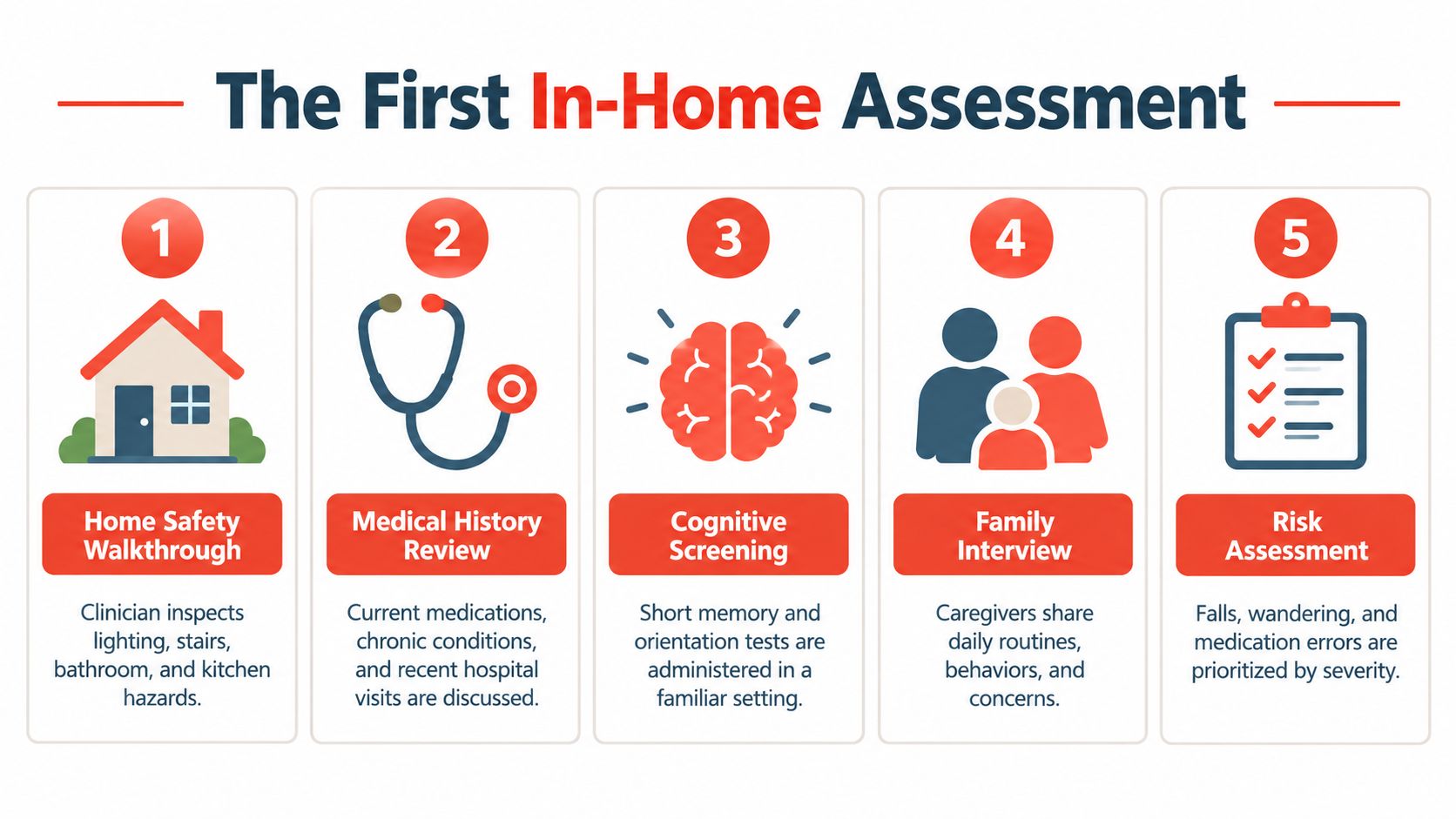
That scene is the point of an in-home assessment. The home provides context a medication list or an office conversation can miss, and a good visit mixes respectful questions with direct observation while the person living with dementia takes part.
What the Clinician Is Reading
Four threads run through that kitchen visit. Cognition and communication: what your father understands, remembers, and can still express. Daily function: which tasks need a reminder, which need supervision, and which need hands. Health and wellbeing: mood, appetite, mobility, sleep, and the other conditions he carries. Caregiver capacity: who is nearby, what they can safely manage, and where they're already stretched thin.
Specifics carry the visit further than labels. "She's declining" gives the clinician little to investigate. "She stopped making lunch three weeks ago" points somewhere concrete.
What to Gather, and Where the Wellness Visit Fits
Bring the clear picture, not a tidied one: prescription bottles, over-the-counter medicines, supplements, recent discharge papers, specialist instructions. If the pills sit beside the kettle because that's where breakfast happens, say so, and say who checks they've been taken.
The Medicare Annual Wellness Visit centers on prevention and risk assessment, covering daily activities, home safety, nutrition, depression, loneliness, and social isolation. The CMS Annual Wellness Visit guidance also recommends bringing medication information and details about current providers. Ask how that screening sits alongside evaluation of active symptoms, so a new complaint doesn't fall between appointments.
Before the clinician leaves, request a written summary: the main concerns, who owns each next step, and when to follow up. The visit should produce a baseline, the landmark every later conversation gets measured against. When the daughter calls again in six months, "he's worse" becomes "what changed."
Adapting the Home for Safety and Daily Function
A common scene plays out like this. A father falls at night, the family buys a raised toilet seat and a motion light, and two weeks later he falls again in the kitchen. The purchases were reasonable. The order was wrong. Equipment came before observation, so it solved a problem nobody had confirmed.
Walk the route your relative uses, not the rooms visitors see. Bed to bathroom at 2 a.m. Favorite chair to the kettle. Front door to the mailbox. Each route tells the clinician where attention belongs first.
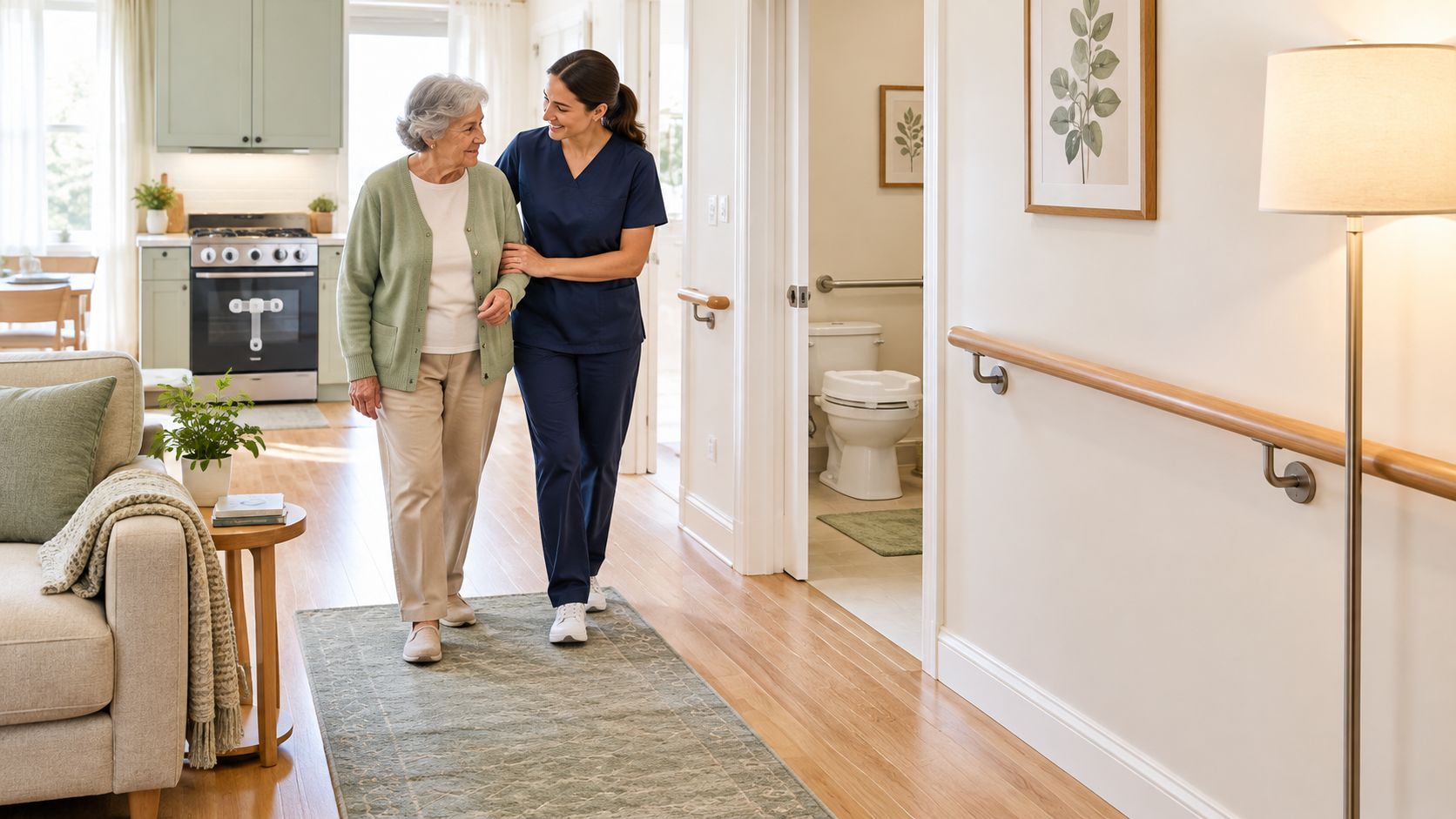
An accessible hallway offers a useful example of how the physical surroundings can support assistance.
Bring the Clinician a Problem, Then Ask for the Fix
The pattern above flips when the family leads with what they've seen. Each observation becomes a question the visit can answer.
| What you observe | What to ask the clinician |
|---|---|
| He can't find the bathroom at night | Which lighting and visual cues would guide him? |
| She grips the towel rail to stand | Is that rail load-bearing, and what belongs there instead? |
| The stove gets left on | Should cooking access change, and who supervises? |
| Pills sit in the wrong rooms | What storage matches her ability to manage medicines? |
| He leaves through the front door | Which door alerts work without blocking emergency exits? |
A home fall-prevention checklist gives you a structured way to record these observations before the visit, so the conversation starts from evidence rather than memory.
The following video provides another resource to discuss when reviewing the home environment.
Decide What to Change, and What to Leave Alone
More adaptation can mean more confusion. Rearranged furniture removes the landmarks a person with dementia uses to orient herself, so ask which changes matter now and which can wait until she adjusts.
A safer home should still feel like the person's home.
The National Academies' summary of dementia care interventions emphasizes individualized caregiver support and describes limited evidence for many approaches. Treat that as a prompt to test each change against your relative's actual behavior, since no device or layout prevents every problem.
Building a Clinician-Led Care Plan After Diagnosis
A son drives home from the assessment with three pages of notes: stop one medicine, recheck blood pressure, lock up the car keys, call the pharmacy. Six weeks later, none of it has happened, because no name was ever attached to any item. Unassigned advice is where plans stall.
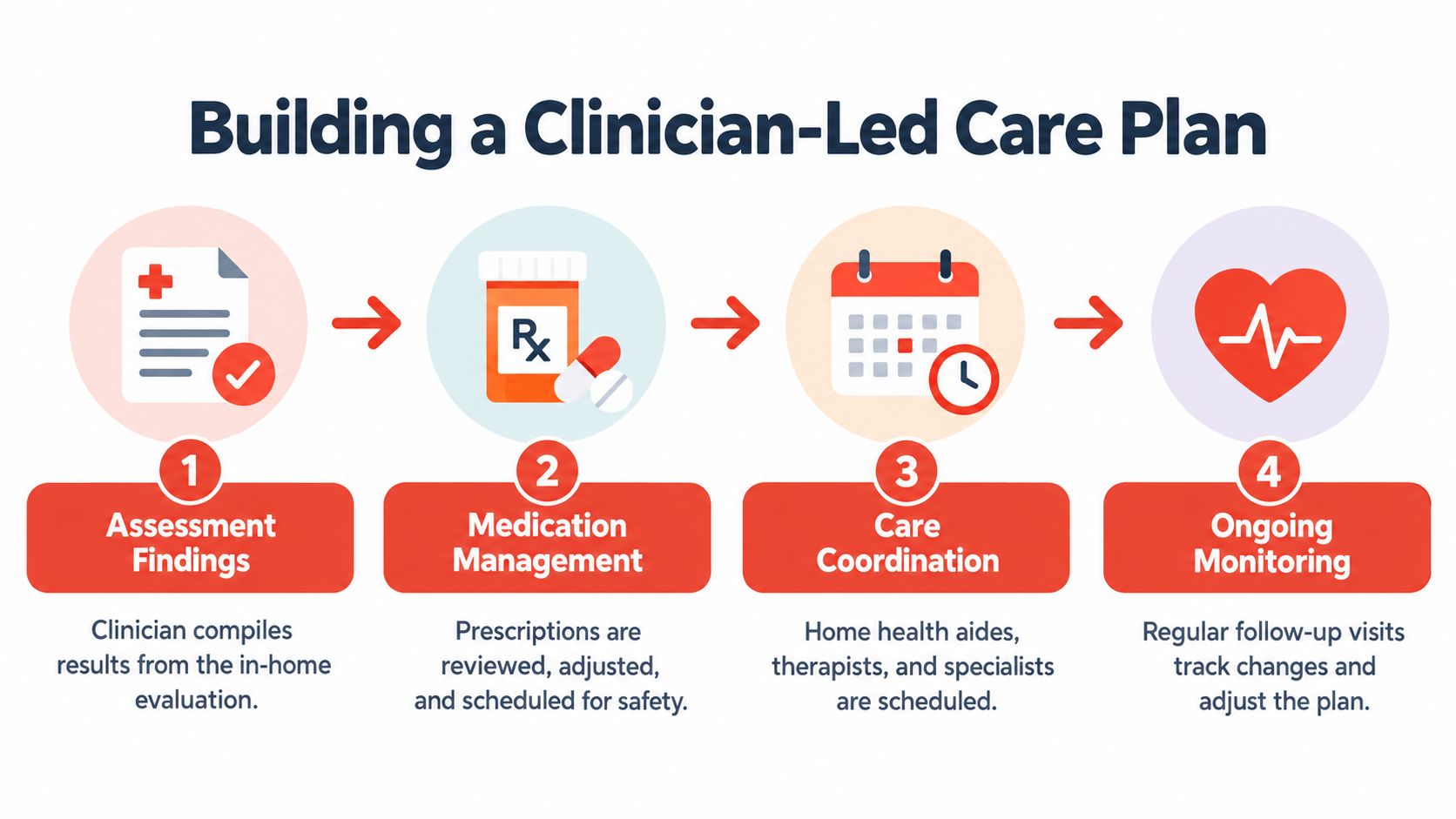
A clinician-led plan answers three questions for every finding: what the concern is, who owns it, and when it gets reviewed. That ownership question matters most in dementia care, where a specialist, a primary care clinician, a home health agency, and the family can each assume someone else is following up. A plan works like a relay handoff: the visit only counts if someone takes the baton.
Write the Plan the Way the Week Actually Runs
Medication reconciliation is a good first test of whether a plan is real. The family supplies the bottles, the pharmacy printouts, and what they have observed at home. The clinician establishes an accurate, shared account of what the person should be taking across prescribers and signs off on changes. That division of labor belongs on the page in writing, not in someone's memory of the visit.
A workable page might read:
- Medicines: reconciled by the house-call clinician, rechecked after every hospital stay.
- Daily routine: daughter carries out the agreed schedule, neighbor covers Tuesdays.
- New symptoms: son photographs and reports them; clinician decides whether treatment changes.
- Care preferences: clinician schedules the conversation while the person can still take part.
As needs move from mild toward advanced dementia, that same page picks up heavier entries. Early on it may hold a medication review and a follow-up date. Later it carries referral questions about neurology, psychiatry, therapy, palliative care, or hospice, plus a contact route for a relative coordinating details from another state. A house-call practice can coordinate that care without being the only provider.
Measure More Than Completed Visits
Finished appointments are a weak yardstick. The MIND pilot randomized trial found that a structured, home-based intervention under clinician oversight reduced the adjusted hazard of leaving home by 37%, alongside improvements in certain unmet needs and self-reported quality of life; those findings apply to that intervention, not every home-care service (MIND trial abstract).
For one household, useful tracking is simpler: missed medicines, falls, appetite changes, emergency visits, safety concerns that never got resolved. Ask which observations the clinician wants recorded and which ones should trigger a call.
Medicare-covered home health also runs on a formal process: a practitioner-established care plan, qualifying skilled needs, certification, and a Medicare-certified agency, as explained in Medicare's home-health guide. A referral alone settles neither eligibility nor whether services have begun.
Supporting the Caregiver So Care Can Continue at Home
It is 2 a.m., and the person with dementia is awake for the third time. The daughter who leads his care starts work at seven, and the plan on paper assumes she can do this every night. A plan that only works when nobody is tired is not a plan. Caregiver capacity belongs inside the clinical conversation, next to memory scores and medication lists.
Ask directly about sleep, physical strain, mood, missed work, and whether the caregiver can carry out what has been prescribed. In the Alzheimer's Association's national report, 59% of dementia caregivers reported high or very high emotional stress, and 38% reported physical stress (2025 Alzheimer's disease facts and figures). Those numbers describe households that look fine at a Tuesday appointment and fall apart by Friday.
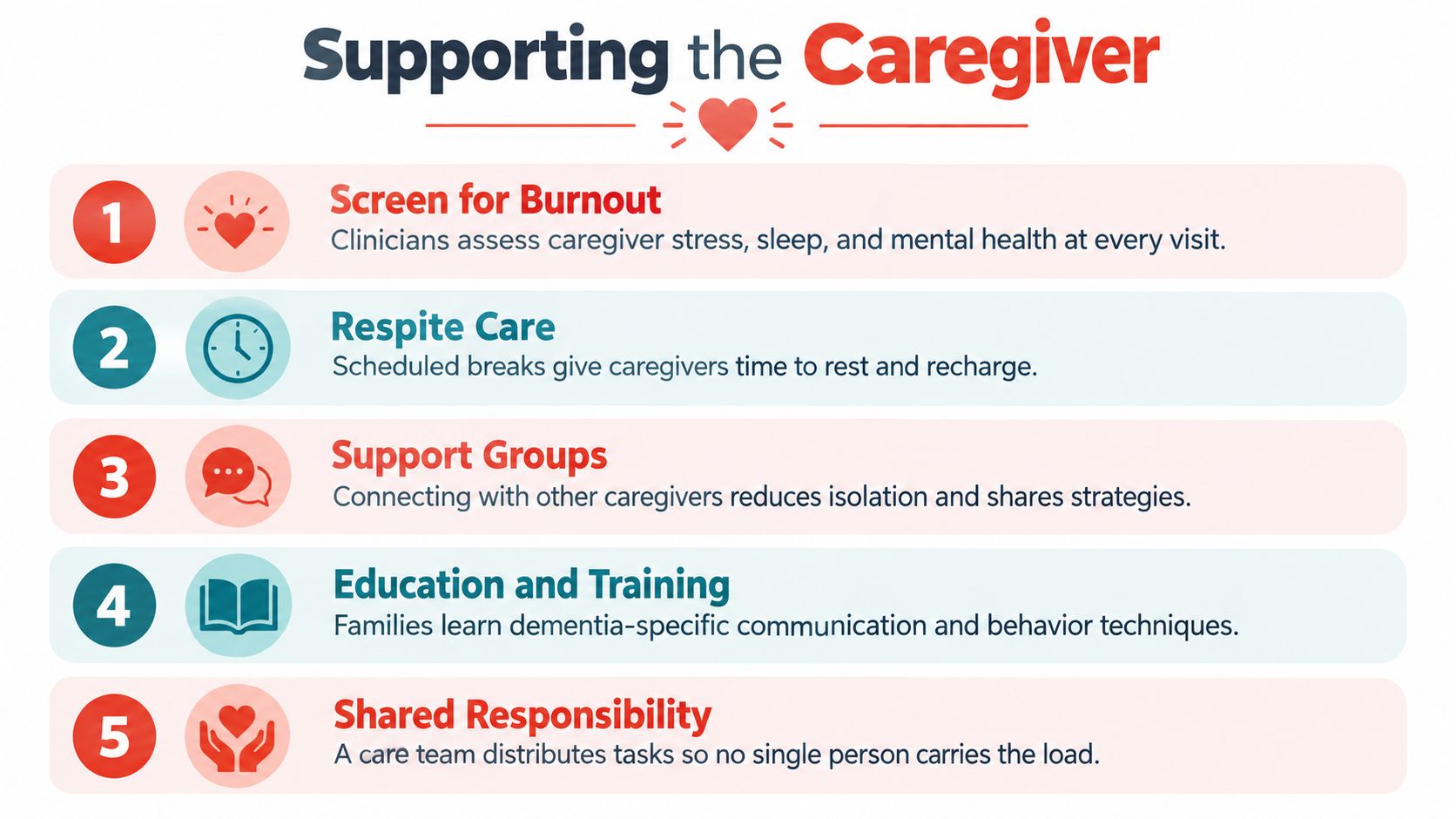
One way to check capacity is the bad-night test.
Ask it plainly: could this household carry out the plan on a difficult night, not just on a good afternoon?
Name the Person Behind Each Task
A relative who says "call me anytime" has offered goodwill. Coverage means a named person owns each task. Write down who reports changes, who handles the daily routine, which out-of-state relative coordinates paperwork and appointments with appropriate permission, and who steps in when the usual caregiver cannot. For dispersed families, request written visit summaries, agree on phone-based result sharing, and keep a shared handoff record with current instructions, pending appointments, questions, and the responsible person for each item.
Training deserves the same specificity. Have the caregiver describe a hard moment, such as resistance during dressing, then coach the exact words to try, what to change in the approach, and the point where they should stop and call. A scheduled review answers real situations better than a handout.
Families may also encounter nutrition-related material, including Tecton Ketones™’ discussion of how ketones fuel brain health. Treat commercial educational resources as questions to raise with the treating clinician, not as evidence that a product can replace established care or justify changing treatment.
Finally, record caregiver concerns alongside patient concerns. If the arrangement depends on someone repeatedly giving up sleep or their own medical care, ask for a revised support plan.
Behavior, Medications, and Knowing When to Escalate
Don't assume a sudden change is just dementia getting worse. Families don't need to diagnose the cause. They need to describe what changed, when it began, and whether the person is safe while awaiting help.
Ask the treating clinician to provide an individualized escalation plan. It should distinguish familiar behaviors that caregivers have been trained to manage from new symptoms, injuries, or situations that require prompt assessment.
Escalation Triggers for Families and Clinicians
The possible explanations below are discussion points, not diagnoses.
| Trigger | Likely Cause | Action |
|---|---|---|
| Sudden confusion or marked behavior change | Cause uncertain; medical assessment is needed | Contact the clinical team promptly rather than assuming progression |
| Fall or suspected injury | Cause and injury severity need assessment | Seek prompt guidance; use emergency services for serious injury or immediate danger |
| Missing person or unsafe wandering | Supervision and safety arrangements need reassessment | Begin the emergency response immediately if the person is missing |
| Possible duplicate or missed medication | Administration problem or unclear instructions | Contact the clinician or pharmacist; don't improvise replacement doses |
| Persistent refusal of food or drink, or noticeable weight loss | Cause uncertain and potentially multifactorial | Request clinical assessment and report the observed pattern |
| Aggression that threatens safety | Trigger may be unclear | Prioritize everyone's immediate safety and seek urgent assistance |
For severe symptoms or immediate danger, use emergency services rather than waiting for a house call.
Choose the Right Service for the Task
House-call primary care evaluates medical concerns and coordinates treatment. Skilled home health provides qualifying nursing or therapy services. Personal home care assists with everyday tasks, while hospice should be discussed with the treating team when end-of-life care may be appropriate. Family-only care leaves relatives responsible for recognizing when outside help is needed.
Medication questions deserve a defined contact route. This guide to medication management services for seniors explains how to organize that conversation without making prescription changes yourself.
Medicare's homebound standard doesn't mean a person can never leave home. It generally involves difficulty leaving without assistance or considerable and taxing effort, alongside a need for qualifying intermittent skilled services; convenience alone doesn't establish eligibility (Medicare home-health coverage requirements).
A Staged Pathway From Early Diagnosis to Advanced Dementia
The best planning question isn't whether someone can stay home. It's what support makes home workable now, and what change would require a different arrangement. Use stages as discussion guides, not deadlines or predictions about an individual.
A scoping review of dementia caregivers' information needs identified gaps around disease trajectory, post-diagnostic options, and practical home support. Families deserve clear decisions to consider, not just a list of available services.
Match Support to Current Needs
| Care phase | Main goal | Useful discussion with the care team |
|---|---|---|
| Mild cognitive changes or early diagnosis | Preserve participation and establish a baseline | Which tasks remain independent, and where is oversight needed? |
| Moderate dementia | Make daily assistance and supervision dependable | Is the current schedule sufficient, including nights and caregiver breaks? |
| Advanced dementia | Reassess comfort, hands-on needs, and household capacity | Can available help safely meet current needs, or is another setting necessary? |
| End-of-life care | Honor preferences and coordinate comfort-focused support | What services, equipment, and after-hours arrangements are appropriate? |
These aren't rigid service packages. A person may need substantial physical help while still participating meaningfully in decisions. Keep asking what matters to them.
Prepare for the Scheduling Conversation
Families in northern and central New Jersey seeking at-home doctor visits can ask about coverage in Morris, Essex, Union, Somerset, Passaic, and Bergen counties. Have the home address, insurance details, medication information, recent records, and the main caregiver's contact information ready.
Confirm appointment availability, insurance participation, and how urgent concerns are handled. Ask whether the practice communicates with out-of-state relatives, coordinates specialists, and provides written follow-up instructions.
Before the first visit, write down the hardest part of the day and the decision you most need help making. That gives the clinician a practical place to begin.
Life Primary Care offers in-home primary care, geriatric and dementia care, medication review, and care coordination across northern and central New Jersey. Visit the practice to ask about insurance verification and scheduling an assessment, and explain which daily tasks or recent changes are making care at home difficult.
Ready for a visit at home?
Call and speak with a real person. We will confirm your insurance, find a time and come to you.
973-607-4911 Call now