
Guide · 15 min read
Comfort & Care at Home a Guide for Families in NJ
The oxygen tubing is looped over the arm of the recliner. There's a walker by the hallway, three pill bottles on the kitchen table, and a specialist appointment next week that already feels exhausting. An adult daughter is trying to figure out whether her father really needs another office trip, or whether there's a calmer way to keep him comfortable while he's still getting treated for heart failure, COPD, cancer, or another serious illness.
That's where comfort & care at home starts to make sense.
For many New Jersey families, the question isn't whether a loved one needs care. It's how to make care fit real life when stairs are hard, car rides wipe someone out, or confusion gets worse in unfamiliar places. A lot of people hear the phrase “comfort care” and assume it means stopping treatment. In practice, it often means something much more active. It means bringing careful, steady primary care into the home so symptoms, medications, safety, and caregiver strain are handled before the day turns into a crisis.
If you've also been looking at resources beyond medical visits, practical home support can help round out the picture. Families comparing daily support options sometimes review services like in-home care services Boise from A Better Solution in Home Care to understand how non-medical help can complement care at home.
Table of Contents
- Introduction to Comfort Care at Home
- What Comfort Care Means Within Palliative Services
- Typical Comfort Measures Provided at Home
- How Comfort Care Differs From Hospice
- Why Receiving Comfort Care At Home Matters
- Caregiver Supports That Ease Daily Coordination
- Choosing Comfort Care And Next Steps For Families
Introduction to Comfort Care at Home
A house call changes the feel of care right away. Instead of rushing through parking, waiting rooms, and a short visit, the clinician steps into the patient's world. You can see the steep bathroom threshold, the throw rug that catches the walker, the unopened discharge papers, and the inhaler sitting in the wrong drawer.
That matters because the need for home-based care didn't disappear when house calls faded from everyday medicine. U.S. physician encounters conducted as house visits fell from about 40% in 1930 to 10% by 1950, and by 1980 they were below 1%, while a review found roughly 2 million older adults in the United States were homebound in 2011, and fewer than 12% of completely homebound people reported receiving any primary care services at home, according to this review of home-based medical care.
Why Families Ask About Comfort and Care Now
Most families don't start with a big philosophical question. They start with a practical one.
Can Mom still see a doctor if getting into the car takes an hour and leaves her wiped out for the rest of the day?
Can someone sort out these medications without dragging Dad back to the office again?
Can comfort-focused care happen while treatment is still going on?
Comfort care at home isn't about doing less. It's about bringing the right kind of attention to the place where problems are actually happening.
What Home-Based Care Looks Like in Real Life
For some patients, that means house calls for seniors after a hospitalization, when medication instructions don't match the bottles in the cabinet. For others, it means at-home doctor visits that focus on breathlessness, pain, appetite, sleep, mobility, or caregiver stress without asking a frail patient to leave home.
Families searching for Visiting physicians NJ, Visiting Doctors NJ, Dr House calls NJ, Doctor house calls NJ, In Home Doctor for Elderly, in-home medical care, Visiting Docs, Doctor home visits for elderly, or Doctor House Calls for Seniors are often looking for that exact combination of medical skill and everyday practicality.
What Comfort Care Means Within Palliative Services
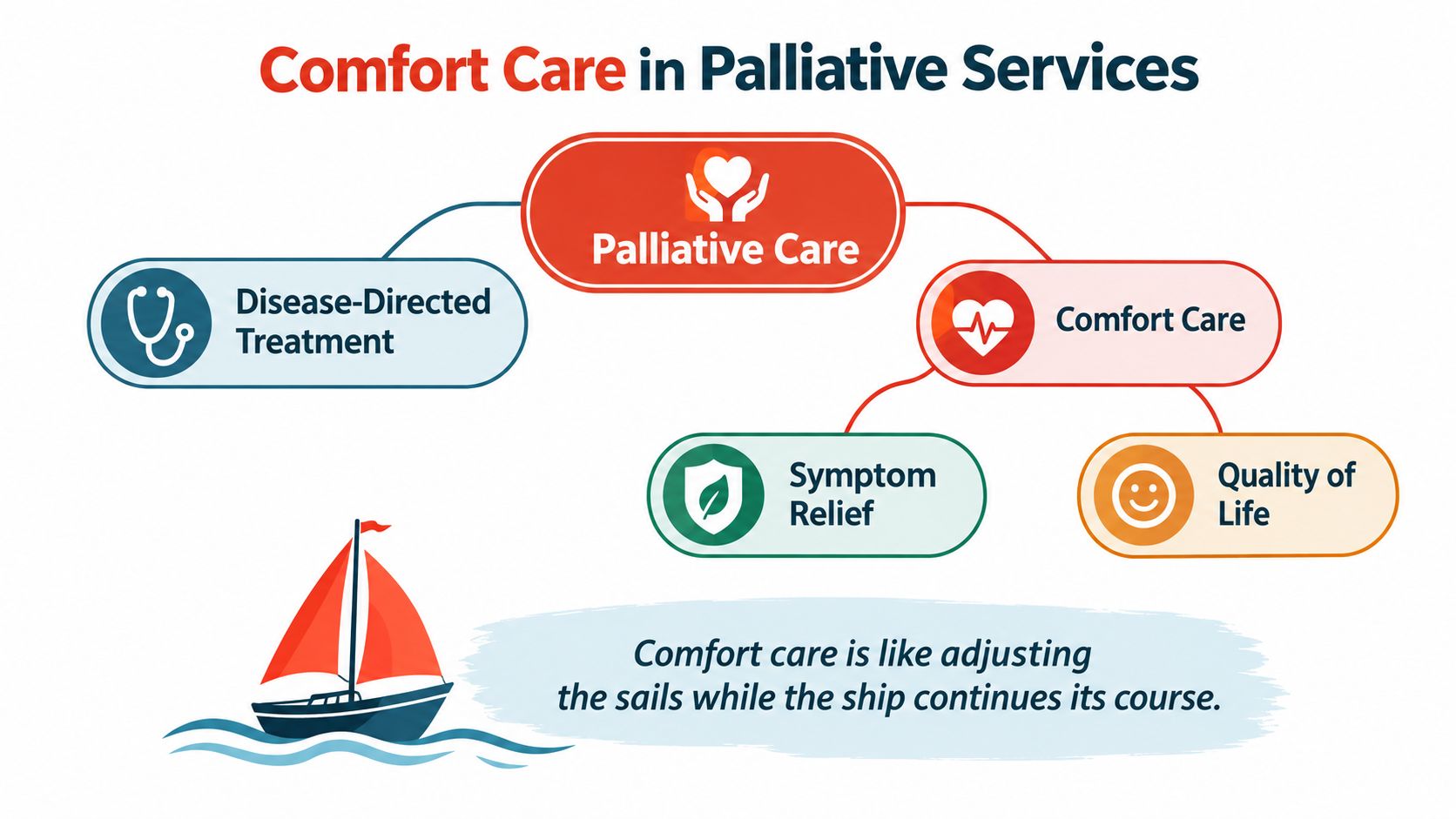
Comfort care is the part of palliative care that focuses on easing symptoms, reducing stress, and helping daily life feel more manageable. It can exist at the same time as treatment aimed at the illness itself. Those two things are not opposites.
Caring for a sailboat in rough water. One set of hands keeps the boat on course. Another adjusts the sails so the ride is safer and steadier. The boat is still moving forward.
What It Includes
Comfort-focused palliative care usually centers on a few plain, practical concerns:
- Symptom relief: noticing what's making the day hard, such as pain, nausea, shortness of breath, poor sleep, or anxiety.
- Function: helping someone move through the day with less strain.
- Coordination: making sure the primary care clinician, specialists, hospital team, and family aren't all working from different scripts.
- Support for decisions: helping patients and families talk through what matters most right now.
Core idea: Comfort care supports the person while other treatment targets the disease.
A home-based model is especially useful because symptom details are often easier to spot in the living room than in an exam room. A clinician can hear how far the patient gets before becoming winded, watch how they transfer from chair to walker, and see what food or fluids are within reach.
Why It Isn't “Giving Up”
People often get stuck. They hear “palliative” and think “end of life.” Sometimes palliative care does become part of later-stage care, but it doesn't have to start there. It can begin when symptoms, stress, or care complexity start taking over the household.
For families who want a fuller picture of how this works at home, this guide to palliative care at home and what to expect helps put the process in everyday terms.
Who Benefits Most
Comfort-focused care at home often helps people who are juggling several problems at once:
- Older adults with serious illness who tire easily with travel
- People recovering after hospitalization who need close follow-up
- Patients with dementia or confusion who do better in familiar surroundings
- Caregivers who are carrying most of the coordination work
The important point is simple. Comfort care isn't a smaller version of real care. It's active care with a different center of gravity. The focus shifts toward what the patient feels, how the day is going, and what can be made easier at home.
Typical Comfort Measures Provided at Home
A good home visit is unhurried enough to notice what a rushed office visit misses. In many house-call practices, visits typically last 45 to 60 minutes, which gives time to sit down, hear the story fully, and look at the details that shape comfort and safety.
That longer format matters because care transitions are messy. A study of adults age 65 and older moving from hospital to long-term care found that 86.2% of medication records contained at least one discrepancy, which supports the value of structured medication reconciliation during geriatric transitions, as discussed in this study on medication discrepancies and reconciliation.
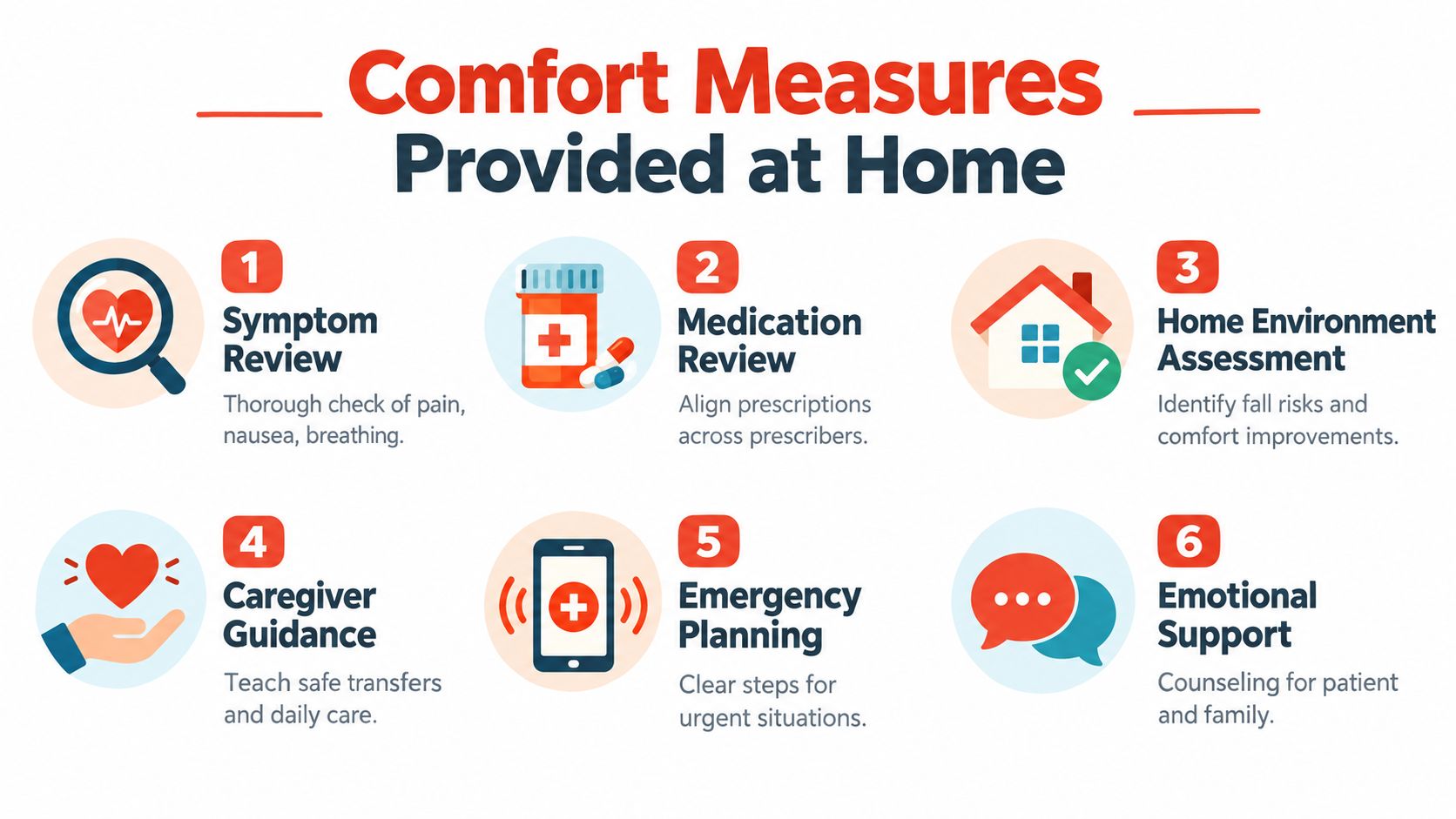
Here's a visual snapshot of what families often see during home-based comfort care.
What Happens During the Visit
A house call usually includes several layers of observation at once:
- A symptom check that feels like a conversation: how breathing is today, whether pain changes with movement, how sleep has been, whether appetite dropped, whether dizziness shows up after standing.
- A medication review with the actual bottles present: not just the printed list, but the inhaler in the bedroom, the duplicate blood pressure bottle in the kitchen, and the old instructions still taped to the refrigerator.
- A walk-through of the living space: stairs, grab bars, bathroom setup, lighting, chair height, and how far the patient has to travel to reach the bathroom or kitchen.
- Caregiver questions: what's becoming hard, what time of day is worst, where confusion starts, and which tasks are taking the most energy.
- Planning for follow-through: labs, EKGs, urine testing, or coordination of mobile X-ray or ultrasound when needed through home-based services.
Why Medication Review Is Such a Big Part of Comfort
Medication reconciliation sounds technical, but the kitchen-table version is simple. It means matching all the instructions to what the patient is taking.
That's important because transitional care steps that include medication reconciliation have evidence of lowering readmission risk in older adults. A systematic review and meta-analysis found medication reconciliation was associated with lower readmissions, with a pooled relative risk of 0.88, and telephone follow-up also reduced readmissions, with a relative risk of 0.84, according to this review in Age and Ageing.
Practical rule: The medication list in the chart and the bottles in the house should tell the same story.
A family may discover that one doctor stopped a drug, another restarted it, and the patient kept both. Or the discharge instructions mention an inhaler that never made it home. These aren't small details. They shape comfort, stamina, and safety every day.
A short video can help make the home-visit model easier to picture.
Common Comfort Measures Families Notice Right Away
Some of the most visible parts of in-home medical care are not dramatic. They're steady.
- Listening long enough to get the full picture: the patient has time to answer without being rushed.
- Checking the body and the environment together: breathing, swelling, mobility, and the setup of the home all affect one another.
- Following up by phone between visits: that helps families report changes before they become emergencies.
- Including the caregiver in the plan: not as an afterthought, but as part of how care works.
One example in New Jersey is Life Primary Care, a house-call primary care practice that provides home visits, transitional care, in-home diagnostics coordination, telehealth follow-up, and palliative care that runs alongside treatment. For families, the practical difference is that care happens where the patient lives rather than in a clinic waiting room.
How Comfort Care Differs From Hospice
The most common misunderstanding is that comfort-focused care and hospice are the same thing. They overlap in spirit, but they aren't the same path.
Comfort-focused palliative care can begin earlier, while treatment for the illness is still continuing. Hospice is generally for a later point, when goals shift more fully toward comfort and end-of-life support.
For families who want a separate plain-language explanation, this guide on the difference between hospice and palliative care can help.
Comfort Care Versus Hospice At A Glance
| Feature | Comfort-Focused Palliative Care | Hospice Care |
|---|---|---|
| When it starts | When symptoms, stress, or care complexity begin affecting daily life | When care goals have shifted primarily toward end-of-life comfort |
| Treatment status | Can run alongside disease-directed treatment | Usually entered when curative treatment is no longer the main focus |
| Main aim | Improve comfort, daily function, and coordination | Focus on comfort, dignity, and support near the end of life |
| Where it happens | Home, clinic, hospital, or other settings depending on the program | Often at home, and can also be provided in other residential settings |
| Family role | Families are included in symptom tracking, planning, and coordination | Families receive intensive support around caregiving and end-of-life needs |
| What families often ask | “Can we get help now without stopping treatment?” | “Is it time to shift fully toward comfort?” |
A Simple Way To Think About The Choice
If your loved one is still seeing specialists, still pursuing treatment, and still needs active symptom support, comfort-focused palliative care may fit.
If the medical focus has moved mainly toward comfort in the last stage of life, hospice may fit better.
You don't have to wait for a crisis to ask which kind of support matches your family's goals.
This isn't a moral choice between “fighting” and “accepting.” It's a care-planning choice. The right option depends on where the patient is in the illness, what treatments are still in play, and what kind of support the household needs.
Why Receiving Comfort Care At Home Matters
Home is where the obstacles show up. The pill organizer is there. The narrow bathroom is there. The extra step at the front door is there. So is the caregiver who has been managing all of it.
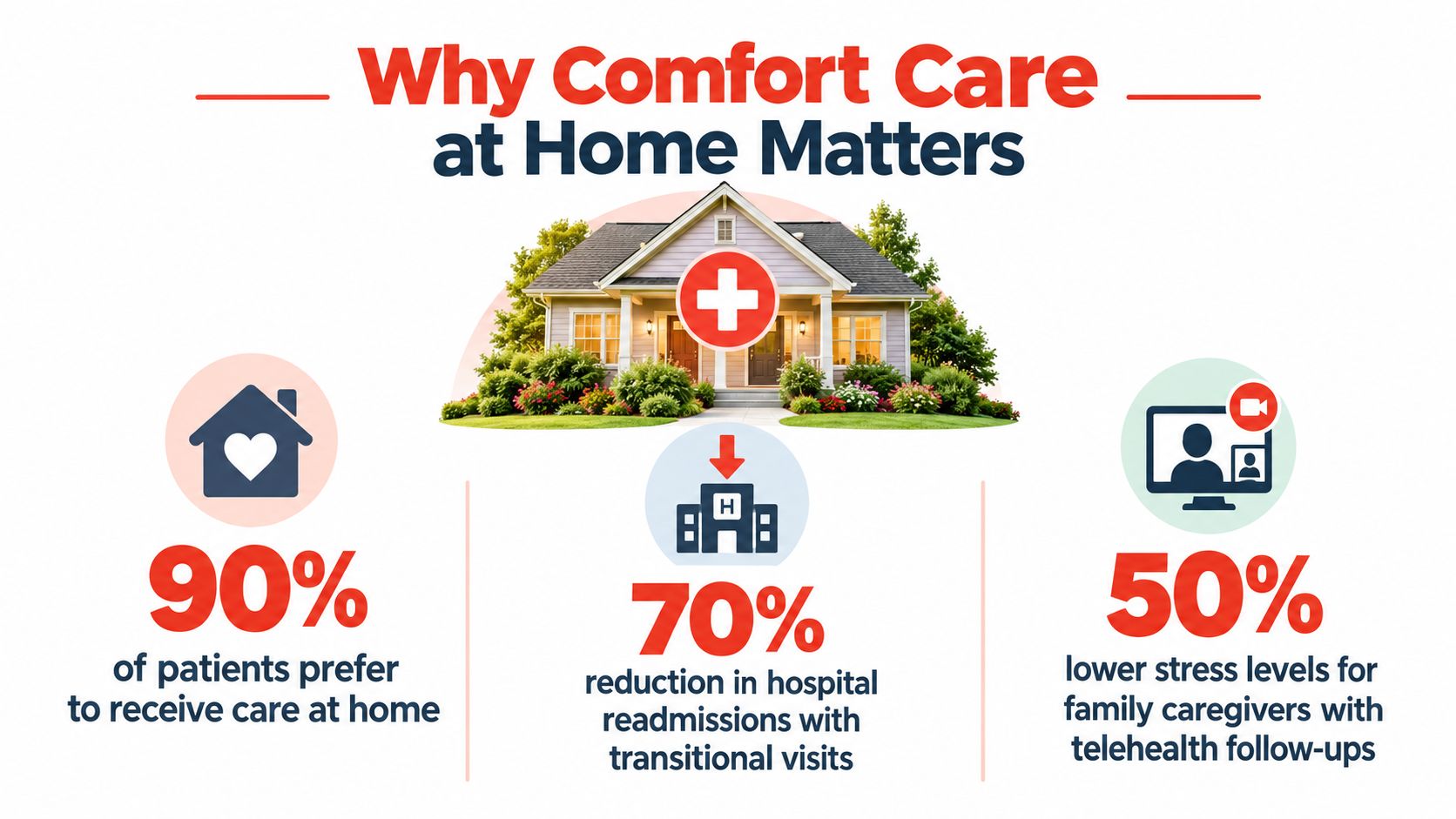
That's one reason home-based primary care keeps coming back into focus. An AAFP review reported that in 2011 there were about 2 million homebound people in the United States, but only 12% received home-based primary care, and the homebound population was projected to reach 4 million by 2030. The same review noted that Medicare Part B billings had risen to nearly 2.6 million paid house calls in 2015, according to the AAFP overview of house calls and home-based primary care.
Home Visits Catch What Travel Hides
A patient may look “stable” in an office but struggle badly with the trip itself. The car transfer, the waiting, and the walk from lot to lobby can drain the energy needed for the rest of the day.
Home-based care removes that layer. It also helps with transitions after discharge, when readmission risk is often shaped by the first few days at home. An AHRQ evidence review concluded that home-based primary care reduces hospitalizations and hospital days, and one large VA analysis found a 22% relative decrease in hospital readmissions at 6 months for the most disabled subgroup, according to the AHRQ review of home-based care evidence.
Why The Evidence Is Helpful, But Not Simple
Families often want a yes-or-no answer. Does home care reduce readmissions or not?
The honest answer is that it depends on timing, patient mix, and coordination. CMS tracks discharge-to-community and potentially preventable post-discharge readmissions as separate quality measures, and newer comparative evidence shows mixed results rather than a universal effect, as summarized in this CMS outcome measures table.
That nuance matters. The strongest value of comfort & care at home often comes from targeted follow-up after discharge, medication review, and seeing how the patient is functioning where they live.
The Kitchen Table Advantage
A home visit lets a clinician do ordinary, high-value things that don't look dramatic but often matter a great deal:
- Review every bottle in one place
- Watch the patient stand and walk
- Check for edema, breathing effort, and fatigue in real conditions
- See whether the caregiver understands the latest plan
That's hard to reproduce in a waiting room.
Caregiver Supports That Ease Daily Coordination
Families often talk about caregiving as emotionally hard, and it is. But it's also a workload problem. Someone has to answer the phone, manage the calendar, sort medications, relay updates to siblings, and keep track of what changed after the last appointment.
The scale of that unpaid work is large. The Caregiving in the US 2025 report says the number of family caregivers providing ongoing complex care has risen from 43 million in 2015 to 63 million today, with more than four in 10 in high-intensity situations and nearly one in four providing 40 or more hours per week, according to the Caregiving in the US 2025 report.

What Actually Reduces The Load
Caregiver relief isn't only respite. Often it starts with reducing mental clutter.
A house-call practice can ease that burden in practical ways:
- Phone-based scheduling: fewer moving parts for a spouse who's already overwhelmed
- Insurance verification handled centrally: one less administrative task for the family
- Results communicated by phone: no extra trip just to hear the plan
- Referral coordination: specialist follow-up doesn't have to be rebuilt from scratch
- Unhurried visits that include the caregiver: questions can be answered while everyone is in the room
Independent research also shows burden rises with daily caregiving hours, caregiving duration, co-residence, lack of backup caregivers, and greater functional impairment of the care recipient. You can feel that truth in ordinary life. The more tasks one person carries alone, the thinner the margin gets.
Support For Families Near And Far
This matters for the daughter who lives twenty minutes away and the son who lives three states away. A home-based practice can become the set of eyes inside the house, helping families understand what's changed and what needs attention next.
For medication-heavy households, a practical explainer on medication management services for seniors can help families think through what good oversight looks like.
Sometimes comfort also comes from small, non-medical gestures that make the home feel warmer and more supportive. Families who want ideas beyond equipment and supplies sometimes browse thoughtful gifts for elderly parents that can make daily rest a little easier.
In New Jersey, these supports matter across private homes, apartments, family residences, and assisted living communities. They also matter across a wide geography, including Morris, Essex, Union, Somerset, Passaic, and Bergen counties, where transportation and family schedules can turn simple care into a complicated project.
Choosing Comfort Care And Next Steps For Families
When families start looking into Visiting Physicians NJ, Visiting Doctors NJ, or Doctor House Calls for Seniors, the most useful question isn't “Are we at the end?” It's “What kind of support do we need right now?”
If your loved one is still being treated but daily life is getting harder, comfort-focused care at home may be the right next step. If travel is the main barrier, doctor home visits for elderly patients can bring primary care, medication review, and follow-up into the living room instead of forcing another difficult trip.
A Short Decision Checklist
- Symptoms are becoming disruptive: breathlessness, fatigue, pain, nausea, or poor sleep are shaping the day.
- Appointments are getting harder to reach: stairs, oxygen, weakness, or transportation are limiting access.
- Medication lists no longer feel clear: different prescribers may have left the household with mixed instructions.
- The caregiver is carrying too much coordination: scheduling, updates, and follow-through are becoming a second job.
- You want support without stepping away from treatment: comfort and active medical care can exist together.
It also helps to ask practical questions during a first home visit. Who coordinates with existing specialists? How are lab results communicated? What happens after a hospital discharge? Can the caregiver be included in the care plan by phone if they live out of state?
For families who are also planning ahead more broadly, a simple end of life plan for families can be a useful organizing tool, even when the current goal is still active support at home rather than hospice.
A calm, well-run house-call model should make life simpler, not more complicated. In East Hanover, that means scheduling through a central office, care delivered at home, no travel fee or membership charge, and visits arranged in a practical time frame for families who need help soon.
Life Primary Care provides house-call primary care across northern and central New Jersey, including comfort-focused palliative support that can continue alongside treatment, plus transitional visits, wellness visits, and in-home diagnostics coordination. If your family is trying to keep a loved one safe, comfortable, and medically supported without repeated office trips, visit Life Primary Care to learn how the home-visit model works.
Ready for a visit at home?
Call and speak with a real person. We will confirm your insurance, find a time and come to you.
973-607-4911 Call now