
Guide · 16 min read
Chronic Disease Management at Home: A Practical Guide
Your mother is sitting at the kitchen table with a blood pressure cuff, a glucose meter, two recent hospital papers, and a row of pill bottles that no longer seem to match any one medication list. She feels mostly fine today, but her legs are a little more swollen than last week, her appetite is off, and no one is quite sure which specialist changed what.
That's where chronic disease management becomes real. It's not an abstract program. It's the steady, organized work of checking symptoms, reviewing medicines, watching for early changes, and making sure one condition's treatment doesn't worsen another. For many older adults, especially those with diabetes, heart failure, COPD, kidney disease, high blood pressure, or high cholesterol, that work happens day by day at home.
A house call changes the conversation because the clinician sees the life around the illness. They can look at the salt-heavy pantry after a heart failure admission, notice the inhaler sitting unopened on the counter, check whether the bathroom setup raises fall risk, and sort through the actual pill bottles instead of relying on memory. That's very different from a short office visit.
Table of Contents
- Why Chronic Disease Management Matters for Older Adults at Home
- The Scale of Chronic Disease and Why Home Care Changes the Equation
- Six Common Conditions and What Home-Based Management Looks Like
- How In-Home Monitoring and Visits Reduce Hospital Readmissions
- Medication Optimization Through Comprehensive In-Home Reviews
- Care Coordination After the Hospital Stay
- Bringing It Together for Better Outcomes at Home
- Practical Questions Families Ask About In-Home Chronic Care
Why Chronic Disease Management Matters for Older Adults at Home
Older adults rarely deal with just one diagnosis. A 78-year-old might be tracking blood sugar in the morning, weighing herself for fluid retention, limiting sodium, trying to remember whether the kidney doctor wanted a lab this week, and recovering from a recent hospital stay at the same time.
That workload is why chronic disease management matters. In plain language, it means building a routine so small changes get noticed early. The goal isn't to chase emergencies after they happen. The goal is to catch trouble when it still looks manageable.
What this work actually includes
At home, chronic disease management usually involves a few core tasks:
- Monitoring day-to-day changes: weight, blood pressure, swelling, breathlessness, home glucose readings, oxygen levels, or appetite.
- Reviewing medications carefully: checking that the bottles in the home match the current list, and that the schedule still makes sense.
- Coordinating across clinicians: helping primary care, specialists, home health, and family work from the same plan.
- Supporting recovery after setbacks: especially after hospitalization, when medication errors and confusion are common.
A lot of families think the main issue is the disease itself. Often, the bigger issue is the friction around the disease. Getting to appointments. Understanding discharge papers. Keeping medicines straight. Noticing that “a little more tired” has become “can't walk to the bathroom without stopping.”
Why home makes the difference
A clinic visit tells you what happens in a clinic chair. A house call shows what happens between breakfast and bedtime.
Practical rule: If you want to understand why a chronic condition is stable or unstable, look at the patient's routine, not just the chart.
That's why families often find home-based care calmer and more useful. The visit can focus on the questions. Which pills are being taken? Is there enough food in the house that fits the diet plan? Can the patient get safely to the bathroom at night? Are family caregivers hearing the same instructions?
For older adults, chronic disease management works best as a partnership. One person brings the medical training. The patient and family bring the daily reality.
The Scale of Chronic Disease and Why Home Care Changes the Equation
Chronic illness isn't a niche problem. According to the World Health Organization, noncommunicable diseases caused at least 43 million deaths in 2021, representing 75% of all non-pandemic-related deaths worldwide. Cardiovascular diseases accounted for about 19 million deaths, cancers for 10 million, chronic respiratory diseases for 4 million, and diabetes for more than 2 million, as outlined in the WHO fact sheet on noncommunicable diseases.
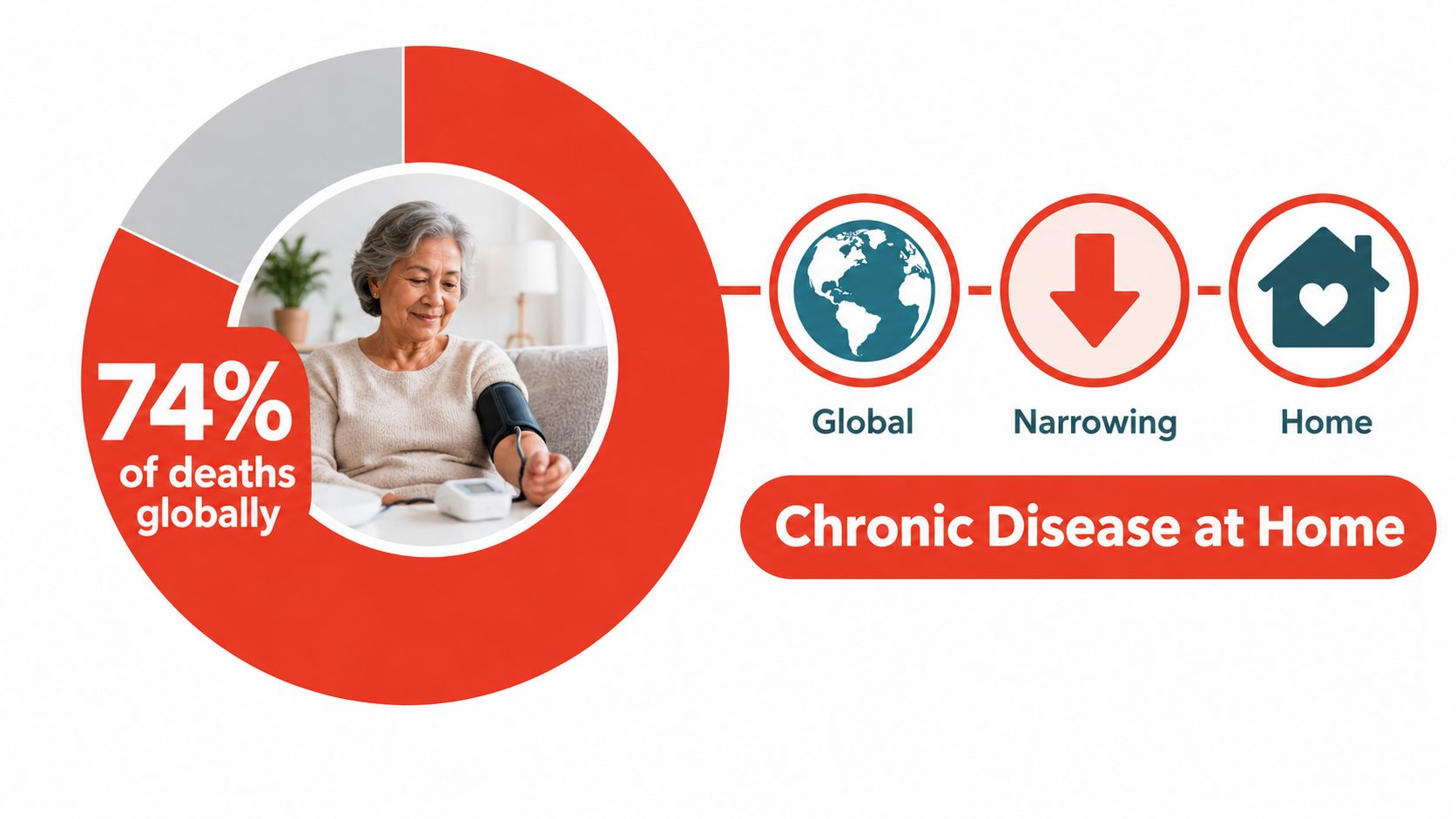
Those are global numbers, but the home version is easy to recognize. One person may have three or four diagnoses, several prescribers, different refill dates, changing appetites, and limited stamina for travel. Every day involves choices about food, fluids, movement, rest, and medications.
Why the home setting changes the clinical picture
In the office, a clinician sees a snapshot. At home, they see patterns.
They can notice that the blood pressure cuff is too small and giving misleading readings. They can see whether the patient climbs stairs safely. They can check if the low-sodium plan is realistic given what's in the refrigerator. They can also tell whether the family understands the plan the same way the chart describes it.
For families exploring health care delivered at home, that difference matters because context drives adherence. A treatment plan that looks perfect on paper may fail in a home where transportation is limited, dexterity is poor, or memory problems affect dosing.
The hidden burden isn't only medical
A recent perspective described a persistent gap between promising digital health pilots and durable health-system value, with the challenge lying less in having more tools and more in embedding them into workflow, reimbursement, interoperability, and patient support, as summarized in this chronic disease management market analysis.
The important question often isn't whether monitoring can work. It's whether the support around it is strong enough to make it work consistently.
That's one reason home care changes the equation. It places monitoring, medication review, and coordination inside the patient's actual environment instead of asking the patient to translate everything back home alone.
Six Common Conditions and What Home-Based Management Looks Like
The six diagnoses most often managed at home share a structure. Each needs regular monitoring, medication review, and clear thresholds for when something has changed enough to act. But the details differ quite a bit.
What the clinician is watching for
| Condition | Key Home Monitoring | Medication Priorities | Red Flags to Act On |
|---|---|---|---|
| Diabetes | Home glucose log, eating pattern, foot skin checks, symptoms of low blood sugar | Matching medication schedule to meals, kidney function, and risk of low sugar | Repeated low sugars, very high readings, confusion, poor intake, new foot wound |
| Congestive heart failure | Daily weight, swelling, breathing, activity tolerance, sodium intake | Diuretic timing, adherence, avoiding missed doses | Rapid weight gain, worse swelling, shortness of breath, waking breathless |
| Hypertension | Home blood pressure technique, timing, trend over days | Dosing schedule, avoiding duplicate agents, checking side effects | Very high readings with symptoms, dizziness, fainting, falls |
| Chronic kidney disease | Lab follow-up, fluid status, medication list, over-the-counter use | Dose adjustment for kidney function, avoiding nephrotoxins | Less urine, worsening swelling, confusion, medication side effects |
| COPD | Inhaler technique, cough, sputum change, oxygen use, exertional tolerance | Correct inhaler use, refill access, spacing and routine | More shortness of breath, change in sputum, inability to do usual activity |
| Hyperlipidemia | Lab follow-up in context of overall risk, adherence | Statin consistency, checking for tolerability issues | New medication confusion, stopping treatment without discussion |
Condition by condition at the kitchen table
Diabetes management at home often starts with the logbook, meter, and meal pattern. A clinician isn't only looking for high readings. They're also asking whether there have been shaky episodes, skipped meals, or low sugars overnight. For people with type 2 diabetes and chronic kidney disease, recent guideline recommendations place more emphasis on matching therapy to kidney and heart risk, not glucose alone. The 2026 ESC guideline recommends individualized HbA1c targets generally below 7.0%, with a range from <6.5% to <8.0% depending on patient factors, and recommends SGLT2 inhibitors and GLP-1 receptor agonists as first-line agents in type 2 diabetes with CKD because they slow CKD progression and lower cardiovascular events, as described in the 2026 ESC cardiovascular guideline.
Congestive heart failure is often managed through pattern recognition. Is the morning weight creeping up? Are shoes tighter? Is the patient sleeping propped up higher? Small clues matter.
Hypertension seems simple until you watch someone take their home reading with crossed legs, after coffee, while talking. Technique changes interpretation. Timing matters too.
Different diseases, same discipline
For chronic kidney disease, medication safety is central because kidney function affects dosing. For COPD, inhaler technique can matter as much as the prescription itself. For high cholesterol, the discussion is usually broader. It's about cardiovascular prevention, medication consistency, and how the lipid plan fits with diabetes, kidney disease, or prior heart disease.
Some patients are also managing pain or stiffness that interferes with exercise, sleep, or medication routines. In that situation, a practical guide on building a chronic pain daily routine can help families think through pacing, movement, and daily structure without treating pain as a separate issue from the rest of chronic care.
One of the most useful shifts in home care is this: instead of asking “What disease are we treating today?” the clinician asks “What pattern is changing in this person's daily life?”
How In-Home Monitoring and Visits Reduce Hospital Readmissions
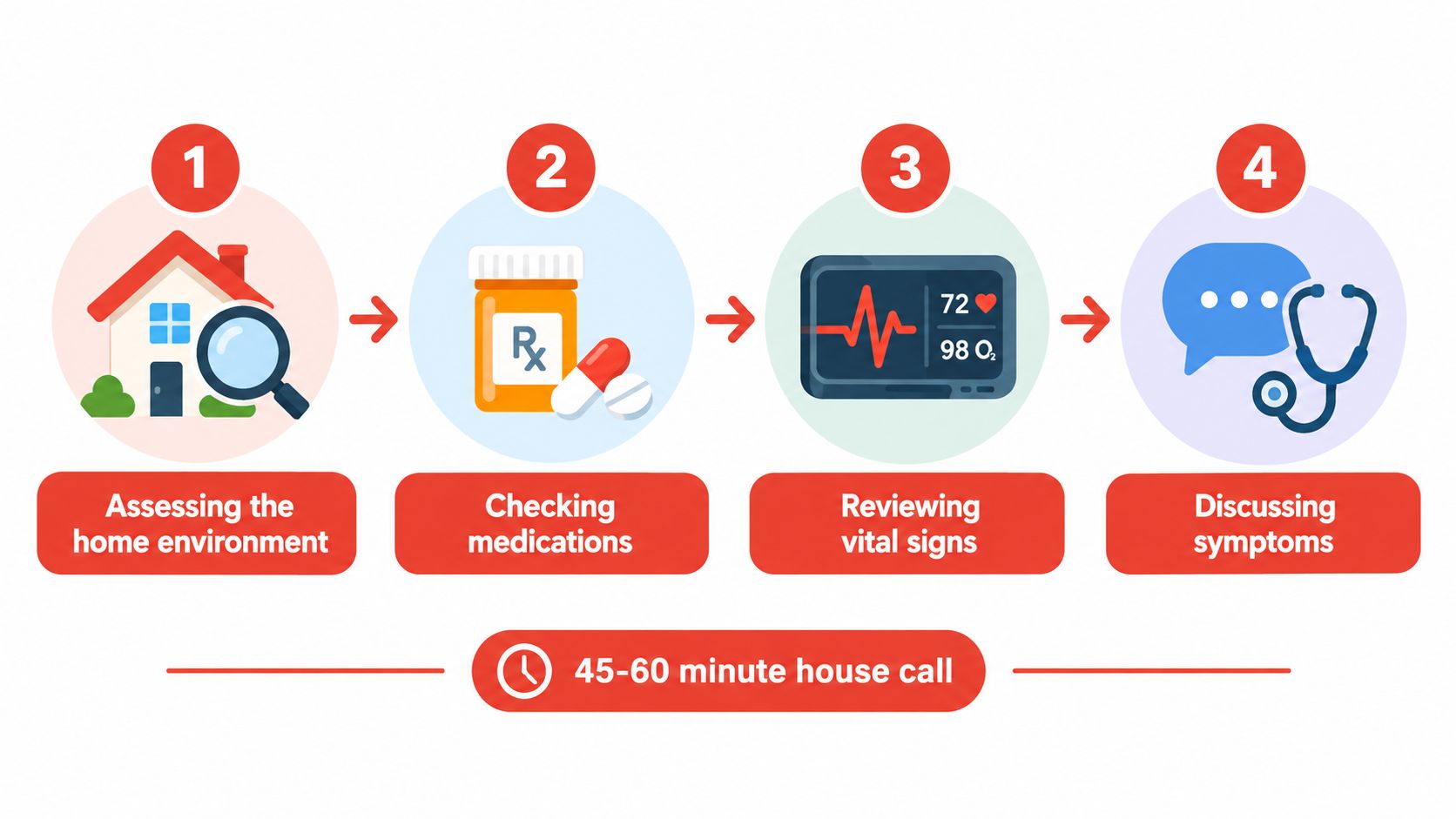
A good house call is structured, even when it feels relaxed. The visit often lasts 45 to 60 minutes, which gives enough time to catch the practical issues that short office visits miss.
What happens during the visit
The home environment gets assessed. The clinician looks for fall hazards, checks whether food access supports the diet plan, and sees how oxygen, walkers, or stairs affect daily function.
Vital signs are gathered in context. Blood pressure, heart rate, oxygen saturation, weight, and sometimes temperature get interpreted alongside symptoms and activity tolerance.
Every medication bottle comes to the table. This “brown bag” review compares the home supply to the active chart and the recent hospital list.
Changes get addressed early. That might mean clarifying instructions, adjusting timing, arranging follow-up labs, or escalating concerns before the patient lands in the emergency room.
Why this format can lower readmissions
The evidence supports the basic idea. A systematic review found that home visits for heart failure were associated with a statistically significant reduction in hospital readmission risk, with RR 0.82 and 95% CI 0.69 to 0.97, and broader evidence showed self-monitoring and self-management programs reduced all-cause or disease-specific readmissions by up to 54% when patients were taught symptom-triggered escalation, according to this systematic review on home care interventions.
A second evidence synthesis found that discharge planning plus postdischarge support reduced readmissions, with pooled readmission risk at RR 0.75 and 95% CI 0.64 to 0.88, as reported in this review of discharge planning and postdischarge support.
Families who want a simple overview of remote patient monitoring heart benefits often find that the useful part isn't the gadget itself. It's the follow-up plan attached to the readings.
The practical mechanism is simple
Readmissions often begin as small misses. A patient gains fluid but doesn't realize it matters. A new inhaler isn't being used correctly. A discharge instruction is misunderstood. A blood pressure medicine causes dizziness and the patient starts skipping doses.
Home visits help because they uncover those misses where they happen. Not in theory. In the living room, with the scale, the pill bottles, the food labels, and the family caregiver present.
Medication Optimization Through Comprehensive In-Home Reviews
Medication review is where house calls often produce the clearest “how did no one catch this?” moments.
A common scene looks like this: an older adult has prescriptions for diabetes, atrial fibrillation, high blood pressure, and high cholesterol. One specialist adjusted a dose. Another added a new medication after a hospital stay. Someone bought an over-the-counter pain reliever for knee pain. The chart may be updated in pieces, but the pill organizer at home tells the story.
What the kitchen-table review uncovers
During an in-home review, the clinician can line up every bottle by the sink or dining table and compare them with the active list. That's often when problems surface:
- Duplicate medications: two versions of the same statin, or an old bottle still being taken alongside the new one.
- Kidney-related dosing concerns: a medicine that was reasonable months ago may no longer fit the current kidney picture.
- Interaction risks: a blood thinner plus a newly added pain medicine can create trouble quickly.
- Schedule confusion: morning pills taken at night, missed doses because labels are hard to read, or “as needed” medicines used every day.
This is one reason families value medication management services for seniors. The work isn't just making a list. It's matching the list to what the patient is taking.
Why the home setting helps
At home, there's time to ask who fills the pill box, whether the patient can open the bottles, and what happens on weekends when routines change. Family members often remember details that never come up in the office, like “he stopped that one because it upset his stomach” or “she takes this later because it makes her dizzy.”
Kitchen-table lesson: The medication list in the chart is only a starting point. The bottles in the home are the evidence.
From there, the clinician can communicate with prescribers, simplify schedules where appropriate, and flag issues that need formal medical review. That doesn't replace specialist care. It makes specialist care safer and more coherent.
Care Coordination After the Hospital Stay
The first stretch after a hospital discharge is often the most fragile. Patients come home tired. Medication lists have changed. Follow-up appointments may not be scheduled yet. Family members are trying to decode instructions while also managing meals, mobility, and sleep.
What strong transitional support looks like
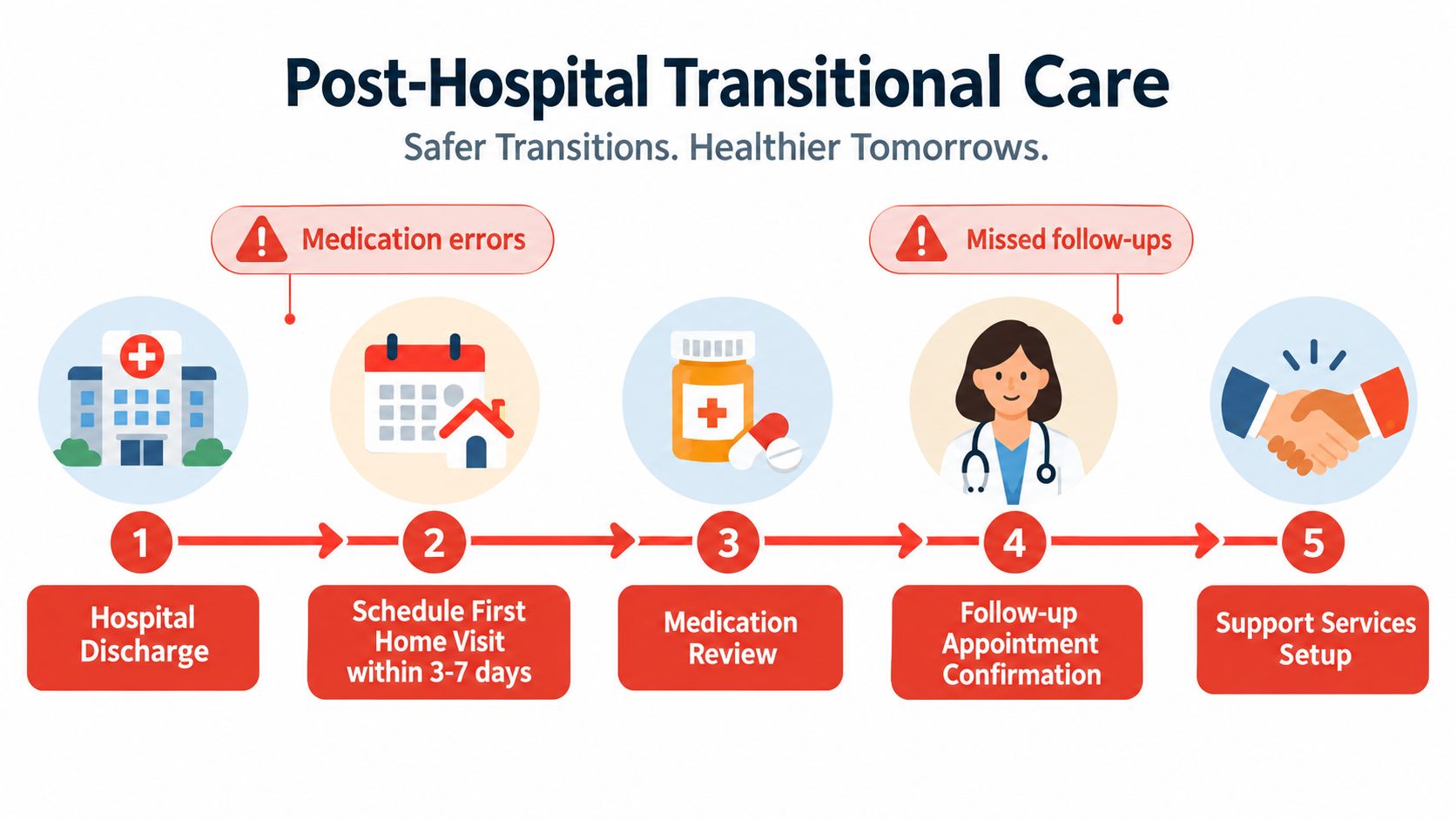
A practical pathway usually starts with a home visit within 3 to 7 days of discharge. At that visit, the clinician reviews the discharge paperwork alongside the medications already in the house and answers the question every family has: “What are we supposed to do now?”
The next steps usually include:
- Medication reconciliation: matching the hospital list, prior home list, and actual bottles on hand.
- Red-flag teaching: helping the family know which changes matter, such as more swelling, more shortness of breath, blood sugar swings, weakness, or falls.
- Follow-up planning: confirming specialist visits, labs, imaging, and who is responsible for each part.
Why this window matters
In a large transitional-care evaluation of patients with multiple chronic conditions, receiving a home visit after hospital discharge cut 30-day readmission odds nearly in half, with an odds ratio of 0.52 and a 95% confidence interval of 0.48 to 0.57. The same study found lower total costs for the highest-risk patients, with an average per-member-per-month difference of $970, according to this evaluation of postdischarge home visits.
For families trying to understand the vulnerable early period, this guide to the first two weeks after hospital discharge can help organize what to watch and what documents to keep close.
Keeping one plan in motion
Some patients also need telehealth check-ins between visits, calls to specialists, coordination with home health nursing, or help arranging labs and imaging. The key is continuity. Hospital instructions often arrive as fragments. Transitional care turns those fragments into one working plan at home.
Bringing It Together for Better Outcomes at Home
Home-based chronic disease management works best when it isn't treated as a set of unrelated services. Monitoring, medication review, and post-hospital follow-up strengthen each other.
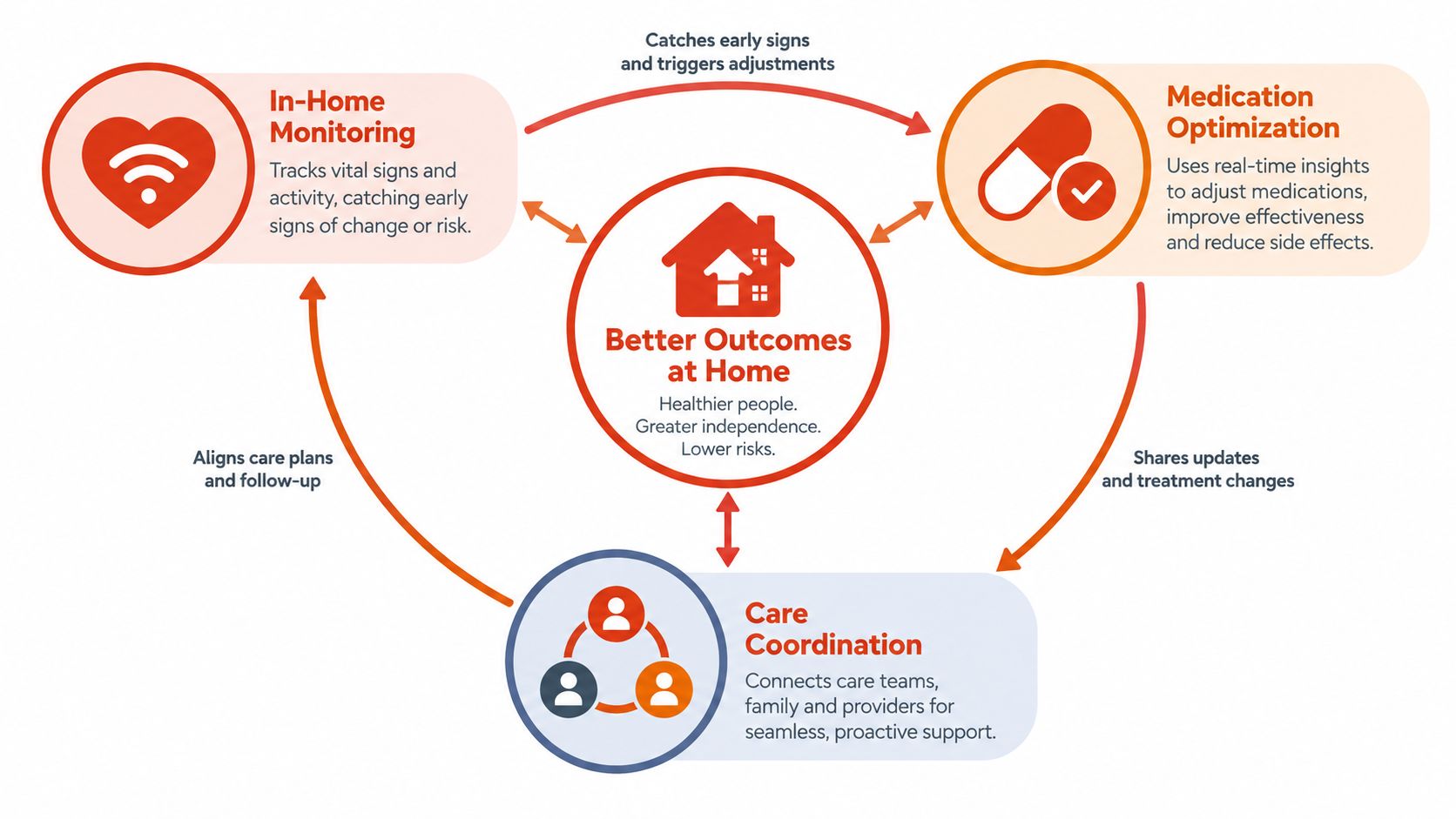
Three parts of one system
Routine monitoring helps catch early warning signs before they become crises. Medication optimization reduces the chance that the treatment plan itself is causing confusion or harm. Transitional support closes the risky gap after discharge, when instructions are fresh but often unclear.
A coordinated home program usually includes:
- Scheduled follow-up based on complexity: more frequent visits for unstable symptoms, recent discharge, or several interacting conditions.
- One clinician seeing the whole medication picture: not replacing specialists, but connecting their plans.
- Clear family communication: so caregivers know what changed, what to watch, and who to call.
What families often care about most
Most families aren't looking for elegant care models. They want fewer emergency trips, steadier symptoms, and less chaos.
One underserved part of this conversation is confidence. Late-2025 OECD data showed that 59% of people living with chronic conditions felt confident managing their own health, compared with 70% of people without chronic conditions, as summarized in this report on chronic disease management. That gap helps explain why even good medical plans can fail when the daily burden is high.
A practical home-based model can also include a preventive visit. Medicare's Annual Wellness Visit is a conversation-based preventive visit used to develop or update a personalized prevention plan, covered once every 12 months, and if the provider accepts assignment, the patient pays nothing for the visit, according to Medicare's Annual Wellness Visit guidance.
Better outcomes at home usually come from steadier follow-through, not from one dramatic intervention.
One option families in New Jersey sometimes consider is Life Primary Care, a house-call primary care practice that provides in-home medical care, transitional follow-up, medication review, telehealth check-ins, and Medicare wellness visits in the home. Services like these are part of a larger offering that can also include home health, specialist follow-up, and caregiver support.
This article offers general health information only. Individual treatment decisions, medication changes, and monitoring plans need to be set by a clinician who knows the patient.
Practical Questions Families Ask About In-Home Chronic Care
Families usually ask the practical questions first, and that makes sense. Before anyone thinks about care models, they want to know whether house calls are realistic.
Who tends to benefit most
In-home chronic care is often a good fit for older adults who have trouble getting to a clinic, live with several chronic conditions, use oxygen or mobility aids, have memory concerns, or recently came home from the hospital. It can also help when an adult child is coordinating from another town and needs one clear point of contact.
Search phrases like Visiting physicians NJ, Visiting Doctors NJ, Dr House calls NJ, Doctor house calls NJ, House calls for seniors, In Home Doctor for Elderly, At-Home Doctor Visits, in-home medical care, Visiting Docs, Doctor home visits for elderly, and Doctor House Calls for Seniors all point to the same need. Families want care that reaches the patient where daily life happens.
What to ask before scheduling
A few questions make the first call easier:
- Coverage questions: Ask whether the practice accepts your insurance and whether there are any visit-related patient costs under the plan. Coverage varies, so it's worth confirming directly.
- Scheduling questions: Ask how often routine visits happen, how urgent concerns are handled between visits, and whether telehealth follow-up is available.
- Preparation questions: Before the visit, gather medication bottles, discharge papers, recent lab results if you have them, and the names of outside specialists.
Some families also want a broader, non-promotional read on care coordination with Venus Health Co. because it highlights a point that applies well beyond one practice: chronic care becomes easier when someone helps connect the moving parts.
What the first visit often feels like
The first home visit is usually more conversational than people expect. The clinician asks about symptoms, routines, falls, food, sleep, medications, and what has felt hardest to manage. They're also paying attention to the home setup, caregiver strain, and whether the written plan fits real life.
That kind of visit won't replace every specialist appointment, and it won't solve every problem in one day. But for many families, it creates a more workable starting point.
This information is general and educational. Specific medical decisions should be made with a qualified clinician who can assess the individual patient.
Life Primary Care provides house-call primary care across northern and central New Jersey, including chronic disease management, post-hospital follow-up, medication reviews, urgent visits, and Medicare wellness visits in the home. If you're looking for a calmer way to manage complex conditions without repeated office travel, visit Life Primary Care to learn how home-based care works.
Ready for a visit at home?
Call and speak with a real person. We will confirm your insurance, find a time and come to you.
973-607-4911 Call now