
Guide · 14 min read
Autism Spectrum Disorder Physical Therapy: A Practical Guide
Only 31.6% of children with autism spectrum disorder receive physical therapy, even though roughly 50% to 88% experience motor impairments. Autism spectrum disorder physical therapy can address far more than walking or running. It can support balance, participation, social engagement, behavior, and everyday independence.
Families often hear about speech therapy, occupational therapy, or behavioral services first. Those services can be important, but movement affects how a child plays, learns, communicates, sleeps, manages transitions, and joins family or community activities. A child who can't climb playground equipment may miss opportunities to play with peers. An adult who tires quickly while walking may avoid social events altogether.
The central question isn't whether a child must become an athlete. It's whether movement difficulties are limiting meaningful participation, and whether a physical therapist can make daily activities more accessible, predictable, and enjoyable.
Table of Contents
- Understanding the Physical Therapy Gap in Autism
- Common Motor Challenges in Autism Spectrum Disorder
- What Physical Therapy Approaches Work for Autism
- Comparing Intervention Types and Expected Outcomes
- How a Physical Therapy Program Unfolds in Practice
- Delivering Physical Therapy Activities at Home
- Common Misconceptions About Physical Therapy for Autism
- Taking the Next Step Toward Better Outcomes
Understanding the Physical Therapy Gap in Autism
The 2020 SPARK study analysis identified a striking service mismatch. It found that 31.6% of children with autism spectrum disorder received physical therapy, compared with 79.8% receiving occupational therapy and 82% receiving speech therapy (OUP analysis of the SPARK study). Later reviews of the same evidence reported that about 30% to 35% of autistic children received physical therapy even though roughly 50% to 88% experienced motor impairments. One clinical guide summarized movement problems in around 87% of people with autism, using the same line of evidence.
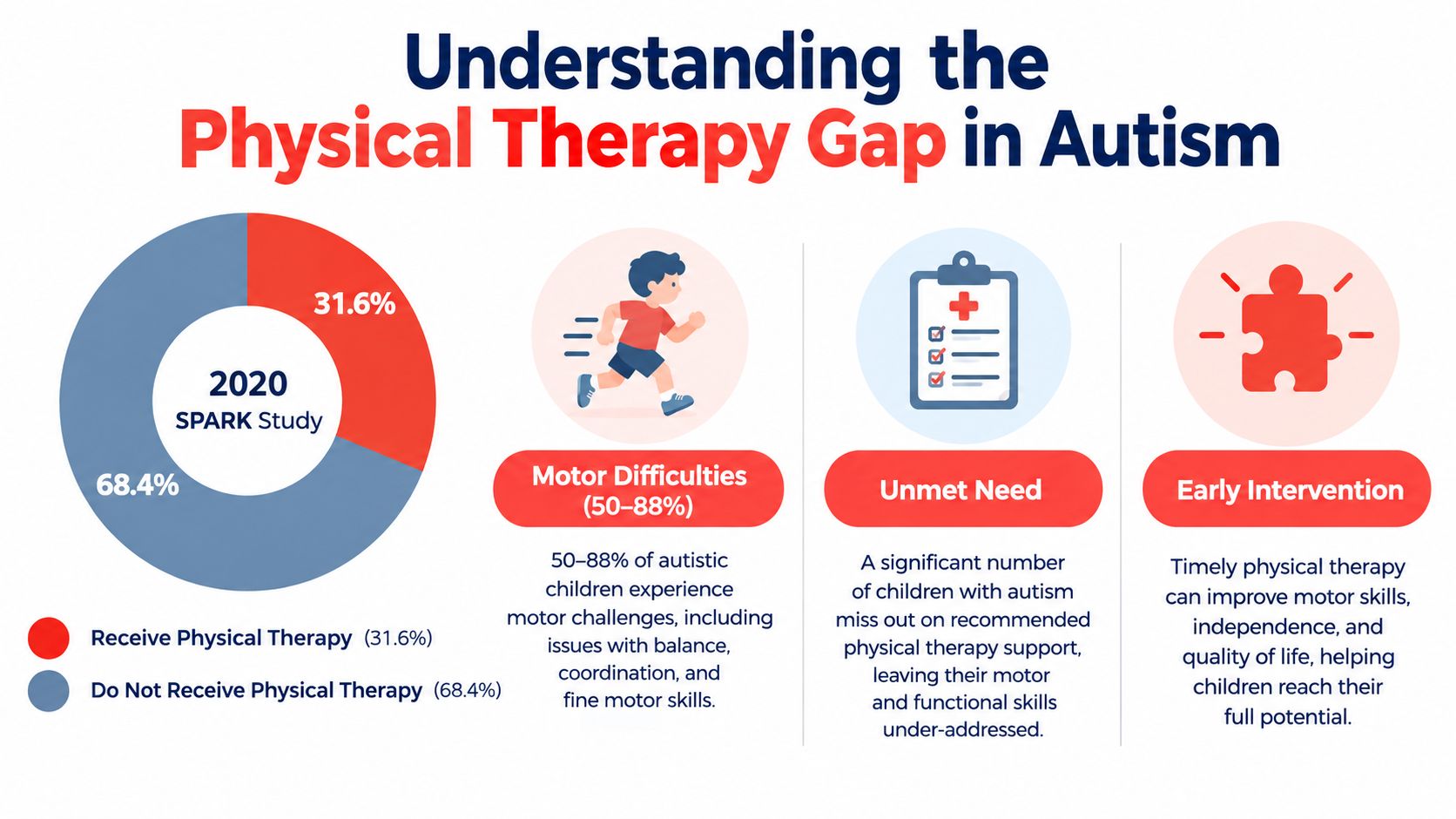
The gap doesn't necessarily mean families are refusing care. Referral patterns often favor speech and occupational therapy because communication and sensory differences are more visible during developmental evaluations. Some parents and providers also interpret clumsiness, poor endurance, or unusual gait as a behavioral issue, a temporary delay, or a matter of motivation.
Why movement needs get missed
Motor differences can look subtle in a clinic or classroom. A child may walk independently but struggle with stairs, uneven ground, playground equipment, or rapid transitions between activities. An older person may appear mobile but avoid sports, fatigue during errands, or need much longer to organize a sequence of movements.
Physical therapy is sometimes viewed as less urgent than communication support. That framing misses the connection between movement and participation. Balance, posture, coordination, and gait can determine whether someone can reach a classroom, sit comfortably, carry materials, play a game, or remain engaged in a family routine.
Practical rule: The question isn't only, “Can my child walk?” Ask, “What activities are harder because of movement?”
Autism spectrum disorder physical therapy should therefore be considered part of a broader developmental team. The aim isn't to erase autistic traits or force a child into a narrow physical ideal. It's to reduce barriers that interfere with comfort, safety, independence, and access to daily life.
Common Motor Challenges in Autism Spectrum Disorder
Motor challenges can appear in many forms, and they won't look identical from one person to another. A child might have trouble balancing on a curb, catching a ball, or climbing a ladder. An adult might frequently bump into doorframes, misjudge distances, or find it exhausting to move from sitting to standing repeatedly.

Balance and postural control
Balance depends on information from the eyes, inner ear, muscles, and joints. Some autistic people may have difficulty combining these signals, especially when the surface changes or the environment becomes busy. At home, this might appear as frequent tripping, reluctance to use playground structures, or needing a hand on the wall when walking downstairs.
Postural control affects how someone holds the body during movement and stillness. A child may slump at a table, lean heavily on furniture, or lose stability when reaching. These patterns can make schoolwork, dressing, bathing, or floor play more tiring than expected.
Coordination and motor planning
Coordination involves timing several body parts together. Motor planning, sometimes called praxis, involves figuring out what movement is needed, organizing the sequence, and carrying it out. A child may understand a direction such as “jump forward,” yet struggle to coordinate the preparation, takeoff, and landing.
These difficulties aren't just defiance or poor attention. They can reflect differences in neurological motor planning and execution. Families seeking a plain-language explanation may find this resource on dyspraxia support from Guiding Growth useful when motor planning concerns overlap with autism.
Gait may also differ. A person might walk on the toes, use a wide base, take uneven steps, or have trouble changing speed. Fine and gross motor differences can overlap, so an individual may struggle both with fastening clothing and with running, throwing, or navigating stairs. Families can also review broader mobility concerns through this guide to arthritis and mobility, although autism-related movement differences require an individualized assessment.
Sensory processing differences may intensify these challenges. Bright lights, loud rooms, unfamiliar flooring, or unexpected touch can make movement less predictable. A physical therapist considers both the movement pattern and the environment in which it occurs.
What Physical Therapy Approaches Work for Autism
The most useful physical therapy is active, purposeful, and tied to daily participation. Movement practice works like rehearsal for the nervous system. Stepping, climbing, balancing, swimming, throwing, and changing direction give the brain repeated information about force, timing, and body position. Passive treatment can have a role in selected situations, but meaningful movement usually requires meaningful practice.
A 2026 scoping review reported large pooled gains in motor skills and balance, with standardized mean differences of about 1.07 to 1.82. It identified aquatic training as a promising format when provided about two sessions per week for at least 60 minutes per session (Frontiers in Public Health review). These findings guide planning rather than prescribe a universal schedule. The therapist still matches the activity to the person's safety, communication style, sensory preferences, and participation goals.
Matching the activity to participation
Aquatic therapy uses buoyancy and water resistance to make balance and locomotion practice feel different from land-based exercise. Fundamental motor skill programs may rehearse running, jumping, throwing, catching, and changing direction. Martial arts or structured sports add turn-taking, shared rules, and coordinated attention to repeated movement patterns.
The best choice depends on the person and the goal. Someone who dislikes unexpected touch may tolerate water-based practice better than hands-on exercises. Another child may participate more willingly in martial arts because the sequence is predictable and the immediate feedback is clear. Interests therefore become part of clinical planning. Enjoyment can increase the amount of useful practice without making therapy less purposeful.
A 2024 systematic review and meta-analysis of 28 randomized controlled trials involving 1,081 participants found improvements in motor performance, restricted repetitive behaviors, and social dysfunction. Reported effects included SMD 1.72 for motor performance, SMD -0.81 for restricted repetitive behaviors, and SMD -0.76 for social dysfunction (RSD Journal review). The findings are encouraging, although substantial heterogeneity and high risk of bias mean they should not be treated as guaranteed outcomes.
Why the broader benefits matter
A movement session can also rehearse skills used outside the gym or pool: waiting for a turn, shifting attention, following a sequence, and coping with a change in routine. Reviews describe possible benefits for social communication, executive function, sleep-related behavior, and physical health. They also report limited evidence for autistic adults and insufficient study of anxiety and depression (2025 integrative review).
PT is therefore a participation and health intervention, not merely a service for improving muscle strength. The therapist connects body control with a practical outcome, such as joining a playground game, dressing with less help, or walking through a busy hallway with greater confidence. Movement improvement matters because it can widen access to everyday experiences, relationships, and independence.
Comparing Intervention Types and Expected Outcomes
Families often ask which activity they should choose. A better question is, what goal matters most right now, and which setting makes practice sustainable? The following comparison summarizes how common approaches are generally used. Dosing details come from the evidence where specific parameters were reported, not from a universal prescription.
| Intervention type | Main goals | Dosing information from research | Evidence interpretation |
|---|---|---|---|
| Aquatic training | Balance, locomotion, gross motor control, confidence in movement | About 2 sessions weekly for at least 60 minutes per session in the 2026 scoping review (Frontiers in Public Health review) | Promising motor and balance findings, with the child's water safety and sensory response requiring careful consideration |
| Martial arts or structured sports | Motor coordination, rule-following, shared attention, and social functioning | Dosing varies across programs, so the therapist should individualize frequency and duration | Organized sports and exercise may support balance, locomotor skills, and social functioning, but overall certainty remains limited (2026 review) |
| Fundamental motor skill programs | Running, jumping, throwing, catching, balance, and transitions | Repeated, task-oriented practice is emphasized, but no single universal schedule is established | Useful when goals are specific and observable, with evidence still developing |
| General exercise | Physical fitness, participation, routine, sleep, and psychological function | Programs vary by age, ability, access, and preference | A review of young adults found the strongest evidence for medium-to-large gains in physical fitness, followed by motor outcomes and psychological function, while evidence for reducing core symptoms remained insufficient (2024 review) |
The table shouldn't be used as a ranking system. A pool may be inaccessible, a sports group may be overwhelming, and a home-based motor program may be the most realistic starting point. The best choice is one the person can safely repeat and connect to daily life.
A broader guide to ABA Finder autism therapy can help families understand how behavioral services may fit within a multidisciplinary plan. Physical therapy has a distinct role, especially when movement limits participation or creates safety concerns, and collaboration among providers can prevent competing demands.
The evidence also includes important cautions. A separate 2024 meta-analysis of exercise interventions in young adults found strong physical fitness findings but insufficient evidence that exercise increases physical activity engagement or reduces core autism symptoms. That distinction helps families set goals that are meaningful and measurable rather than expecting one activity to address every developmental domain.
How a Physical Therapy Program Unfolds in Practice
Consider Marcus, a fictional child whose family notices that playground time ends quickly. He can walk and run, but he avoids climbing, stumbles on uneven ground, and becomes upset when adults ask him to try unfamiliar movements.
The physical therapist begins by observing how Marcus enters the room, changes direction, steps over objects, rises from the floor, and responds to verbal or visual cues. The assessment isn't limited to strength. It also considers balance, coordination, endurance, motor planning, communication preferences, sensory triggers, and the activities Marcus wants to join.
Turning observations into goals
Instead of writing a vague goal such as “improve gross motor skills,” the therapist and family choose observable targets. Marcus might practice stepping over low obstacles, climbing a small set of playground steps, or moving between stations without losing balance. His interest in vehicles becomes part of the session, with floor markers arranged like a road and each movement linked to a destination.
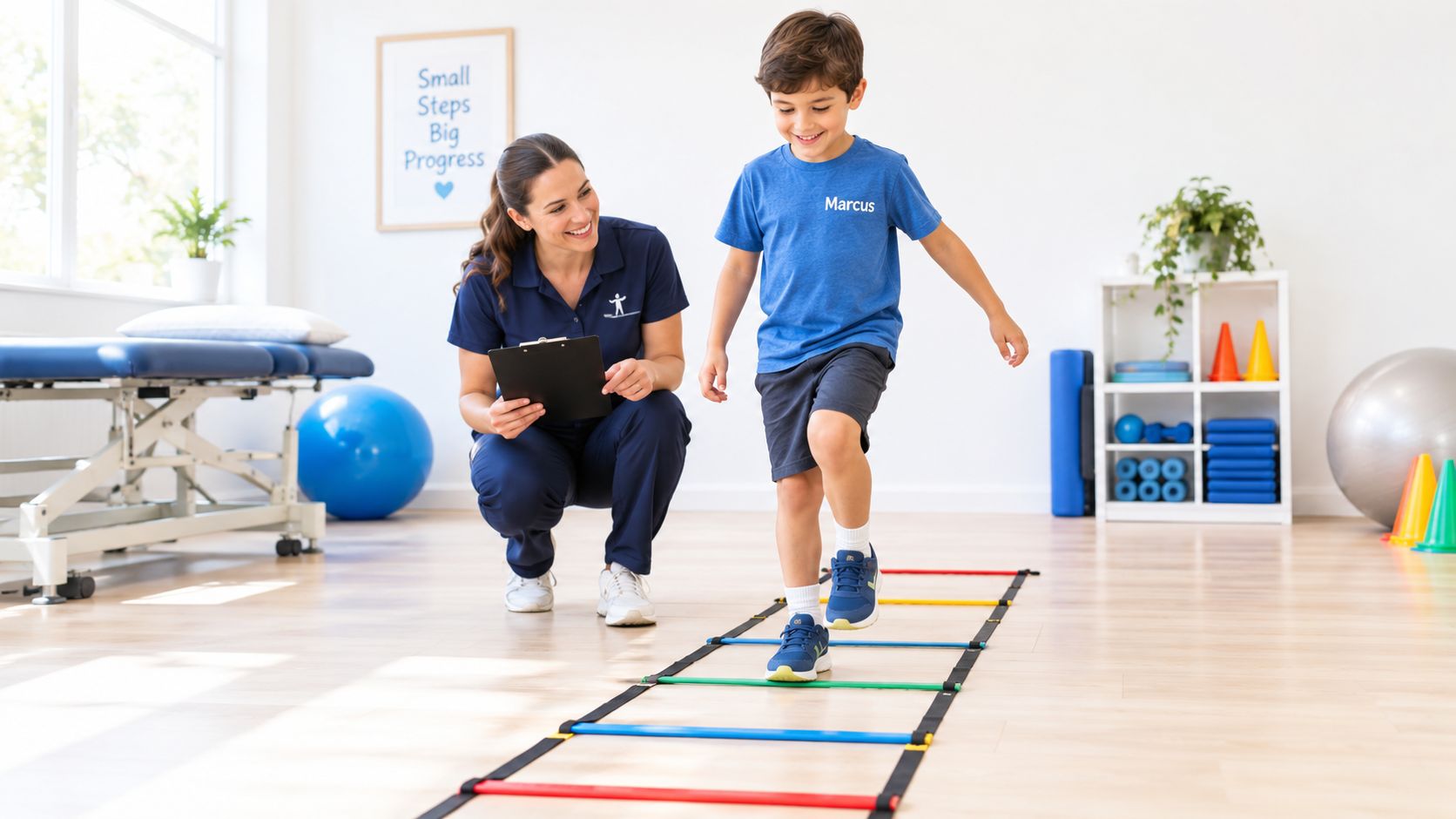
The therapist then teaches the family how to practice safely at home. A short routine might involve stepping over cushions, carrying a light object between marked spots, or walking along a clear path. The exact activity depends on the evaluation, and caregivers shouldn't add challenging equipment or movements without guidance.
Progress rarely follows a straight line. Marcus may perform a skill easily one morning and struggle after poor sleep or a noisy school day. The therapist uses those observations to adjust the environment, cueing, repetitions, and goals. A plateau isn't automatically failure. It can show that the task needs a different entry point.
Delivering Physical Therapy Activities at Home
Home practice works best when it feels like a predictable part of life rather than a second clinic appointment. The therapist should identify the movement goal, explain what success looks like, and show caregivers how to make the activity safe. Families can then repeat a manageable routine and report what they observe.
Build practice into familiar routines
A child who enjoys music might step to a rhythm. Someone who likes cars might carry toy vehicles along a taped path. A teenager may prefer a structured fitness routine, while another person may participate more willingly when movement is attached to walking the dog or visiting a familiar park.
Use a visual schedule when transitions are difficult. Show the order clearly, such as “movement, preferred activity, finished.” Predictability lowers the need to negotiate every step, while a choice between two therapist-approved activities gives the person some control.
Keep the environment workable
Before practice, check the floor, lighting, noise, footwear, and available space. Remove clutter and avoid unstable furniture. Families can use this falls prevention checklist for the home to identify environmental hazards, but it doesn't replace individualized safety advice from the treating clinician.
At home, consistency matters more than performance. A calm repetition of a simple task can teach more than a demanding session that ends in distress.
Resistance is information. The movement may be uncomfortable, the room may be too loud, the instruction may be unclear, or the task may be too difficult. Tell the therapist what happened instead of forcing the activity. The plan may need a different surface, a shorter sequence, a visual cue, a rest break, or a more motivating context.
Caregiver fatigue also deserves attention. Rotate responsibilities when possible, keep equipment simple, and use naturally occurring opportunities such as stairs, dressing, or reaching for a shelf. Home practice supplements clinical therapy. It can't reproduce a full assessment, identify subtle changes in gait, or safely redesign a program when a new problem appears.
Common Misconceptions About Physical Therapy for Autism
Misconception one, PT is only for walking and running. Physical therapy can also address posture, balance, coordination, endurance, transitions, safety, and participation. A person may walk independently and still need help navigating stairs, playgrounds, crowded spaces, or fatigue-producing routines.
Misconception two, motor differences will automatically disappear. Some skills develop with time, but persistent difficulty can limit play, school access, fitness, and social opportunities. A professional assessment helps distinguish a passing variation from a barrier that deserves support.
Misconception three, autism PT is the same as standard pediatric PT. The movement goal may be similar, but the delivery often needs adaptation. Visual communication, sensory accommodations, preferred interests, predictable routines, and careful attention to arousal can determine whether practice is successful.
Misconception four, progress should be rapid and linear. Motor learning may include plateaus, uneven performance, and temporary setbacks. Sleep, illness, sensory load, anxiety, and changes in routine can affect performance from one session to the next.
Misconception five, a home program replaces professional therapy. Home practice reinforces skills between visits, but it doesn't replace clinical reasoning. A physical therapist can assess movement quality, modify difficulty, consider safety, and coordinate goals with other members of the care team.
The evidence supports an active approach, but it doesn't justify promising identical outcomes for every person. A 2020 meta-analysis found positive effects of physical activity on social interaction, communication, motor skills, and autism-related measures, while finding no significant effect on stereotyped behavior in children and adolescents. It also reported greater intervention effects with continuous physical activity (2020 meta-analysis). Families should use that evidence to guide thoughtful planning, not to measure a child against a predetermined result.
Taking the Next Step Toward Better Outcomes
A physical therapy referral starts with a clear description of what the person struggles to do, not just a diagnosis. Record the activity that causes difficulty, when it happens, what makes it easier, and what the person wants to join but avoids. “Trouble with balance” becomes more useful when described as difficulty stepping into the bathtub, crossing uneven ground, carrying school materials, or staying comfortable during a community activity.
Share these examples with the primary care clinician. Ask whether a referral to a physical therapist with autism experience is appropriate and whether the therapist can assess movement, sensory needs, communication, and safety together. A diagnosis provides context, but the daily activity shows where support may have the greatest value.
Questions families can ask
- Goal alignment: Which daily activities will the program address first?
- Communication: How will instructions, choices, and feedback be presented?
- Sensory fit: Which sounds, surfaces, lighting, or types of touch could affect participation?
- Therapist experience: How does the therapist adapt sessions for autistic children or adults?
- Home practice: Which activities are safe to repeat between visits, and how often?
- Progress tracking: What observable changes will show that the plan is helping?
- Team coordination: How will PT goals fit with speech, occupational, school, or behavioral supports?
Ask how the therapist will respond if performance varies from one visit to the next. A useful plan allows for changes in sleep, illness, anxiety, sensory load, and routine rather than treating every uneven session as failure.
Access can also shape the plan. The service mismatch described in the SPARK study analysis supports asking directly about motor function, even when communication or sensory concerns receive more attention. Families can review the evidence discussed earlier in the 2024 review summary while keeping decisions tied to the individual's goals and response.
Caregivers may need support with routines, communication, and the emotional demands of developmental care. Practical parenting support for autism can complement the movement plan. If transportation or mobility makes appointments difficult, primary care house calls may help with medical coordination. That service is separate from PT, but it can support the wider care plan.
Life Primary Care provides in-home primary care, chronic disease management, wellness visits, urgent visits, and care coordination across northern and central New Jersey. Families facing mobility, transportation, or caregiver demands can visit Life Primary Care to learn about home-based medical care.
Ready for a visit at home?
Call and speak with a real person. We will confirm your insurance, find a time and come to you.
973-607-4911 Call now